
- Why Remote Industrial Networking Is Important in Process Industries
- What Is Remote Industrial Networking?
- Major Remote Industrial Networking Devices
- Remote Terminal Units RTUs for Remote SCADA
- Remote Industrial Networking Devices Comparison
- How to Select the Correct Remote Industrial Networking Device
- Practical Remote SCADA Communication Example
- Common Remote Industrial Networking Problems
- OT Cybersecurity for Remote Industrial Networks
- Common Remote Industrial Networking Design Mistakes
- Best Practices for Remote Industrial Networking
- FAQs About Remote Industrial Networking Devices
- Conclusion: Key Takeaways for Remote Industrial Networking
Why Remote Industrial Networking Is Important in Process Industries
Remote industrial networking becomes necessary when the equipment that needs to exchange process data is not located in the same control room or plant area. A pipeline pumping station may be several kilometers away from the main control room. A tank farm may have its own PLC and remote I O. A water treatment facility may have multiple pumping stations spread across a large site.
In these applications, instruments and control systems still need to exchange reliable information even though they are physically separated.
This is where remote industrial networking devices become important.
Industrial Ethernet switches, routers, gateways, RTUs, protocol converters, cellular routers, industrial radios, fiber communication equipment and firewalls each perform a different function in the communication path.
For an instrumentation or control engineer, selecting these devices is not simply a matter of choosing the fastest communication equipment. The distance, protocol, environment, network architecture, availability, cybersecurity and maintenance requirements all affect the selection.
What Is Remote Industrial Networking?
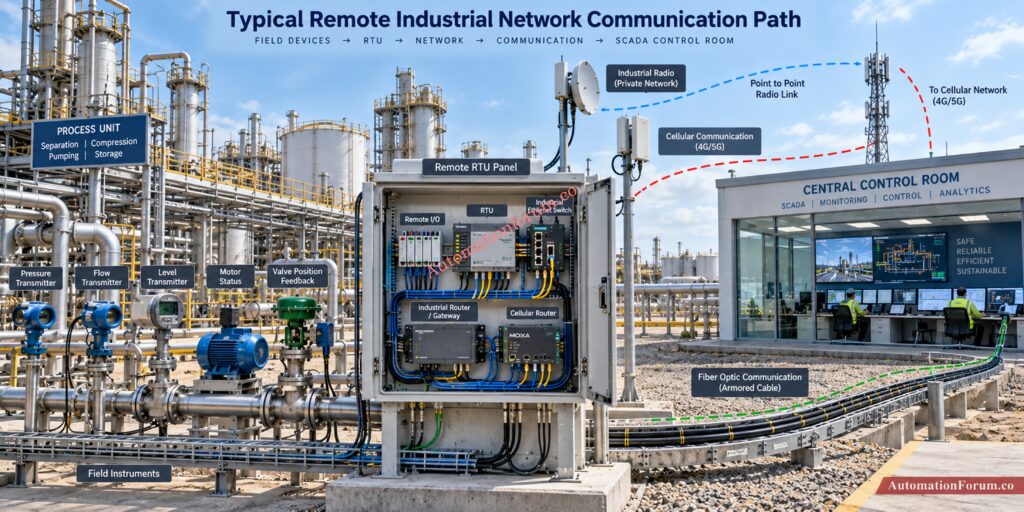
How Remote Industrial Communication Works
Remote industrial networking connects automation equipment located at different physical locations so that process information can be monitored, exchanged and controlled.
Typical Remote Industrial Network Communication Path
A typical process may look like this:
Field instruments → Remote I O or RTU → Industrial Ethernet switch → Router or gateway → Fiber, radio or cellular network → Control room network → SCADA
Remote Industrial Networking in Process Plants
A pressure transmitter may provide a process measurement to a remote RTU. The RTU collects that value and sends it through the communication network to the SCADA system.
The operator may then see the pressure value in the control room and, depending on the control philosophy, send a command back to the remote station.
The networking devices in between make this communication possible.
Secure Remote PLC Access Before Attackers Find Vulnerabilities: What is Two Factor Authentication for Remote PLC Programming in Process Automation?
Major Remote Industrial Networking Devices
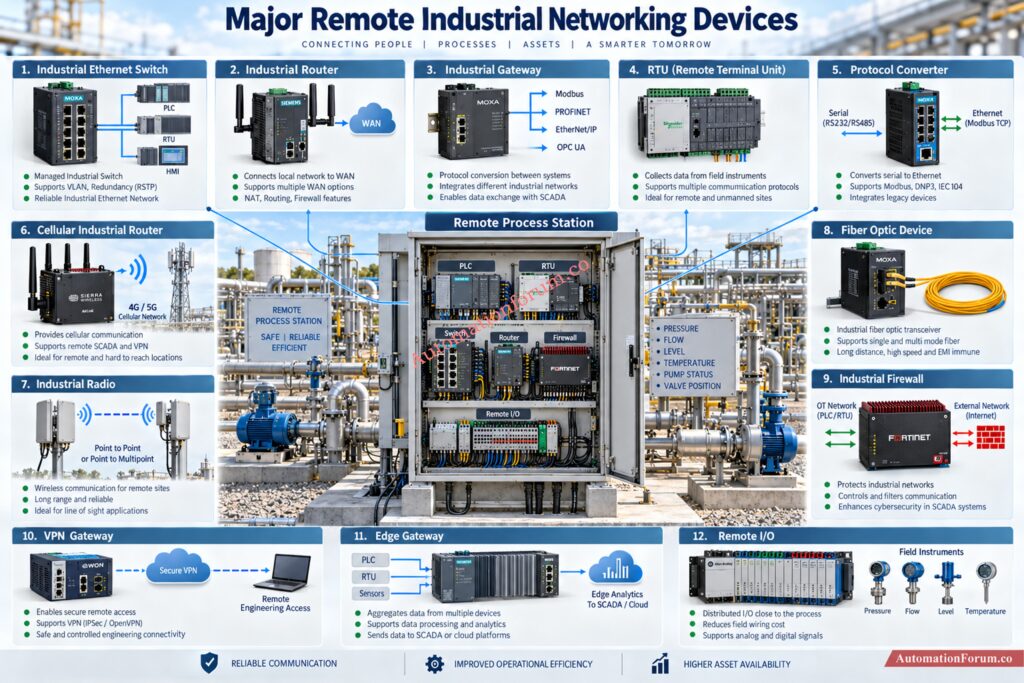
This is the most important part of remote industrial networking because different devices solve different communication problems. Using the wrong device can result in poor reliability, difficult troubleshooting and unnecessary network complexity.
Industrial Ethernet Switches for Remote Industrial Networks
An industrial Ethernet switch connects Ethernet based devices within an industrial network.
For example, a remote station may contain a PLC, RTU, remote I O, HMI, engineering workstation and gateway. An Ethernet switch provides the local communication path between these devices.
Managed and unmanaged switches are commonly used.
An unmanaged switch is relatively simple. It can be suitable for a small network where advanced diagnostics and network management are not required.
A managed switch provides considerably more control. Engineers can configure VLANs, monitor ports, check communication status and implement network redundancy depending on the device and architecture.
In process plants, industrial switches are selected for their ability to operate under industrial temperature, vibration and electromagnetic conditions. Fiber ports may also be required when the remote station is connected to a long distance network.
During troubleshooting, switch port status can provide useful information. A failed link, excessive errors or an unexpected loss of a port can help identify whether the problem is local to the device or somewhere further along the communication path.
Fix Remote I O Communication Failures Before Production Stops: PLC Troubleshooting Remote IO Rack Communication Failure Complete Troubleshooting Guide for Industrial Automation Engineers
Industrial Routers for Remote SCADA Communication
An industrial router connects different IP networks.
Consider a remote pumping station with a local PLC network and a central SCADA network. The two networks may be separated by a fiber, cellular or radio WAN connection. A router provides the network level communication between them.
Depending on the equipment, an industrial router may provide functions such as routing, NAT, VPN, firewall functions and remote access.
A router is particularly useful when several remote sites need to communicate with a central control room.
For example, a pipeline may contain ten remote pumping stations. Each station can have its own local network, while routers provide communication between the individual stations and the central SCADA network.
The engineer should check IP addressing, routing tables, subnet configuration, WAN availability and firewall rules when troubleshooting router communication.
Never Miss Critical Instrumentation Documents During Project Execution: 82 Essential Drawings and Documents for Instrumentation and Control Engineers
Industrial Gateways for Automation Network Integration
An industrial gateway provides communication between different networks, systems or communication interfaces.
This becomes useful when equipment does not communicate using the same communication method.
For example, an existing machine may communicate through a serial interface while the new plant network is Ethernet based. A suitable gateway can provide the required interface between these systems.
Gateways are also used for controlled communication between machine networks and external networks.
A gateway should not automatically be treated as the same device as a router. A router primarily manages traffic between IP networks. A gateway can perform a broader integration function depending on its design and application.
In a process plant, gateways are often found between legacy equipment, PLC systems, SCADA systems and newer industrial networks.
Protect Remote Engineering Access From Serious Cybersecurity Threats: Remote Work Cybersecurity: Common Vulnerabilities and How to Prevent Attacks
Remote Terminal Units RTUs for Remote SCADA
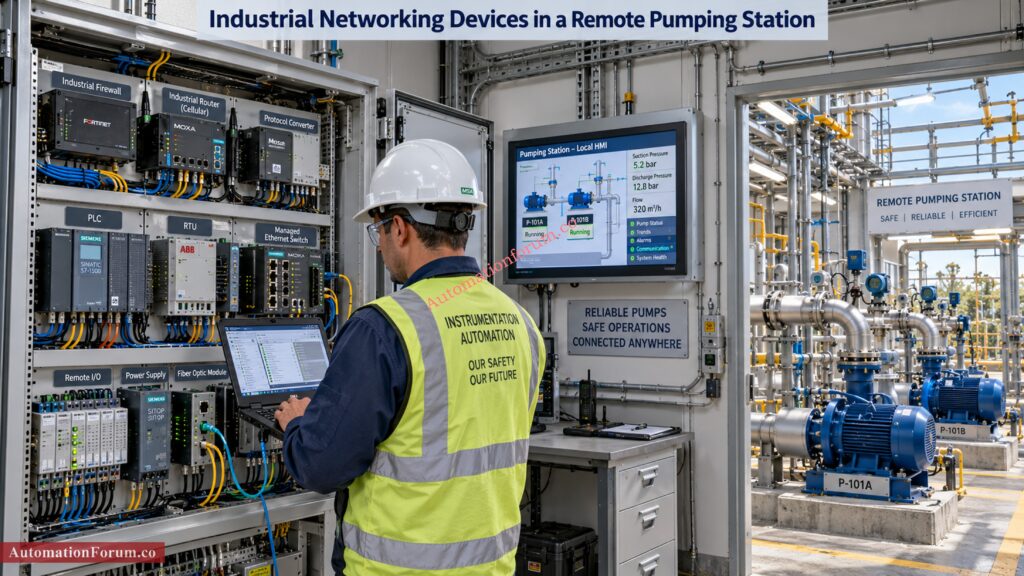
The Remote Terminal Unit or RTU is one of the most important devices in remote SCADA communication.
An RTU collects information from remote process equipment and communicates that information to a central monitoring or control system.
A remote pumping station could have:
- Pressure transmitters
- Flow transmitters
- Tank level transmitters
- Pump running status
- Motor fault status
- Valve position feedback
- Emergency shutdown status
The RTU receives these signals through its I O channels and sends the required information to the SCADA system.
An RTU can communicate using serial interfaces, Ethernet, radio, cellular networks or other communication systems depending on its design.
RTUs are widely used in pipelines, water treatment systems, oil and gas facilities, remote pumping stations and geographically distributed utility systems.
When selecting an RTU, engineers should look at I O capacity, communication protocols, power requirements, environmental conditions, diagnostics and future expansion.
Refer the below link for the Understanding RTU (Remote Terminal Unit): Key Components, Functions, and Applications in Industrial Automation
Industrial Protocol Converters for Remote Communication
A protocol converter is used when two systems use different communication protocols.
A common example is Modbus RTU to Modbus TCP.
An older instrument or PLC may communicate using Modbus RTU over RS 485. The plant network may use Ethernet and Modbus TCP. A protocol converter can provide the interface between these systems.
Protocol converters can also be used when integrating legacy equipment into a newer automation system.
During commissioning, protocol mapping needs particular attention. Correct wiring does not guarantee communication. Device addresses, register mapping, data types and communication parameters must also be correct.
Serial to Ethernet Converters for Industrial Networks
Many existing industrial devices still use serial communication.
A serial to Ethernet converter allows equipment using interfaces such as RS 232, RS 422 or RS 485 to communicate across an Ethernet network.
For example, an existing Modbus RTU instrument may be located inside a remote control panel. Instead of installing a completely new Ethernet capable instrument, a serial to Ethernet converter can provide network connectivity.
During troubleshooting, check baud rate, parity, stop bits, data bits and device address before assuming that the converter has failed.
Industrial Modems for Remote Industrial Communication
An industrial modem provides communication through a particular communication medium.
Industrial applications may use cellular modems, radio modems or other modem technologies depending on the communication architecture.
The modem itself may only provide the communication link. Additional equipment such as a router or gateway may be required for routing, VPN, firewall or protocol integration.
Cellular Industrial Routers for Remote SCADA
A cellular industrial router provides remote network connectivity through a cellular network.
This can be very useful for remote assets where installing fiber or communication cables would be expensive.
A remote well site, pumping station or tank monitoring station may use a cellular router to connect its local PLC or RTU to the central SCADA system.
The actual reliability of the solution depends heavily on cellular coverage and antenna installation.
Engineers should check:
- Cellular signal strength
- Antenna location
- SIM configuration
- APN settings
- Network availability
- Power stability
- VPN configuration
- Data usage
- Environmental conditions
A good router cannot solve a fundamentally poor cellular signal. Antenna selection and installation therefore need to be considered during site engineering.
Choose The Right Industrial Protocol For Network Performance: Modbus TCP/IP vs Profinet: Which Protocol Suits your Industrial Network Best?
Industrial Wireless Radios for Remote Process Communication
Industrial radio systems provide communication between remote locations without physical communication cables.
They are commonly used for remote SCADA, pipeline monitoring, water systems and remote process stations.
A radio link may operate as point to point or point to multipoint communication depending on the network architecture.
Radio communication requires careful consideration of antenna height, line of sight, interference, frequency, distance and environmental conditions.
During commissioning, communication should be tested under actual operating conditions rather than relying only on nominal radio specifications.
Discover Critical OT Security Vendors Shaping Industrial Protection: Top Companies in Industrial Cyber Security: Best OT Security Vendors for Industrial Automation
Industrial Wireless Access Points
Industrial wireless access points provide wireless Ethernet connectivity within an industrial environment.
They may be used for mobile maintenance terminals, engineering laptops, operator devices or other local wireless equipment.
They are different from long distance industrial radio systems.
The engineering focus is usually coverage, interference, authentication, network segmentation and environmental suitability.
Wireless access should also be separated from critical control communication where the plant architecture requires such segregation.
Fiber Optic Communication Devices for Industrial Networks
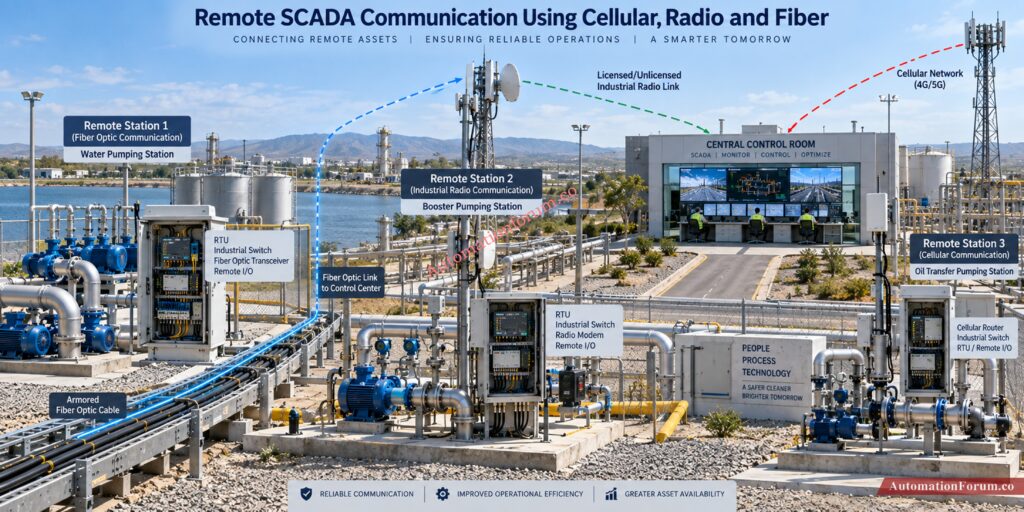
Fiber optic communication is widely used when remote equipment must communicate over longer distances.
Fiber provides several advantages for industrial applications, including high bandwidth, electrical isolation and immunity to electromagnetic interference.
A remote substation or pumping station may connect to the main control room through fiber.
Fiber capable industrial switches can directly provide optical communication. Media converters can also convert copper Ethernet communication into fiber communication.
When troubleshooting a fiber link, check the optical modules, connectors, patch cables and fiber condition. A communication failure may originate from the physical fiber path rather than the Ethernet device.
Harden PLC Networks Before Remote Cyber Attacks Become Serious: How to Safeguard PLCs Against Cyber Attacks in Industrial Networks ?
Industrial Firewalls for OT Network Security
An industrial firewall controls network traffic between different network zones.
For example, a firewall may be installed between a remote industrial network and a wider corporate or external network.
In OT environments, firewall rules should permit only the communication that is actually required.
A PLC should not automatically be reachable from every network simply because it is connected to Ethernet.
Firewall configuration should therefore be considered part of the control system architecture rather than something added after commissioning.
Build Essential Networking Skills Every Instrument Engineer Needs: Essential Networking skills required for an Instrument engineer
VPN Gateways for Secure Remote Industrial Access
A VPN gateway provides protected communication across an IP network.
VPNs can be used for communication between remote industrial sites and a central control network or for controlled engineering access.
A remote maintenance engineer may need access to a PLC or gateway for troubleshooting. Instead of exposing the device directly to an external network, a controlled VPN connection can provide a more appropriate access path.
Edge Gateways for Industrial Data Collection
An edge gateway collects and processes information close to the process.
It can aggregate information from PLCs, RTUs and other industrial equipment before sending selected information to another system.
This can reduce unnecessary communication and provide local data processing.
For a remote facility containing multiple controllers, an edge gateway can collect information from several systems and provide a consolidated data interface to a higher level monitoring platform.
Protect DCS Networks Before Cyber Threats Reach Control Systems: DCS Cybersecurity: Mitigating Risks in Industrial Automation
Remote I O Communication Modules
Remote I O modules allow field signals to be located closer to the process instead of running every individual signal cable back to a central control cabinet.
For example, a remote process unit may have dozens of digital signals and analog transmitters. Remote I O can be installed close to that equipment and communicate with the PLC or DCS through an industrial network.
This can reduce field wiring and make distributed control architectures more practical.
The communication medium may be industrial Ethernet, fiber or another supported industrial network.
Refer the below link for the Understanding Remote I/O in PLC Control Systems
Remote Industrial Networking Devices Comparison
| Device | Primary Function | How It Is Used | Typical Application |
| Industrial Ethernet Switch | Connects Ethernet based industrial devices | Connects PLCs, RTUs, remote I O, HMIs and other Ethernet devices within the same industrial network | PLC and RTU networks, control panels and remote process stations |
| Industrial Router | Connects different IP networks | Provides communication between a local industrial network and a remote or central network using routing, NAT or VPN functions where supported | Remote SCADA, pipeline stations and distributed process facilities |
| Industrial Gateway | Connects different industrial systems or networks | Provides an interface between equipment using different network types, communication interfaces or system architectures | Automation integration and remote equipment connectivity |
| Remote Terminal Unit RTU | Collects and communicates remote process data | Receives analog, digital and other field signals and sends process information to a central SCADA system | Pipelines, pumping stations, tank farms and water systems |
| Protocol Converter | Converts one communication protocol to another | Allows equipment using different protocols to exchange required process data | Modbus RTU to Modbus TCP and legacy equipment integration |
| Serial to Ethernet Converter | Connects serial equipment to an Ethernet network | Allows RS 232, RS 422 or RS 485 devices to communicate through an Ethernet network | Modbus RTU instruments, legacy PLCs and remote serial devices |
| Industrial Modem | Provides a communication link through a specific communication medium | Establishes communication through cellular, radio or other supported transmission systems | Remote stations and geographically distributed equipment |
| Cellular Industrial Router | Provides network connectivity through a cellular network | Connects remote PLCs, RTUs or gateways to a central SCADA network through cellular infrastructure | Remote SCADA, pumping stations, well sites and tank monitoring |
| Industrial Radio | Provides wireless communication between remote locations | Transfers industrial data between sites without requiring a physical communication cable | Remote process assets, pipelines and distributed SCADA systems |
| Fiber Optic Communication Device | Provides long distance optical communication | Uses fiber optic cable to transport industrial Ethernet or other supported communication signals | Long distance networks, substations and remote process facilities |
| Industrial Firewall | Controls and filters network traffic | Restricts communication between industrial network zones and controls permitted connections | OT network protection, control networks and remote sites |
| VPN Gateway | Provides protected remote network connectivity | Establishes a controlled VPN connection between remote industrial networks and authorized systems | Remote engineering access and secure SCADA communication |
| Edge Gateway | Collects, aggregates and processes local data | Collects information from multiple industrial devices before sending selected data to higher level systems | Remote monitoring, data aggregation and industrial system integration |
| Remote I O Module | Provides distributed field I O | Places I O closer to the process and communicates field signals with the PLC or DCS over an industrial network | Remote process units, distributed I O and large process plants |
Master Industrial Network Architecture Before Commissioning Begins: Basics of industrial networking architecture
How to Select the Correct Remote Industrial Networking Device
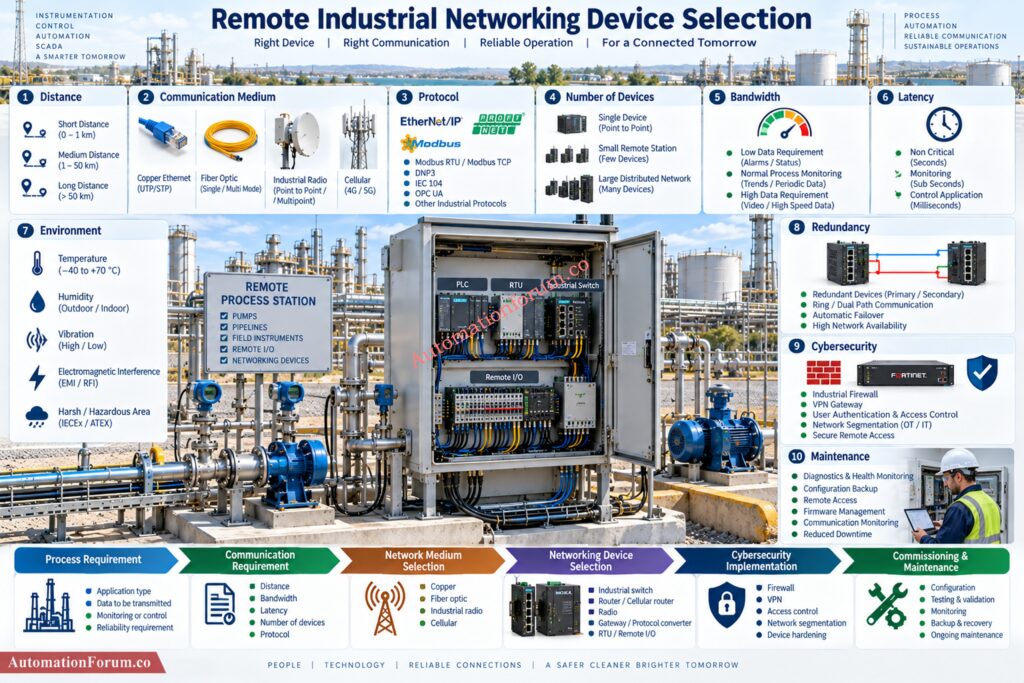
Device selection should start with the actual process requirement.
First determine the distance between locations. Then identify the communication protocol and interface.
Next consider whether the connection should use copper, fiber, radio or cellular communication.
The engineer should also evaluate:
- Number of connected devices
- Required bandwidth
- Communication update rate
- Acceptable latency
- Power availability
- Operating temperature
- Humidity
- Vibration
- EMC conditions
- Hazardous area requirements
- Network redundancy
- Cybersecurity requirements
- VPN requirements
- Future expansion
- Maintenance requirements
A device that works well in a laboratory environment may not be suitable for a remote compressor station exposed to temperature variation, vibration and electrical interference.
Compare Industrial Protocols Before Making Your Network Decision: PROFIBUS vs PROFINET: Complete Industrial Network Comparison
Practical Remote SCADA Communication Example
Remote Pumping Station Network Architecture
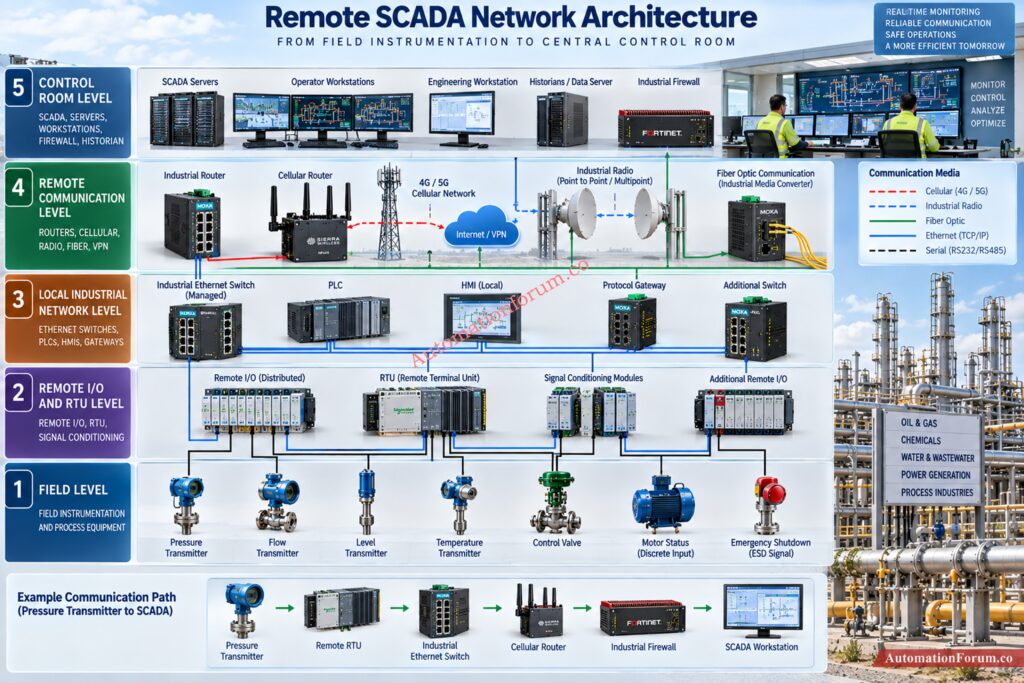
Consider a remote pumping station several kilometers from the main control room.
Pressure and flow transmitters are connected to remote I O or an RTU. Pump status and valve feedback are also connected to the RTU.
The RTU communicates with an industrial Ethernet switch.
The switch connects to a cellular router because installing fiber to the station is not practical.
The cellular router establishes the WAN connection to the control center.
At the control center, the communication reaches the SCADA network through appropriate routing and security equipment.
Step by Step Remote Communication Troubleshooting
If the SCADA operator suddenly loses the pumping station, troubleshooting should begin at the remote station.
- Check RTU power.
- Check switch link status.
- Check router status.
- Check cellular signal.
- Check WAN connectivity.
- Check VPN status if used.
- Check firewall rules.
- Check SCADA communication.
This approach is much faster than immediately replacing the RTU.
Unlock Ethernet APL Benefits For Modern Process Networks: Ethernet-APL (Advanced Physical Layer): Practical Guide for EPC Instrumentation & Process Automation Engineers
Common Remote Industrial Networking Problems
- PLC and RTU Cannot Communicate: Check power and physical connections Check Ethernet Link status Check IP addresses and subnet setup Then check the communication protocol and the device configuration.
- SCADA Loses a Remote Station: Find out if only one station is affected. If you have numerous remote sites failing at the same time look at the core network or WAN architecture.
- Cellular communication drops: Verify signal strength, antenna installation, SIM status, APN configuration and power supply. Also examine whether the problem happens continually or only in particular intervals.
- Fiber Communication Failure: Check fiber connectors, patch cables, switch diagnostics and optical modules. If the defect cannot be found by means of network diagnostics physical fiber testing may be necessary.
- Protocol Converter Does Not Communicate: Verify protocol selection, baud rate, parity, device address, register mapping and data type configuration.
Diagnose SCADA Communication Failures Before They Escalate: SCADA Communication Problems and How to Fix Them – A Complete Troubleshooting Guide
OT Cybersecurity for Remote Industrial Networks
- Remote connectivity increases the number of pathways into an industrial control environment.
- Network segmentation should isolate important control systems from networks that do not need direct access.
- Industrial firewall can restrict allowed communication. VPN technology can secure remote connections. Who can connect to what systems must be decided via authentication and access control.
- If not necessary for remote access, it should be disabled and restricted when maintenance activities necessitate it.
- Network monitoring and configuration backups are also valuable during troubleshooting and recovery.
Know The Communication Difference Before Selecting Your Protocol: Difference Between Fieldbus and HART Communication Protocols: Complete Comparison Guide for Process Automation Engineers
Common Remote Industrial Networking Design Mistakes
- Using office grade networking equipment in harsh process environments can create reliability problems.
- Other common mistakes include incorrect IP addressing, poor wireless antenna installation, inadequate redundancy, insufficient bandwidth, poor protocol mapping and inadequate network documentation.
- Another frequent problem is designing the network only for the current number of devices. Remote stations often expand after commissioning, so spare ports and communication capacity should be considered during the original design.
Boost PLC Performance With Proven Engineering Optimization Techniques: How to Increase PLC Speed: 7 Optimization Tips + Advanced Programming Guide
Best Practices for Remote Industrial Networking
- Use industrial grade networking equipment suitable for the actual environment.
- Document every IP address, protocol, device address and communication path.
- Use managed switches where diagnostics and network management are required.
- Use fiber where distance, electrical isolation or electromagnetic interference makes it appropriate.
- Use cellular or radio communication only after verifying actual site conditions.
- Provide redundancy for communication paths where loss of communication can affect plant operation.
- Test communication during FAT, SAT and commissioning where applicable.
- Maintain configuration backups for routers, switches, gateways and firewalls.
- Keep remote access controlled and documented.
- Monitor communication health after commissioning.
Strengthen Safety Systems With IEC 61511 Engineering Knowledge: S84 / IEC 61511 Standard for Safety Instrumented Systems – Complete Guide
FAQs About Remote Industrial Networking Devices
What devices are used in remote industrial networking?
Common devices include industrial Ethernet switches, routers, gateways, RTUs, protocol converters, cellular routers, radios, fiber devices and industrial firewalls.
The actual combination depends on the distance, communication protocol, network architecture and site conditions.
What is an industrial gateway?
An industrial gateway allows different industrial systems, networks or communication interfaces to exchange data.
It is commonly used when PLCs, RTUs or legacy equipment cannot communicate directly with the plant network.
What is the difference between an industrial router and gateway?
An industrial router mainly connects different IP networks and manages the movement of network traffic between them.
A gateway can provide broader system integration, including communication between different interfaces, networks or protocols.
What is the role of an RTU in remote SCADA?
An RTU collects signals from remote instruments and equipment and sends the process information to the central SCADA system.
It is commonly used at pipelines, pumping stations, tank farms and other remote process facilities.
Which device is used for remote PLC communication?
A PLC can communicate remotely through an industrial router, gateway, cellular router, radio or fiber network depending on the application.
The PLC interface, communication protocol, distance and available infrastructure determine the appropriate device.
Why are industrial Ethernet switches used in process plants?
Industrial Ethernet switches connect PLCs, RTUs, remote I O and other Ethernet devices within the plant network.
Managed models can also provide useful diagnostics, network management and redundancy features.
When should fiber optic communication be used?
Fiber is a practical choice for long distance communication, high bandwidth requirements and areas with significant electromagnetic interference.
It also provides electrical isolation, which can be valuable when connecting separate plant areas.
What are 7 network devices?
Seven common network devices are switches, routers, gateways, modems, firewalls, access points and repeaters.
In industrial networks, specialized versions are selected according to the process environment and communication requirements.
What are L1, L2, L3, and L4 in networking?
L1 refers to the physical layer, L2 handles data link communication, L3 handles network routing and L4 manages transport functions.
These layers help engineers understand where a communication problem is occurring within the network.
What are 10 common networking devices?
Ten common devices include switches, routers, gateways, modems, firewalls, access points, repeaters, bridges, network interface devices and media converters.
Industrial versions are designed for applications where environmental conditions and communication reliability are important.
What are some examples of Industrial IoT?
Industrial IoT examples include connected pressure transmitters, vibration monitoring systems, smart meters, condition monitoring devices and connected PLC systems.
These devices collect plant data and can send it to monitoring, analytics or higher level industrial systems.
Master CC Link Networking Before Integrating Industrial Controllers: CC-Link Industrial Network Protocol: Architecture, Variants, and Applications
What are 5 IoT device examples?
Five common IoT devices are smart sensors, connected meters, GPS trackers, smart cameras and environmental monitoring devices.
In industrial applications, similar connected devices are adapted for process monitoring and equipment condition monitoring.
What is the difference between IoT and Industrial IoT?
IoT generally connects consumer, commercial or general purpose devices for monitoring and automation applications.
Industrial IoT focuses on machines, instruments and industrial processes where reliability, safety, cybersecurity and continuous operation are important.
Explore Critical Control System Standards Before Project Execution: 30+ International Standards for Control Systems: The Complete Guide for Automation & Instrumentation Engineer
Conclusion: Key Takeaways for Remote Industrial Networking
Remote industrial networking is not based on one device. A reliable system normally combines several devices, with each one performing a specific role.
The industrial Ethernet switch connects local equipment. The router connects networks. The gateway integrates different systems. The RTU collects remote process information. Protocol converters handle incompatible communication systems, while cellular routers, radios and fiber devices provide the physical communication path.
For instrumentation and control engineers, the key is to understand how these devices work together.
A properly selected remote networking architecture can make remote SCADA communication easier to commission, troubleshoot and maintain while supporting reliable process monitoring and control.
The device should always be selected according to the actual process application, communication medium, environmental conditions, network architecture, availability and OT cybersecurity requirements.
Refer the below link for the Running Inspection Checklist of PLC Components in Control Panels
