
IEC 60751 · ASTM E1137 · JIS C1604 — All Classes & Grades
- What is an RTD Tolerance Calculator?
- What is an RTD Tolerance Calculator?
- What is RTD Tolerance?
- RTD Tolerance Standards Comparison
- How the RTD Tolerance Calculator Works
- Understanding the Callendar Van Dusen Equation
- How to Use the RTD Tolerance Calculator
- RTD Tolerance Calculation Example
- Industrial Applications of RTD Tolerance Calculations
- Common RTD Tolerance Mistakes Engineers Should Avoid
- Benefits of Using the RTD Tolerance Calculator
- Frequently Asked Questions About the RTD Tolerance Calculator
- Conclusion: Why Every Engineer Should Use an RTD Tolerance Calculator Before Calibration
What is an RTD Tolerance Calculator?
Why RTD Tolerance Matters in Industrial Temperature Measurement
In all process industries, temperature measurement is important. Whether it’s in a refinery, power plant, pharmaceutical facility, food processing plant or water treatment system, the quality of temperature data directly influences the quality of the product, the stability of the process, the reliability of equipment and the safety of the plant. A little measurement inaccuracy can cause poor control performance, unplanned shutdowns or costly repair tasks.
How the RTD Tolerance Calculator Improves Measurement Accuracy
Many engineers concentrate on selecting the proper RTD sensor but forget the tolerance class. This might lead to unanticipated measurement discrepancies, especially during commissioning or calibration. Understanding RTD tolerance helps engineers to identify the correct sensor for each application and to test if a sensor still operates within acceptable limits.
The RTD Tolerance Calculator makes these calculations easy by calculating the temperature tolerance, resistance tolerance, nominal resistance, resistance limits and the appropriate operating range per international standards. The calculator supports: IEC 60751; ASTM E1137; JIS C1604; Pt100; Pt500; Pt1000 Resistance temperature detectors. Engineers can acquire reliable findings for design, calibration, maintenance and troubleshooting tasks rapidly, rather than conducting manual calculations.
Refer the below link for the Why Thermocouple Reference Junction Compensation(CJC) is Essential for Accurate Temperature Measurement ?
What is an RTD Tolerance Calculator?
What is a Resistance Temperature Detector
A Resistance Temperature Detector (sometimes abbreviated as an RTD) is a temperature sensor whose electrical resistance varies with temperature. The resistance of the sensor element varies predictably with rise in temperature. This predictable relationship makes RTDs one of the most accurate temperature sensors for industrial automation applications.
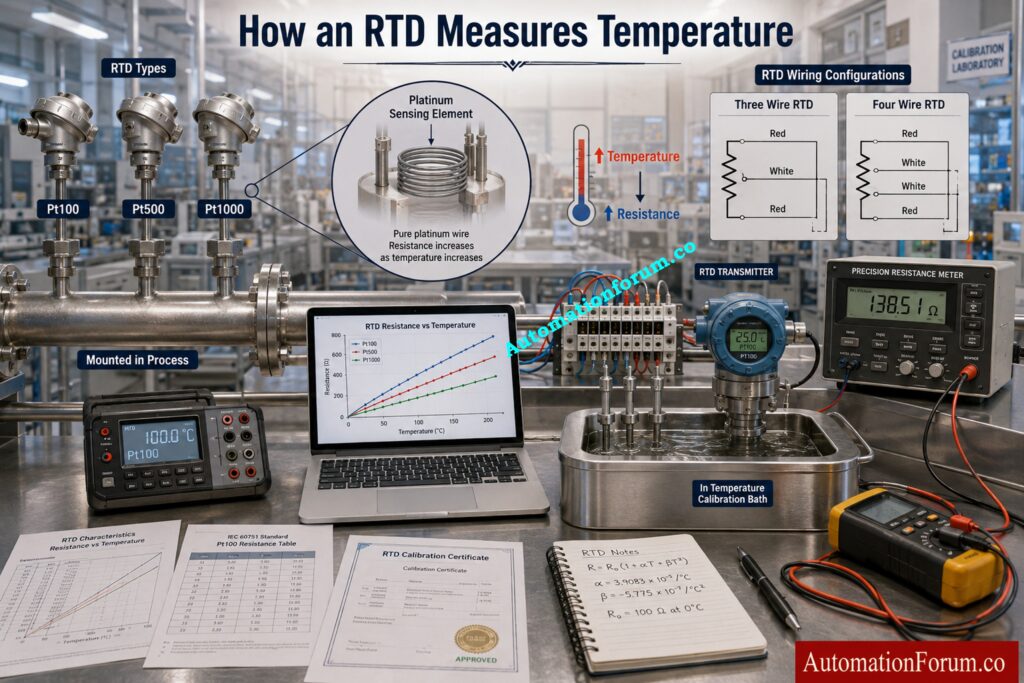
How Platinum RTDs Measure Temperature
Platinum is the most used sensing material due to its superior stability, repeatability, corrosion resistance, and long-term measurement precision. The platinum sensors also have stable features over a large temperature range and are therefore well suited to harsh industrial situations.
Difference Between Pt100 Pt500 and Pt1000 RTDs
The most common RTD types are shown below.
| RTD Type | Resistance at 0°C | Typical Use |
| Pt100 | 100 Ω | General industrial applications |
| Pt500 | 500 Ω | Improved signal sensitivity |
| Pt1000 | 1000 Ω | Long cable installations and building automation |
The supplied RTD Tolerance Calculator supports all three sensor types, allowing engineers to calculate the tolerance values based on the specified resistance element.
Calculate Temperature Characteristics Correctly Using Industry Standard Engineering Methods: RTD Temperature Coefficient Calculation
Common Industrial Applications of RTDs
RTDs are widely used in:
- Chemical plants
- Oil and gas facilities
- Power generation
- Pharmaceutical manufacturing
- Food processing
- Water treatment
- HVAC systems
- Calibration laboratories
Because of their great stability they are useful where precise measurement of temperature is important.
What is RTD Tolerance?
Meaning of RTD Tolerance
RTD tolerance is the maximum allowable difference between the measured temperature and the true temperature as established by an international standard.
For example, if an RTD has a tolerance of ±0.55°C at a certain temperature, the actual sensor reading could be anywhere in the permissible tolerance and still fulfill the standard.
Calculate Accurate Analog Signals Without Complex Manual Engineering Calculations: How to Calculate Temperature Transmitter 4-20mA Output Using Linear Equation and Percentage Method
Difference Between RTD Tolerance and RTD Accuracy
Tolerance is often confused with accuracy, but they are not identical.
| Term | Meaning |
| Tolerance | Maximum allowable manufacturing deviation |
| Accuracy | Overall measurement performance including sensor, transmitter, wiring, calibration, and installation |
Why RTD Tolerance Changes with Temperature
An RTD could be manufactured within its tolerance and still give inaccurate measurements because of other faults in the measurement system.
RTD tolerance varies with temperature as well. With increasing operating temperature the permissible deviation increases. This is the reason why the tolerance equations use the absolute measurement temperature in the computation.
Depending on the application, engineers can select the right sensor from different tolerance classes specified by manufacturers according to international standards.
Solve Temperature Control Problems Before They Disrupt Plant Operations Completely: Temperature Controller Troubleshooting Guide: Common Problems, Causes and Solutions
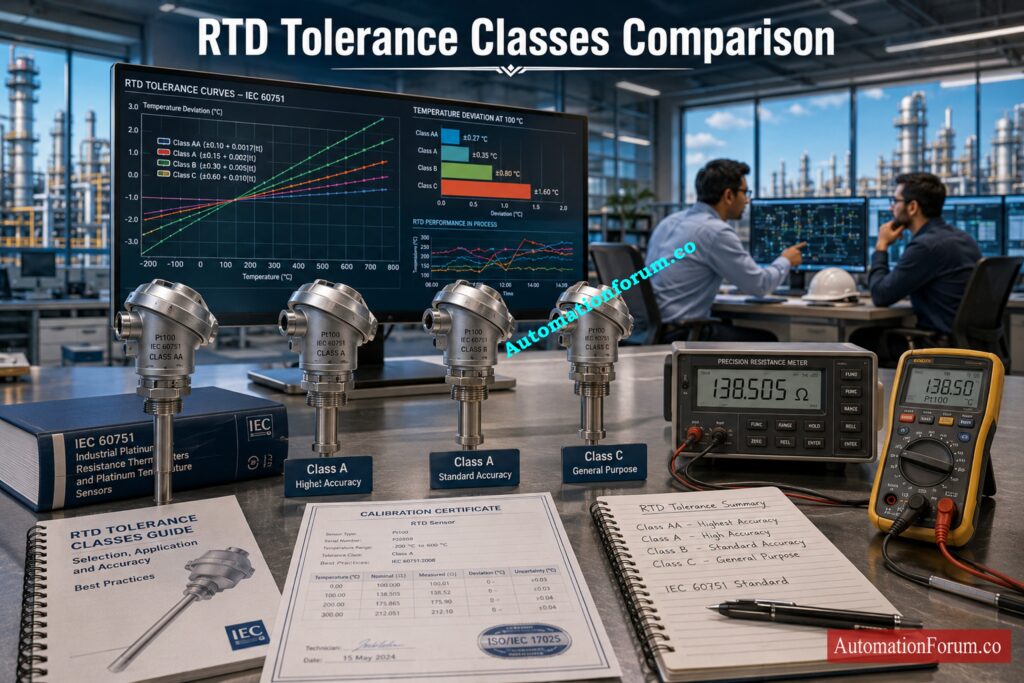
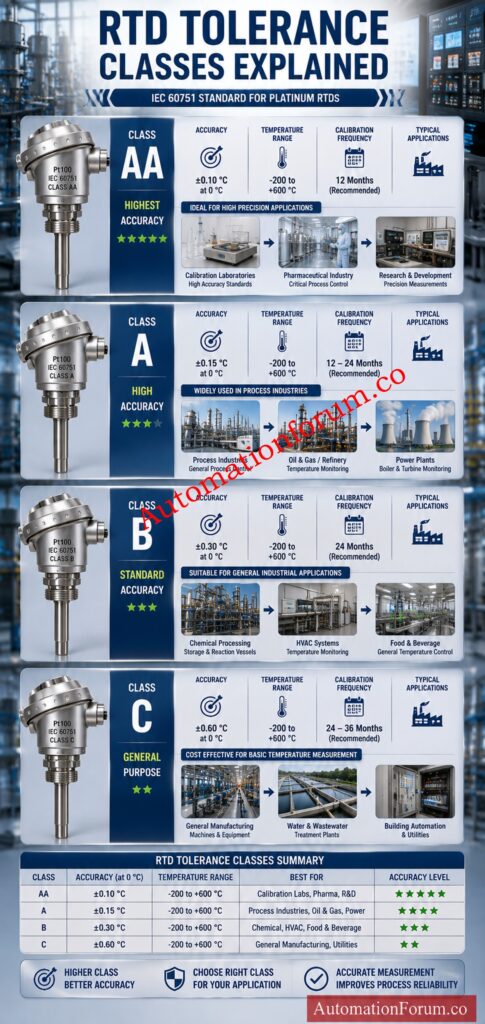
RTD Tolerance Classes Explained
Typical examples are as follows:
- Class AA for laboratory and high precision applications
- Class A for critical process measurements
- Class B for general industrial service
- Class C for less demanding applications
Selecting the appropriate tolerance class increases the confidence on measurements across the lifetime of the sensor.
Discover the Engineering Principle Behind This Critical Installation Practice: Why Install Thermowells at a 45° Angle? Engineering Logic Explained
RTD Tolerance Standards Comparison
Several international standards specify RTD performance, acceptable tolerances and working temperature limits.
IEC 60751 RTD Tolerance Classes
| Standard | Typical Classes | Typical Temperature Range | Common Applications |
| IEC 60751 | Class AA, Class A, Class B, Class C | Varies by class | Industrial process measurement |
| ASTM E1137 | Grade A, Grade B | Industrial and laboratory service | North American industries |
| JIS C1604 | Class A, Class B | Similar to IEC classes | Japanese industrial applications |
The calculator supplied supports all three standards and automatically sets the correct tolerance equation and the operating temperature restrictions for the class selected.
Choosing the right standard guarantees the sensor performance complies with project specifications, customer needs and calibration methods.
Perform Accurate PT500 Temperature Calculations Without Manual Formula Errors: Free Online PT500 RTD Calculator: Resistance to Temperature Conversion for Instrumentation Professionals
How the RTD Tolerance Calculator Works
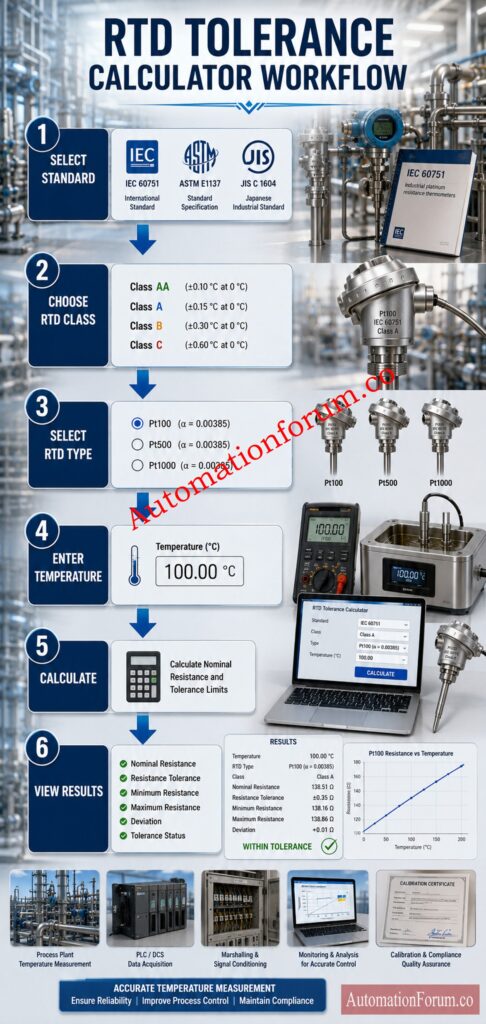
The RTD Tolerance Calculator takes engineers through many basic inputs and promptly provides the appropriate tolerance values.
Standard Selection
Choose one of the supported standards:
- IEC 60751
- ASTM E1137
- JIS C1604
Each standard uses its own tolerance equations and operating limits.
Ensure Reliable Temperature Measurement with Proper Transmitter Calibration Techniques: How to Calibrate RTD transmitter?
Selecting the RTD Tolerance Class
Select the class or grade, such as Class AA, Class A, Class B, Class C, Grade A or Grade B.
Choosing the RTD Type
Choose the sensing element:
- Pt100
- Pt500
- Pt1000
Temperature of Measurement
Enter the necessary process temperature in °F.
See Why Precision Applications Always Prefer This Sensor Configuration Today: Why 4 wire RTD’s measurement accuracy is better than 2 and 3 wire RTD?
Understanding the Calculator Results
After entering the required values, the calculator provides:
| Output | Purpose |
| Temperature tolerance | Maximum allowable temperature deviation |
| Resistance tolerance | Equivalent resistance variation |
| Nominal resistance | Expected RTD resistance at the selected temperature |
| Resistance range | Minimum and maximum acceptable resistance values |
| Applicable temperature range | Valid operating range for the selected tolerance class |
Engineers can use these results to choose, calibrate, acceptance test, maintain, and troubleshoot sensors.
Test Your Engineering Knowledge Before Your Next Instrumentation Project Begins: Quiz on RTD and Thermocouple Selection for Instrumentation Design Engineers
Understanding the Callendar Van Dusen Equation
Why RTD Resistance Changes with Temperature
The connection of resistance to temperature is not a linear one. The resistance of platinum varies with temperature according to a well documented mathematical relationship known as the Callendar Van Dusen equation.
Thankfully, engineers don’t have to conduct these computations by hand.
How the Callendar Van Dusen Equation Calculates Resistance
Behind the scenes, the RTD Tolerance Calculator employs this equation to calculate the nominal resistance for the given RTD type and measurement temperature. It also specifies the tolerance on resistance and the allowed resistance limits for the selected tolerance class.
Importance of the Equation During RTD Calibration
This approach enhances the uniformity of calibration, acceptance testing and maintenance. It also cuts down on the manual calculation errors that are so often made when engineers depend simply on printed resistance tables.
Knowledge of how resistance varies with temperature enables engineers to validate sensor performance, correlate field measurements with those that are predicted, and identify potential calibration or installation problems before they impair process performance.
Understand Critical Sensor Placement That Improves Measurement Reliability Significantly: Why RTD Temperature Sensors are Installed Downstream of Orifice Plates?
How to Use the RTD Tolerance Calculator
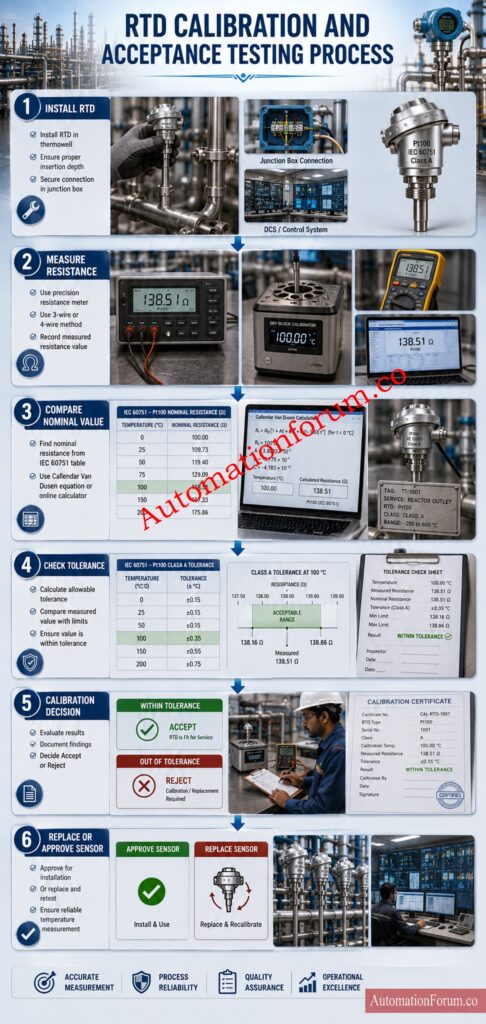
The RTD Tolerance Calculator is easy to use and just takes a few steps.
- Select the required standard from IEC 60751, ASTM E1137 or JIS C1604.
- Select the right tolerance class or grade for your application.
- Choose RTD type like Pt100, Pt500 or Pt1000.
- Enter the temperature of the procedure in °C.
- Review computed findings including temperature tolerance, resistance tolerance, nominal resistance, resistance range and appropriate operating temperature range.
The data can be used for sensor selection, calibration, commissioning, trouble shooting and routine maintenance.
Challenge Your Practical Instrumentation Skills with Expert Level Questions: RTD (Resistance Temperature Detector) Advanced Quiz
RTD Tolerance Calculation Example
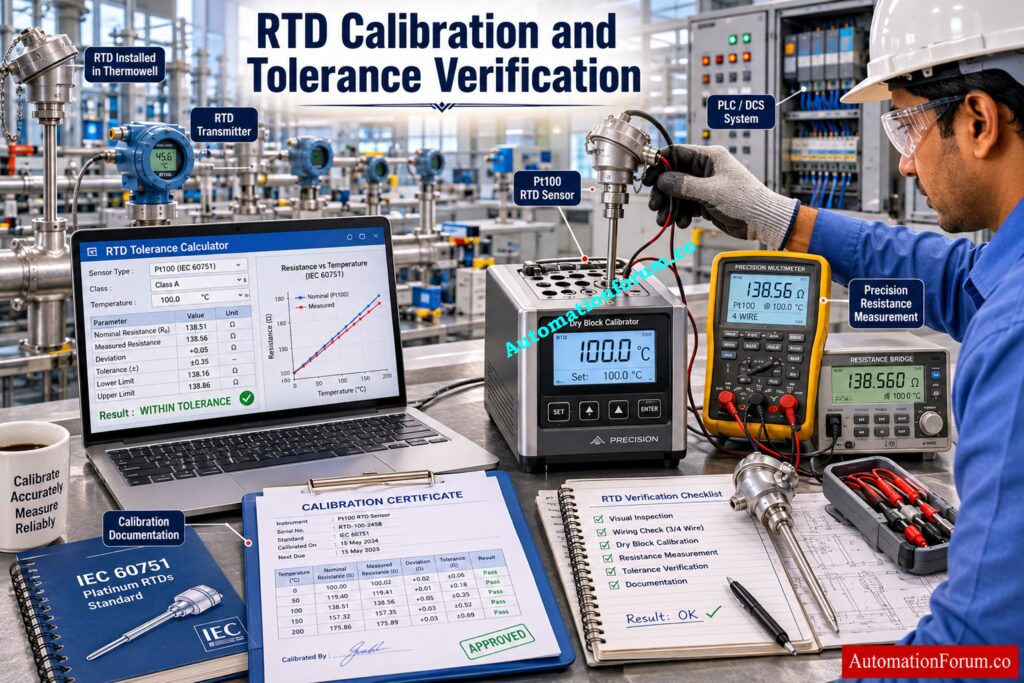
Consider a process reactor operating at 200°C.
| Parameter | Value |
| Standard | IEC 60751 |
| RTD Type | Pt100 |
| Temperature | 200°C |
| Tolerance Class | Class A |
The calculator calculates the corresponding nominal resistance and permissible resistance range and determines the allowed temperature tolerance, depending on the specified standard.
For a calibration engineer this means that the resistance measured should be within the calculated limits. If the measured value is out of range, the RTD may require recalibration or replacement.
This basic check can save precious maintenance time and also assist to avoid production being affected by false temperature data.
Refer the below link for the RTD Callendar–Van Dusen Calculator | Accurate PT100, PT500, and PT1000 Conversion
Industrial Applications of RTD Tolerance Calculations
RTD tolerance calculations serve a lot of industrial activities.
- Chemical Plants: Accurate reactor and process temperature measurement increases product uniformity and process stability.
- Oil and Gas Accurate temperature measurement helps safeguard rotating equipment, heat exchangers and process units operating in difficult environments.
- Food Processing: Temperature control enhances the quality of products while meeting food safety criteria.
- Power Plants Accurate temperature monitoring is essential for optimal functioning of steam systems, boilers, condensers and turbines.
- Pharmaceutical Manufacturing Accurate temperature management, critical for batch quality and compliance.
- Water Treatment: Temperature monitoring enhances the chemical dosage and effectiveness of the process.
- HVAC Systems Accurate sensors increase energy efficiency and building comfort
- Calibration Labs: RTD tolerance calculations will be used by engineers to assess sensor performance prior to certification or installation.
Never Miss Essential Checks During Temperature Instrument Commissioning Activities: RTD Commissioning Checklist
Common RTD Tolerance Mistakes Engineers Should Avoid
Even skilled engineers make blunders selecting or assessing RTDs.
- Selecting the improper tolerance class: A general purpose sensor may not be accurate enough for essential applications.
- Ignoring operational temperature: A sensor must always be used within the temperature limits defined for its tolerance class.
- Confusing sensor accuracy with transmitter accuracy: The total measurement is the result of the RTD, transmitter, wiring, installation and calibration.
- calibrating uncertainty ignored The measurement uncertainty due to calibrating equipment also has to be addressed in testing.
- Wrong resistance tables: The resistance values must agree with the RTD type and standard chosen.
- Installation effects ignored Poor thermal contact, severe insertion error, vibration or broken wiring can cause measurement inaccuracies in spite of the RTD itself being within its set tolerance.
Master Proven Inspection Techniques Used by Experienced Field Engineers: RTD Testing Methods
Benefits of Using the RTD Tolerance Calculator
The RTD Tolerance Calculator has many practical advantages.
- Fewer manual calculations.
- Reduces calculating errors.
- Speeds up engineering design work.
- Calibration scheduling support
- Helps commissioning engineers with loop checks.
- Helps maintenance workers to verify the status of the sensor.
- Helps in troubleshooting temperature measurement difficulties.
- Boosts confidence while choosing RTDs for new projects.
Engineers get the findings immediately depending on the standard and type of sensor they choose, rather than looking for values in several resistance tables and doing the calculations themselves.
Avoid Unexpected Sensor Failures Before They Shut Down Production: Common Reasons for RTD Failures and How to Prevent Them
Frequently Asked Questions About the RTD Tolerance Calculator
What is RTD tolerance?
The RTD tolerance is the maximum permitted difference between the real temperature and the measured temperature of a Resistance Temperature Detector. The accuracy of its temperature measurement is determined by standards IEC 60751, ASTM E1137 and JIS C1604.
What is a Class A RTD?
Class A RTD is more accurate than Class B RTD and is generally used for industrial process control, calibration and critical temperature monitoring.
What is a Class AA RTD?
A Class AA RTD delivers one of the highest accuracy standards defined in IEC 60751. It is widely used for laboratory measurements, precise calibration and applications needing good temperature accuracy.
Select the Right Temperature Sensor for Maximum Process Performance: Choosing Between Thermocouples and RTDs: A Practical Guide for Temperature Sensing
What is the difference between IEC 60751 and ASTM E1137?
They are defined as RTD tolerance classes in IEC 60751 as Class AA, Class A, Class B and Class C; and ASTM E1137 as Grade A and Grade B. Both standards specify specifications for platinum RTDs regarding tolerance and performance temperature.
What is the difference between Pt100 and Pt1000?
A Pt100 RTD has 100 Ω nominal resistance at 0°C, while a Pt1000 has 1000 Ω. Pt1000 sensors eliminate lead wire resistance mistakes and are the optimum solution for long cable runs.
How is RTD resistance tolerance calculated?
The RTD Resistance Tolerance is determined by translating the permissible temperature tolerance to resistance using the Callendar Van Dusen Equation . The RTD Tolerance Calculator does this calculation for you automatically!
What is nominal resistance in an RTD?
Nominal resistance is the electrical resistance of an RTD at a certain temperature. It is determined based on the chosen RTD type and international norm.
Can RTD tolerance change over time?
Yes. Sensor age, heat cycling, vibration, contamination and harsh working conditions can slowly degrade RTD performance. You then periodically calibrate to make sure that the sensor is still within its stated tolerance.
Why is RTD calibration important?
RTD calibration checks that the sensor is reading within a specific tolerance and ensures that the temperature measurements are accurate. Regular calibration enhances process quality, safety and confidence in measurement.
Which RTD class should I select?
Choose the RTD class according to the measurement precision and the application. Class AA is appropriate for high precision operations, Class A for most industrial processes and Class B for general use temperature measurement.
How do I calculate the RTD formula?
The RTD equation is derived from the Callendar Van Dusen equation, which connects the temperature to the electrical resistance. The calculator automatically uses this equation to find nominal resistance and tolerance values.
How do I calculate RTD tolerance?
Select the RTD standard, tolerance class, RTD type and measurement temperature. The calculator then automatically computes the permitted temperature tolerance, resistance tolerance and acceptable resistance range.
How do I check an RTD value?
Using a calibrated digital multimeter or RTD calibrator, measure the RTD resistance and compare it to the predicted resistance as obtained from an RTD resistance table or calculator. Values outside of the permitted tolerance may indicate sensor drift or failure.
Practice Accurate Field Simulation Like Professional Commissioning Engineers Every Time: How to simulate RTDs and Thermocouples using Multifunction calibrator?
What is the RTD formula?
For platinum RTDs, the resistance is computed using the Callendar Van Dusen equation which precisely models the temperature-resistance relationship across the operational range. This equation is used by the calculator internally.
How do you test a 3 wire RTD?
Remove the RTD from the measurement circuit and measure the resistance between the three leads . The resistance of the two lead wires should be about equal and the resistance of the sensing element should be equal to expected value at the temperature to be measured .
Improve Measurement Accuracy Using Smarter Wiring Conversion Techniques Today: Converting 2-Wire and 3-Wire RTDs into 4-Wire RTDs
Conclusion: Why Every Engineer Should Use an RTD Tolerance Calculator Before Calibration
The first step in acquiring an accurate temperature reading is choosing the suitable RTD and knowing its permissible tolerance. Understanding the RTD tolerance enables engineers to make better judgments in the selection, calibration, commissioning, maintenance and troubleshooting of equipment. This understanding also increases confidence in measurement and minimizes the likelihood of process errors caused by faulty temperature readings.
The RTD Tolerance Calculator does these calculations quickly, consistently and reliably and supports IEC 60751, ASTM E1137 and JIS C1604 standards as well as Pt100, Pt500 and Pt1000 sensors. It automatically calculates temperature tolerance, resistance tolerance, nominal resistance, resistance limitations and usable operating range, thereby allowing engineers to avoid laborious calculations and enhance measurement accuracy. Using the calculator on AutomationForum.co is a practical approach to assist reliable industrial temperature measurement whether you are constructing a new system or checking an existing installation.
Refer the below link for the 8 Steps RTD Calibration Procedure
