
- Embedded Interactive Calculator
- What is the Callendar–Van Dusen Equation?
- Understanding Different RTD Types
- How the Callendar-Van Dusen RTD Calculator Works
- Comparing Normal RTD Calculators vs. Callendar-Van Dusen Model
- Example Calculation Using the Callendar-Van Dusen Equation
- When to use a Callendar-Van Dusen RTD Calculator
- Practical Tips for Accurate RTD Measurements
- Why this Calculator Stands Out
- Frequently Asked Questions (FAQ) on RTD Callendar-Van Dusen Calculator
Every instrumentation engineer knows that how accurately they measure temperature may make or break a process. The Resistance Temperature Detector, or RTD, is one of the most reliable sensors for keeping an eye on a reactor, calibrating a transmitter, or building a control loop.
But not all of the computations for RTDs are the same.
Most online RTD calculators utilize simple linear algorithms to guess the temperature or resistance. These are good for fast inspections, but they can cause little but important mistakes when accuracy is very important.
The Callendar-Van Dusen equation is an internationally accepted model that is defined by IEC 60751. It shows a very exact link between temperature and resistance for platinum RTDs like PT100, PT500, and PT1000.
We made an interactive Callendar-Van Dusen RTD Calculator that can do both forward and reverse conversions with engineering-grade accuracy to help you see and figure out these connections.
Free Online PT2000 RTD Calculator – Resistance to Temperature Conversion → PT2000 RTD Temperature Conversion Tool
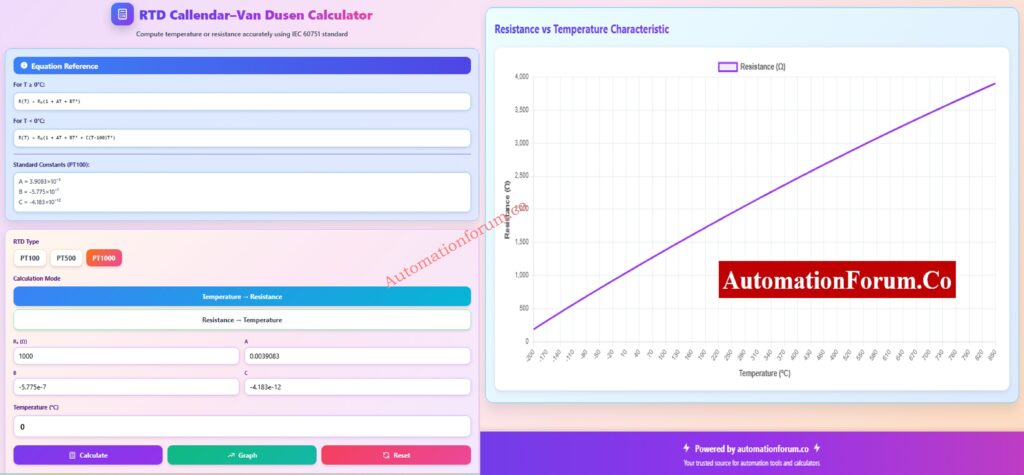
Embedded Interactive Calculator
The interactive widget below lets you convert things right away.
RTD Callendar–Van Dusen Calculator
Compute temperature or resistance accurately using IEC 60751 standard
Equation Reference
For T ≥ 0°C:
For T < 0°C:
Standard Constants (PT100):
- A = 3.9083×10⁻³
- B = -5.775×10⁻⁷
- C = -4.183×10⁻¹²
Your trusted source for automation tools and calculators
Choose the RTD type, the calculation mode, and the value you want to use.
The result updates right away, and you can use it to make a graph of the resistance-temperature curve.
RTD Class C Tolerance Calculator – IEC 60751 Standard Accuracy → Calculate RTD Class C Tolerance Online
What is the Callendar–Van Dusen Equation?
The Callendar-Van Dusen model is a math equation that shows how the resistance of platinum changes when the temperature changes.
It makes up for the metal's non-linearity, which makes readings more accurate than just using linear interpolation.
Formula for Temperature Above 0 °C
When the temperature is above 0 degrees Celsius, the resistance is shown as
R(T) = R₀ × (1 + A T + B T²)
Formula for Temperature Below 0 °C
A cubic term is added to keep things accurate when the temperature is below 0 degrees Celsius:
R(T) = R₀ × (1 + A T + B T² + C (T − 100) T³)
Here:
- R(T) is the measured resistance at temperature T
- R₀ is the nominal resistance at 0 °C
- A, B, and C are constants standardized for pure platinum
IEC 60751 Standard Coefficients (A, B, C)
- A = 3.9083 × 10⁻³
- B = −5.775 × 10⁻⁷
- C = −4.183 × 10⁻¹²
The Callendar-Van Dusen equation works for all platinum RTDs made to the IEC 60751 standard because of these constants
RTD Class B Tolerance Calculator → Class B RTD Tolerance Calculator
Understanding Different RTD Types
| RTD Type | Nominal Resistance at 0 °C | Typical Application |
| PT100 | 100 Ω | Most common in process industries |
| PT500 | 500 Ω | Used in precision instruments that need a stronger signal level |
| PT1000 | 1000 Ω | Perfect for systems that save energy and extensive cable runs |
The temperature-resistance connection stays the same, even when the base resistance is different.
Your calculator automatically changes for these kinds, so that every calculation utilizes the right R₀ value.
RTD Temperature Coefficient Calculation → Calculate RTD Temperature Coefficient
How the Callendar-Van Dusen RTD Calculator Works
The IEC 60751 standard defines the exact mathematical equations that our calculator uses.
It can figure out:
- Temperature to Resistance - This feature lets you enter a given temperature and get the resistance that goes with it.
- Resistance to Temperature - When you measure a resistance value in the field, it uses an iterative solver to find the real temperature with great accuracy.
You can change the A, B, and C coefficients for bespoke or calibrated sensors because the calculator lets you set your own constants.
RTD Class A Tolerance Calculator → Class A RTD Tolerance Calculator Online
Comparing Normal RTD Calculators vs. Callendar-Van Dusen Model
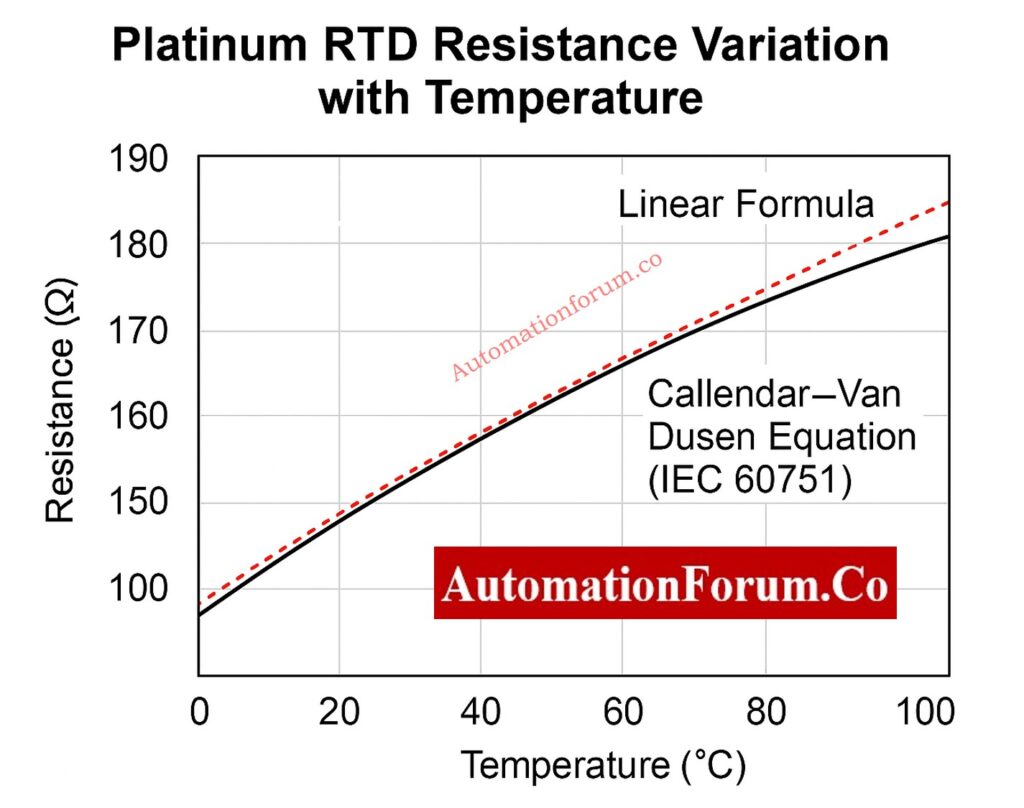
Most RTD calculators that you can use online or on your phone use linear approximation:
R(T) = R₀ × (1 + α T)
where α is a constant temperature coefficient, usually 0.00385 for platinum.
This formula works rather well for temperatures between 0 °C and 100 °C. However, the mistake becomes clear when the temperature goes to extremes, as below zero or above 400 °C.
1.Accuracy and Non-Linearity Correction
An regular RTD calculator doesn't take into account how the platinum resistance curve bends. The Callendar-Van Dusen variant uses quadratic and cubic terms to show this curve.
Result: better than ±0.05 °C variation, which is better than ±0.3 °C for simpler formulas.
2. Dual-Range Capability (−200 °C to +850 °C)
Most of the time, standard calculators don't work or give wrong answers when measuring below zero. The Callendar-Van Dusen calculator works perfectly from −200 °C to +850 °C.
3. Customization and Editable Constants
Regular calculators have constants that don't change. This tool, on the other hand, lets you change constants (A, B, C), which lets calibration engineers insert coefficients that are specific to the manufacturer for custom RTDs.
4. Graphical Visualization of Resistance vs. Temperature
Most calculators provide only numeric output.
This tool generates a Resistance vs Temperature graph using Chart. letting you visualize how resistance varies across the entire temperature range.
It’s a valuable feature for both design engineers and educators.
5. Practical Field Use and Troubleshooting
When commissioning, technicians routinely assess the health of RTDs by comparing the measured resistance to the expected values.
A linear calculator might say that a sensor is broken while it is actually working.
The Callendar-Van Dusen version matches the real platinum reaction, thus it can be used as a reliable guide for fixing and maintaining things.
Collection of Temperature Measurement Calculators → All Temperature Measurement Calculators
Example Calculation Using the Callendar-Van Dusen Equation
PT100 Resistance at 100 °C (Step-by-Step Example)
Let's check out the Callendar-Van Dusen equation.
Given:
R₀ = 100 Ω
A = 3.9083 × 10⁻³
B = −5.775 × 10⁻⁷
C = −4.183 × 10⁻¹²
At 100 °C (above zero):
R(T) = 100 × (1 + A T + B T²)
= 100 × (1 + 0.39083 − 0.005775)
= 138.51 Ω
A standard RTD calculator using the linear equation (α = 0.00385) would provide 138.5 Ω, which is close, but the difference gets bigger when the temperature is lower or higher.
The linear formula overestimates resistance by around 0.6 Ω at 500 °C, which is about 1.2 °C off.
It can fluctuate by more than 0.2 °C at -100 °C. This may not seem like much, but it might compromise calibration accuracy in industries that need to be very precise, such pharmaceuticals and petrochemicals.
Why RTD Temperature Sensors are Installed Downstream of Orifice Plates? → RTD Placement After Orifice Plates Explained
When to use a Callendar-Van Dusen RTD Calculator
- During calibration or sensor verification, make sure that the resistance reading fits the intended curve.
- When you need to accurately simulate RTD signals over the whole temperature range, use transmitter configuration.
- When making automation systems, make sure to design input scaling for DCS or PLC analog modules.
- For checking the drift or degradation of old RTD sensors during maintenance work.
- In academic or training settings, to demonstrate the non-linear nature of platinum sensors visually.
RTD Commissioning Checklist → RTD Installation & Commissioning Checklist
Practical Tips for Accurate RTD Measurements

- Pick the right type of RTD. If you use PT500 values in a PT100 loop, you can get readings that are five times higher.
- Think about how much lead resistance there is. For long cable runs, 3-wire or 4-wire setups are better.
- Don't let the excitation current go too high. High current could heat the inside of the element, which would give incorrect readings.
- Use reference instruments that have been calibrated. When you want to compare field measurements, use a certified multimeter or calibrator.
- Do not go over the boundaries of the sensor. Most industrial RTDs work best between −200 °C and +600 °C; outside of this range, they become less accurate.
Why this Calculator Stands Out
This tool is more than simply a formula-based converter; it's a whole engineering resource.
It has a modern interface made with TailwindCSS and Chart.js, and it works and looks good for technical professionals.
Key highlights:
- Calculations in real time with high accuracy
- Works with all conventional platinum RTDs
- Editable constants for labs that do calibrations
- Graphical curve charting for learning and studying
- Works without an internet connection in any browser
You can diagnose temperature problems faster and more accurately by adding this tool to your workflow.
For decades, the Callendar-Van Dusen equation has been the most important part of RTD calibration since it shows how platinum really works with amazing accuracy.
Our powerful calculator turns this complicated relationship into a straightforward, interactive tool that engineers may use every day.
It gives professionals scientific accuracy, full-range performance, and the ability to customize that standard RTD calculators don't.
This Callendar-Van Dusen RTD calculator gives you the reliability and assurance that only a true IEC-based solution can give you, whether you are calibrating transmitters, fixing sensors, or teaching instrumentation.
8 Steps RTD Calibration Procedure→ Step-by-Step RTD Calibration Guide
Frequently Asked Questions (FAQ) on RTD Callendar-Van Dusen Calculator
What is the Callendar–Van Dusen equation used for in RTDs?
How does this calculator differ from a normal RTD calculator?
This tool fixes non-linearity using IEC 60751 coefficients (A, B, C), which is better than ±0.05 °C accuracy even at very high or low temperatures..
What is the formula for the RTD calculator?
The fundamental RTD calculator formula connects resistance and temperature like this:
R(T) = R₀ × (1 + A·T + B·T² + C·(T − 100)·T³)
where
- R(T) = resistance at temperature T (°C)
- R₀ = nominal resistance at 0 °C (100 Ω for PT100)
- A, B, C = Callendar–Van Dusen coefficients defined by IEC 60751.
For quick guesses above 0 °C, you can use a simple linear form:
R(T) = R₀ × (1 + α·T)
where α = 0.00385 Ω/Ω/°C for standard platinum RTDs.
What is the Callendar–Van Dusen equation?
The Callendar–Van Dusen equation is the model that everyone agrees on for how the electrical resistance of a platinum RTD changes with temperature.
It has a quadratic term for temperatures above 0 °C and a cubic correction for temps below 0 °C:
- Above 0 °C: R(T) = R₀ × (1 + A·T + B·T²)
- Below 0 °C: R(T) = R₀ × (1 + A·T + B·T² + C·(T − 100)·T³)**
This model guarantees precise conversion for PT100, PT500, and PT1000 sensors within the temperature range of −200 °C to +850 °C.
How to calculate RTD sensitivity?
The change in resistance per degree Celsius is called RTD sensitivity. It is provided by:
S = (R₂ − R₁) / (T₂ − T₁)
The average sensitivity of a PT100 sensor with α = 0.00385 near 0 °C is:
S ≈ 100 Ω × 0.00385 Ω/Ω/°C = 0.385 Ω/°C
That means that for every 1 °C change in temperature, the resistance of a PT100 goes up by around 0.385 Ω.
Converting 2-Wire and 3-Wire RTDs into 4-Wire RTDs → Convert 2/3-Wire RTDs to 4-Wire RTDs
How is PT100 calculated?
Using the Callendar–Van Dusen equation with R₀ = 100 Ω, you can figure out the resistance of a PT100 at any temperature.
Example at 100 °C:
R(T) = 100 × (1 + 3.9083×10⁻³×100 − 5.775×10⁻⁷×100²)
= 100 × 1.38509 ≈ 138.5 Ω.
This is the same as the standard IEC 60751 resistance value for a PT100 at 100 °C.
How to calculate RTD 3-wire?
A 3-wire RTD setup is utilized to make up for the resistance of the lead wires.
To find the temperature, you first measure three resistances:
- R1 = lead 1 + RTD + lead 2
- R2 = lead 1 + lead 3
- R3 = lead 2 + lead 3
The device or transmitter automatically subtracts one lead resistance by assuming that both leads have the same resistance:
R(T) ≈ R1 − ((R2 + R3)/2)
This gives the real RTD resistance, which reduces cable-length inaccuracy in the field.
What is 0.00385 in RTD?
The value 0.00385 is the temperature coefficient of resistance (α) for standard platinum RTDs, as defined by IEC 60751.
This means that the resistance changes by 0.00385 Ω per Ω of nominal resistance for every 1 °C change in temperature.
For a PT100, this is around 0.385 Ω/°C, which means that the response is predictable and linear between 0 °C and 100 °C.
What is the value of PT100 RTD at 100 °C?
The IEC 60751 standard says that a PT100 RTD has a resistance of 138.51 Ω at 100 °C.
The Callendar–Van Dusen equation gives us this number directly, using standard coefficients (A = 3.9083×10⁻³, B = −5.775×10⁻⁷, C = −4.183×10⁻¹²).
This exact number is often used to check the accuracy of measurements during RTD calibration and transmitter setup.
100+ Online Instrumentation Calculators Collections → Explore 100+ Instrumentation Calculators
