
- What is RTD Accuracy Class According to IEC 60751?
- IEC 60751 Accuracy Class Formulas
- What is the Tolerance of a Class C RTD?
- Formula for RTD Class C Tolerance
- Example Calculations
- How to use the RTD Class C Tolerance Calculator?
- RTD Accuracy Classes – Tolerance Comparison Table
- IEC 60751 Accuracy Classes – Tolerance vs Temperature Curve
- Comparison Between RTD Accuracy Classes
- Applications of Class C RTDs
- Benefits of using the RTD Class C Tolerance Calculator
- Related Calculator and Articles
- FAQ on RTD Tolerance Classes and Pt100 Sensors
Resistance Temperature Detectors (RTDs) are one of the most reliable and commonly used sensors for measuring temperature in HVAC, process control, and industrial automation systems. In many cases where moderate temperature ranges and precise measurements are needed, they are better than thermocouples because they are more accurate, repeatable, and stable over time.
The IEC 60751 standard sets accuracy classes for RTDs, which tell you how much the temperature readings can change in different working ranges. Class C RTDs are the lowest standard accuracy class, which means they can have the biggest tolerance band. Class C RTDs are not as accurate as Class A and B, but they are good for situations where cost is more important than precision.
This article talks about Class C RTD tolerance, gives the formula and reference table, compares the accuracy classes of Class A, B, and C, and gives you a free RTD Class C Tolerance Calculator to make calculations easier.
What is RTD Accuracy Class According to IEC 60751?
There are accuracy classifications for platinum RTDs (such Pt100, Pt500, and Pt1000) in IEC 60751. Each class tells you how much the measured temperature can be different from the real temperature.
Accuracy depends on:
- The class formula (the equation for tolerance).
- The temperature at which the measurement is taken.
- The way the wires are set up (2-wire, 3-wire, 4-wire).
- The quality of the sensor’s construction and calibration.
IEC 60751 Accuracy Class Formulas
The IEC 60751 and expanded DIN standards set the following tolerance formulas:
- Class A: Δt=±(0.15+0.002⋅∣T∣)
- Class B: Δt=±(0.30+0.005⋅∣T∣)
- Class C: Δt=±(0.60+0.01⋅∣T∣)
- 1/3 DIN: Δt=±(0.10+0.0017⋅∣T∣)
- 1/10 DIN: Δt=±(0.03+0.0005⋅∣T∣)
Here,
- Δt = tolerance in °C
- ∣T∣ = absolute temperature in °C
Note: |T| is the temperature in °C, which makes sure the formula works for both positive and negative values.
What is the Tolerance of a Class C RTD?
The tolerance of a Class C RTD tells you how accurate it is at a certain temperature. Class C RTDs have the widest tolerance band of all the classes. This means they are good for situations where accuracy isn’t the most critical thing, but affordability and durability are.
Explore Field & Lab Practices: RTD Testing Methods
Formula for RTD Class C Tolerance
For Class C RTDs, the formula is:
Tolerance (°C) = ±(0.60 + 0.010× |T|)
This means that the error margin gets bigger as the temperature goes up.
Example Calculations
Class C RTD at 200 °C
Δt = ±(0.60 + 0.01 × 200) = ±(0.60 + 2.00) = ±2.60 °C.
Class A RTD at 100 °C
Δt=±(0.15+0.002⋅100)=±(0.15+0.20)=±0.35°C
1/10 DIN RTD at 0 °C
Δt=±(0.03+0.0005⋅0)=±0.03°C
Suppose you have a Class C RTD at 150°C:
Tolerance = ±(0.60 + 0.01 × 150) °C
Tolerance = ±(0.60 + 1.50) °C
Tolerance = ±2.10 °C
Therefore, the RTD could measure between 147.90 °C and 152.10 °C and still comply with Class C accuracy.
How to use the RTD Class C Tolerance Calculator?
- Choose the type of RTD: Decide if you want to use a 2-wire, 3-wire, or 4-wire RTD setup.
- Enter the temperature: Please type in the temperature in degrees Celsius (°C) that you want to use to figure out the tolerance.
- Find out the tolerance: The calculator will show the acceptable variation according to the DIN IEC 60751 Class C standard.
Learn How:Converting 2-Wire and 3-Wire RTDs into 4-Wire RTDs
RTD Accuracy Classes – Tolerance Comparison Table
The table below shows the tolerance levels for different accuracy classes at important temperatures:
| Temperature (°C) | Class A (°C) | Class B (°C) | Class C (°C) | 1/3 DIN (°C) | 1/10 DIN (°C) |
| -200 | ±0.55 | ±1.30 | ±2.60 | ±0.44 | ±0.13 |
| -100 | ±0.35 | ±0.80 | ±1.60 | ±0.27 | ±0.08 |
| 0 | ±0.15 | ±0.30 | ±0.60 | ±0.10 | ±0.03 |
| 100 | ±0.35 | ±0.80 | ±1.60 | ±0.27 | ±0.08 |
| 200 | ±0.55 | ±1.30 | ±2.60 | ±0.44 | ±0.13 |
| 300 | ±0.75 | ±1.80 | ±3.60 | ±0.61 | ±0.18 |
| 400 | ±0.95 | ±2.30 | ±4.60 | ±0.78 | ±0.23 |
| 500 | ±1.15 | ±2.80 | ±5.60 | ±0.95 | ±0.28 |
| 600 | ±1.35 | ±3.30 | ±6.60 | ±1.12 | ±0.33 |
| 650 | ±1.45 | ±3.55 | ±7.10 | ±1.20 | ±0.36 |
This table now has Class C values next to Class A, B, and extended DIN classes, which makes it complete.
IEC 60751 Accuracy Classes – Tolerance vs Temperature Curve
The graph below shows the acceptable tolerance (in °C) for different RTD accuracy classes as set by IEC 60751 and expanded DIN standards. For regularly used classes like Class A, Class B, Class C, 1/3 DIN, and 1/10 DIN, each graph shows how the maximum permitted inaccuracy goes up as the temperature goes up.
- Class A and B are the standard IEC 60751 categories. They are commonly used in industrial RTDs.
- Class C is less accurate and should only be used for non-critical tasks.
- 1/3 DIN and 1/10 DIN are stricter tolerance levels that are typically utilized in labs or for precision control systems.
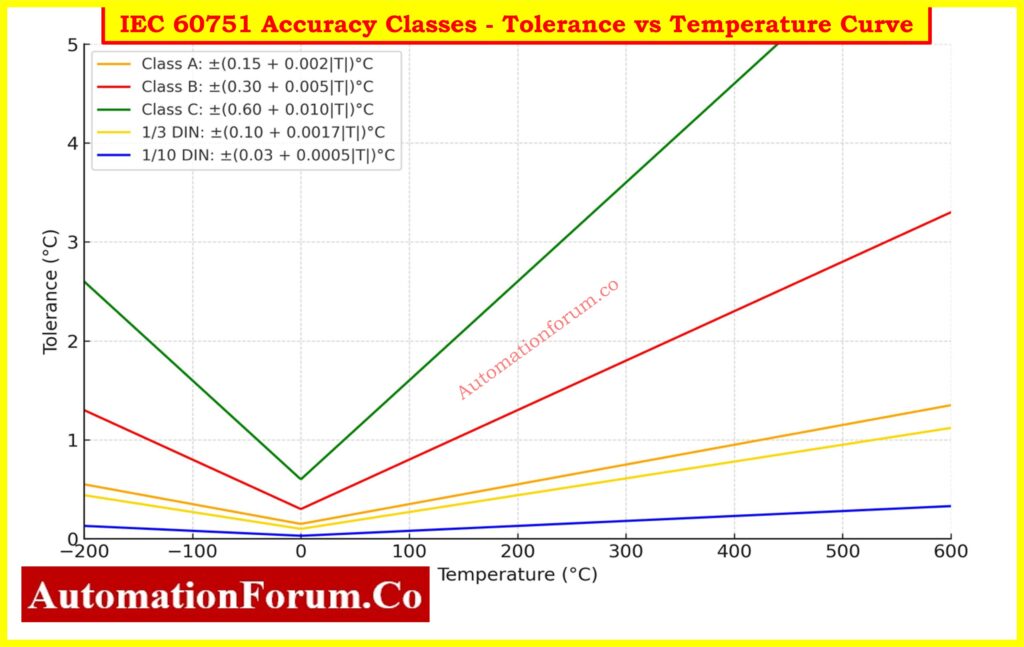
The above image makes it easy to see how the accuracy limits of different RTD classes compare across the whole operating range (–200 °C to +650 °C). This curve helps engineers choose the right RTD class for a job by weighing factors including accuracy, cost, and environmental conditions.
Download Step-by-Step Guide: RTD Commissioning Checklist
Comparison Between RTD Accuracy Classes
| Feature | Class A RTD | Class B RTD | Class C RTD | 1/3 DIN RTD | 1/10 DIN RTD |
| Tolerance Formula (°C) | ±(0.15 + 0.002T) | ±(0.30 + 0.005T) | ±(0.60 + 0.01T) | ±(0.10 + 0.0017T) | ±(0.03 + 0.0005T) |
| Accuracy | Very high | Moderate | Lowest IEC accuracy | Higher than Class A | Extremely precise |
| Applications | SIS, calibration, labs | General process control | Non-critical monitoring | Metrology labs | High-end research instruments |
| Temperature Range | Narrower, high precision | Wider, acceptable precision | Wide, low precision | Narrow, precise | Ultra-precise limited range |
| Cost | Highest | Medium | Lowest (cost-effective) | High | Very high |
Refer the below link to Understand Now: Why 4 wire RTD’s measurement accuracy is better than 2 and 3 wire RTD?
Applications of Class C RTDs
Class C RTDs are utilized when saving money and having a reasonable amount of tolerance are more important than getting exact measurements. Some such uses are:
- HVAC stands for heating, ventilation, and air conditioning.
- Monitoring the environment and automating buildings
- Industries that work with general processes and can handle wide tolerances
- Checking on food storage and cold rooms (non-critical ranges)
- Systems for managing energy
- Watching over the refrigerator and freezer
- Alarms and indicators for temperatures that aren’t critical
- Training and educational labs where high accuracy isn’t needed
Benefits of using the RTD Class C Tolerance Calculator
Engineers, technicians, and project managers can use this calculator for a number of reasons:
- Makes ensuring that the IEC 60751 Class C tolerance requirements are followed.
- Calculates tolerance at any temperature automatically, saving you time.
- Helps choose sensors for big, expensive projects.
- Gives handy reference values for tolerance in °C and ohms.
- Helps with troubleshooting in the field when RTD readings go wrong.
- Lowers the danger of over-specification, which lowers the cost of buying things.
- Helps with calibration and acceptability testing.
- Helpful for teaching and learning about RTD requirements.
- Helps engineers figure out the best balance between cost and precision.
- Useful for EPC instrumentation engineers while reviewing designs.
Related Calculator and Articles
- RTD Class A Tolerance Calculator
- RTD Class B Tolerance Calculator
- RTD Temperature Coefficient Calculator
- RTD Tolerance Calculation Guide
Engineers working on cost-sensitive projects where accuracy isn’t the most important thing need the RTD Class C Tolerance Calculator. It quickly finds the allowable deviation values in °C and ohms across the RTD’s operating range by using the IEC 60751 Class C formula.
Class C RTDs are the least accurate of all IEC-standard RTDs, but they are nonetheless reliable, strong, and very helpful in HVAC, building automation, and general monitoring systems. Knowing their tolerance helps you avoid over-specifying, saves money, and makes sure you get the right sensor.
When accuracy is very important, you should choose Class A, Class B, or specific tolerances like 1/3 DIN or 1/10 DIN. Class C RTDs, on the other hand, are the best choice for non-critical monitoring since they are the ideal mix of cost and performance.
Follow with Examples: 8 Steps RTD Calibration Procedure
FAQ on RTD Tolerance Classes and Pt100 Sensors
1. What is the classification of RTD?
IEC 60751 accuracy classes, such as Class A, Class B, and Class C, as well as stricter DIN extensions (1/3 DIN, 1/10 DIN), are used to group RTDs. These set the limitations for accuracy and tolerance.
2. What is the tolerance class of RTD?
Tolerance classes tell you how much inaccuracy is allowed:
- Class A: ±(0.15 + 0.002|T|) °C
- Class B: ±(0.30 + 0.005|T|) °C
- Class C: ±(0.60 + 0.01|T|) °C
DIN versions (1/3, 1/10) give even tighter tolerances.
3. What is the common resistance of an RTD at 0 °C?
The most popular RTD is the Pt100, which has a resistance of 100 Ω at 0 °C. There are also Pt500 (500 Ω) and Pt1000 (1000 Ω) variants.
4. What is the resistance of Pt100 at 0 °C?
At 0 °C, a Pt100 has a resistance of exactly 100.00 Ω, and it goes up by around 0.385 Ω/°C.
5. What is the tolerance class of Pt100?
Depending on how accurate they need to be, Pt100 sensors are made to IEC 60751 classes: Class A, B, C, or extended DIN classes.
6. What is the range of Class A RTD?
The range of Class A RTD is: –100 °C to +450 °C (more accurate, but less range than Class B).
7. What is the range of Class B RTD?
Class B RTD range: –196 °C to +600 °C (standard precision, most commonly used in industry).
8. How accurate is Class A vs Class B RTD?
At 100 °C:
- Class A: ±0.35 °C
- Class B: ±0.80 °C
Class A is nearly twice as precise as Class B.
9. What is the difference between Class A and Class B Pt100?
- Accuracy: Class A is more accurate than Class B.
- Class B’s range is bigger than Class A’s.
- Cost: Class A costs extra.
- Applications: Class A is for calibration and pharmaceuticals, while Class B is for general industrial application.
