
- Calibration Audit in Process Plants: Why It Matters for ISO Compliance and Measurement Accuracy
- What Is a Calibration Audit in Process Industry
- ISO 9001 Clause 7.1.5 Calibration Requirements Explained
- Calibration Documentation and Procedure Control Audit Questions
- Calibration Standards and Traceability Audit Requirements
- Instrument Identification and Calibration Status Control Checklist
- Calibration Execution Best Practices for Process Instruments
- Calibration Records, Certificates, and Audit Evidence Requirements
- Nonconformance and Corrective Action in Calibration Audits
- Advanced Calibration Audit Questions for Expert Auditors
- Conclusion: How to Achieve ISO Compliant Calibration Control in Process Plants
- FAQ on Calibration Audit Questions
Calibration Audit in Process Plants: Why It Matters for ISO Compliance and Measurement Accuracy
Calibration audit questions are very important for making sure that process facilities follow ISO 9001 standards, since the accuracy of measurements has a direct effect on safety, quality, and operational reliability.
Why Calibration Audits are Critical In Oil And Gas, Power Plants, Pharmaceuticals, And Chemical Industries
In process industries such as oil & gas, pharmaceuticals, power plants, and chemical manufacture, instrument calibration is the backbone of measurement precision and process reliability. A single flow meter or pressure transmitter that isn’t set up correctly might cause problems with product quality, safety, and expensive shutdowns.
How Calibration Supports Product Quality, Safety, And Operational Reliability
Calibration audits aren’t simply ways to make sure you’re following the rules; they’re also very important ways to control risk. ISO auditors look at whether your factory makes sure that measurements are accurate by using traceable, recorded, and controlled calibration procedures.
Calibration, which is based on traceable standards, is the basis of quality assurance and compliance, according to ISO standards.
What ISO Auditors Expect From A Calibration Audit
This guide has 60 real-world calibration audit questions that are in line with ISO 9001 Clause 7.1.5. They are meant for:
- Instrumentation engineers
- QA/QC professionals
- Calibration technicians
- ISO auditors
Risk-Based Calibration Interval Schedule Guide: Calibration Interval Schedule Procedure for Process Instrumentation Using Risk-Based Method
What Is a Calibration Audit in Process Industry
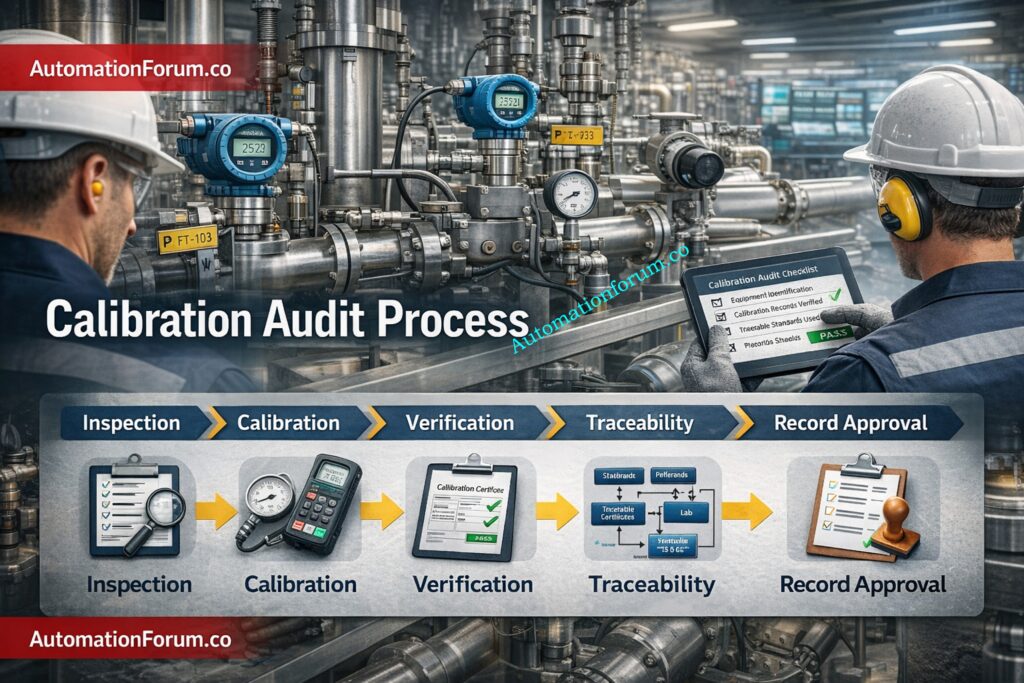
Calibration Audit Definition
A calibration audit is a planned check of how an organization handles:
- Measurement instruments
- Calibration processes
- Traceability systems
- Documentation & records
Main Objectives Of A Calibration Audit
Make sure that all measurement tools give data that are accurate, trustworthy, and easy to trace.
Internal Audit Versus External ISO Audit
- Internal Audit – Conducted by plant QA team
- External Audit – Conducted by ISO certification bodies
Real Example:
An auditor looks at a flow transmitter in a refinery:
- Is it calibrated?
- Is it traceable?
- Are records maintained?
Complete ISO Instrument Calibration Guide: ISO Standards For Instrumentation Calibration Complete Guide for Industrial Engineers
ISO 9001 Clause 7.1.5 Calibration Requirements Explained
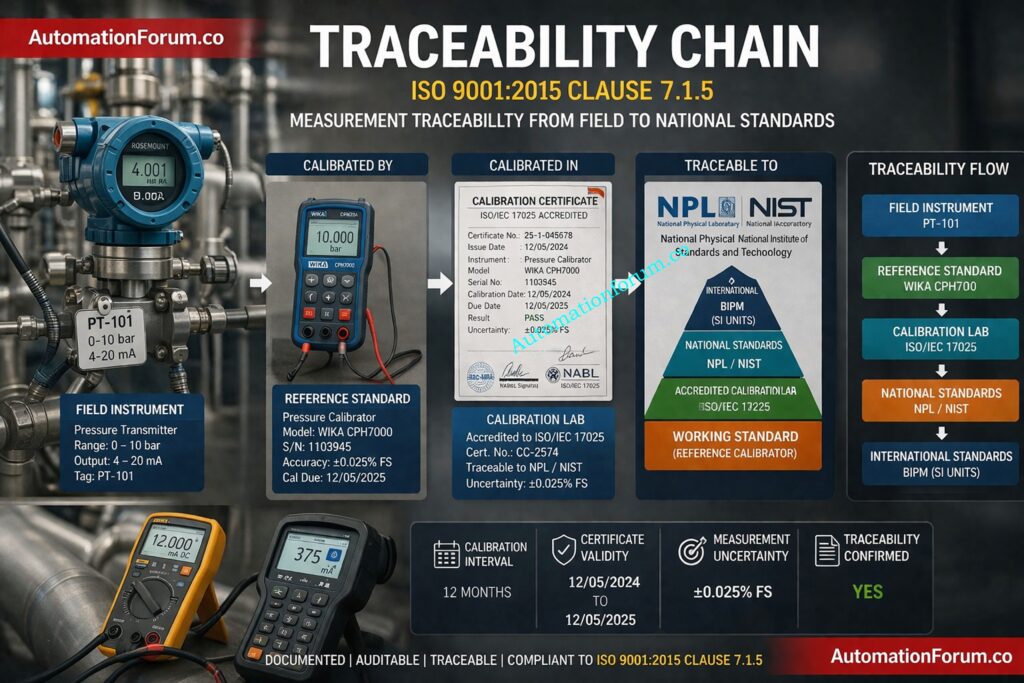
ISO 9001 Clause 7.1.5 focuses on Monitoring and Measuring Resources.
Calibration Audit Key Requirements:
- At set times, equipment has to be calibrated.
- Must be able to be traced back to national or international standards
- Calibration status must be marked on instruments.
- Equipment needs to be safe from damage.
- You have to keep records.
ISO makes it clear that businesses must make sure that their measurement tools are appropriate for the job and give accurate results.
Critical Calibration Audit Expectations
- Defined and followed calibration intervals
- Set up a chain of traceability
- Records have the date, the results, and the next due date.
- Equipment is properly labeled and managed.
Smart Pressure Transmitter Trim Guide: Smart Pressure Transmitter Sensor Trim Guide with Diagrams & Calibration Steps
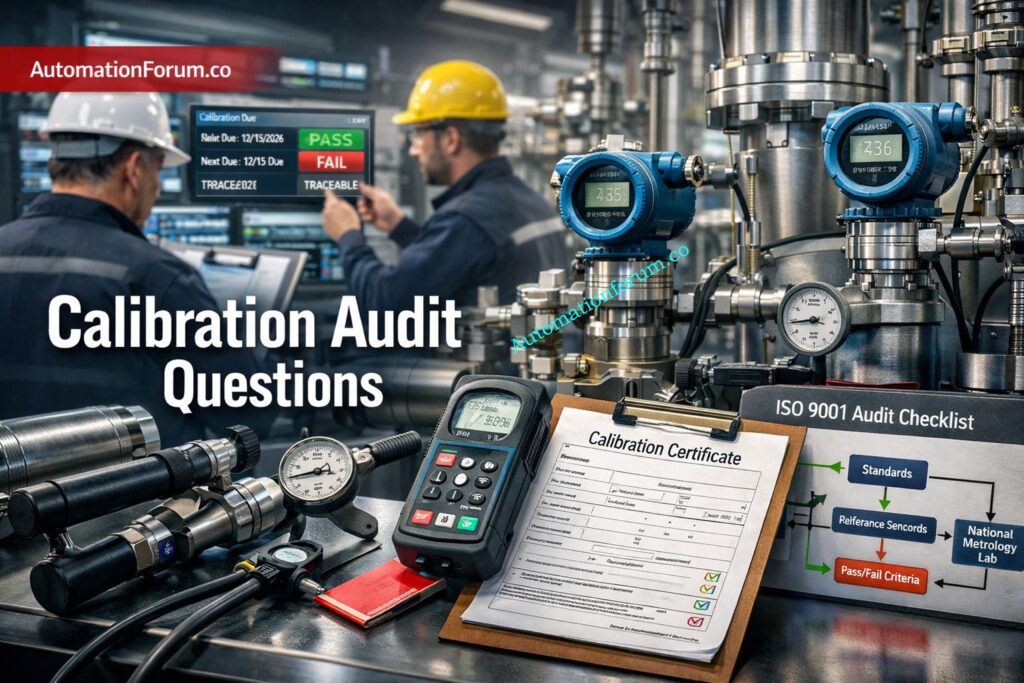
Calibration Documentation and Procedure Control Audit Questions
1. Show calibration procedure for this instrument
The protocol must be an accepted document that clearly states the revision number, scope, technique, and acceptance criteria. It should show the actual processes that technicians took to calibrate, not just be a generic template.
In practice, a pressure transmitter technique must have zero adjustment, span verification, test points, and restrictions on how much error is allowed.
2. Is there a defined calibration policy
The quality management system of the organization should have a clear calibration policy that spells out the scope, frequency, responsibilities, and compliance requirements. It makes sure that calibration work is done in a planned and regulated way throughout the plant.
Auditors check to see if the policy meets ISO standards for getting accurate and reliable measurement data.
3. Are calibration procedures version controlled
Controlled papers are an important part of ISO that helps keep measuring processes consistent and reliable.
4. Are OEM recommendations followed
Calibration procedures should either follow the manufacturer’s instructions or have a different method that is technically sound. Any departure must be substantiated with verified validation.
For instance, not taking the actuator spring range into account while calibrating the control valve can lead to the wrong travel characteristics.
5. Is a master instrument list available
The full instrument register should have the tag number, location, range, calibration interval, and status. This makes sure that all tools are tracked and that no equipment is missing during audits.
Auditors usually choose random instruments from the field and check them against this master list.
Top 15 Costly Calibration Mistakes: Top 15 Common Calibration Mistakes in Industrial Instruments
6. Are calibration methods standardized
To make sure that results can be repeated and compared, similar instruments should use the same calibration methodology. Different ways show that there is no control.
For instance, all pressure transmitters should use the same multi-point calibration procedure with set test points.
7. Are procedures accessible to technicians
Calibration methods must be easy to find on site or through digital systems so that technicians can look them up while they are working. Not being able to access something makes people rely on their memory, which raises the danger of making mistakes.
For ISO to work well, it demands documented information to be available at the point of use.
8. Are responsibilities defined
It is thought that separating execution and approval is a useful way to keep quality control.
Essential Instrument Calibration Guidelines: Calibration Guidelines
9. Is document control system maintained
It is thought that separating execution and approval is a useful way to keep quality control.
10. Are procedures periodically reviewed
There should be a way to make sure that old procedures are thrown away and only the most up-to-date ones are employed. Auditors frequently examine for unregulated printed copies in the field.
Proper document control keeps things consistent and stops people from calibrating things wrong.
Why Calibrating Calibrators Matters Most: Why Calibrating your Calibrators is Critically Important: Accuracy, Compliance and ISO 17025 and NIST Traceability
Calibration Standards and Traceability Audit Requirements
11. What reference standard is used
Based on audit results, changes to equipment, or process enhancements, procedures must be revised from time to time. This makes sure that they stay useful and correct from a technical point of view.
ISO quality systems believe that procedures will always get better.
Calibration Standards and Requirements for Traceability Audits
12. Is traceability ensured
Calibration must be done with a standard that is more accurate than the device being tested. This makes sure that the measurement findings are accurate and usable.
For instance, field pressure transmitters are calibrated with a certified pressure calibrator.
13. Show traceability chain
Measurement results must be traceable to national or international standards via an uninterrupted calibration chain. This gives you faith in the accuracy and constancy.
Traceability makes guarantee that all measurements can be compared across time and space.
Re-ranging Is Not Calibration: Why Calibration Isn’t the Same as Re-ranging in Process Instrumentation
14. Are master instruments calibrated
Reference instruments must themselves be calibrated at defined intervals to maintain their accuracy. If the master is incorrect, all downstream calibrations become invalid.
Auditors always verify the calibration certificates of master equipment.
15. Are standards within validity
Calibration should only be performed using standards within their valid calibration period. Expired standards invalidate all measurements taken using them.
ISO requires calibration at specified intervals to maintain measurement reliability.
16. How is measurement uncertainty handled
Uncertainty must be considered during calibration to define confidence in measurement results. It helps determine whether instrument accuracy meets required tolerance.
Advanced audits look at whether the calibration team has written down and understood any uncertainty.
Weighing System Calibration Procedure: Weighing System Calibration Procedure
17. Are calibration labs accredited
Accredited labs should do external calibration to make sure it is accurate and follows the rules. Accreditation makes sure that people follow known calibration standards.
Auditors usually check the extent and validity of external labs’ accreditation.
18. Are certificates traceable
Calibration certificates must identify the reference standards that were utilized and how they may be traced. This makes sure that the entire measurement chain is well documented.
Missing certificates are a common problem found during audits.
Complete Instrument Calibration Guide: Instrument Calibration in Process Industries – Complete Guide
19. Is SI traceability maintained
All measurements must eventually be connected to SI units through accepted standards. This makes sure that things are the same all around the world.
ISO requires traceability to internationally accepted measurement systems.
20. Are standards stored properly
Reference instruments must be stored in controlled environments to prevent damage or drift. Temperature, humidity, and handling conditions must be controlled.
ISO requires equipment to be protected to maintain its accuracy.
Types of Calibrators and Procedures: Different types of Calibrators and their Calibration Procedures
Instrument Identification and Calibration Status Control Checklist
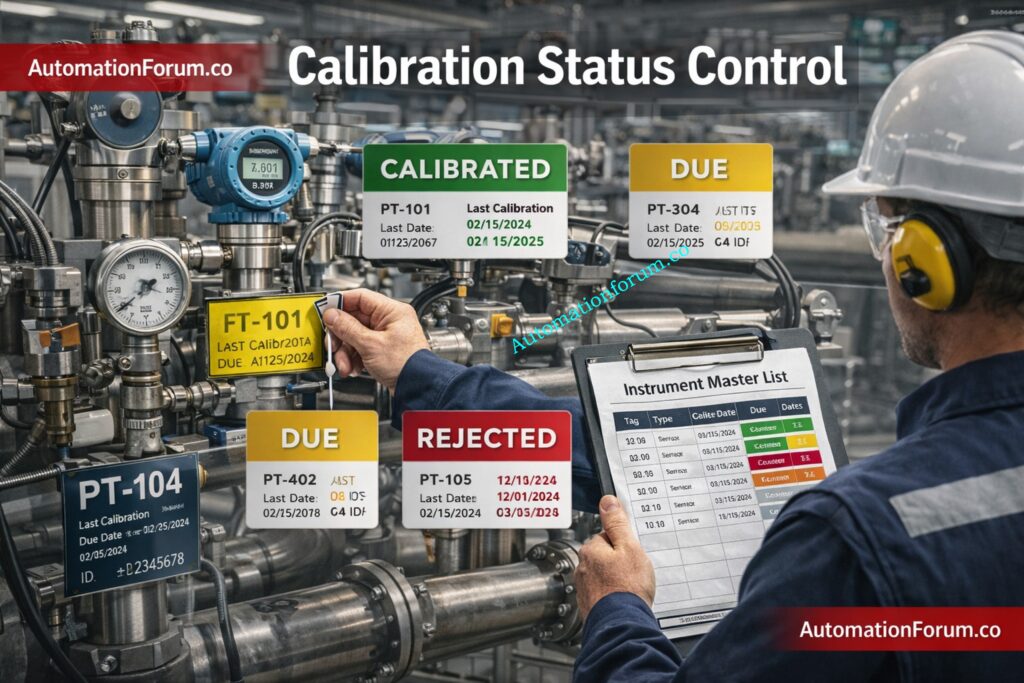
21. Does the instrument have calibration tag
22. What is the calibration status
The instrument must clearly indicate whether it is calibrated, due, or out of service. This prevents use of unreliable equipment.
Clear identification of status is mandatory for compliance.
23. Is the tag readable
24. Are instrument IDs unique
Each instrument must have a unique identification number linked to calibration records. This ensures proper traceability and avoids confusion.
Duplicate identification leads to serious record management issues.
25. Is overdue equipment identifiable
There should be a system or visual method to identify overdue instruments. This prevents accidental use of non compliant equipment.
Auditors often request a list of overdue instruments.
Analytical Instrument Calibration Procedures: Analytical Instruments Calibration Procedures
26. Is status updated after calibration
Calibration status must be updated immediately after completion of calibration activity. Delay in updating indicates weak system control.
Modern systems use digital updates to ensure accuracy.
27. Are rejected instruments marked
Failed instruments must be clearly identified and removed from service. This prevents incorrect measurements from affecting process quality.
ISO requires control of nonconforming equipment.
28. Is color coding used
Color coding provides quick visual identification of calibration status. It improves operational efficiency and reduces human error.
Many plants adopt standard color systems for easy recognition.
Refer the below link for the Control Valve Calibration Procedures
Calibration Execution Best Practices for Process Instruments
29. Are as found readings recorded
Initial readings must be recorded before any adjustment to assess instrument drift. This helps evaluate long term performance.
Auditors use this data to verify effectiveness of calibration system.
30. Are environmental conditions controlled
Calibration must be performed under controlled environmental conditions to ensure accuracy. Temperature and humidity variations affect measurement results.
ISO highlights the need to maintain suitable conditions for measurement activities.
31. Is instrument cleaned before calibration
Cleaning ensures that no external contamination affects measurement accuracy. Dirt or residue can distort readings significantly.
This is critical for flow meters and pressure instruments.
32. Are technicians competent
Personnel performing calibration must be trained and competent. Competency ensures correct execution and reliable results.
ISO requires organizations to ensure personnel competence for measurement activities.
Control Valve Stroke Checking Procedure: Control Valve Stroke Checking -Complete Procedure, Errors, Setup, and FAQ
33. Is procedure strictly followed
Calibration must strictly follow approved procedures without shortcuts. Any deviation can lead to inaccurate results.
Auditors may witness calibration to verify compliance.
34. Are tolerances defined
Each instrument must have defined acceptance limits based on process requirements. Without tolerance, calibration result is meaningless.
Example is plus minus accuracy limit defined in datasheet.
35. Is loop calibration performed
Loop calibration verifies the entire signal path including transmitter, wiring, and control system. This ensures overall system accuracy.
Widely used in process plants to validate control loops.
Signal Converter Calibration Procedures: Signal Convertors Calibration Procedures
36. Is process isolation ensured
The instrument must be isolated from process before calibration to avoid interference. This ensures safety and measurement accuracy.
Failure to isolate can lead to wrong readings or hazardous situations.
37. Are safety procedures followed
Safety procedures such as lockout and tagout must be followed during calibration. This protects personnel and equipment.
Auditors consider safety compliance as critical.
38. Is repeatability checked
Multiple readings must be taken to confirm consistent results. Repeatability indicates stability of the instrument.
Poor repeatability suggests internal instrument issues.
Temperature Calibration Procedure: Temperature Calibration Procedure
Calibration Records, Certificates, and Audit Evidence Requirements
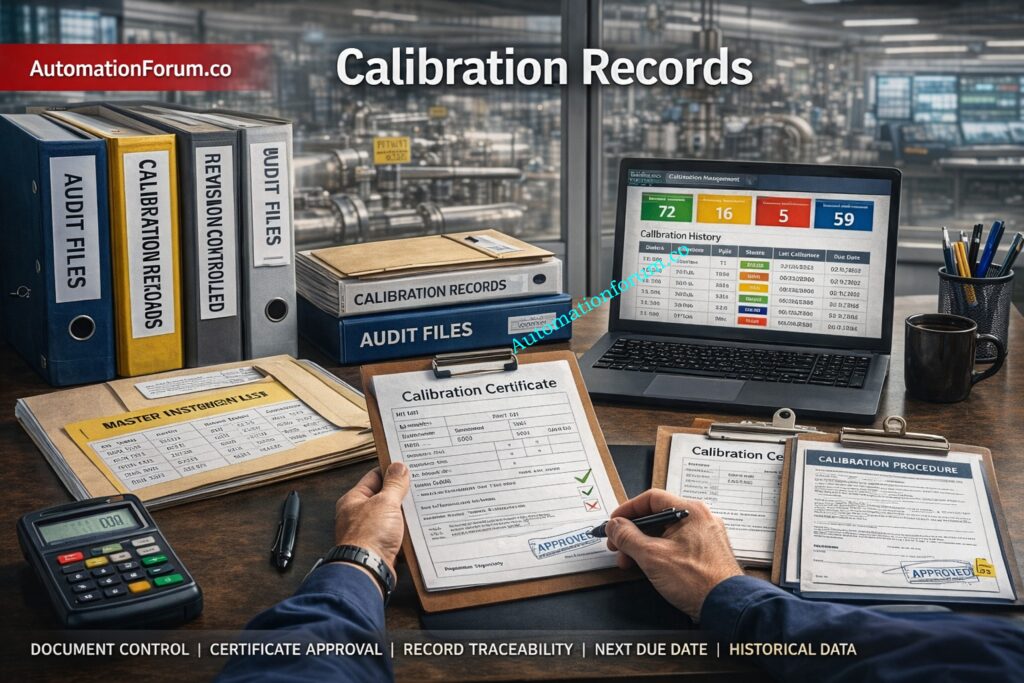
39. Show calibration certificate
Certificate must include instrument details, method, results, and reference standards. It is the primary evidence during audit.
Auditors verify random certificates for compliance.
40. Are results recorded clearly
Actual readings must be documented instead of only pass or fail. This provides detailed audit trail and supports analysis.
Clear records help identify trends and deviations.
41. Is next due date mentioned
Each certificate must clearly state the next calibration due date. This ensures timely scheduling and compliance.
Missing due date indicates weak calibration control system.
42. Are deviations recorded
Any deviation or adjustment must be documented clearly. This ensures transparency and traceability of actions.
Auditors check whether deviations are properly handled.
43. Are records traceable
Calibration records must be linked to instrument ID and reference standards. This ensures complete traceability.
Traceability is a fundamental ISO requirement.
44. Are backups maintained
Records must be stored securely with proper backup systems. This prevents data loss and ensures availability during audits.
Digital systems improve reliability and accessibility.
45. Are certificates approved
46. Are historical records maintained
Past calibration data should be maintained for trend analysis. This helps in predicting drift and optimizing intervals.
Auditors often check historical consistency.
Level Measurement Device Calibration Procedures: Calibration Procedures for Level Measurement Devices
Nonconformance and Corrective Action in Calibration Audits
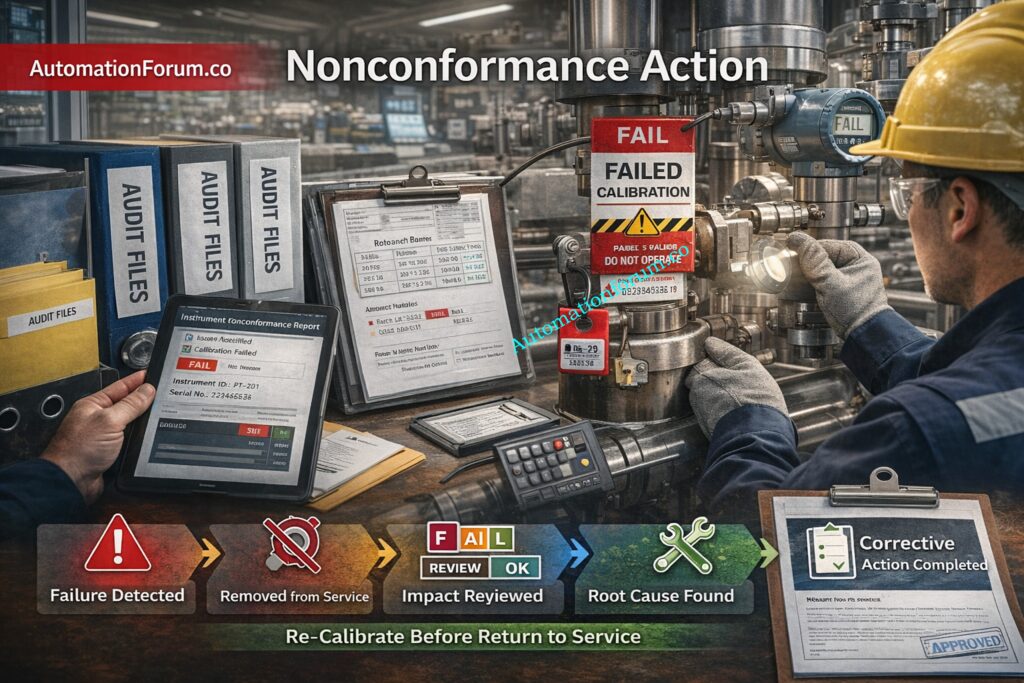
47. What happens if instrument fails
The instrument must be immediately removed from service and clearly marked. This prevents use of inaccurate equipment.
ISO requires control of nonconforming measuring equipment.
48. Is impact analysis performed
Previous measurements must be reviewed to assess impact on product quality. This ensures no defective product is released.
ISO requires evaluation of validity of previous results.
49. Are previous results reviewed
Data collected before failure must be analyzed for accuracy. This is critical in regulated industries.
Incorrect measurements may require product revalidation.
50. Is corrective action implemented
Root cause must be identified and corrective action taken. This prevents recurrence of the issue.
Example includes replacing faulty instrument or improving procedure.
51. Are affected batches evaluated
Products processed using faulty instruments must be checked for compliance. This ensures quality assurance.
Common requirement in pharmaceutical and food industries.
52. Are deviations documented
All non conformities must be recorded in the system. This provides traceability and supports corrective action tracking.
Auditors verify deviation logs during audits.
53. Is root cause identified
Root cause analysis must determine why failure occurred. This could be due to drift, damage, or improper handling.
Effective root cause analysis improves system reliability.
Pressure Instrument Calibration Procedures: Calibration Procedures for Various Pressure Measuring Instruments
Advanced Calibration Audit Questions for Expert Auditors
54. Is risk based calibration used
Calibration frequency should be based on risk and criticality of instrument. Critical instruments require more frequent calibration.
This approach improves efficiency and ensures reliability.
Refer the below link for the Free Instruments Calibration Procedures: 60+ Step-by-Step Methods for Pressure, Temperature, Flow & Level
55. How are intervals optimized
Calibration intervals should be adjusted based on historical performance and drift trends. Stable instruments can have extended intervals.
This reduces unnecessary calibration effort.
56. Is statistical analysis used
Trend analysis is used to predict instrument performance over time. This helps in proactive maintenance planning.
Advanced plants use statistical tools for calibration optimization.
57. Are critical instruments prioritized
Instruments affecting safety and product quality are given higher priority. This ensures critical measurements remain accurate.
Examples include safety shutdown systems.
58. Is calibration linked to safety
Calibration ensures safety systems operate correctly and prevent hazards. Incorrect calibration can lead to major incidents.
Auditors check linkage between calibration and safety integrity.
59. Are smart diagnostics used
Modern instruments provide diagnostic data to detect faults early. This improves maintenance efficiency.
Smart devices reduce manual calibration dependency.
60. Is calibration integrated with CMMS
Calibration activities should be integrated with maintenance systems for scheduling and tracking. This ensures timely execution.
Digital integration improves audit readiness and traceability.
ISO Flow Instrument Calibration Procedures: ISO Standard Calibration Procedures for Flow Measuring Instruments
Conclusion: How to Achieve ISO Compliant Calibration Control in Process Plants
Why calibration audits improve safety, quality, and reliability
ISO 9001 requires calibration systems to ensure valid, reliable, and traceable measurements across all processes
If your team can confidently answer at this level during audit
you are not just compliant
you are operating at a world class instrumentation standard.
Validation vs Calibration: Key Differences: Differences Between Validation and Calibration
How to build a world class calibration system
Calibration audits are not just compliance activities they are critical to plant safety, product quality, and operational reliability. ISO 9001 Clause 7.1.5 ensures that all measurement systems are accurate, traceable, and controlled, forming the backbone of any quality management system.
By implementing the 60 audit questions outlined in this guide, process industries can:
- Eliminate measurement errors
- Reduce audit risks
- Improve process efficiency
- Achieve ISO compliance confidently
Remember: If your instruments are wrong, your decisions are wrong.
Traceability ensures all measurements are linked to national or international standards, guaranteeing accuracy and consistency across processes.
How often should calibration be performed
Calibration frequency depends on instrument criticality, usage, and historical performance, often defined through risk based calibration strategies.
Ultimate ISO Calibration Audit Checklist: Internal Audit Checklist for ISO Process Instrument Calibration in Process Industries
FAQ on Calibration Audit Questions
What is a calibration audit in process plants
A calibration audit verifies that instruments are accurate, traceable, and compliant with ISO standards ensuring reliable measurement and process control.
Is calibration QA or QC?
Calibration is part of both QA and QC, ensuring measurement accuracy across processes and final product verification. It supports quality assurance by maintaining system reliability and quality control by validating results.
What is calibration in auditing?
Calibration in auditing is the verification of instruments to ensure they provide accurate and traceable measurements as per standards. Auditors check calibration records, traceability, and compliance with ISO requirements.
Best Calibration Management Software: Best Calibration Management Software
What is ISO 9001 calibration?
ISO 9001 calibration refers to controlling measuring equipment to ensure accuracy, traceability, and reliability of results. It is defined under Clause 7.1.5 for monitoring and measuring resources.
Does ISO 9001 cover calibration?
Yes, ISO 9001 covers calibration under Clause 7.1.5, requiring instruments to be calibrated at defined intervals. It ensures measurement traceability, proper identification, and documented records
What is the 7.3 clause of ISO 9001?
Clause 7.3 of ISO 9001 relates to awareness, ensuring employees understand quality policies and their role in achieving objectives. It focuses on competence, communication, and quality responsibility.
What does ISO 9001 require for calibration
ISO 9001 requires instruments to be calibrated at defined intervals, traceable to standards, properly identified, and supported with documented records.
