
- Understanding the Different Types of Bill of Materials
- What Is a Bill of Materials [BOM]
- Why Are Different Types of BOM Required
- Types of Bill of Materials [BOM]
- BOM Structure and Hierarchy
- Key Information Included in a BOM
- How BOM Supports Manufacturing and Production Planning
- Engineering BOM vs Manufacturing BOM
- How to Create an Accurate BOM
- Common BOM Mistakes to Avoid
- Benefits of Accurate BOM Management
- Frequently Asked Questions About Types of Bill of Materials
- Conclusion: How to Choose the Right Type of Bill of Materials
Understanding the Different Types of Bill of Materials
A production engineer is given a custom control panel order. The design team has finished the drawings, but production requires a different view of the product to identify assemblies, acquired parts, wiring materials, and objects needed at each production stage. The service staff also needs a different vision to identify the replaceable parts after installation.
This is why it’s crucial to understand the various forms of Bill of Materials.
A Bill of Materials, or BOM, is more than just a list of parts. It links product design to procurement, inventories, manufacturing, production planning, costing, quality, maintenance and service. Different companies need different information about the same product, hence different organizations utilize different BOM types for different objectives.
The precise classification may differ from industry to industry and organization to organization. But the goal remains the same: to provide a correct structure of the materials, components, assemblies and information needed to construct, market, repair or manage a product.
What Is a Bill of Materials [BOM]
What Information Does a Bill of Materials Contain
A Bill of Materials is a structured list of all the materials, components, assemblies, and subassemblies required to make a product or complete an assembly.
A typical BOM can contain the part number, component description, quantity, unit of measure, revision, material specification, assembly relationship, and supporting documentation.
Bill of Materials vs Simple Material List
For example, consider a control panel. The BOM may contain the enclosure, circuit breakers, contactors, terminal blocks, power supply, PLC, relays, cables, cooling fan, mounting accessories, and other required components. Some of these items may themselves contain smaller assemblies.
A simple material list only tells you what materials are required. A properly structured BOM also shows how those materials relate to the final product and where they belong within the product structure.
Refer te below link for the 82 Essential Drawings and Documents for Instrumentation and Control Engineers
Why Are Different Types of BOM Required
- One product can be viewed differently by engineering, manufacturing, procurement, sales, service, and finance.
- An engineer may be interested in design relationships and technical specifications. A production planner needs to know what materials are required to manufacture the product. A purchasing team needs information about externally purchased components. A service engineer needs to identify replaceable parts.
- Using one structure for every purpose can create confusion. Different BOM types provide the appropriate view for each business function.
- BOM information also supports product lifecycle management, material planning, inventory control, production scheduling, costing, engineering changes, and maintenance activities.
Types of Bill of Materials [BOM]
![Types of Bill of Materials [BOM]](https://cdn.automationforum.co/uploads/2026/09/Types-of-Bill-of-Materials-BOM-2-683x1024.jpg)
1. Engineering BOM [EBOM]
An Engineering BOM, or EBOM, represents the product from the engineering and design perspective.
It is normally created during product development and is closely associated with engineering drawings, CAD information, specifications, components, and assemblies. Engineers use the EBOM to define what the product is designed to contain.
For example, an industrial pump may have a motor, coupling, pump casing, impeller, shaft, bearings, seals, and other components in its engineering BOM.
The engineering team normally creates and maintains this BOM as the product design develops. Changes to the EBOM may effect manufacturing and procurement and as such engineering revisions must be strictly regulated.
2. Manufacturing BOM [MBOM]
The Manufacturing BOM, a.k.a. MBOM, describes the product from the point of view of manufacturing.
The MBOM enables the restructuring of engineering data into a production-friendly format. This may comprise assemblies to be manufactured, materials necessary, phases of production, job instructions and things required during assembly.
For example, an electrical panel could have an engineering design with a lot of distinct components. The manufacturing BOM can categorize those components by panel assembly, wiring activities, testing and final inspection.
The distinction is straightforward. EBOM describes what engineers designed. MBOM describes how the product will be built.
Calculate measurement uncertainty before trusting critical process readings: Measurement Uncertainty Calculator: Calculate Combined and Expanded Uncertainty Using GUM
3. Service BOM
A Service BOM is for maintenance, repair, servicing and replacement activities.
It assists service professionals to know what components were put in equipment and to recognize parts that may need inspection or replacement during the equipment lifecycle.
For example, an industrial compressor may feature filters, seals, bearings, valves, sensors, belts and other replaceable parts. A Service BOM lets maintenance professionals identify these components and better manage spare parts.
This sort of BOM is very beneficial when equipment contains several assemblies and spare parts.
4. Sales BOM
A Sales BOM represents a product from the customer and sales perspective.
It can be used for products sold as packages containing several components. It can also represent optional components selected according to customer requirements.
For example, a packaged automation system may include a control panel, operator interface, communication equipment, enclosure, and documentation. The sales BOM can represent the complete package that appears in the customer order.
The structure is client purchase oriented, not precise manufacturing sequence oriented.
Decode DP transmitter hookups before installation mistakes happen: How to Read the Hookup Drawing of a DP Type Level Transmitter?
5. Assembly BOM
An Assembly BOM outlines the parts and assemblies that make up a final assembly.
It is useful when a product is made up of multiple smaller assembly. The BOM illustrates the relationship of the finished product to main assemblies, subassemblies and individual components.
For example an industrial machine may have a driving subassembly, electrical subassembly, hydraulic subassembly and mechanical frame. There may be further components in each assembly.
With a clear Assembly BOM, it’s easier to plan the assembly and decreases the risk of missing components in production.
6. Configurable BOM [CBOM]
A Configurable BOM (or CBOM) is helpful when a product comes in many configurations.
Many industrial machines are not the same. There are many motor sizes, control options, communication interfaces, materials, sensors or accessories to choose from for the customers.
Instead than writing an entirely new BOM for each potential combination, a configurable structure can have defined options and rules.
For example, a custom pumping system may be provided in a range of motor sizes, control panels, communication choices, and instrumentation. The components to be included in the finished product are determined by the customer configuration selected.
Understand control valve hookups before commissioning costly errors: How to Read Control Valve Hookup Drawings?
7. Production BOM
The Production BOM is used for actual manufacturing and production execution.
It contains the material amounts and product structure that are needed for a production order. Production planners utilize this information to determine material needs and to make sure the relevant parts are on hand.
For example, if a manufacturer needs to make 100 control panels, the production BOM helps to identify how many breakers, terminal blocks, relays, cables, enclosures and other materials are needed.
This information can also be used to support production scheduling and material planning.
8. Procurement BOM
A Procurement BOM focuses on purchasing requirements.
It helps purchasing teams identify the components and resources that need to be sourced from vendors. Information can contain desired quantities, buying data, supplier information and material specs.
For instance, a machine maker might obtain motors, bearings, sensors, fasteners and electrical components from many different suppliers. A procurement BOM organizes these needs before the purchase order is created.
Also, a correct procurement BOM can help avoid non-value add purchases and material shortages.
Interpret complex instrument drawings without missing critical details: Complete Guide to Interpreting Instrument and Electrical Drawings for Engineers
9. Costed BOM
Costed BOM Links product components with appropriate costs.
This could cover material costs, costs of acquired components, labor costs, manufacturing overhead and other relevant expenditures. This is useful in product costing, quotes, budgeting and cost analysis.
For example, if a company is preparing a quote for a custom machine, the costed BOM can help in estimating the cost of major components and assemblies.
Cost information should be updated with caution as material pricing or component specification changes may effect final product cost.
10. Software Bill of Materials [SBOM]
A Software Bill of Materials, commonly called an SBOM, is different from a traditional physical product BOM.
An SBOM identifies software components, libraries, dependencies, versions, and other software elements used within a product or application.
This is increasingly important for connected industrial systems, automation platforms, embedded controllers, and other software based products. Knowing which software components are present helps organizations understand software dependencies and improve cybersecurity visibility.
Discover critical project documents engineers often overlook: Vendor Document for Project Systems Architecture: Complete Engineering Guide for Instrumentation, Automation and Control
BOM Structure and Hierarchy
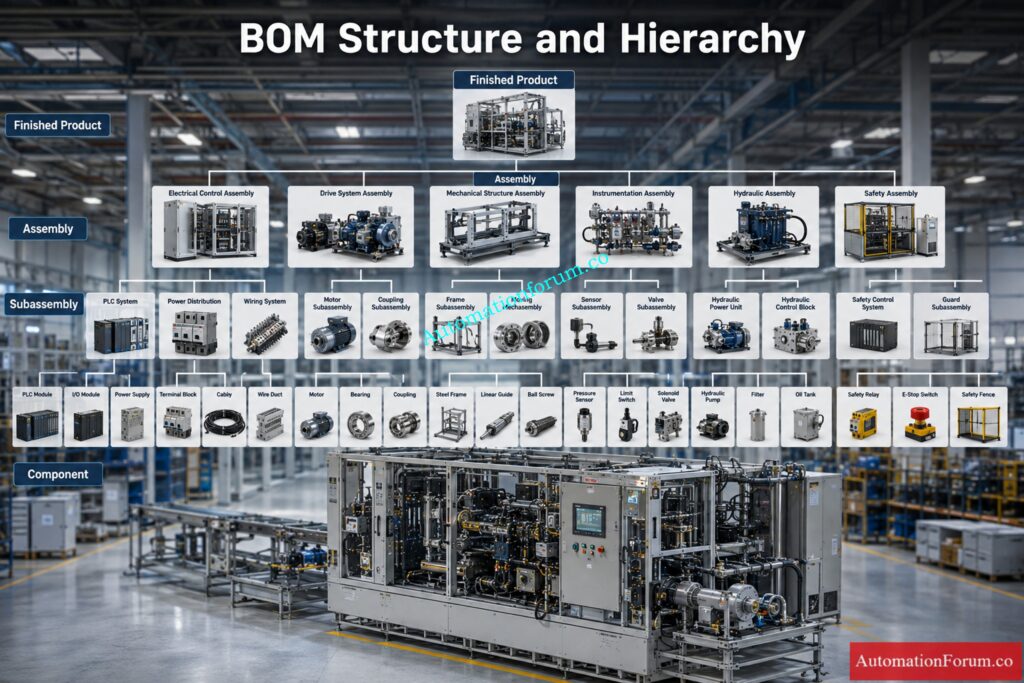
What Is a Single Level BOM and Multi Level BOM
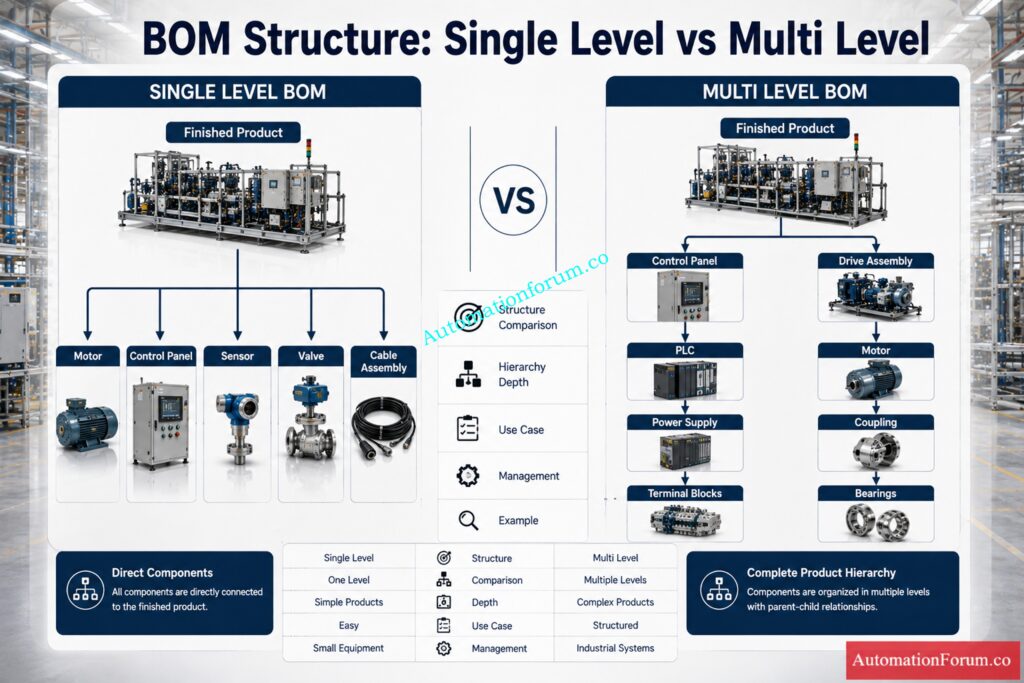
A BOM can be organized as a single level BOM or a multi level BOM.
A single level BOM shows the immediate components required for a parent item. A multi level BOM provides several levels of product structure.
Know the essential I&C standards behind reliable engineering: Key Instrumentation & Control (I&C) Standards Every Engineer Should Know
BOM Hierarchy Example for a Manufacturing Product
For example, an industrial machine can be the finished product. Below it may be a control panel, drive assembly, and mechanical assembly. The control panel can then contain a PLC, power supply, terminal blocks, breakers, and other components.
The parent item is the final machine and the assemblies and components below it are child items. This BOM hierarchy is useful in the management of complicated products.
Prevent dangerous grounding failures with proper instrumentation earthing: Instrument Earthing Systems
Key Information Included in a BOM
Typical important BOM information includes:
- Part number
- Part description
- Component quantity
- Unit of measure
- BOM level
- Parent and child relationship
- Revision information
- Material specification
- Procurement information
- Reference documents
- Cost information
- Alternative or substitute components
Precision is everything. inappropriate part numbers, inappropriate quantities and wrong revisions can all lead to material shortages, production delays, purchasing errors, rework and increased expense.
Refer the below link for the What is HAZOP Study in Instrumentation Engineering for EPC Engineers in Process Industries
How BOM Supports Manufacturing and Production Planning
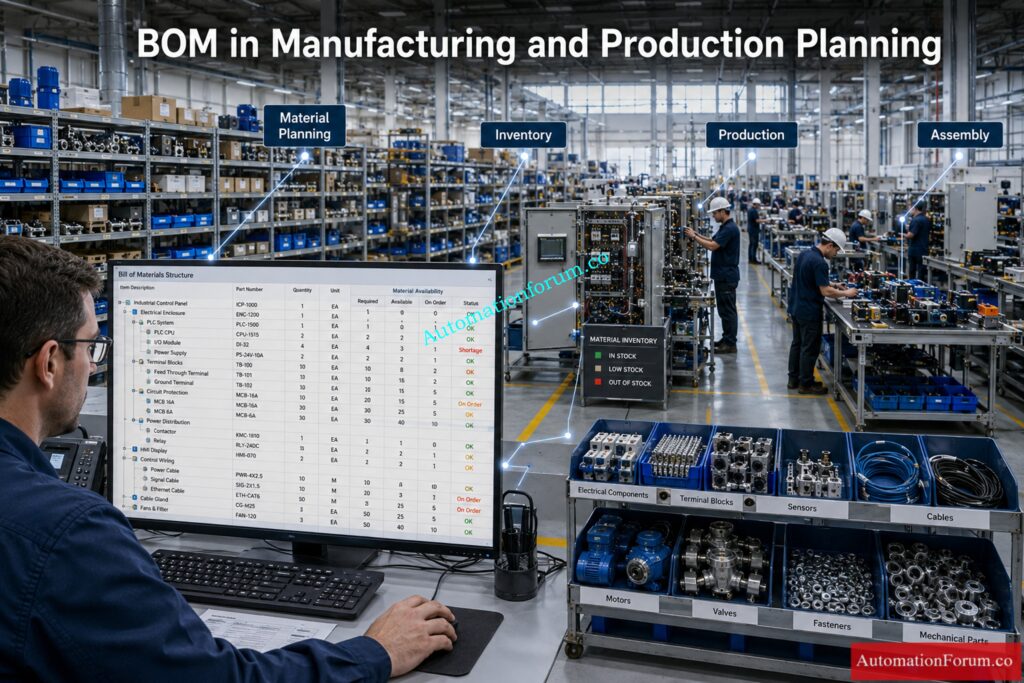
Almost all the major production activities are supported by a well kept BOM.
It helps production planners determine what materials are needed and it helps purchasing teams work out what they need to order. BOM data is used by inventory teams to understand material use and by production teams to develop and execute manufacturing orders.
BOM data can be used for production scheduling, assembly, costing, quality control, engineering changes and maintenance.
The connection between BOM and MRP is especially crucial. MRP also uses production needs and inventory information to determine what materials must be acquired or manufactured . This is based on the product structure and needed quantities from the BOM .
Access essential engineering templates engineers need immediately: Downloadable Engineering Documentation Instrumentation and Control Templates
Engineering BOM vs Manufacturing BOM
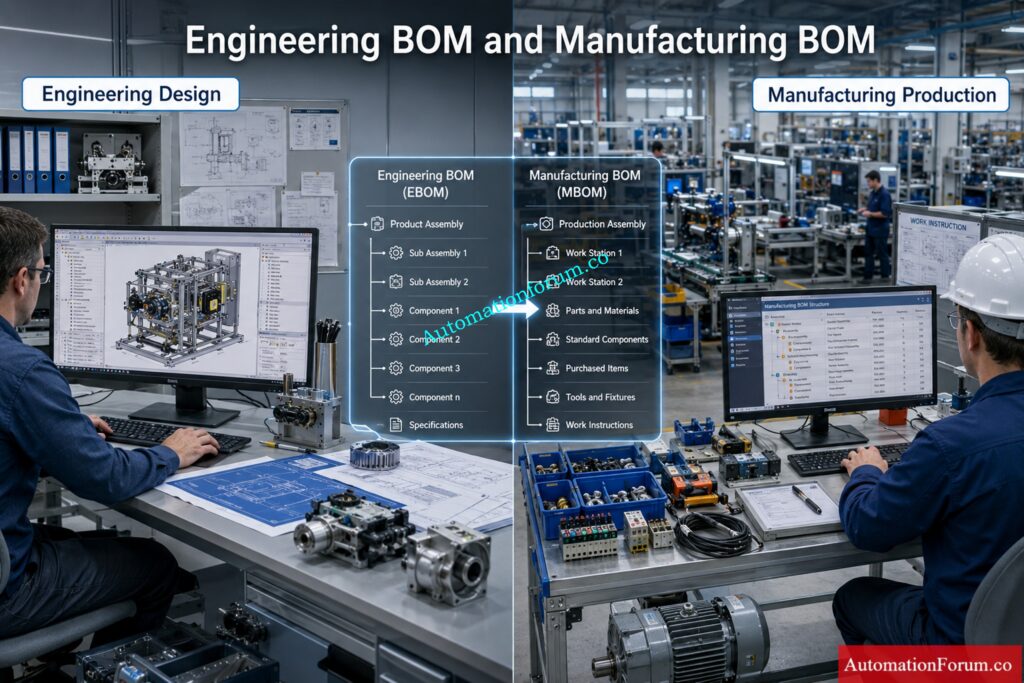
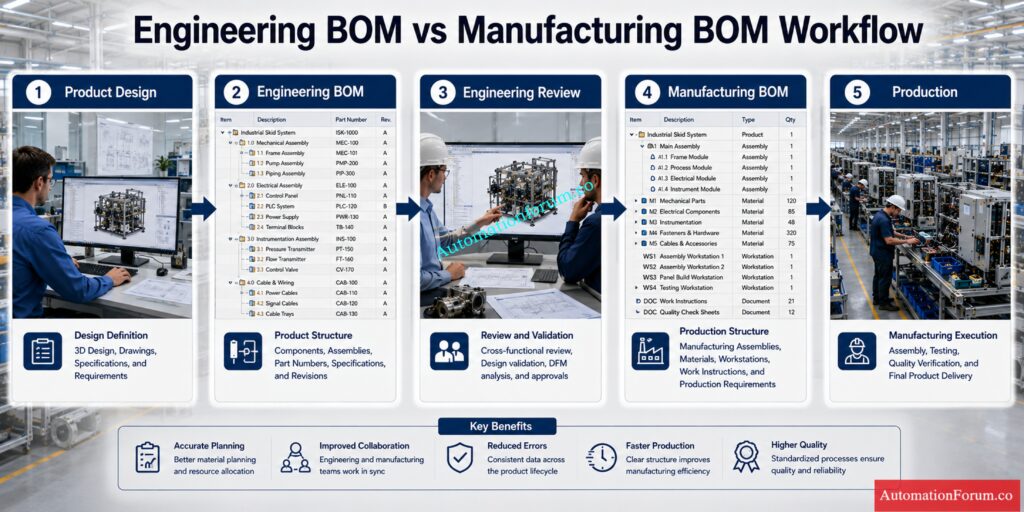
The EBOM represents the product as designed by engineering. The MBOM represents the product as it needs to be organized and built by manufacturing.
EBOM is mainly used by engineering teams for design and technical definition. MBOM is mainly used by manufacturing and production teams for assembly, material planning, and production execution.
In practice, the two structures must remain connected. A major engineering change should be reviewed for its impact on manufacturing, procurement, inventory, quality, and service.
Understand shutdown planning before process safety becomes critical: Shutdown Philosophy: Engineering Documentation for Process Safety and Emergency Shutdown Systems
How to Create an Accurate BOM
Start by clearly identifying the finished product. Then break that down into main assemblies . Then break the large assemblies down into individual components and sub assemblies.
Unique Part Numbers and Descriptions: Use the right amount and measurement for each ingredient. Establish a coherent BOM structure and check each change against the most current approved engineering information.
Finally, examine the BOM with engineering, production, procurement, inventory, quality and service teams. Experienced manufacturing teams realize that this cross functional assessment frequently catches problems before they ever get to the work floor.
Master PLC alarm and trip documentation before commissioning: PLC Alarm and Trip Documentation Procedure – EPC PLC Automation Engineer Guide
Common BOM Mistakes to Avoid
Common BOM problems include incorrect component quantities, missing components, wrong part numbers, outdated revisions, incorrect units of measure, poor BOM hierarchy, missing substitute information, and incorrect costing information.
Another common problem is poor coordination between engineering and production.
These errors may appear small on a computer screen, but their effect on the factory can be significant. Missing part can halt an assembly. Wrong manufacturing can occur from an old revision. Wrong quantities might produce material shortages or too much inventory.
Avoid PLC documentation gaps that create serious commissioning problems: PLC System Documentation Guide: Essential Records for Industrial Automation
Benefits of Accurate BOM Management
BOM management accuracy will increase production accuracy, material availability, procurement planning, inventory control, cost accuracy, engineering change management, production efficiency, product quality and traceability.
It also enhances cooperation between engineering, procurement, manufacturing, quality, maintenance and service teams.
For organizations manufacturing complex products, a reliable BOM becomes an important source of product knowledge throughout the product lifecycle.
Explore essential instrumentation drawings every engineer should understand: Types of Engineering Drawings and Documents used in Instrumentation
Frequently Asked Questions About Types of Bill of Materials
What is a Bill of Materials?
A Bill of Materials is a systematic list of materials, components, assemblies, and quantities required to produce or manage a product. It may also include changes, specs, cost and procurement details.
What are the different types of BOM?
Common types are Engineering BOM, Manufacturing BOM, Service BOM, Sales BOM, Assembly BOM, Configurable BOM, Production BOM, Procurement BOM, Costed BOM and Software BOM.
What are the different types of BOMs in SAP?
SAP can, for example, provide BOM frameworks for engineering, production, sales, maintenance and costing. The specific use of the BOM is dependent on the organization and its SAP configuration.
Who prepares a BOM?
The first BOM is usually generated by engineering or product development using product design and requirements. The BOM can be reviewed by the manufacturing, procurement, quality and service teams for their needs.
Generate accurate instrument indexes faster for EPC projects: Instrument Index Generator for EPC Instrumentation Projects
What are the two levels of BOM?
Single level BOM illustrates the immediate components necessary for a parent item. The multi level BOM provides a complete view of the product hierarchy, including assemblies, subassemblies, and individual components.
What is an Engineering BOM?
An Engineering BOM describes the product in terms of the engineering design and is coupled with drawings and technical specifications. It provides the product structure required during design and development.
What is the difference between EBOM and MBOM?
EBOM is the product from the engineering design perspective, and MBOM is the structure to build the product. MBOM can order components based on assembly and production needs.
What is a Manufacturing BOM used for?
A Manufacturing BOM is the material structure needed to build a product. It helps you plan and execute production. This assists the production teams to determine the right components and amounts.
What is a Configurable BOM?
A Configurable BOM is used for items that can be offered with different choices selectable by customer. It allows the selection of permitted components and configurations depending on unique product needs.
What is an item category in BOM?
An item category describes the behavior of a component in a BOM and affects the way it is used in the product structure. The specific meaning and options available will depend on the ERP system in use.
What information does a BOM contain?
A BOM typically includes part numbers, descriptions, quantities, units of measure, revisions, specifications, hierarchy information, procurement details and cost information.
Why is BOM important in manufacturing?
A BOM links engineering design with procurement, inventory, production, costing and quality processes. An precise BOM helps prevent material shortages, production errors, excess inventory, and costly rework.
Master safety instrumented system requirements before design approval: S84 / IEC 61511 Standard for Safety Instrumented Systems – Complete Guide
Conclusion: How to Choose the Right Type of Bill of Materials
The Bill of Materials comes in many flavors giving diverse perspectives on the same product to engineering, manufacturing, sales, procurement, service, costing, production and software.
Engineering teams might require an EBOM, manufacturing teams might require an MBOM or Production BOM. Procurement teams need purchasing information, service teams need replacement information, and modern linked items may also require an SBOM.
The actual BOM classification may differ from organization to organization but the need for precise product structure is universal.
Effective BOM management affects production efficiency, material planning, inventory, procurement, cost, quality, maintenance and product lifecycle management. Keeping a BOM accurate and controlled is one of the cornerstones of reliable production for any manufacturing business.
Refer the below link for the Build accurate instrument BOMs without costly engineering mistakes
