
- MTBF vs MTTR for Plant Reliability
- What Is MTBF and What Does MTBF Mean?
- What Is MTTR and What Does MTTR Mean?
- MTBF vs MTTR: What Is the Difference?
- How MTBF and MTTR Affect Equipment Availability
- MTBF vs MTTR Practical Plant Example
- Which KPI Matters More for Plant Reliability?
- Common Causes of Low MTBF
- How to Improve MTBF in Industrial Plants
- Common Causes of High MTTR
- How to Reduce MTTR in Plant Maintenance
- Why You Should Improve Both MTBF and MTTR
- How to Calculate MTBF and MTTR Using a Calculator
- Common MTBF and MTTR Calculation Mistakes
- Final Engineering Takeaway: MTBF vs MTTR for Plant Reliability
- Frequently Asked Questions About MTBF and MTTR
MTBF vs MTTR for Plant Reliability
Why MTBF and MTTR Matter in Industrial Maintenance
In a process plant, equipment reliability is rarely judged by one number. Maintenance teams usually review several maintenance performance indicators during reliability meetings, but two of the most important are MTBF and MTTR.
MTBF Meaning and MTTR Meaning
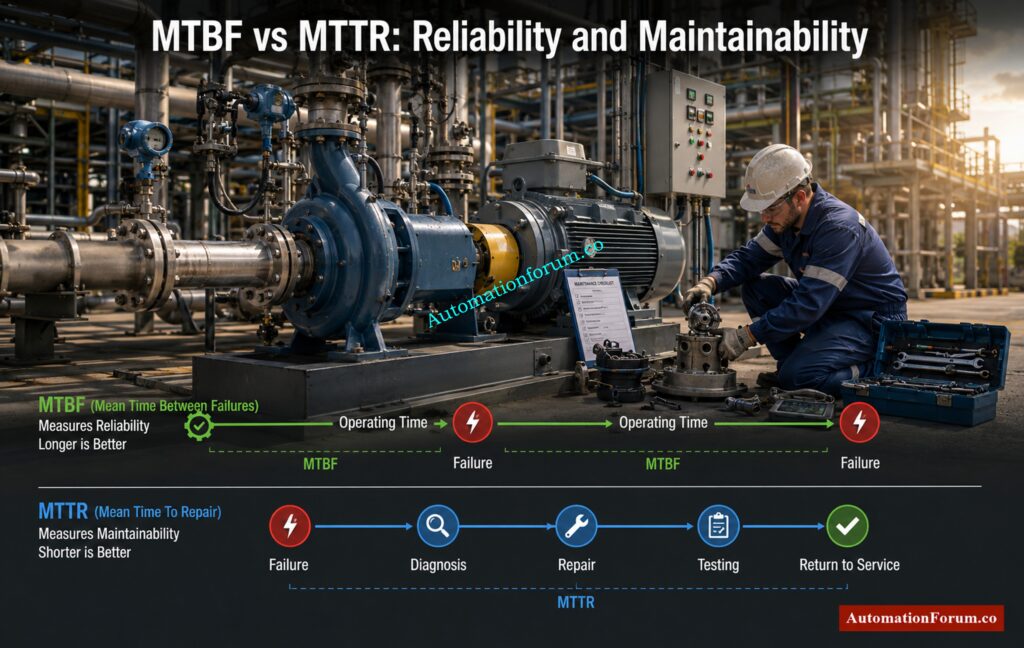
MTBF means Mean Time Between Failures. It represents the failure rate of repairable equipment in operation. MTTR stands for Mean Time To Repair. It shows how quickly the equipment can be restored after a failure.
This creates an important engineering question: MTBF vs MTTR, which KPI matters more for plant reliability?
Reliability Versus Maintainability in Plant Maintenance
A plant may have excellent repair capability and still experience serious production losses if critical equipment keeps failing. The real objective is therefore to prevent failures wherever possible and restore equipment efficiently when failures cannot be avoided.
Refer the below link for the Failure Rate (λ) Calculator for Process Instrumentation and Industrial Maintenance
What Is MTBF and What Does MTBF Mean?
MTBF Meaning in Industrial Maintenance
MTBF stands for Mean Time Between Failures. It is the average period of operation of repairable equipment between successive failures.
What Does a High MTBF Indicate?
Generally, a greater MTBF suggests more reliable equipment. When equipment runs longer without faults, there are fewer delays in output, and maintenance workers spend less time responding to unanticipated malfunctions.
MTBF Formula
The basic formula for MTBF is:
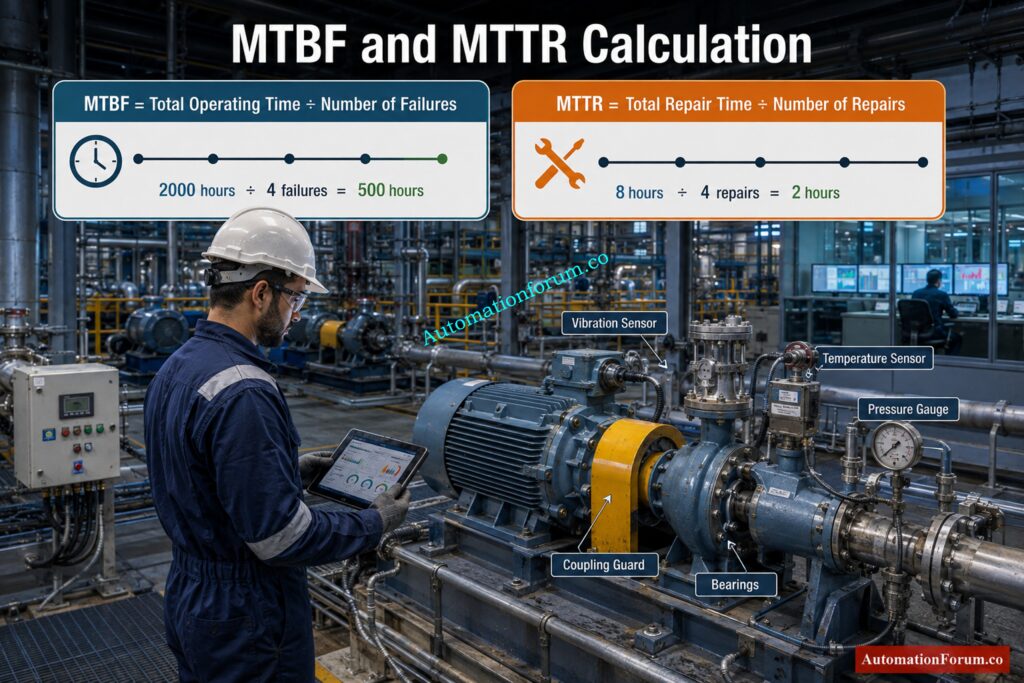
MTBF = Total Operating Time ÷ Number of Failures
How to Calculate MTBF
For example, an air compressor that runs 2000 hours and encounters four failures.
MTBF = 2000 / 4 = 500 hours That means the compressor averaged 500 hours of operation between failures during the period in question.
How MTBF Is Used in Maintenance
However, engineers should not treat MTBF as a simple number without checking the quality of the data. Failure definitions must remain consistent. Operating hours must be accurate, and the equipment duty and operating conditions should be considered when comparing results.
Refer the below link for theMean Time Between Failures (MTBF) Calculator for Process Instrumentation Maintenance
What Is MTTR and What Does MTTR Mean?
MTTR Meaning in Industrial Maintenance
MTTR means Mean Time To Repair. This is the mean time to repair equipment after a breakdown.
What Does a Low MTTR Indicate?
Repair time might include a variety of things. This may encompass fault identification, equipment isolation, troubleshooting, spare part procurement, repair or replacement of failed component, equipment testing, functional verification and restoration to service.
MTTR Formula
The MTTR formula is essentially:
MTTR = Total Repair Time ÷ Number of Repairs
How to Calculate MTTR
For example, if four failures took 8 hours of repair time total:
MTTR = 8/4 = 2 hours
This means an average fix took 2 hours.
Is MTTR a Maintenance KPI?
Lower MTTR means faster recovery and higher maintenance efficiency, in general. However, minimizing MTTR shouldn’t come at the cost of hasty fixes. A quick but not fully effective repair will cause another failure and finally MTBF will decrease.
Refer the below link for the Mean Time To Repair (MTTR) Calculator for Process Instrumentation Downtime Analysis
MTBF vs MTTR: What Is the Difference?
MTBF Measures Equipment Reliability
The difference between MTBF and MTTR becomes easier to understand when viewed from the questions they answer.
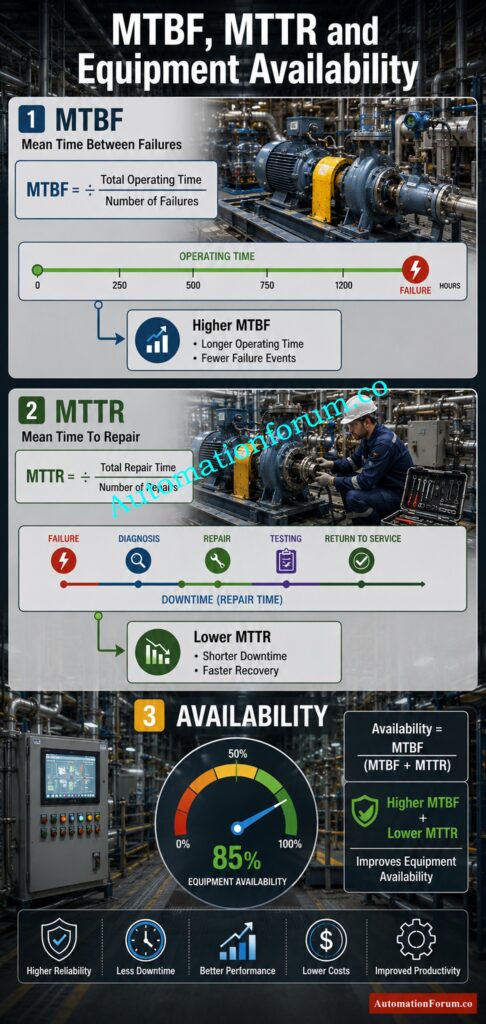
MTBF asks: How often does the equipment fail?
MTTR Measures Equipment Maintainability
MTTR asks: How quickly can the equipment be restored?
MTBF is therefore mainly associated with reliability. MTTR is mainly associated with maintainability.
Build Smarter Reliability Programs Using Proven RCM Principles: What is Reliability Centered Maintenance (RCM)?
Is Higher MTBF or Lower MTTR Better?
Consider a pump that operates for a long period before developing a fault but takes several hours to repair. Its MTBF may be strong while its MTTR needs improvement.
Why High MTBF and Low MTTR Matter Together
Now consider another pump that can be repaired in less than an hour but fails repeatedly. Its MTTR may look excellent, but its reliability is poor.
For most plants, the preferred condition is a high MTBF combined with a low MTTR.
Optimize Calibration Intervals Before Accuracy Problems Cause Failures: Calibration Interval Schedule Procedure for Process Instrumentation Using Risk-Based Method
How MTBF and MTTR Affect Equipment Availability
Relationship Between MTBF, MTTR, and Equipment Availability
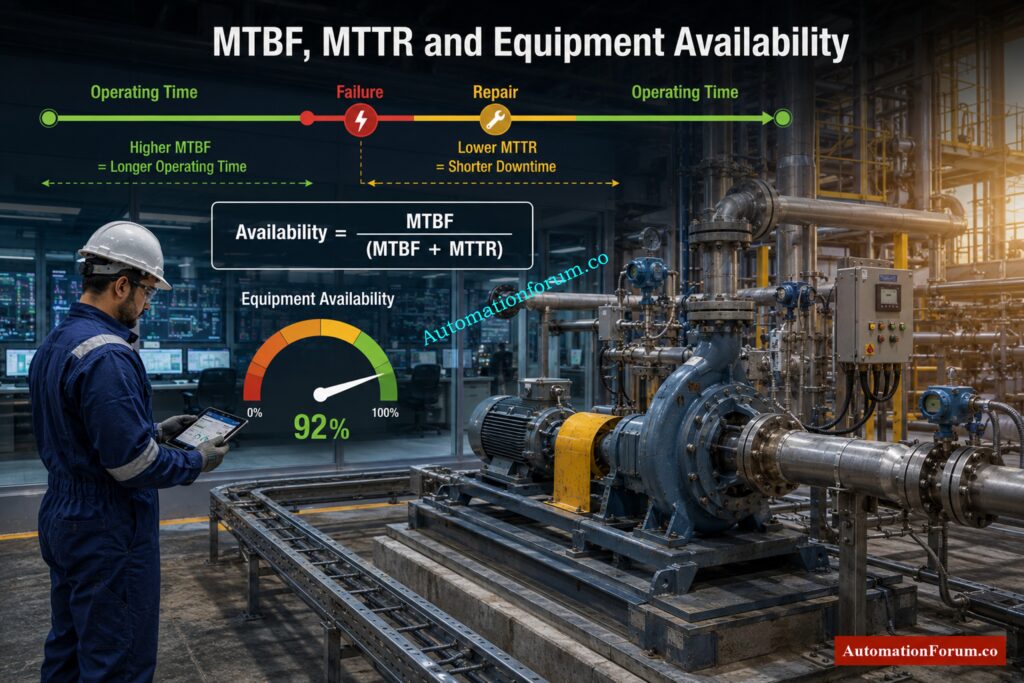
Equipment availability is influenced by both failure frequency and repair duration.
Equipment Availability Formula
A commonly used relationship is:
Availability = MTBF ÷ (MTBF + MTTR)
How Increasing MTBF Improves Availability
The relationship is straightforward. Increasing MTBF means the equipment operates longer before another failure occurs.
Master Shutdown Turnaround Tasks Before Critical Instrument Failures: Instrumentation Shutdown and Turnaround Activity Checklist: A Complete Step-by-Step Procedure
How Reducing MTTR Improves Availability
A lower MTTR means less downtime when a failure occurs.
For example, enhancing failure prevention can improve MTBF, and better troubleshooting, spare availability, qualified technicians, and prepared repair processes can reduce MTTR.
Using an MTBF and MTTR Calculator
The MTBF and MTTR calculator can assist engineers assess these correlations based on actual plant data. Enter true operating hours, the frequency of failures and the time it takes to repair them instead of making assumptions and see how the changes affect the calculated figures.
Optimize Calibration Intervals Before Accuracy Problems Cause Failures: Calibration Interval Schedule Procedure for Process Instrumentation Using Risk-Based Method
MTBF vs MTTR Practical Plant Example
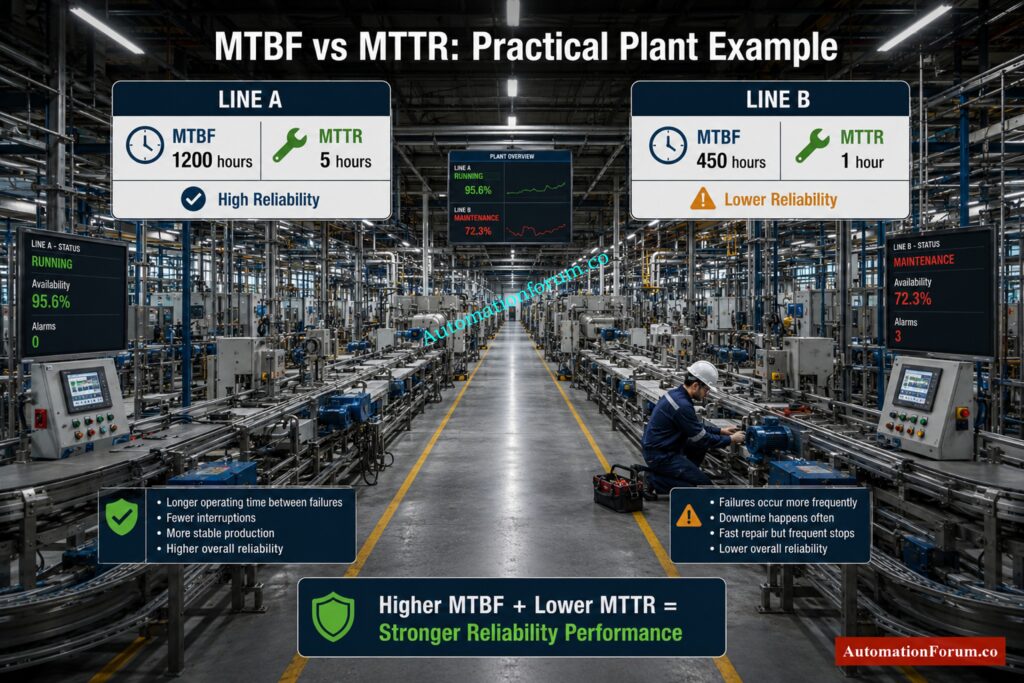
Line A With High MTBF and High MTTR
Consider two production lines.
Line A
MTBF = 1200 hours
MTTR = 5 hours
Line B With Low MTBF and Low MTTR
Line B
MTBF = 450 hours
MTTR = 1 hour
On the face of it, Line B is appealing: maintenance crews can fix it swiftly. But line B fails significantly more frequently.
Every failure can lead to production disruption, operator involvement, maintenance workload, spare usage, troubleshooting activity and process instability .
Line A is more difficult to repair, but it is less likely to break down. From the point of view of reliability engineering, Line A displays better equipment reliability.
Understand Maintenance Strategies That Keep Plants Running Reliably: What is maintenance? Types of Maintenance
What This Example Means for Plant Maintenance
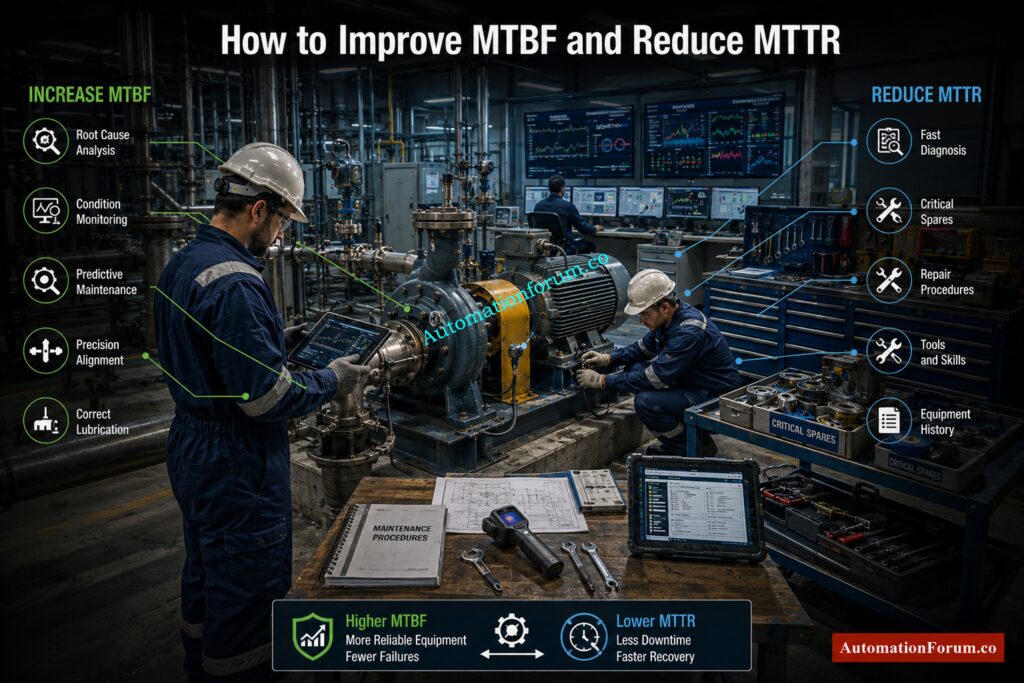
This example highlights an important point. Fast repairs do not compensate indefinitely for frequent failures.
If Line A has a frequent failure mechanism, the maintenance team should investigate why it takes 5 hours to fix it. If Line B continues failing every few hundred operating hours, the priority should be identifying and eliminating the underlying causes.
Fix PLC Output Failures Before They Stop Production: PLC Input ON but Output Not Energizing: Complete Troubleshooting Guide
Which KPI Matters More for Plant Reliability?
When MTBF Should Be the Priority
- If the question is specifically about equipment reliability, MTBF has the more direct connection because it measures the frequency of failure.
- But MTTR remains important for plant availability and production continuity.
- Priority is given based on the criticality of equipment, process demands, redundancy, safety consequences, operating conditions and maintenance strategy.
- Repeated failures of a crucial process compressor should be a high focus item for MTBF enhancement. Root cause analysis, condition monitoring, lubrication improvement, alignment checks, operating condition assessment and predictive maintenance can be needed.
Build Smarter Reliability Programs Using Proven RCM Principles: What is Reliability Centered Maintenance (RCM)?
When MTTR Should Be the Priority
- The best reliability strategy is therefore not a competition between MTBF and MTTR. It is about understanding which problem is limiting plant performance and addressing it correctly.
Strengthen PLC I/O Reliability and Prevent Repeated Downtime: Proactive Maintenance Strategies for PLC I/O Modules: Reduce Downtime & Improve Reliability
Common Causes of Low MTBF
- Common causes include poor installation, incorrect equipment selection, improper alignment, lubrication problems, excessive vibration, electrical faults, poor operating conditions, instrumentation problems, incorrect control settings, process upsets, low quality spare parts and inadequate preventive maintenance.
- One of the most destructive maintenance practices is to repair equipment over and over without analyzing the cause of failure.
- Replacing a broken bearing can bring a pump back to life but if the failure was due to shaft misalignment the same problem could happen again.
- This is why root cause analysis and failure analysis are critical for long term reliability.
Never Miss Critical Maintenance Tasks With This Checklist: Maintenance Checklist
How to Improve MTBF in Industrial Plants
Improving MTBF starts with preventing recurring failures.
- If equipment fails often, root cause analysis should be performed. Rotating equipment should be properly aligned and lubricated in accordance with the equipment specifications.
- Condition monitoring can provide early warning of developing problems. Vibration monitoring is particularly useful for many rotating machines. Predictive maintenance can then be used to identify degradation before it becomes a functional failure.
- Preventive maintenance should also be reviewed periodically. A maintenance task should have a clear technical reason rather than being performed simply because it has always been included in the schedule.
- Instrumentation and Control Engineers can provide a substantial contribution in terms of precise calibration, effective alarm management, dependable process measurement, control performance monitoring and early identification of aberrant equipment behavior.
- The greater MTBF is further supported by quality spare parts and functioning within the design envelope.
Find Why Energized Solenoids Fail to Move Valves: Solenoid Valve Energized but Valve Not Actuating: Troubleshooting Instrumentation Control Circuits in Hydraulic Systems
Common Causes of High MTTR
High MTTR is often caused by delays in the actual repair.
- Poor fault diagnosis, lack of spare parts, lack of tools, limited technical information, poor planning, lack of skilled personnel, difficulty in equipment access, ambiguous procedures, poor maintenance records, delay in isolation, permit delays and lack of coordination between operations and maintenance can all contribute to the time taken to recover.
- In many plants, the actual physical replacement of components may be a minor percentage of the total downtime. The remaining time can be used for troubleshooting, waiting, preparation, access, isolation, testing and restart activities.
- It is important to know where the time is actually going.
Prepare Marshalling Cabinets Before Shutdown Problems Escalate: Shutdown Maintenance Procedure for Marshalling Cabinets in Process Plant
How to Reduce MTTR in Plant Maintenance
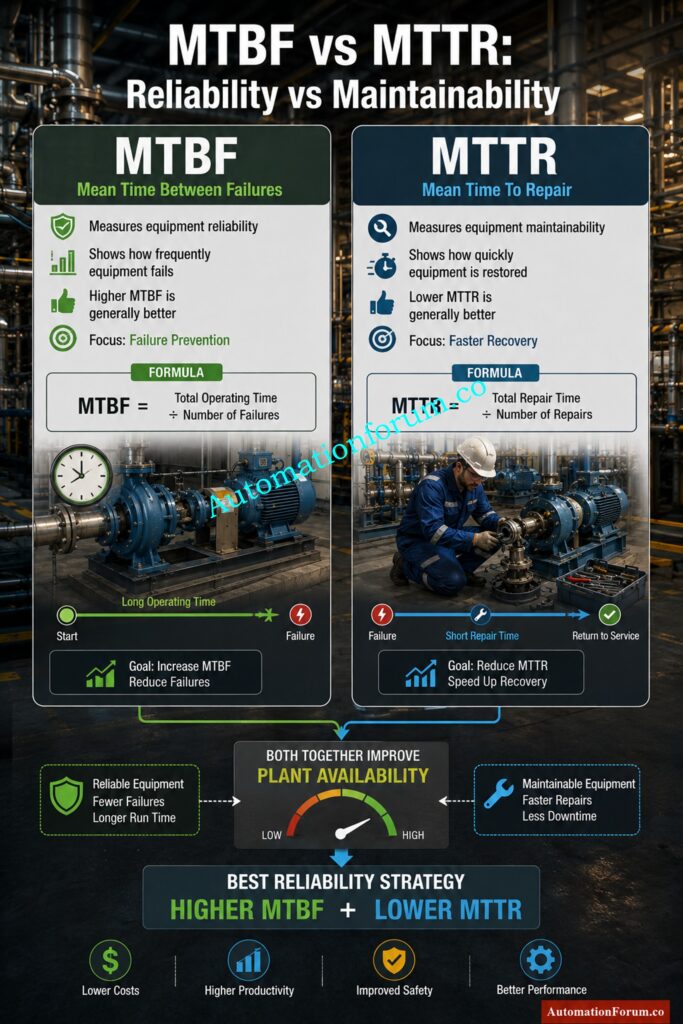
Reducing MTTR requires preparation before the failure occurs.
- Standard repair procedures allow specialists to follow uniform recovery processes. Critical spare parts should be identified and stocked at acceptable levels.
- Maintenance staff also need the necessary tools, technical paperwork, drawings, equipment history and information for problem solving.
- Previous failures, corrective actions, components changed and failure patterns recurring might help improve recovery time by use of digital maintenance data.
- Useful diagnostic information is available from modern automation systems and smart instrumentation. PLC diagnostics, control system alarms, smart instrument status information and maintenance management systems can all help to narrow down the fault site before physical troubleshooting ever begins.
Prevent Wet Leg Level Measurement Failures With Proper Checks: Checklist: Preventive Maintenance Procedure for Closed Tank Wet Leg Level Measurement
Why You Should Improve Both MTBF and MTTR
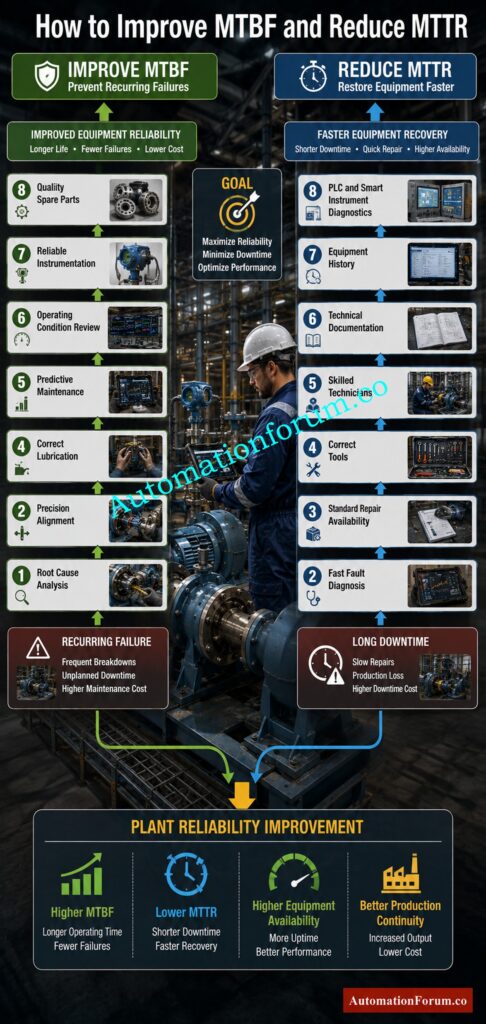
Strong maintenance organizations do not focus exclusively on one KPI.
- The best case is equipment that breaks less frequently and can be restored in an effective manner also when a breakdown does occur.
- Improving MTBF is mainly about preventing failures. Improving MTTR is about reducing the impact when failures cannot be prevented.
- Both contribute to equipment availability, plant maintenance efficiency, production continuity, and overall plant reliability.
- The relationship is simple. If equipment fails frequently, reducing repair time alone will not solve the underlying reliability problem. If failures are rare but recovery takes an excessive amount of time, maintainability improvements can deliver significant benefits.
Explore Proven PM Procedures for Industrial Instrumentation Reliability: Collection of Preventive Maintenance (PM) Procedures for Instrumentation and Control Systems
How to Calculate MTBF and MTTR Using a Calculator
The calculator becomes most useful when it is connected to actual plant data.
- Start by determining the total operating time for the equipment being evaluated. Next, identify the number of relevant failures during that period.
- For MTTR, determine the total repair time associated with those failures. Use consistent rules when deciding what time should be included.
- The calculator can then be used to determine MTBF and MTTR and compare the results with previous periods.
- Do not rely on one monthly number alone. Trends are usually more useful.
- If MTBF gradually decreases over several months, the equipment may be developing a recurring reliability problem. If MTTR suddenly increases, investigate whether the cause is spare availability, troubleshooting difficulty, manpower, access, documentation, or another maintenance constraint.
Keep Control Valves Reliable With Essential Preventive Checks: Control Valve Preventive Maintenance Checklist and Inspection Procedure
Common MTBF and MTTR Calculation Mistakes
- One common mistake is using inconsistent failure definitions.
- Another is using inaccurate operating hours or excluding relevant repair time. Planned maintenance should also be separated appropriately from unplanned failure events when calculating these indicators.
- Comparing equipment with completely different duties can also produce misleading conclusions. A heavily loaded compressor and a lightly loaded standby pump should not automatically be judged using the same expectations.
- Most importantly, engineers should avoid looking at one KPI without considering equipment criticality and actual plant impact.
- Good reliability decisions depend on good data.
Choose the Right Maintenance Strategy for Maximum Equipment Reliability: Difference between Predictive Maintenance and Preventive Maintenance
Final Engineering Takeaway: MTBF vs MTTR for Plant Reliability
- MTBF tells engineers how often equipment fails.
- MTTR tells engineers how quickly the maintenance team can restore equipment after failure.
- So, which matters more in the MTBF vs MTTR discussion?
- For equipment reliability itself, MTBF has the more direct connection because it measures failure frequency. MTTR is equally important when the focus is equipment availability, downtime, maintainability, and recovery performance.
- The strongest maintenance strategy is not about choosing one KPI.
- It is about improving both.
- Increase MTBF by understanding failure mechanisms, improving installation and operating practices, applying condition monitoring, using predictive maintenance, and eliminating recurring root causes.
- Reduce MTTR by improving diagnosis, spare readiness, procedures, technical documentation, tools, skills, and coordination.
- The ultimate goal is not simply to become faster at repairing equipment.
- Plant reliability improves when engineers understand why equipment fails and prevent those failures from happening again.
Recover Stuck Control Valves Before Process Disruptions Spread: How to do maintenance on struck control valve?
Frequently Asked Questions About MTBF and MTTR
How do you calculate MTBF and MTTR?
MTBF = total time in operation / number of failures.
MTTR is derived by dividing the total repair time by the number of repairs.
MTBF = Total uptime ÷ Number of failures
MTTR = Total Repair Time / Number of Repairs
How much MTBF is good?
There is no one MTBF rating that is deemed good for all types of industrial equipment. The MTBF is good depending on equipment design, duty, operating conditions, criticality and past plant performance.
In reality, engineers should be comparing current MTBF to earlier times and similar equipment, not one universal standard.
What is MTTR, MTTF, and MTBF?
MTTR (Mean Time To Repair) is a measure of how quickly you can return defective equipment to service. MTBF stands for Mean Time Between Failures and is used to quantify the average operating time between failures of repairable equipment.
MTTF stands for Mean Time To Failure and is usually used for equipment or components that are not repaired after failure but replaced.
Prevent PLC Failures With This Essential Maintenance Checklist: Checklist to Carry out PLC Preventive Maintenance Activity
How is MTTR calculated?
MTTR is the total time to repair divided by the number of repairs in the chosen measurement period.
For example, if four pieces of equipment break down and it takes a total of eight hours to fix them, the MTTR is 8 ÷ 4 = 2 hours.
Is MTTR a KPI?
Yes. MTTR is a very significant maintenance KPI to measure the efficiency of a maintenance organization in restoring equipment after failures.
A lowering MTTR is generally a good thing, meaning faster recovery, but should be looked at in relation to MTBF, because faster repairs won’t fix the problem of equipment failing over and over.
How can MTTR be reduced?
The MTTR can be minimized by improving the problem diagnosis, preserving important spare parts, preparing standard repair methods, assuring tool availability, educating the maintenance people and maintaining the accurate equipment history.
Better diagnostics from PLC systems, smart instrumentation, condition monitoring systems and maintenance management software can also assist staff find defects faster.
How is MTBF used in maintenance?
MTBF helps you understand how often repairable equipment fails. It helps you recognize changes in the reliability of equipment over time.
MTBF trends can assist maintenance teams with identifying repeated failures, assessing the effectiveness of preventive maintenance, supporting predictive maintenance decision making, and prioritizing root cause analysis.
How do I calculate MTBF?
To calculate the MTBF, add up all the operating hours of the equipment and divide the result by the number of relevant failures in that working period.
For example, if an air compressor fails 4 times in 2000 hours of operation. This would yield an MTBF of 2000 ÷ 4 = 500 hours.
How do you calculate MTBF and MTTR using a calculator?
Enter total operating time and number of failures to compute MTBF. Then enter total repair time and number of repairs to calculate MTTR.
Engineers use the results together to decide if the major problem is frequent equipment failure, sluggish recovery, or both.
Is a higher or lower MTBF better?
Generally, the higher the MTBF, the better, because it signifies the equipment performs longer, on average, between failures.
However MTBF should always be interpreted according to equipment duty, operating conditions, failure
Is a lower or higher MTTR better?
The lower the MTTR the better, as this means that the maintenance crew can get failed equipment back into service quicker.
However, decreasing MTTR should not be an excuse to do incomplete repairs. The best result is a reduced MTTR and a greater MTBF.
What is the difference between MTBF and MTTR?
MTBF is a measure of how often equipment fails and MTTR is a measure of how soon equipment is restored after a failure.
How do MTBF and MTTR affect equipment availability?
Both metrics impact equipment availability. Higher MTBF means fewer failures, but lower MTTR means less downtime when faults do happen.
A often used relation is:
Availability = MTBF ÷ (MTBF + MTTR)
Hence, the best maintenance plan is usually to raise the MTBF and to decrease the MTTR.
Refer the below link for the Top 10 Essential Maintenance Metrics Every Reliability Engineer Must Track
