
- Control Valve Leakage Calculator for Seat Leakage Testing
- What Is Control Valve Leakage?
- Why Is Control Valve Leakage Important?
- What Is a Control Valve Leakage Class?
- How Does the Control Valve Leakage Calculator Work?
- Inputs Required for Control Valve Leakage Calculation
- Control Valve Leakage Calculation Formula
- How to Calculate Allowable Control Valve Leakage
- Control Valve Leakage Test Example
- Control Valve Leakage Testing During FAT and SAT
- Class V and Class VI Control Valve Leakage
- How to Interpret Control Valve Leakage PASS or FAIL Results
- Common Control Valve Leakage Testing Mistakes
- Control Valve Leakage Calculator Limitations
- Frequently Asked Questions About Control Valve Leakage
- What is a control valve leakage calculator?
- How is control valve seat leakage calculated?
- What is Class IV control valve leakage?
- What is the difference between Class V and Class VI leakage?
- Why is Cv required for some leakage classes?
- Does a PASS result certify the control valve?
- What should be checked before accepting a control valve leakage test?
- What is the formula for calculating control valve leakage?
- How do you calculate control valve size?
- How do you calculate allowable control valve leakage?
- What is a Class IV valve leakage rate?
- What is the maximum leakage rate for a control valve?
- How much valve leakage is acceptable?
- Can this calculator be used for control valve FAT?
- Can this calculator be used during SAT?
- What causes excessive control valve seat leakage?
- Is Class VI control valve leakage zero?
- What is the difference between metal seat and soft seat leakage?
- Why does differential pressure matter during leakage testing?
- Can measured leakage be higher than the calculator result?
- What should I do if a control valve fails the leakage test?
- Conclusion: Control Valve Leakage Calculator
Control Valve Leakage Calculator
Control Valve Leakage Test Schematic
Leakage Classification
Valve Test Parameters
Class VI Soft Seat Verification
Control Valve Leakage Results
| Parameter | Value |
|---|
Control Valve Leakage Calculator for Seat Leakage Testing
A control valve is expected to shut off within its specified leakage limit when it reaches the closed position. However, a small amount of flow may still pass through the valve because the seat and plug do not always provide a completely zero flow condition. The acceptable leakage depends on the specified control valve leakage class, valve design, seat construction, test conditions, and applicable acceptance requirements.
The Control Valve Leakage Calculator provides a practical engineering method for determining the maximum allowable seat leakage and comparing it with measured leakage during a valve test. It supports control valve leakage Classes II, III, IV, V and VI and provides a PASS or FAIL indication based on the entered test parameters.
The calculator uses terminology associated with ANSI FCI 70.2 and IEC 60534 and can support engineering activities such as valve inspection, control valve FAT, SAT, commissioning, maintenance and troubleshooting. A leakage result should always be evaluated against the applicable standard, approved project specification and manufacturer procedure before final valve acceptance.
Control valve leakage is not automatically a valve failure. The permitted leakage varies according to the specified leakage class and test conditions. By entering the relevant valve data and measured leakage, engineers can quickly determine whether the measured result is within the calculated allowable limit.
What Is Control Valve Leakage?
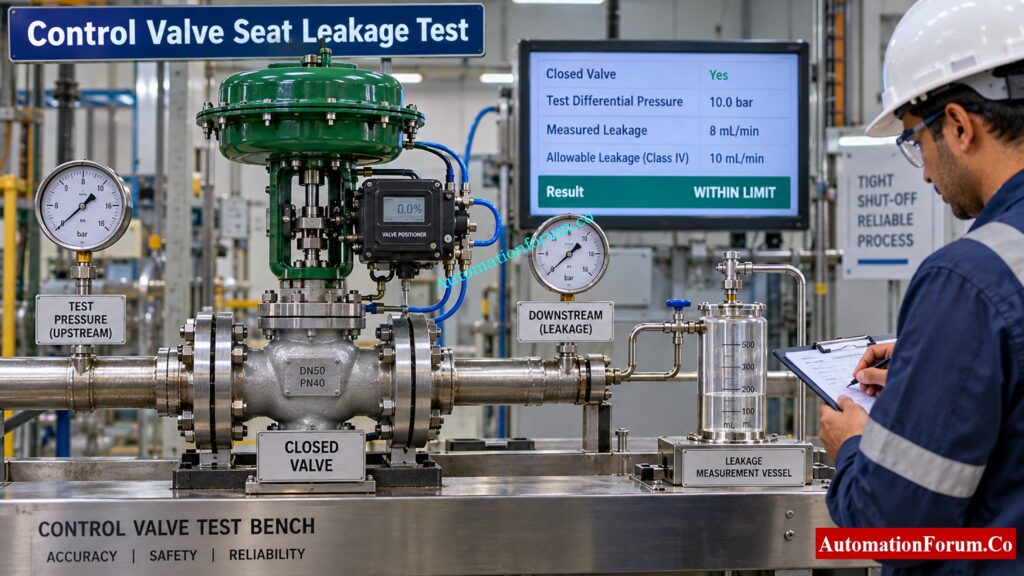
What Is Control Valve Seat Leakage?
Control valve leakage is the amount of process or test fluid that passes through a valve when the valve is in the closed position.
During a control valve seat leakage test, the actuator moves the valve to its closed position. A specified differential pressure is then applied across the valve. The leakage passing through the closed seat is measured and compared with the allowable leakage for the specified leakage class.
Why Does a Closed Control Valve Leak?
Some leakage can be acceptable for a particular valve. A valve with a lower leakage class requirement may permit more leakage than a valve designed for very tight shutoff. Therefore, simply observing a small amount of flow does not determine whether the valve has failed.
The correct approach is to compare the measured control valve seat leakage with the allowable value for the specified class and test conditions.
Refer the below link for the Field Troubleshooting Guide: Control Valve Not Responding in Process Area
Why Is Control Valve Leakage Important?
Control Valve Leakage and Process Isolation
Excessive control valve leakage can create problems in process operation and equipment performance.
For critical process services, unwanted flow through a closed valve can affect process isolation, shutdown performance and process stability. It can also cause energy losses, unwanted heating or cooling, product contamination and unnecessary equipment loading.
Effect of Excessive Seat Leakage on Process Performance
Leakage becomes particularly important when a valve is expected to provide tight shutoff during a shutdown or isolation condition. Excessive seat leakage can also increase maintenance requirements because repeated seat damage or poor shutoff may indicate problems with the valve trim, actuator, positioner, installation or operating conditions.
For this reason, control valve leakage testing is an important part of valve inspection and acceptance.
Master the right valve calibration steps before commissioning begins: Control Valve Calibration Procedures
What Is a Control Valve Leakage Class?
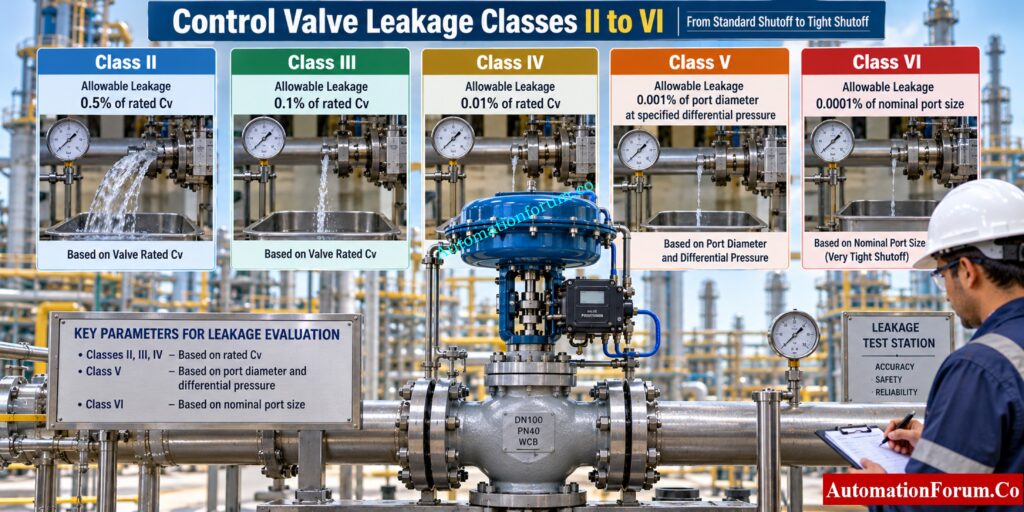
A control valve leakage class defines the allowable seat leakage associated with a particular test classification. The calculator supports five classes.
Control Valve Leakage Classes II to VI Comparison
| Leakage Class | Calculator Leakage Basis | Engineering Interpretation |
| Class II | 0.5 percent of rated Cv | Higher allowable leakage |
| Class III | 0.1 percent of rated Cv | Lower leakage than Class II |
| Class IV | 0.01 percent of rated Cv | Tight metal seat leakage |
| Class V | 5 × 10⁻⁴ ml/min/in/psi | Critical metal seat leakage |
| Class VI | Nominal port leakage limit | Very tight shutoff requirement |
The calculator uses these specific bases for its screening calculations. Class VI is represented through a nominal port size leakage table rather than treating the valve as having literally zero leakage.
Find out why your valve becomes unstable in AUTO: Why Control Valve Hunts in AUTO but Runs Smoothly in MANUAL
How Does the Control Valve Leakage Calculator Work?
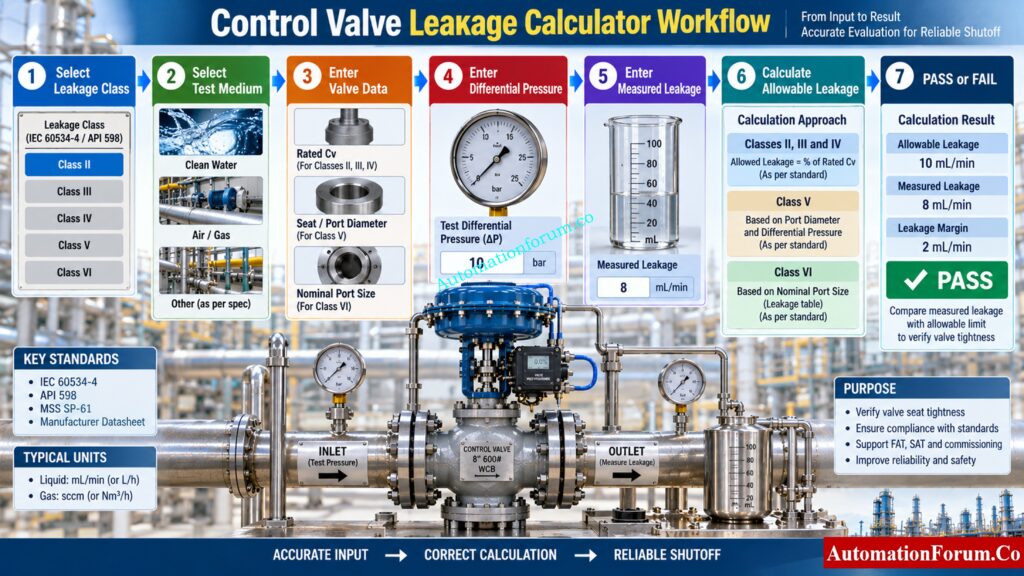
The calculation process is straightforward.
First, select the required leakage class and test medium. Enter the valve rated Cv when working with Classes II, III or IV. For Classes V and VI, enter the applicable seat or port diameter.
Next, enter the test differential pressure and measured leakage. The calculator then determines the maximum allowable leakage using its programmed calculation basis.
The result displays the allowable seat leakage, leakage class, test differential pressure, measured leakage and leakage margin. It also provides a PASS or FAIL evaluation.
A PASS result means the entered measured leakage is within the calculated allowable limit. A FAIL result means the measured leakage exceeds that limit.
Inputs Required for Control Valve Leakage Calculation
Leakage Class
The selected leakage class determines which calculation method is used.
Classes II, III and IV use a percentage of the valve rated Cv. Class V uses port diameter and differential pressure. Class VI uses the nominal port size table included in the calculator.
Selecting the correct class is therefore essential. The calculator cannot compensate for an incorrect project requirement.
Test Medium
The calculator provides Water and Air/Nitrogen as test medium options.
For Classes II, III and IV, the displayed liquid flow conversion assumes liquid specific gravity equal to 1. This is an important limitation when interpreting the calculated value.
The actual approved test procedure should always define the required test medium and conditions.
Valve Rated Capacity Cv
Cv is required by this calculator for Classes II, III and IV.
The rated Cv represents the valve flow capacity used as the basis for determining the allowable leakage coefficient. Entering an incorrect Cv can significantly change the calculated leakage limit.
Calculate required valve travel with greater engineering confidence: Control Valve Stroke Length Calculator
Seat or Port Diameter
Port diameter is used for Class V and Class VI evaluation.
For Class V, the calculator uses the entered diameter directly in its leakage relationship. For Class VI, the nominal port size determines the corresponding leakage value from the calculator table.
Test Differential Pressure
Differential pressure is the pressure difference applied across the closed valve during the leakage test.
It is important because the calculator uses differential pressure directly in its Class V calculation and in the approximate liquid flow conversion for Classes II, III and IV.
Measured Leakage
Measured leakage is the actual leakage observed during the test.
The value is compared with the maximum allowable leakage calculated for the selected conditions. Accurate measurement is therefore essential for a meaningful PASS or FAIL result.
Discover why a closed valve still allows unwanted flow: Control Valve Passing Even When Fully Closed: Causes, Symptoms, Troubleshooting and Solutions
Control Valve Leakage Calculation Formula
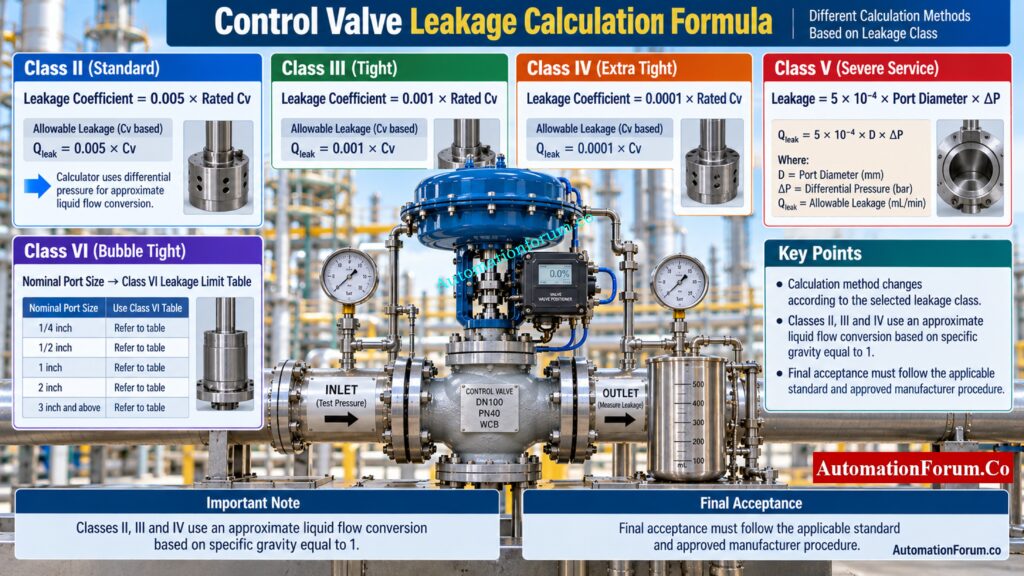
The control valve leakage calculation depends on the leakage class specified for the valve. The calculator uses rated Cv for Classes II, III and IV, while Class V uses port diameter and differential pressure, and Class VI uses the nominal port size leakage table.
This section is particularly useful for engineers searching for control valve leakage formula, control valve leakage calculation, and allowable control valve leakage formula.
Size valve actuators correctly before final equipment selection: Valve Actuator Sizing Calculator – Complete Engineering Guide for Torque, Safety Factor & Gear Ratio Selection
Class II Leakage Calculation
For Class II, the calculator uses 0.005 of the valve rated Cv as the leakage coefficient. This means the rated Cv entered for the valve is used to determine the leakage capacity before converting it into an approximate liquid flow.
The calculator then uses the entered differential pressure for the liquid flow conversion, with the calculation based on water having a specific gravity of 1.
Class III Leakage Calculation
For Class III, the calculator uses 0.001 of rated Cv as the leakage coefficient. The lower coefficient provides a lower calculated leakage value compared with Class II for the same rated Cv and test conditions.
The resulting leakage Cv is then converted into an approximate liquid leakage flow using the entered differential pressure.
Class IV Leakage Calculation
For Class IV, the calculator uses 0.0001 of rated Cv as the leakage coefficient. This calculation is commonly useful when evaluating a control valve specified for tighter metal seat leakage.
After determining the leakage Cv, the calculator estimates the corresponding liquid flow at the entered differential pressure, assuming a liquid specific gravity of 1.
Calculate instrument range and avoid incorrect calibration decisions: Instrument Range Calculator | Calculate Span, Rangeability, Turndown Ratio & Calibration Range
Class V Leakage Calculation
Class V uses a different calculation approach from Classes II, III and IV. The calculator determines the leakage limit using the entered port diameter and test differential pressure.
The calculation used by the calculator is:
Leakage = 5 × 10⁻⁴ × port diameter × differential pressure
Therefore, entering the correct port diameter and test differential pressure is important when using the Class V calculation.
Class VI Leakage Calculation
Class VI does not use the same Cv based calculation used for Classes II, III and IV. The calculator uses the selected nominal port size and its corresponding Class VI leakage limit table.
This approach is intended for very tight shutoff evaluation. The exact applicable standard table and manufacturer’s test procedure should always be verified before using the result for formal acceptance.
Choose the right control valve for your process application: Globe vs Ball vs Butterfly Control Valves Complete Comparison Guide for Flow Control Selection and Applications in Process Industries
How to Calculate Allowable Control Valve Leakage
The allowable control valve leakage is determined by first identifying the specified leakage class and then applying the calculation method associated with that class.
The engineer should enter the correct valve information and test conditions into the calculator. The resulting allowable leakage can then be compared with the leakage measured during the valve test.
Allowable Leakage for Classes II, III and IV
For Classes II, III and IV, the calculator starts with the valve rated Cv and applies the corresponding leakage coefficient.
Class II uses 0.005, Class III uses 0.001, and Class IV uses 0.0001 of rated Cv. The calculator then estimates the liquid leakage flow using the entered differential pressure and a water specific gravity of 1.
Allowable Leakage for Class V
For Class V, the allowable leakage is based on port diameter and test differential pressure rather than rated Cv.
The engineer should therefore confirm the actual valve port diameter and the differential pressure specified for the leakage test before interpreting the calculated result.
Understand why actuator bench set matters for valve performance: Why is Control Valve Actuator Bench Set Important ?
Allowable Leakage for Class VI
For Class VI, the calculator determines the allowable leakage from the selected nominal port size and its programmed leakage limit.
Because Class VI testing involves very tight shutoff requirements, the calculated value should be checked against the applicable current standard and the manufacturer’s approved leakage test procedure before certification.
Effect of Differential Pressure on Leakage Calculation
Test differential pressure is an important input because it represents the pressure difference applied across the closed valve during the leakage test.
In this calculator, differential pressure is used directly in the Class V calculation and also affects the approximate liquid flow conversion for Classes II, III and IV. Therefore, using a test pressure that does not match the approved procedure can lead to an incorrect engineering comparison.
Refer the below link for the Control Valve Noise Prediction Calculator – IEC 60534 Based Engineering Tool
Control Valve Leakage Test Example
Class IV Control Valve Leakage Calculation Example
Consider a control valve with a rated Cv of 250. Select Class IV and enter a test differential pressure of 50 psi.
The Class IV coefficient used by the calculator is 0.0001.
The leakage Cv becomes:
0.0001 × 250 = 0.025
Using the calculator’s liquid flow conversion at 50 psi gives an approximate maximum allowable leakage of 669.17 ml/min.
If the measured leakage is 0.08 ml/min, the calculator identifies the result as PASS because the measured value is below the calculated allowable limit. The calculated margin is approximately 99.99 percent.
This example demonstrates how the calculator can quickly screen a test result. It should not, however, be treated as a substitute for the approved valve acceptance procedure.
Stop PID problems from driving your control valve unstable: Control Valve Hunting Due to PID Controller: Causes, Effects, Root Analysis and Complete Troubleshooting Guide for Industrial Process Control Systems
Control Valve Leakage Testing During FAT and SAT
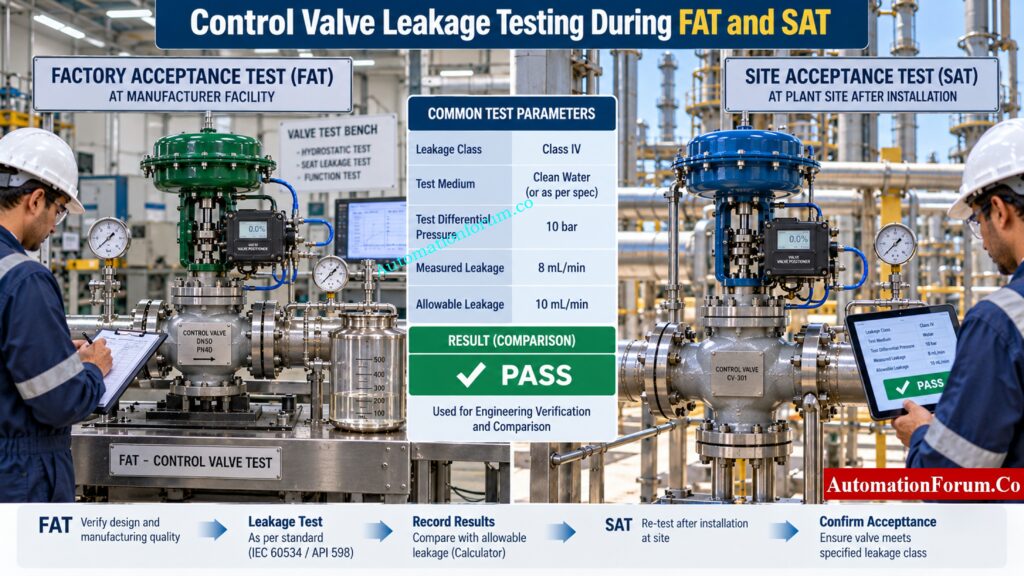
Control valve seat leakage testing may form part of Factory Acceptance Testing and Site Acceptance Testing depending on the project requirements.
Before performing the test, the engineer should verify the specified leakage class, applicable standard, valve size, port size, test medium, test pressure and test duration. The manufacturer’s approved procedure, project specification and inspection and test plan should also be reviewed.
During FAT, the test normally provides evidence that the supplied valve meets the specified requirements before shipment. During SAT, the engineer may need to verify the valve condition after installation and confirm that the site test follows the approved requirements.
The calculator can help engineers perform a quick engineering comparison between measured leakage and an allowable value. Final acceptance remains governed by the applicable project documentation and certified manufacturer procedure.
Understand how partial stroking protects critical shutdown valve performance: What is Partial Stroke Test (PST)? A Complete Guide for Shutdown and Control Valves
Class V and Class VI Control Valve Leakage
Class V and Class VI require particular attention because their leakage evaluation differs from the Cv based approach used for Classes II, III and IV.
The calculator treats Class V using port diameter and differential pressure. This makes accurate port information and test pressure important.
Class VI uses nominal port size and a standardized leakage limit table. It is commonly associated with very tight shutoff and is often relevant to soft seat control valve applications.
The calculator includes nominal port selections and a Class VI leakage measurement field expressed in bubbles per minute. The exact current standard table and manufacturer’s acceptance procedure should be verified before certification.
How to Interpret Control Valve Leakage PASS or FAIL Results
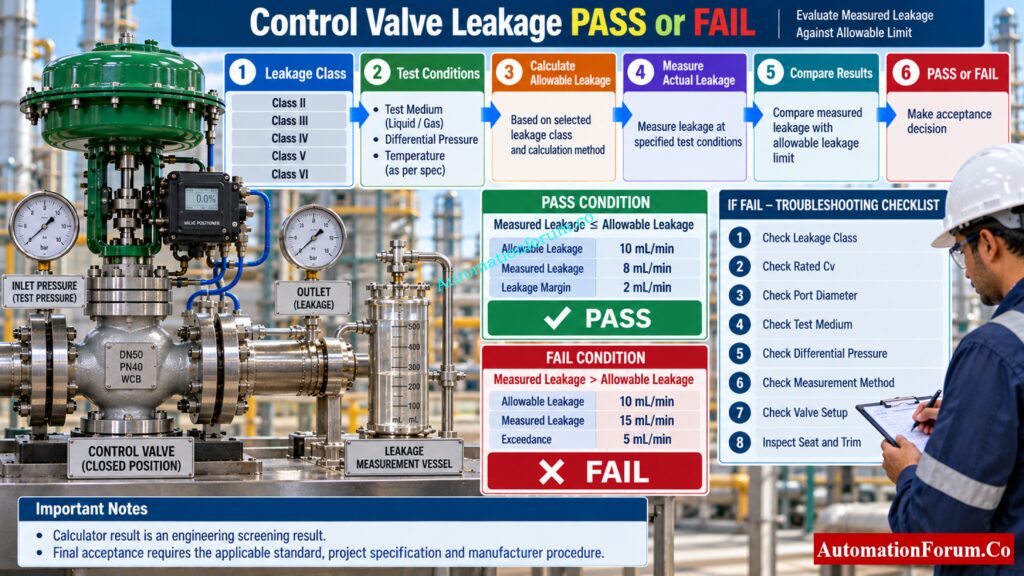
A PASS result means the entered measured leakage is within the allowable limit calculated by the calculator.
A FAIL result means the measured leakage is greater than the calculated allowable value.
However, a FAIL result should not immediately be interpreted as a defective valve.First ensure that correct leakage class, Cv, port diameter, differential pressure and test medium have been entered.
The engineer shall also examine the test setup, test procedure and test stability. Excessive leakage can also be caused by seat damage , foreign material , actuator difficulties and inappropriate valve setting.
Verify actual valve movement before trusting control performance: Control Valve Stroke Checking
Common Control Valve Leakage Testing Mistakes
One of the most common mistakes is using the wrong leakage class. The engineer should confirm the class from the valve datasheet, purchase specification and approved test procedure.
Incorrect Cv or port diameter can also produce an incorrect allowable value. The test differential pressure and medium must match the approved procedure.
Another common mistake is comparing the measured result with an incorrect standard or ignoring the manufacturer’s acceptance criteria.
Leakage measurement should be taken only after the test conditions are properly established and stabilized. Most importantly, a calculator result should not be treated as a certified test record.
Learn the correct methods for measuring valve seat leakage: Control Valve Leakage Testing, Types, and Calculation Standards
Control Valve Leakage Calculator Limitations
The Control Valve Leakage Calculator is an engineering screening tool. It is designed to help engineers understand allowable leakage and perform a quick comparison between calculated limits and measured values.
It does not replace ANSI FCI 70.2, IEC 60534, the applicable current standard edition, project specifications or the manufacturer’s certified leakage tables.
Final FAT, SAT, inspection, certification and contractual acceptance decisions must use the specified test medium, pressure, port size, rated capacity, leakage class and approved manufacturer procedure.
The calculator itself provides this qualification and specifically advises engineers to verify the exact standard and manufacturer’s acceptance requirements before certification.
Absolutely. I would make the FAQ answers short, natural, engineer focused, and exactly around two lines each, while keeping the SEO terms naturally included.
Restore stuck valve movement with practical maintenance methods: How to do maintenance on struck control valve?
Frequently Asked Questions About Control Valve Leakage
What is a control valve leakage calculator?
A control valve leakage calculator determines the allowable seat leakage for a selected leakage class and test condition. It also compares the measured leakage with the allowable limit to show PASS or FAIL.
How is control valve seat leakage calculated?
The computation relies on the leakage class selected. Classes II through IV use rated Cv for the calculator, Class V uses port diameter and differential pressure and Class VI uses nominal port size.
What is Class IV control valve leakage?
Class IV uses 0.0001 of the valve rated Cv as the leakage coefficient in this calculator. The result is converted into an approximate liquid leakage flow using the entered differential pressure.
What is the difference between Class V and Class VI leakage?
Class V leakage is calculated using port diameter and test differential pressure. Class VI uses nominal port size and its corresponding leakage limit for very tight shutoff service.
Why is Cv required for some leakage classes?
The calculator uses rated Cv as the basis for Classes II, III and IV leakage calculations. The applicable leakage coefficient is multiplied by Cv to determine the leakage capacity.
Choose the correct flow characteristic for stable valve control: Control Valve Flow Characteristic Calculator: Linear, Equal Percentage, and Quick Opening Guide
Does a PASS result certify the control valve?
No, a PASS result only shows that the entered leakage is within the calculator’s allowable limit. Final valve acceptance must follow the applicable standard, project specification and manufacturer procedure.
What should be checked before accepting a control valve leakage test?
Check the leakage class, valve data, port size, test medium, differential pressure and measured leakage. Verify the approved test technique and project acceptance criteria.
What is the formula for calculating control valve leakage?
The formula depends on the leakage class selected for the test. Classes II to IV use a percentage of rated Cv, while Class V uses port diameter and differential pressure.
How do you calculate control valve size?
Control valve sizing normally requires process flow, pressure conditions, fluid properties and the required flow coefficient Cv. The leakage calculator itself does not perform control valve sizing.
How do you calculate allowable control valve leakage?
Allowable leakage is determined from the specified leakage class and the applicable valve test conditions. This calculator uses different calculation methods for Classes II to VI.
What is a Class IV valve leakage rate?
In this calculator, Class IV uses a leakage coefficient of 0.0001 of rated Cv. The calculator then estimates the corresponding liquid leakage at the entered differential pressure.
What is the maximum leakage rate for a control valve?
There is no single maximum leakage value for every control valve. The allowable value depends on the leakage class, valve characteristics, port size and specified test conditions.
How much valve leakage is acceptable?
The acceptable leakage depends on the specified leakage class and approved testing requirements. A measured value is acceptable when it remains within the applicable allowable leakage limit.
Can this calculator be used for control valve FAT?
Yes, it can be useful as an engineering screening tool during FAT to compare measured leakage with an estimated allowable value. Final FAT acceptance should always follow the approved project and manufacturer test procedure.
Can this calculator be used during SAT?
Yes, the calculator can help engineers review measured seat leakage during SAT. However, site acceptance must be based on the specified standard, project requirements and approved testing procedure.
What causes excessive control valve seat leakage?
Common causes are damaged seats, foreign material, wrong actuator adjustment, inappropriate valve closure and trim damage. Wrong test settings or measuring methods can also lead to false results.
Is Class VI control valve leakage zero?
No, Class VI should not be interpreted as literally zero leakage. It represents a very tight shutoff requirement with leakage limits based on the applicable nominal port size and test arrangement.
What is the difference between metal seat and soft seat leakage?
Metal seat valves can permit a small amount of seat leakage depending on their design and specified class. Soft seat valves can provide very tight shutoff, but the actual requirement still depends on the specified test standard and valve design.
Why does differential pressure matter during leakage testing?
Differential pressure establishes the pressure driving force across the closed valve during the test. The calculator uses differential pressure directly for some leakage calculations and for its approximate liquid flow conversion.
Can measured leakage be higher than the calculator result?
Yes. If the measured leakage exceeds the permissible computed limit, then the calculator displays an FAIL result. Before you conclude that the valve is defective, check the test setup, the data entered and the appropriate acceptance criteria.
What should I do if a control valve fails the leakage test?
First verify the leakage class, test pressure, test medium, valve data and measurement method. If the test conditions are correct, inspect the seat, plug, actuator and valve internals for possible causes of excessive leakage.
Calculate pneumatic air demand before sizing your instrument system: Air Consumption Calculator for Pneumatic Control Valves, Actuators and Instrument Air System Sizing
Conclusion: Control Valve Leakage Calculator
A control valve leakage test is an important part of valve inspection and acceptance, particularly when reliable shutoff is required for critical process service. The allowable leakage is not the same for every valve, so the specified leakage class and test conditions must always be confirmed before evaluating the result.
The Control Valve Leakage Calculator provides a convenient way to estimate allowable seat leakage for Classes II, III, IV, V and VI and compare the calculated limit with measured leakage. It can be useful for instrumentation engineers, commissioning engineers, maintenance teams and QA QC engineers during engineering checks, FAT, SAT and troubleshooting.
Before accepting a valve, always verify the leakage class, rated Cv or port diameter, test medium, differential pressure and measured leakage against the approved project specification and manufacturer’s procedure. The calculator is an engineering screening tool and should not replace the applicable standard or certified valve test procedure.
When the test conditions and input data are correct, the calculator can make control valve leakage evaluation faster and easier while giving engineers a clear starting point for investigating excessive seat leakage.
Refer the below link for the What are the main causes of control valve hunting?
