
- Why Use a Control Valve Flow Characteristic Calculator?
- What Is a Control Valve Flow Characteristic?
- How the Control Valve Flow Characteristic Calculator Works
- Understanding Linear Valve Characteristics
- Understanding Equal Percentage Valve Characteristics
- What Is an Equal Percentage Characteristic?
- Equal Percentage Characteristic Formula
- How Equal Percentage Flow Changes With Valve Opening
- Why Equal Percentage Trims Are Widely Used
- Advantages of Equal Percentage Control Valves
- Limitations of Equal Percentage Control Valves
- Typical Industrial Applications of Equal Percentage Valves
- Understanding Quick Opening Valve Characteristics
- Control Valve Flow Characteristic Formulas Explained
- Control Valve Characteristic Comparison Table
- Sample Calculation Using the Calculator
- Installed Characteristic vs Inherent Characteristic
- Engineering Factors Affecting Actual Valve Performance
- Industrial Standards Related to Control Valve Characteristics
- Common Mistakes Engineers Make When Selecting Valve Characteristics
- Benefits of Using a Control Valve Flow Characteristic Calculator
- Valve Characteristic and Service Fit
- Flow Behavior at Different Openings
- Frequently Asked Questions About Control Valve Characteristics
- What is a Control Valve Characteristic?
- Which Valve Characteristic is Best?
- Why is Equal Percentage Commonly Used?
- What is Valve Rangeability?
- How Does Valve Opening Affect Flow?
- What is Valve Authority?
- What is the Difference Between Inherent and Installed Characteristics?
- Can Valve Characteristics Affect Loop Stability?
- Why Do Control Valves Hunt?
- How Accurate are Valve Flow Calculators?
- What are the Characteristics of a Control Valve?
- What are the 4 Types of Control Valves?
- What is a Characterized Control Valve?
- What are the Different Valve Characteristics?
- How to Select Control Valve Characteristics?
- What are the 7 Types of Valves?
- What is a 3-Way Control Valve?
- What are the Three Types of Flow Characteristics?
- Why is Valve Characteristic Selection Important?
- Which Valve Characteristic is Best for Temperature Control?
- Which Valve Characteristic is Best for Flow Control?
- What is a Quick Opening Valve Characteristic?
- What is a Linear Valve Characteristic?
- What is an Equal Percentage Valve Characteristic?
- Can a Control Valve Characteristic be Changed?
- Key Takeaways: Control Valve Flow Characteristic Calculator
Control Valve Flow Characteristic Calculator
Linear • Equal Percentage • Quick Opening
Calculator
Results
Flow Rate
Flow %
Factor
Type
Status
Applications
| Characteristic | Application |
|---|---|
| Linear | Level & Flow Control |
| Equal Percentage | Pressure & Temperature |
| Quick Opening | On-Off & Safety Service |
Formulas
Linear: Q = Qmax × x
Equal Percentage: Q = Qmax × ((e^(4x)-1)/(e⁴-1))
Quick Opening: Q = Qmax × √x
Standards
- IEC 60534
- ISA 75
- ANSI/ISA Standards
- ISO Process Control Guidelines
Engineering Notes
- Installed and inherent characteristics differ.
- Pressure drop affects actual flow.
- Rangeability impacts low-flow control.
- Trim design affects valve performance.
Why Use a Control Valve Flow Characteristic Calculator?
A Control Valve Flow Characteristic Calculator is one of the most useful learning and troubleshooting tools in instrumentation engineering because it connects valve opening to actual flow behavior in a simple way. In process control, the relationship between stem position and flow is not just a theory. It affects loop stability, controller tuning, valve sizing, rangeability, and overall plant performance. The uploaded calculator includes the three most common characteristics, Linear, Equal Percentage, and Quick Opening, and it also displays flow rate, flow percentage, factor, type, and status, making it a practical engineering aid for both students and working professionals.
When the wrong valve characteristic is selected, the loop may become unstable, the valve may hunt, or the process may respond too aggressively at one part of travel and too slowly at another. That is why understanding control valve characteristics is essential for flow control, pressure control, temperature control, and utility service applications.
This article explains how the calculator works, how each valve characteristic behaves, how to interpret the results, and how to relate the output to real plant conditions. It also connects the calculator to IEC 60534 control valve guidance, ISA 75 valve standards, and practical control valve sizing considerations.
Master Accurate Cv Calculations Before Costly Design Mistakes: Control Valve Sizing Calculator: Complete ISA S75.01 Cv Calculation Guide for Instrumentation Engineers
What Is a Control Valve Flow Characteristic?
A control valve flow characteristic describes how flow changes as the valve opening changes. In simple terms, it tells you how much flow you get at 10 percent, 50 percent, or 80 percent valve travel.
Inherent Characteristic vs Installed Characteristic
There are two important views of valve behavior:
Inherent characteristic
This is the valve’s ideal flow behavior under constant pressure drop across the valve.
Installed characteristic
Why Flow Characteristic Selection Matters in Process Control
This is the actual behavior in the plant, where pipe friction, upstream pressure changes, downstream load, and process conditions all influence performance.
Avoid Sizing Errors That Cause Control Problems: Understanding Rangeability vs Turndown Ratio in Control Valve Sizing
How the Control Valve Flow Characteristic Calculator Works
The calculator in the uploaded file lets the user choose a valve characteristic, enter the valve opening percentage, enter maximum flow rate, and choose engineering units such as m³/h, GPM, LPM, or Cv equivalent. It then calculates flow rate, flow percentage, factor, characteristic type, and status. The file also includes sample loading, reset, print support, application guidance, formulas, and standards references.
Control Valve Flow Characteristic Calculator Inputs Explained
| Input | Meaning |
| Valve Characteristic Selection | Chooses Linear, Equal Percentage, or Quick Opening |
| Valve Opening Percentage | Stem travel from 0 to 100 percent |
| Maximum Flow Rate | The full capacity value used for estimation |
| Engineering Units | The display unit for the calculated flow |
Control Valve Flow Characteristic Calculator Outputs
| Output | Meaning |
| Flow Rate | Estimated flow at the chosen opening |
| Flow Percentage | Flow as a percentage of maximum |
| Flow Factor | Fraction of maximum flow |
| Characteristic Type | The selected characteristic |
| Flow Status | A simple interpretation such as low, moderate, or maximum |
This makes the tool useful not only for quick control valve flow calculation, but also for training and preliminary engineering checks.
Convert Gas Flow Parameters Faster With Proven Methods: Cv to Cg for Gases Conversion Calculator: Control Valve Sizing
Understanding Linear Valve Characteristics
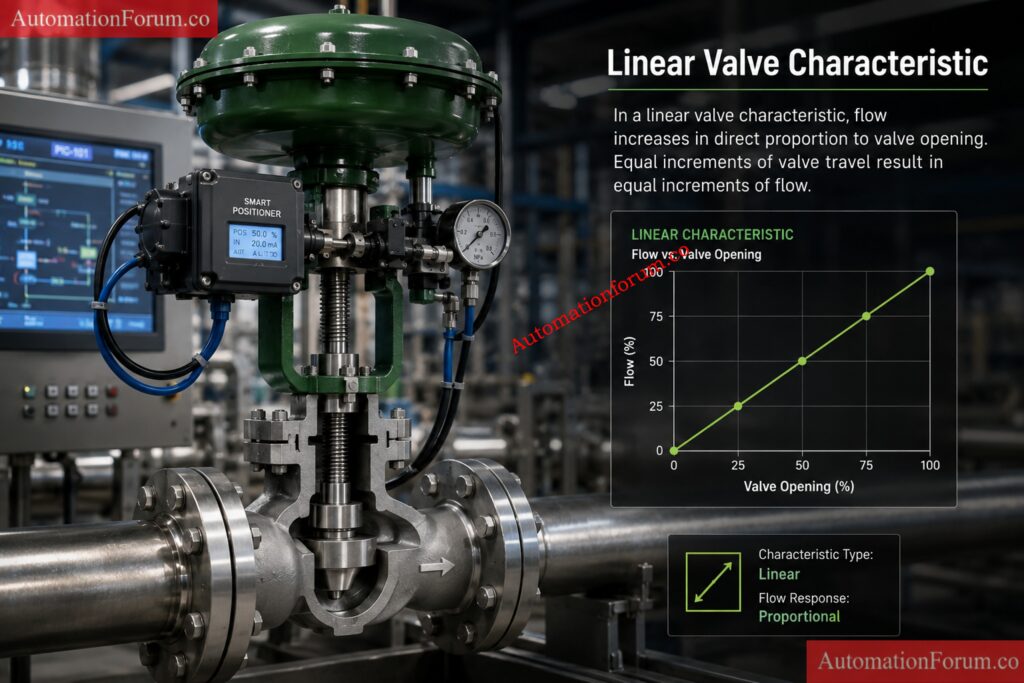
What Is a Linear Characteristic?
A linear valve characteristic means flow increases in direct proportion to valve opening. If the valve is 50 percent open , the flow will be about 50 percent of maximum , assuming a steady pressure decrease .
Linear Characteristic Formula
Q = Qmax × x
Where:
Q = actual flow
Qmax = maximum flow
x = valve opening fraction, for example 0.65 for 65 percent
Linear Flow Behavior
Linear valves have a uniform flow response over the whole trip range. Each percent of opening adds about the same amount of flow.
Advantages of Linear Control Valves
They are easy to understand, easy to calculate, and useful when process demand changes fairly uniformly.
Limitations of Linear Control Valves
They may not give the best controllability in systems where pressure drop varies widely.
Typical Industrial Applications of Linear Valves
Linear characteristics are often used in:
| Application | Why It Works |
| Flow control loops | Direct relationship between travel and flow |
| Level control systems | Stable proportional response |
| Water treatment plants | Predictable service behavior |
| Utility services | Simple operating behavior |
Practical Example
If a linear valve is rated for 250 m³/h and opened to 65 percent, the flow estimate is about 162.5 m³/h. That is easy to interpret, which is why many engineers use linear behavior as a teaching baseline.
Understanding Equal Percentage Valve Characteristics
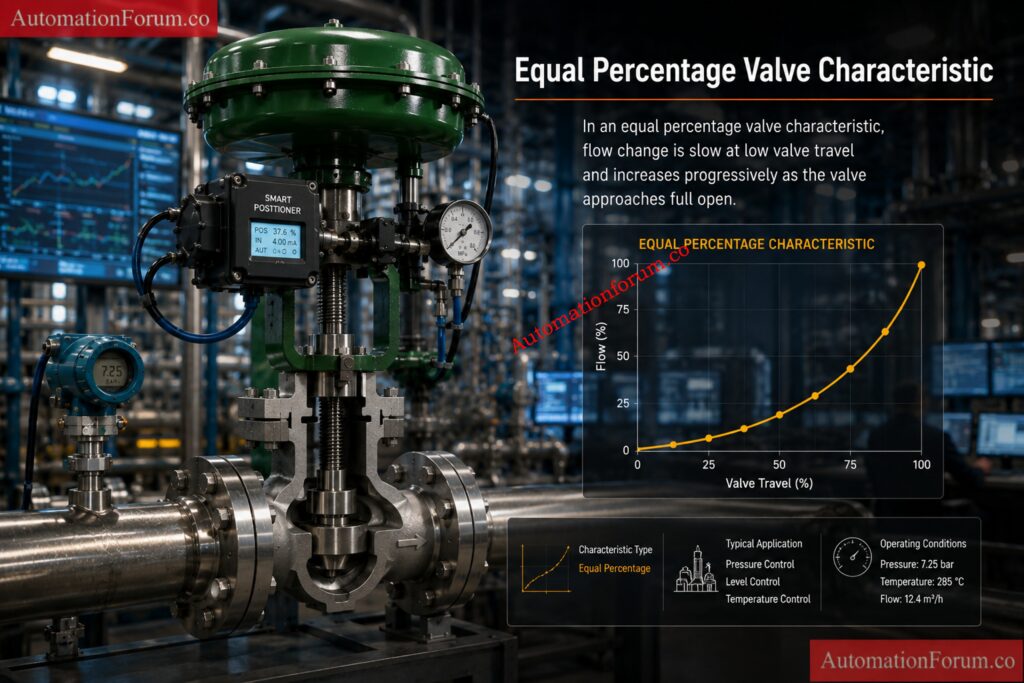
What Is an Equal Percentage Characteristic?
An equal percentage valve characteristic means each equal increment of stem travel produces an equal percentage increase in flow. The flow increase is small at low openings and much larger at higher openings.
Equal Percentage Characteristic Formula
A common simplified form used in calculators is:
Q = Qmax × ((e^(4x) - 1) / (e^4 - 1))
This is a practical approximation for learning and estimation.
How Equal Percentage Flow Changes With Valve Opening
At low openings, the valve is very gentle. At mid travel, the flow begins to rise more noticeably. At higher openings, the valve becomes much more responsive.
Why Equal Percentage Trims Are Widely Used
Equal percentage trim is often preferred because process conditions in real plants are not constant. Pressure drop changes, load changes, and supply variation are common. Equal percentage trims ensure practical control over a large working range.
Advantages of Equal Percentage Control Valves
They offer excellent rangeability, better low flow control, and strong real plant adaptability.
Limitations of Equal Percentage Control Valves
They are not always ideal for simple on off duty or for systems that need a direct one to one relationship between movement and flow.
Typical Industrial Applications of Equal Percentage Valves
| Application | Why It Works |
| Temperature control | Smooth response across changing loads |
| Pressure control | Better handling of varying pressure drop |
| Steam control | Stable behavior under wide operating conditions |
| Heat exchangers | Useful with changing thermal demand |
| Process plants | Strong control over variable service |
Practical Example
A 65 percent open equal percentage valve may still deliver less flow than a linear valve at the same opening, but its real value appears when the system pressure drop changes. That is why equal percentage is often the preferred choice in temperature and pressure loops.
Challenge Your Skills With Advanced Hunting Diagnostics: Advanced Control Valve Hunting Troubleshooting Quiz – Test Your Control Loop Expertise
Understanding Quick Opening Valve Characteristics
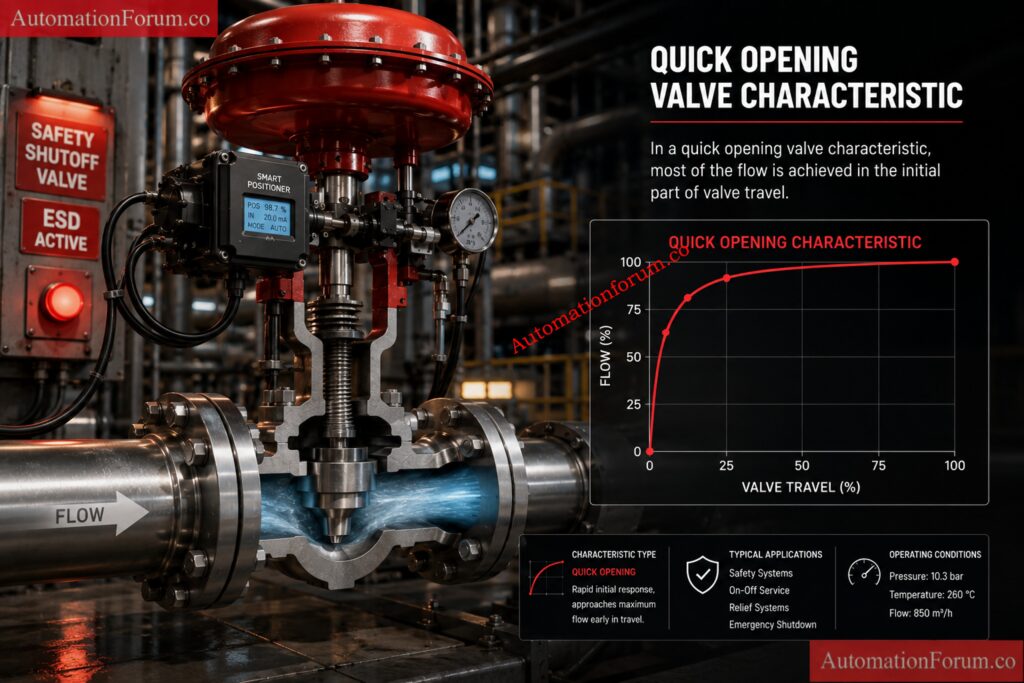
What Is a Quick Opening Characteristic?
A quick opening valve characteristic gives a large flow increase at the first part of valve travel. After that, additional opening creates a smaller relative change in flow.
Quick Opening Characteristic Formula
Quick opening valves are aggressive near the closed position. They are designed to deliver high flow quickly.
Advantages of Quick Opening Valves
They provide fast response and are excellent for isolation or emergency use.
Limitations of Quick Opening Valves
They are usually too aggressive for fine control. Small travel changes can create large process changes.
Typical Industrial Applications of Quick Opening Valves
| Application | Why It Works |
| Emergency shutdown systems | Rapid opening when needed |
| Safety functions | Fast delivery of flow |
| On off control | Clear open or closed service |
| Relief services | Immediate flow response |
Practical Example
A quick opening valve is not usually the first choice for tight process control. It is more suitable when the goal is to move a large amount of flow quickly rather than regulate it precisely.
Positioner Faults Secretly Destroying Control Valve Performance: Control Valve Hunting due to Valve Positioner: Troubleshooting
Control Valve Flow Characteristic Formulas Explained

The calculator uses simple engineering formulas to estimate flow behavior.
Linear
Q = Qmax × x
If maximum flow is 250 m³/h and opening is 65 percent:
Q = 250 × 0.65 = 162.5 m³/h
Equal Percentage
Q = Qmax × ((e^(4x) - 1) / (e^4 - 1))
Using the same 65 percent opening:
x = 0.65
This gives a lower flow than linear at the same travel in the simplified model, which matches the gentler low travel behavior of equal percentage trim.
Quick Opening
Q = Qmax × √x
At 65 percent opening:
Q = 250 × √0.65 ≈ 201.56 m³/h
This shows why quick opening valves respond strongly in the early part of the travel range.
Meaning of Q, Qmax and x
| Symbol | Meaning |
| Q | Actual flow |
| Qmax | Maximum flow |
| x | Opening fraction from 0 to 1 |
Most Overlooked Reasons Behind Persistent Valve Oscillations: What are the main causes of control valve hunting?
Control Valve Characteristic Comparison Table
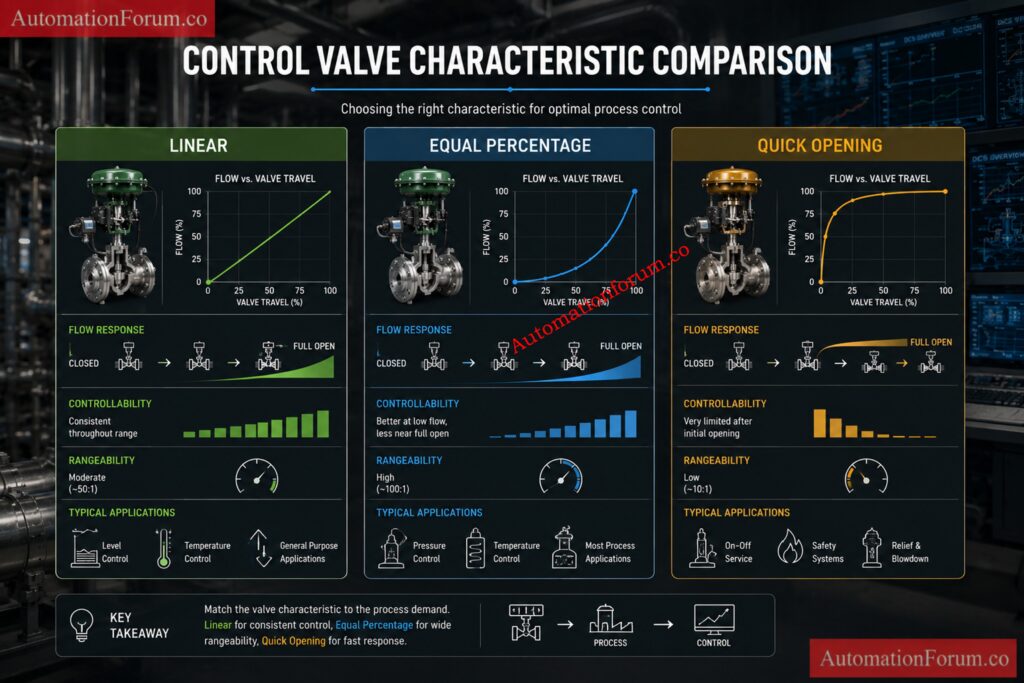
| Characteristic | Flow Response | Controllability | Rangeability | Typical Applications | Advantages | Limitations | Recommended Services |
| Linear | Direct proportional response | Good in stable systems | Moderate | Flow loops, level loops, utilities | Easy to understand | Less flexible with changing pressure drop | Constant or nearly constant load |
| Equal Percentage | Small at low travel, large at high travel | Excellent in real plants | High | Temperature, pressure, steam, heat exchangers | Best all round process adaptability | Less intuitive | Variable pressure drop service |
| Quick Opening | Large early flow increase | Poor for fine control | Low | Shutdown, safety, on off service | Very fast response | Can be too aggressive | Non modulating duties |
Critical Anti-Surge Valve Decisions Every Engineer Must Know: Anti-Surge Control Valve Selection and Sizing – Complete Engineering Guide
Sample Calculation Using the Calculator
The uploaded calculator includes a sample mode with:
Maximum Flow = 250 m³/h
Valve Opening = 65 percent
Characteristic = Equal Percentage.
Results
| Characteristic | Estimated Flow |
| Linear | 162.5 m³/h |
| Equal Percentage | Lower than linear at early travel, then rises strongly at higher travel |
| Quick Opening | Highest early travel response |
Engineering Significance
The comparison shows why valve characteristic selection matters. A linear valve gives a straightforward result. A quick opening valve responds very aggressively. An equal percentage valve gives more refined control in a real process where pressure drop and load are not constant.
EPC Engineers: Avoid These ON-OFF Valve Selection Mistakes: ON OFF Control Valve Type Selection Procedure for EPC Engineering
Installed Characteristic vs Inherent Characteristic
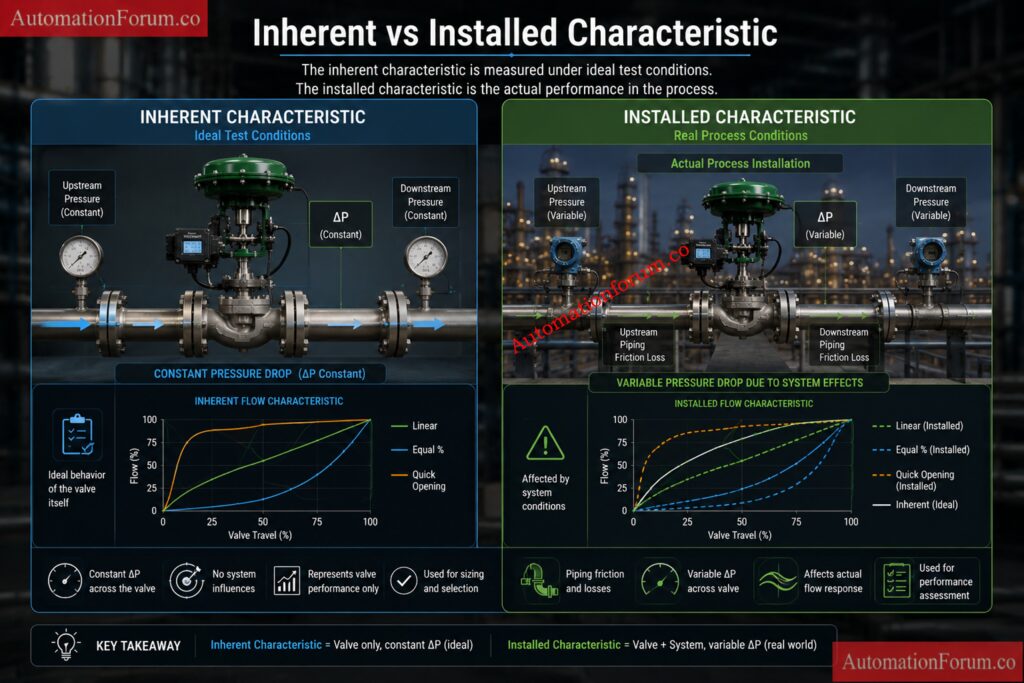
The inherent characteristic is what the valve does on a test bench under constant pressure drop. The installed characteristic is what the plant actually sees.
What Changes Installed Valve Behavior
| Factor | Effect |
| Pipeline effects | Add friction and alter pressure drop |
| Valve authority | Influences how well the valve controls the process |
| Process gain | Changes how sensitive the loop becomes |
| Upstream and downstream pressure variation | Distorts the intended response |
A valve that looks perfect on paper may behave differently in the plant. That is why control valve sizing and system analysis are just as important as characteristic selection.
Prevent Material Selection Errors Before Project Execution: Control Valve Body Material Selection Guide for EPC Design Instrumentation Engineers
Engineering Factors Affecting Actual Valve Performance
Several variables affect real valve behavior.
| Factor | Impact |
| Pressure drop | Changes actual flow capacity |
| Valve sizing | Too large or too small affects control quality |
| Valve authority | Low authority reduces controllability |
| Rangeability | Limits stable control at low flow |
| Cavitation | Damages trim and changes performance |
| Flashing | Reduces usable pressure drop |
| Trim design | Shapes flow behavior and noise |
| Actuator performance | Affects travel speed and force |
| Positioner accuracy | Improves repeatability and response |
In practice, the best valve characteristic still fails if sizing, trim selection, or actuator setup is poor.
Extreme Process Conditions Demand Smarter Valve Selection Strategies: Control Valve Selection and Recommended Practices for Harsh Process Conditions
Industrial Standards Related to Control Valve Characteristics
- IEC 60534: IEC 60534 is a key standard family for industrial process control valves. It helps guide sizing, testing, performance, and terminology.
- ISA 75: ISA 75 is widely used in the control valve industry, especially for sizing and performance guidance.
- ANSI ISA Standards: These standards support consistent engineering practice across vendors and plants.
- ISO Process Control Guidelines: ISO guidance supports broader process instrumentation and quality practice.
Why are these standards important? They allow engineers to compare valves, validate sizing procedures, and choose trim behavior with accepted industry practice.
Stop Guessing Valve Sizes - Use Industry-Proven Tools: Top 10 Control Valve Sizing Software Used in Process Industries
Common Mistakes Engineers Make When Selecting Valve Characteristics
| Mistake | Why It Causes Problems | How to Avoid It |
| Choosing based only on catalog habit | The process may need a different response | Match characteristic to process duty |
| Ignoring valve authority | Poor loop control and instability | Check pressure drop distribution |
| Oversizing the valve | Poor resolution at low travel | Size properly using process data |
| Undersizing the valve | Valve runs near full open too often | Confirm maximum demand |
| Using quick opening for modulation | Causes hunting and overshoot | Reserve it for on off duties |
| Forgetting installed characteristic | Real plant differs from test bench | Review actual system pressure drop |
| Neglecting rangeability | Weak low flow control | Select trim suitable for operating range |
| Ignoring cavitation risk | Trim damage and unstable flow | Evaluate pressure recovery |
| Not considering actuator speed | Sluggish response or overshoot | Match actuator to loop needs |
| Skipping positioner checks | Poor travel accuracy | Calibrate and verify positioner performance |
Test Your Expertise With These Essential Valve MCQs: Top 25 MCQs on Control Valve Types, Selection, and Applications for Project Engineers
Benefits of Using a Control Valve Flow Characteristic Calculator
A control valve flow rate calculator is useful because it gives quick answers that support engineering decisions.
| Benefit | Value |
| Faster engineering decisions | Helps compare characteristic options quickly |
| Better troubleshooting | Shows whether the valve response looks reasonable |
| Training and learning | Helps students understand valve behavior visually |
| Preliminary valve analysis | Useful before detailed sizing |
| Process optimization | Supports better control loop setup |
The calculator is especially valuable when explaining flow control valve performance to junior engineers, operators, or maintenance teams.
Industry Standards Every Control Valve Engineer Should Understand: Codes and Standards for Control Valve Selection in Industrial Applications
Valve Characteristic and Service Fit
| Service | Best Characteristic | Reason |
| Flow control | Linear or equal percentage | Depends on pressure stability |
| Temperature control | Equal percentage | Handles load changes well |
| Pressure control | Equal percentage | Better across varying pressure drop |
| Level control | Linear | Straightforward response |
| On off service | Quick opening | Fast response |
| Steam service | Equal percentage | Strong controllability |
Flow Behavior at Different Openings
| Opening Percent | Linear | Equal Percentage | Quick Opening |
| 10 percent | Low and proportional | Very low | High relative early response |
| 50 percent | Mid range | Moderate | Strong response |
| 65 percent | 65 percent of max | Depends on formula and real trim | Higher than linear in early travel |
| 90 percent | Near maximum | Rapid increase | Near full capacity |
The Engineering Principle That Improves Control Performance: Why Control Valve Characteristics Matter in EPC Instrumentation and Control Engineering
Frequently Asked Questions About Control Valve Characteristics
What is a Control Valve Characteristic?
It is the relationship between valve travel and flow rate.
It indicates flow change as you open the valve.
Which Valve Characteristic is Best?
There is no one optimal choice for all applications.
Equal % is frequently preferable for process control. Linear is good for stable services.
Why is Equal Percentage Commonly Used?
It is effective for the time varying pressure drop and process load.
This offers superior control across a wide working range.
What is Valve Rangeability?
This is the range in which the valve can efficiently control the flow.
Improved rangeability provides improved control at low and high flow.
How Does Valve Opening Affect Flow?
More opening usually means more flow.
The exact change depends on the valve characteristic.
What is Valve Authority?
What is the Difference Between Inherent and Installed Characteristics?
Inherent characteristic is the ideal bench behavior of the valve.
Installed characteristic is the real behavior inside the plant system.
Can Valve Characteristics Affect Loop Stability?
Yes, the wrong characteristic can cause poor tuning, hunting, and oscillation.
Proper selection enhances loop response and quality of control.
Why Do Control Valves Hunt?
Problems with the actuator or positioner may potentially be a factor.
How Accurate are Valve Flow Calculators?
They help in estimation, learning and fast comparison.
Proper engineering approaches and process data should still be applied to final sizing.
What are the Characteristics of a Control Valve?
Common characteristics are linear, equal percentage, and quick opening.
Each one gives a different flow response as the valve opens.
What are the 4 Types of Control Valves?
Common control valve body types include globe, ball, butterfly, and plug valves.
The exact list may vary by industry and manufacturer.
What is a Characterized Control Valve?
It is a valve designed to follow a specific flow-opening curve.
That helps match the valve to the process requirement.
What are the Different Valve Characteristics?
The main characteristics are linear, equal percentage, and quick opening.
Some applications may also use modified or custom characteristics.
How to Select Control Valve Characteristics?
Select based on process behavior, pressure drop variation, and control objective.
Equal percentage is common for variable loads, while linear fits stable systems.
What are the 7 Types of Valves?
Types of valves commonly used are check, gate, globe, ball, butterfly, plug and diaphragm valves.
These are used for isolation, regulation and non return responsibilities.
What is a 3-Way Control Valve?
This is a 3 port valve used for mixing or directing flow.
It is frequently used for temperature control and bypass applications.
What are the Three Types of Flow Characteristics?
There are three basic flow characteristics – linear, equal proportion and rapid opening.
These are the flow features with valve travel.
Why is Valve Characteristic Selection Important?
The right characteristic enhances the control precision and process stability.
A bad choice can lead to hunting, overshoot and poor performance.
Which Valve Characteristic is Best for Temperature Control?
Generally, same proportion is used for temperature control applications.
It performs well under shifting load and pressure circumstances during the process.
Which Valve Characteristic is Best for Flow Control?
Linear valves are commonly employed in situations where the pressure decrease is relatively constant.
They give a direct link between flow and valve travel.
What is a Quick Opening Valve Characteristic?
A fast opening characteristic gives considerable increases in flow at small valve lifts.
It is often utilized for on-off service and emergency applications.
What is a Linear Valve Characteristic?
A linear characteristic means that the flow changes directly according to the valve movement.
The flow increases by roughly the same amount with each additional trip.
What is an Equal Percentage Valve Characteristic?
An equal percentage characteristic gives equal percentage increases in flow for equal increments of trip.
That gives a good controllability over a big operation range.
Can a Control Valve Characteristic be Changed?
Yes you can change the valve trim or characterisation to change the flow behavior.
The procedure depends on valve design and application needs.
Eliminate Power Supply Sizing Errors With Confidence: Instrument Power Supply Load Calculator: 7 Critical Steps for Accurate 24VDC Power Supply Sizing
Key Takeaways: Control Valve Flow Characteristic Calculator
- The Control Valve Flow Characteristic Calculator is a practical tool for understanding how valve travel affects flow.
- Linear valves give direct proportional flow behavior.
- Equal percentage valves give the best all round real plant controllability.
- Quick opening valves are ideal for fast on off or safety service.
- Correct valve characteristic selection improves flow control, stability, and overall process performance.
- For final design, always combine calculator results with proper control valve sizing and standards based engineering review.
Refer th elbow link for the Inspection and Test Plan (ITP) for Control Valves
