
- What is Split Range Control in Process Control Systems
- Why Split Range Control is Important in Process Control Systems
- How Split Range Control Works in DCS and PLC Systems
- Types of Split Range Control Strategies Used in Industrial Automation
- Why Deadband is Important in Split Range Control
- How Engineers Select the Correct Split Point in Split Range Control
- Real Industrial Examples of Split Range Control
- Split Range Control Versus Single Valve Control
- Advantages of Split Range Control in Industrial Automation
- Common Problems in Split Range Control Systems
- Troubleshooting Split Range Control Loops
- When Split Range Control Should NOT Be Used
- Frequently Asked Questions About Split Range Control
- Conclusion:Why Split Range Control Is Widely Used in Industrial Automation
In real industrial plants, one control valve is often not enough.
That is the reality many process engineers discover during commissioning or troubleshooting. A single valve may work perfectly at low load but become unstable at high load. Another loop may oscillate constantly near setpoint because heating and cooling utilities fight each other. Some reactors need both inlet throttling and outlet restriction to maintain pressure. Some temperature loops need steam during startup and cooling water during normal production.
This is where split range control becomes one of the most practical and powerful strategies in industrial automation.
Split range control allows one controller to drive two or more final control elements across different portions of the controller output. Instead of relying on one valve to handle every operating condition, the control loop intelligently sequences multiple valves to improve stability, flexibility, and operating range.
In modern DCS and PLC systems, split range control is widely used in temperature control, reactor pressure control, pH neutralization, flare systems, blending applications, and utility management.
The biggest reason plants use split range control is simple:
Different operating conditions need different control behavior.
And trying to force one valve to do everything usually creates instability, poor controllability, valve wear, and energy waste.
What is Split Range Control in Process Control Systems
How Split Range Control Works in Process Industries
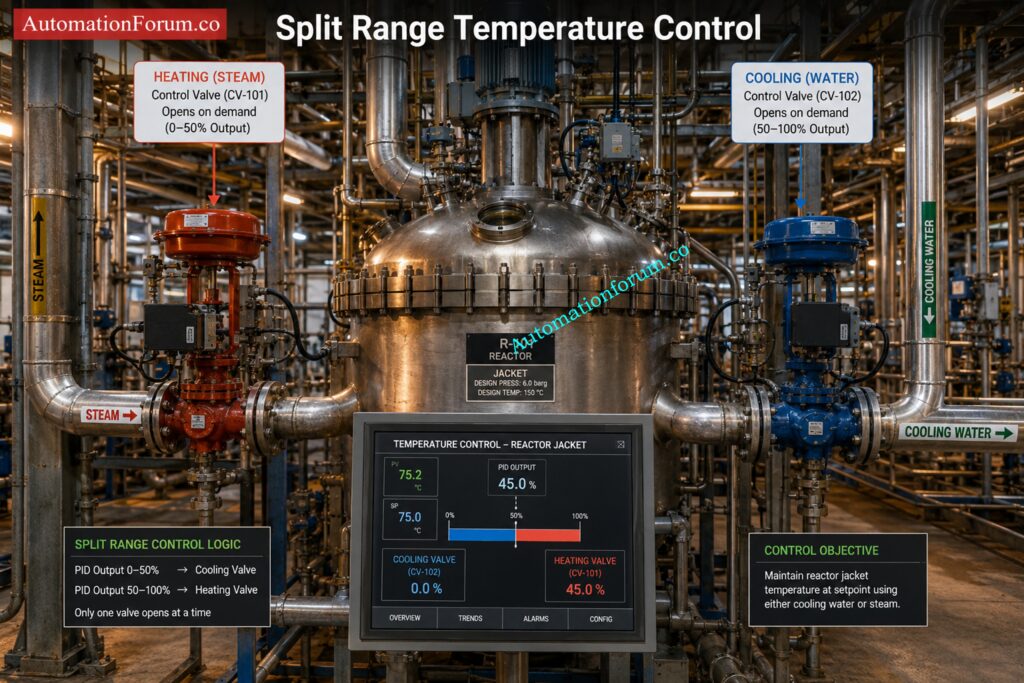
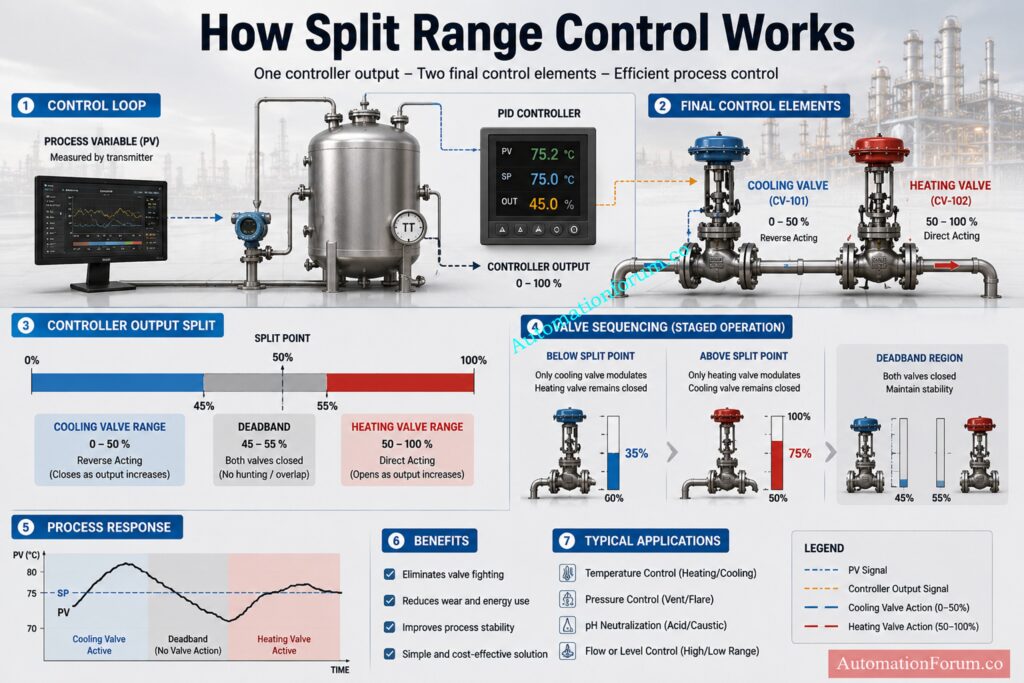
Split range control is a control strategy where a single PID controller output is divided among two or more control valves or final control elements.
Single PID Controller Operating Multiple Control Valves
Instead of one valve operating across the full controller output range from 0 percent to 100 percent, multiple valves operate over assigned sections of that range.
For example:
- Cooling valve operates from 0 percent to 50 percent
- Heating valve operates from 50 percent to 100 percent
When the controller output is low, the cooling valve responds.
When the output increases above the split point, the heating valve begins operating.
This arrangement allows one control loop to manage opposing process requirements such as:
- Heating and cooling
- Acid and caustic dosing
- Inlet and outlet pressure regulation
- Small and large flow valves
- Vent and recycle systems
The concept sounds simple, but successful implementation requires deep understanding of process gain, valve sizing, deadband, and loop dynamics.
Refer the below link for the Understanding Complementary Split Range Control (CSRC)
Why Split Range Control is Important in Process Control Systems
Why One Control Valve Cannot Handle All Operating Conditions
Many industrial processes operate across wide production ranges.
A valve sized for maximum production flow may become uncontrollable at low load conditions. Similarly, a small valve designed for fine low flow control may become fully open during peak demand.
One valve can handle low flow precision control while another handles large process demand.
Importance of Split Range Control in Wide Range Process Applications
This improves:
- Rangeability
- Control accuracy
- Valve life
- Process stability
- Energy efficiency
How Split Range Control Improves Energy Efficiency
Temperature control is the classic split range application.
Consider a reactor jacket.
During startup, the process may require steam heating. Later, the same process may require cooling water because the reaction becomes exothermic.
A single valve cannot provide both heating and cooling.
Split range control allows:
- Cooling valve operation in one output range
- Heating valve operation in another range
The controller automatically selects the required utility based on process conditions.
Process Gain Changes Across Operating Conditions
Many loops behave differently at low load and high load.
A valve that gives smooth control at 20 percent opening may become extremely aggressive at 80 percent opening.
Split range control allows engineers to manage changing process gain more effectively by assigning different valves to different operating regions.
Importance of Split Range Control in Utility Management
Industrial processes often require staged operation.
For example:
- Small valve first
- Large valve later
- Vent valve first
- Flare valve second
- Recycle valve first
- Fresh feed valve later
Split range control provides structured valve sequencing logic while still using one controller.
Improve Process Accuracy Using Smart Valve Sequencing Techniques: Split Range Control in Control Valve Applications
How Split Range Control Works in DCS and PLC Systems
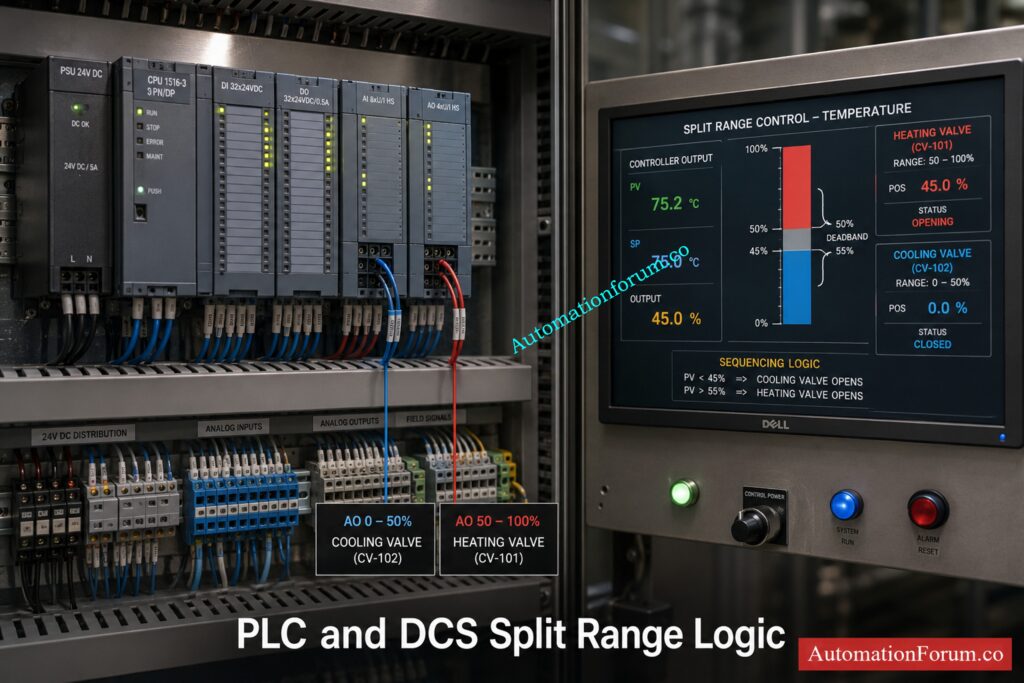
A split range control loop starts with a standard PID controller.
The difference is how the output signal is distributed.
Instead of sending 4 to 20 mA to one valve, the control system divides the signal into multiple operating regions.
Example of Basic Split Range Operation
Cooling Valve
- Operates from 4 to 12 mA
- Fully open at 4 mA
- Fully closed at 12 mA
Heating Valve
- Operates from 12 to 20 mA
- Fully closed at 12 mA
- Fully open at 20 mA
At the midpoint, one valve closes while the other starts opening.
Modern DCS systems usually implement split ranging through software function blocks instead of pneumatic bench set adjustments.
Industrial Split Logic Methods Every Automation Engineer Must Know: Split Range control
Types of Split Range Control Strategies Used in Industrial Automation
Complementary Split Range Control
In complementary operation, one valve opens while the other closes.
Typical application:
- Mixing hot and cold streams
- Blend ratio control
Both valves operate together in opposite directions.
Exclusive Split Range Control
Only one valve operates at a time.
Typical application:
- Heating versus cooling
- Acid versus caustic dosing
Deadband is commonly added to prevent both valves from operating simultaneously.
Progressive Split Range Control
One valve operates first. Another joins later as demand increases.
Typical application:
- Small valve for precision control
- Large valve for bulk flow demand
This configuration significantly improves rangeability.
Exclusive Progressive Valve Operation Methods Explained for Process Plants:
Why Deadband is Important in Split Range Control
Deadband is one of the most misunderstood topics in split range control.
Without deadband, the loop may continuously switch between valves near the split point.
This creates:
- Valve hunting
- Oscillation
- Excessive actuator movement
- Utility waste
- Mechanical wear
For example:
- Cooling valve active from 0 percent to 49 percent
- Deadband from 49 percent to 51 percent
- Heating valve active from 51 percent to 100 percent
This small inactive region prevents constant switching near midpoint operation.
However, excessive deadband can also create poor control response.
This is why deadband tuning requires practical plant experience.
Calculate Precise Output Distribution for Multi Valve Control Systems: Split Range Calculator – Control system
How Engineers Select the Correct Split Point in Split Range Control
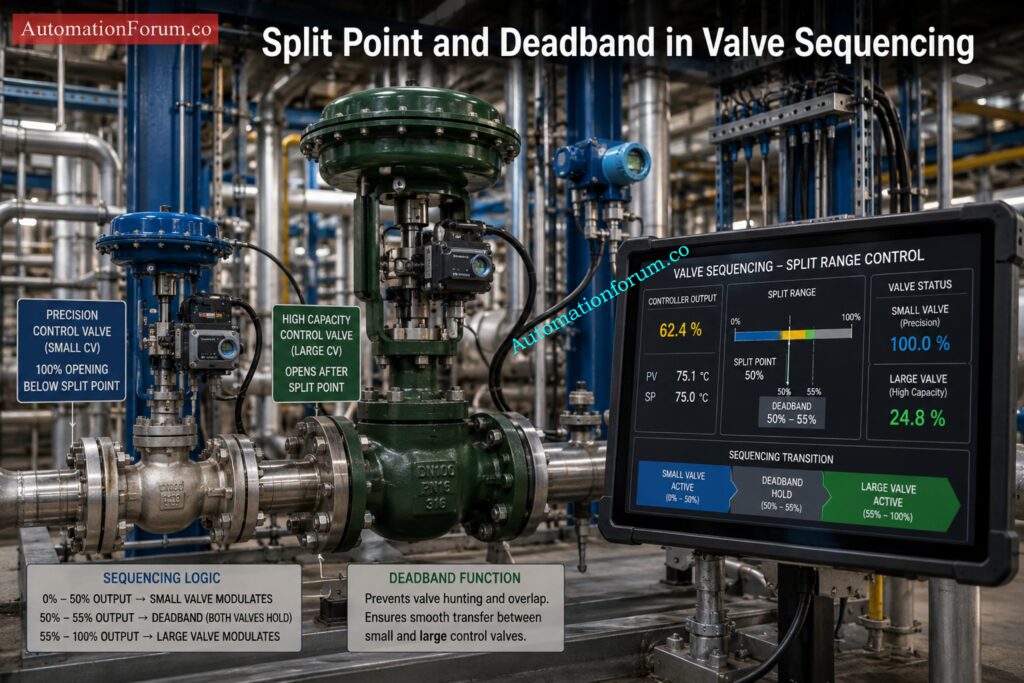
Many engineers assume the split point must always be 50 percent.
That is not true.
The correct split point depends on:
- Valve Cv
- Process gain
- Utility capacity
- Flow characteristics
- Process dynamics
If one valve is significantly larger than the other, a 50 percent split may produce unstable control.
For example:
- Small valve may control effectively up to 70 percent demand
- Large valve only needed above 70 percent
In that case:
- Small valve range = 0 to 70 percent
- Large valve range = 70 to 100 percent
Modern advanced tuning approaches recommend selecting split points based on actual process gain instead of arbitrary percentages.
How Three Way Valves Improve Industrial Temperature Regulation: Application of 3 – Way Control Valve in Process Control Systems
Real Industrial Examples of Split Range Control
Split Range Control in Pressure Control Systems
This is the most common industrial example.
A reactor may require:
- Steam for heating
- Cooling water for heat removal
The temperature controller sequences both utilities using split range control.
Why it matters
Without proper split range logic:
- Steam and cooling water may fight each other
- Utilities become unstable
- Energy consumption increases
- Reactor temperature oscillates
Experienced control engineers know this issue immediately increases steam consumption.
Solve Essential Advanced Control Challenges for Process Industry Engineers: Advanced Process Control Challenge: 25 Essential APC Questions
Pressure Control in Reactors
Some reactors use:
- Inlet valve
- Outlet valve
Both valves work together to maintain reactor pressure.
If pressure drops:
- Feed valve opens
If pressure continues changing:
- Outlet valve adjusts
This coordinated control improves pressure stability.
Split Range Control in pH Neutralization Systems
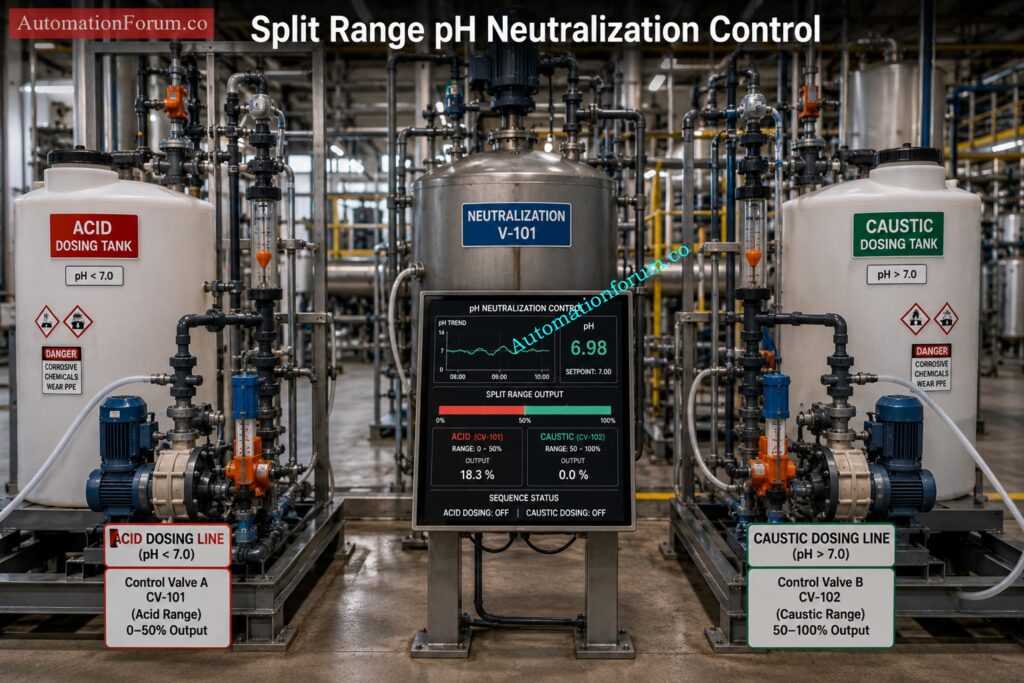
pH control loops often use:
- Acid dosing valve
- Caustic dosing valve
Both utilities cannot operate simultaneously without causing instability.
Split range control sequences acid and caustic addition based on controller output.
This prevents reagent fighting and improves chemical efficiency.
Vent Valve and Flare Valve Split Range Example
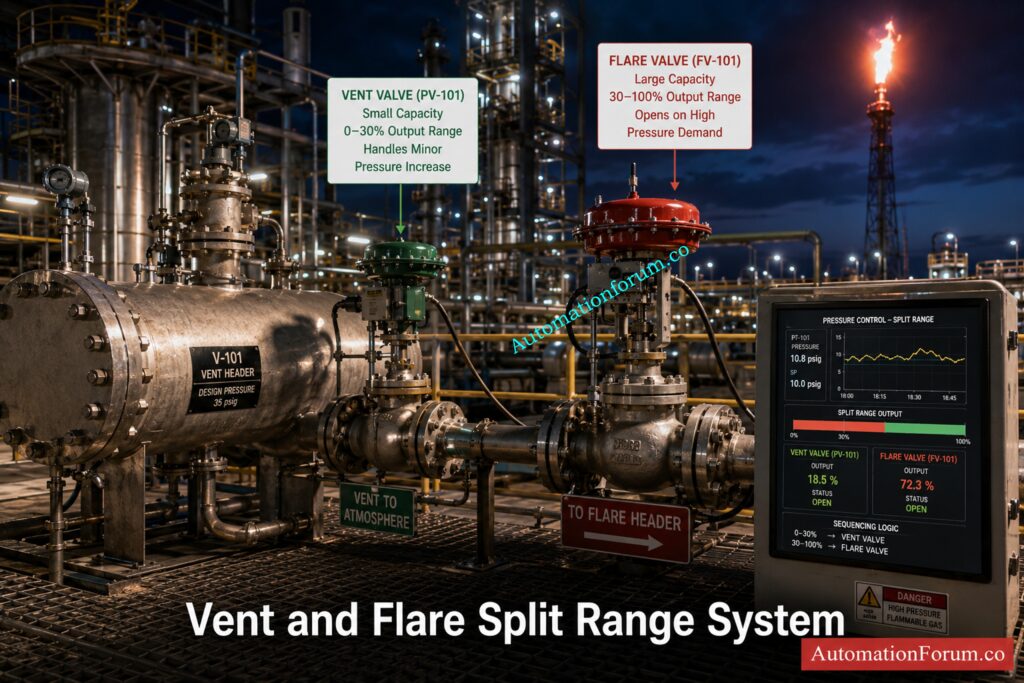
In refinery flare systems:
- Small vent valve handles minor pressure variations
- Large flare valve activates during major pressure rise
This arrangement improves safety while reducing unnecessary flaring.
Split Range Control in Boiler Combustion Systems
Some combustion systems use:
- Small fuel valve for startup
- Large valve for high load
This improves burner stability and flame control.
Choose the Right Industrial Valve for Accurate Flow Regulation: Globe vs Ball vs Butterfly Control Valves Complete Comparison Guide for Flow Control Selection
Split Range Control Versus Single Valve Control
| Parameter | Single Valve Control | Split Range Control |
| Operating range | Limited | Wide |
| Low load controllability | Often poor | Excellent |
| High load handling | May saturate | Improved |
| Process flexibility | Limited | High |
| Energy efficiency | Moderate | Better |
| Valve wear | Higher | Distributed |
| Utility switching | Difficult | Automatic |
| Loop stability | Can vary | Improved when tuned correctly |
The biggest advantage of split range control is controllability across varying plant conditions.
Detect Signal Fluctuation Problems Before Instrument Failure Occurs: Noise and Signal Stability Observation for Running Inspection in Instrumentation and Control Systems
Advantages of Split Range Control in Industrial Automation
- Improved Rangeability: Multiple valves provide better control over wide operating ranges.
- Better Process Stability: The loop operates more smoothly across changing process conditions.
- Improved Energy Efficiency: Heating and cooling utilities are better coordinated.
- Better Utility Management: Steam, cooling water, nitrogen, and fuel systems operate more efficiently.
- Higher Process Flexibility: Plants can handle startup, shutdown, low load, and peak load more effectively.
Stop Unstable Valve Oscillation Caused by Poor PID Settings: Control Valve Hunting Due to PID Controller: Causes, Effects, Root Analysis
Common Problems in Split Range Control Systems
Wrong Split Point Selection
This is extremely common.
Improper split points create:
- Oscillation
- Poor controllability
- Valve saturation
Split points must match actual process behavior.
No Deadband Configuration
Without deadband:
- Valves continuously switch
- Actuators wear rapidly
- Loop becomes unstable
Valve Mismatch
Using mismatched valves creates inconsistent response.
Example:
- Fast cooling valve
- Slow heating valve
This creates asymmetric loop behavior.
Poor PID Tuning
Split range loops often require different tuning characteristics across operating regions.
A tuning setup that works during heating may fail during cooling.
Overlapping or Gapped Ranges
If valves overlap excessively:
- Utilities may fight each other
If gaps exist:
- Controller output produces no response
Both conditions reduce loop stability.
Many experienced engineers blame PID tuning when the real problem is actually a badly selected split point.
In several refinery and chemical plant loops, correcting the split point alone dramatically reduces oscillation without changing PID settings.
Practice Loop Response Testing Using Interactive Excel Simulation Tool: Excel based PID Loop Simulator
Troubleshooting Split Range Control Loops
Loop Oscillates Near Midpoint
Possible causes:
- No deadband
- Split point too aggressive
- Valve stiction
Heating and Cooling Both Active
Possible causes:
- Excessive overlap
- Incorrect valve characterization
- Incorrect DCS configuration
Valve Suddenly Jumps Open
Possible causes:
- Positioner calibration issue
- Wrong signal scaling
- Incorrect actuator bench setting
Poor Low Load Control
Possible causes:
- Oversized valve
- Incorrect sequencing order
- Split point too low
Excessive Valve Movement
Possible causes:
- Aggressive PID tuning
- Noise in process variable
- No output filtering
Boost Plant Efficiency Using Advanced Automation Control Techniques: Advanced Process Control (APC): Working Principle, Components, Benefits, Applications and DCS Integration
When Split Range Control Should NOT Be Used
Split range control is powerful, but not every process needs it.
Avoid using it when:
- One Valve Can Handle the Entire Operating Range: Adding extra valves unnecessarily increases complexity.
- Process Dynamics Are Extremely Fast: Multiple valve interaction may complicate tuning.
- Utilities Cannot Be Allowed to Overlap: Some systems require strict interlocks instead of proportional sequencing.
- Maintenance Capability Is Limited: More calibration, More positioners, More failure points
- Process Gain Is Highly Nonlinear and Unpredictable: Advanced control strategies may work better than simple split ranging.
Split range control is not about adding valves. It is about extending controllability.
A badly selected split point can destroy a perfectly tuned PID loop.
The best split range loops are almost invisible during operation because they transition smoothly.
Optimize Boiler Drum Stability Using Three Element Strategy: Three Element Control
Frequently Asked Questions About Split Range Control
What is split range control in industrial automation?
Split range control is a control strategy where one controller output operates multiple control valves over different portions of the output signal range. It involves a single controller to regulate many process operations efficiently.
Why is split range control used in temperature control systems?
It permits automatic sequencing of heating and cooling valves with one temperature controller. This leads to higher process stability, better energy efficiency and less manual intervention.
What is a split point in control valve sequencing?
The split point is the controller output value where control shifts from one valve to another valve. It defines the operating transition between different control elements.
Why is deadband used in split range control?
Deadband prevents continuous valve switching and hunting near the split point. Provides smoother process control operation and longer valve life.
Can split range control be implemented in PLC and DCS systems?
Yes, current PLC and DCS systems do enable split range control using software logic, function blocks and analog output settings. It is widely utilized in process industries for temperature, pressure and flow control application.
Achieve Faster Stable Response with Proper PID Adjustment Methods: PID controller tuning
Conclusion:Why Split Range Control Is Widely Used in Industrial Automation
Split range control is one of the most practical control strategies used in industrial automation because real processes rarely behave consistently across all operating conditions.
One valve may control well at startup but fail at full load. A heating utility may work perfectly until cooling becomes necessary. A pressure loop may require coordinated inlet and outlet control instead of a single throttling element.
Split range control solves these real plant problems by intelligently sequencing multiple final control elements through one controller.
When properly engineered, it improves:
- Process stability
- Rangeability
- Energy efficiency
- Utility management
- Valve life
- Control accuracy
But successful implementation requires more than textbook knowledge.
Engineers must understand:
- Process gain
- Valve sizing
- Deadband behavior
- Split point selection
- PID interaction
- Real plant dynamics
The best split range systems are not the most complicated ones.
They are the ones operators never have to think about because the process simply stays stable.
Refer the below link for the Best PID ControllerTuning Simulation Tool for Engineers
