
- Why Two Factor Authentication is Essential for Secure Remote PLC Programming in Modern Process Automation
- Why Remote PLC Programming Requires Strong Security
- What is Two Factor Authentication for PLC Remote Access?
- Where is Two Factor Authentication Implemented in Remote PLC Programming?
- VPN Based Two Factor Authentication for Secure Remote PLC Programming
- Advantages of VPN with Two Factor Authentication for Industrial Networks
- Secure Remote Access Gateways for PLC and SCADA Systems
- Using Two Factor Authentication with Remote Desktop Software
- Practical Industrial Example of Secure Remote PLC Programming Using Two Factor Authentication
- Benefits of Two Factor Authentication for Process Automation and Industrial Cybersecurity
- Best Practices for Secure Remote PLC Access
- Engineering Best Practices for Remote PLC Programming Security
- How IEC 62443 Supports Secure Remote Access
- Building a Layered Industrial Cybersecurity Strategy
- Common Engineering Mistakes That Increase Remote PLC Cybersecurity Risks
- Conclusion: Why Two Factor Authentication is the Foundation of Secure Remote PLC Programming
- Frequently Asked Questions About Two Factor Authentication for Remote PLC Programming
Why Two Factor Authentication is Essential for Secure Remote PLC Programming in Modern Process Automation
Remote PLC programming has become an integral aspect of modern process automation. Engineers connect to industrial facilities from engineering offices, support centers, vendor sites or home offices on a routine basis to diagnose equipment, update PLC programs, perform commissioning tasks and support maintenance teams. This strategy will decrease travel time, reduce production downtime and allow technical specialists to fix problems much faster.
However, the increasing use of remote engineering access has also expanded the cyber attack surface of industrial facilities. Cyber criminals no longer target only business networks. The OT environment has become a lucrative target for industrial enterprises, refineries, power stations, water treatment facilities and chemical plants as disruptions could compromise productivity, safety and business continuity.
An attacker might use a compromised engineering account to alter PLC logic, change process parameters, or disrupt crucial plant operations. This is why secure authentication is no longer just an IT need. It has become a fundamental part of Industrial Cybersecurity.
Two Factor Authentication for remote PLC access adds an extra step of identity verification before engineers may access industrial control networks. It works with secure remote access architecture to assist protect production systems, enable regulatory compliance and conform with modern cybersecurity techniques such IEC 62443.
Why Remote PLC Programming Requires Strong Security
Remote PLC programming has many operational advantages, but it also comes with cybersecurity challenges that must be approached cautiously. The impact of unlawful remote engineering access can be felt well beyond the single controller.
Major Cybersecurity Risks of Remote PLC Programming
Potential risks include:
- Forced operation of equipment
- Unexpected production stoppage
- Safety accidents to persons and equipment
- Stealing proprietary control strategies
- Lost engineering project files
- Violations of compliance
- Malware in Industrial Control System networks
- Ransomware assaults that interrupt production
- Vendor remote access uncontrolled
- Insider risks caused by hacked engineering accounts
Why Password Only Authentication is No Longer Enough for PLC Engineering Workstations
Remote access security for years relied on nothing but usernames and passwords for engineering workstations. This strategy was originally thought appropriate but no longer suffices against today’s cyber dangers.
Attackers are increasingly stealing engineering credentials using phishing emails, malware, password spraying, credential stuffing and brute-force attacks. Strong passwords are useless if they fall victim to a phishing attempt or are leaked in a data breach.
This is why passwords alone are no longer able to provide effective protection for remote engineering access.
Rather than just providing a password, businesses authenticate the user’s identity and the device being used prior gaining access to engineering systems.
Refer the below link for the PLC Troubleshooting Remote IO Rack Communication Failure Complete Guide for Industrial Automation Engineers
What is Two Factor Authentication for PLC Remote Access?
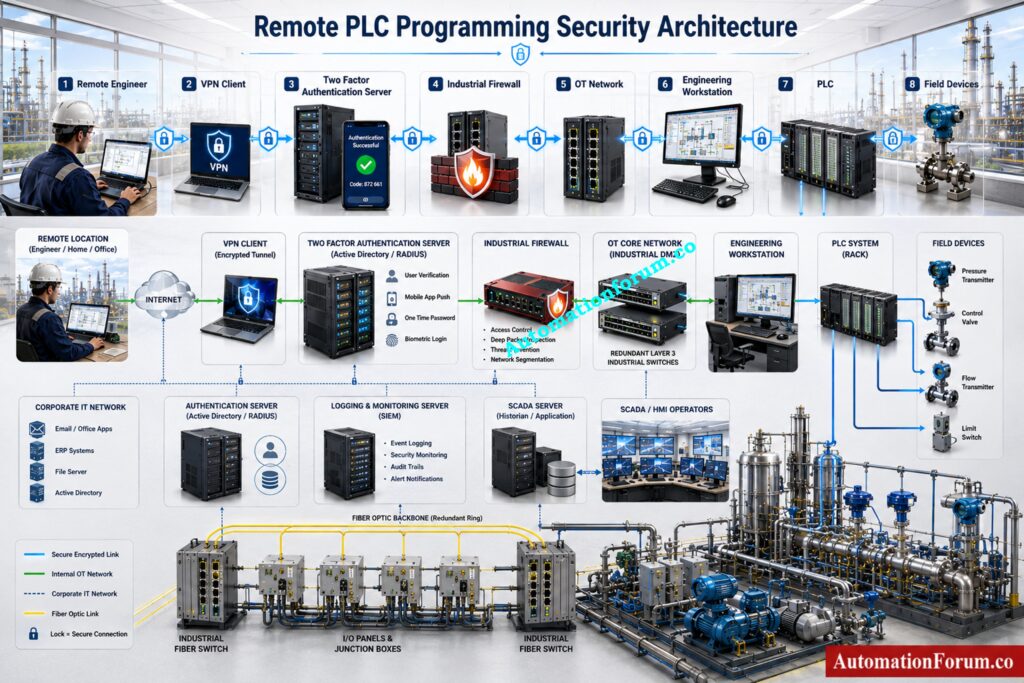
How Two Factor Authentication Works
Two Factor Authentication, generally referred to as 2FA, is a security method that requires the user to verify himself/herself with the help of two different authentication factors before access is provided.
Rather than relying only on a password, the user must successfully complete another verification step.
The authentication factors generally fall into three categories.
Something You Know
Something You Have
This may be:
- Mobile authenticator application
- Hardware security token
- One time password generator
- Company issued authentication device
Something You Are
Some organisations also use biometric verification such as:
- Fingerprint recognition
- Facial recognition
- Iris recognition
Only two of these factors are normally required.
Stop PLC Cyber Attacks Before They Cause Costly Downtime: How to Safeguard PLCs Against Cyber Attacks in Industrial Networks ?
Where is Two Factor Authentication Implemented in Remote PLC Programming?
Do PLCs Support Two Factor Authentication Directly?
One of the biggest misconceptions in industrial automation is that PLCs authenticate Two Factor Authentication directly.
In reality, this rarely happens.
Most PLCs are designed to execute control logic, communicate with field devices, and maintain reliable process operation. Advanced user authentication is normally handled elsewhere within the remote access infrastructure.
Similarly, many SCADA applications depend on external authentication services rather than performing Two Factor Authentication themselves.
The authentication process usually takes place before engineers reach the industrial network.
Typical Remote PLC Access Architecture Using Two Factor Authentication
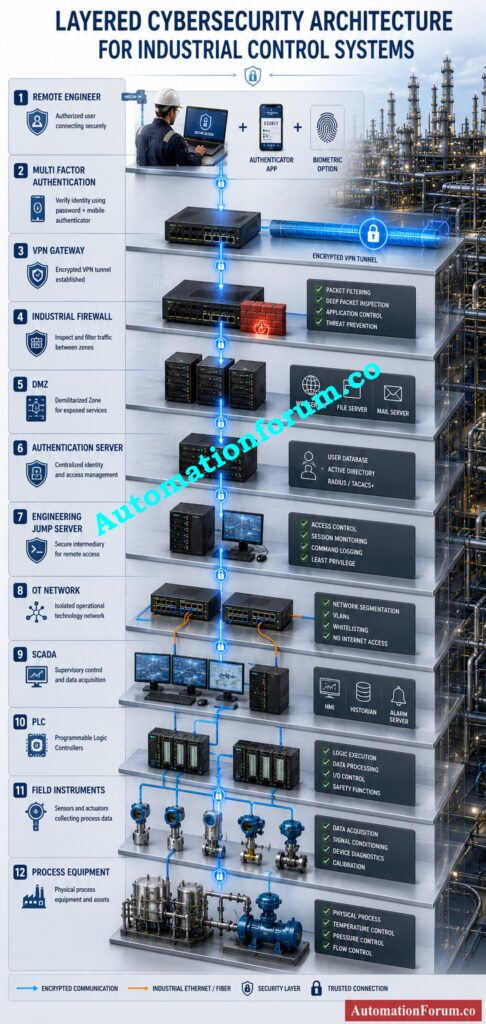
A typical remote access architecture looks like this:
Engineer computer
↓
VPN server or secure remote access gateway
↓
Authentication server
↓
Operational Technology network
↓
Engineering workstation
↓
PLC programming software
↓
PLC
Maximize Plant Availability with Reliable PLC Backup Strategies: Hot Standby in PLC Systems: Architecture, Working, and Benefits Scaling Analog Values in Industrial Automation (PLC)
How the Remote Access Layer Protects Industrial Control Systems
After the engineer successfully completes authentication, the engineering workstation communicates with the PLC using the normal industrial communication protocol.
This layered architecture allows organisations to improve Remote PLC Programming Security without requiring changes to PLC firmware or existing control programs.
Secure Your Remote Workforce Before Cybercriminals Strike Again: Remote Work Cybersecurity: Common Vulnerabilities and How to Prevent Attacks
VPN Based Two Factor Authentication for Secure Remote PLC Programming
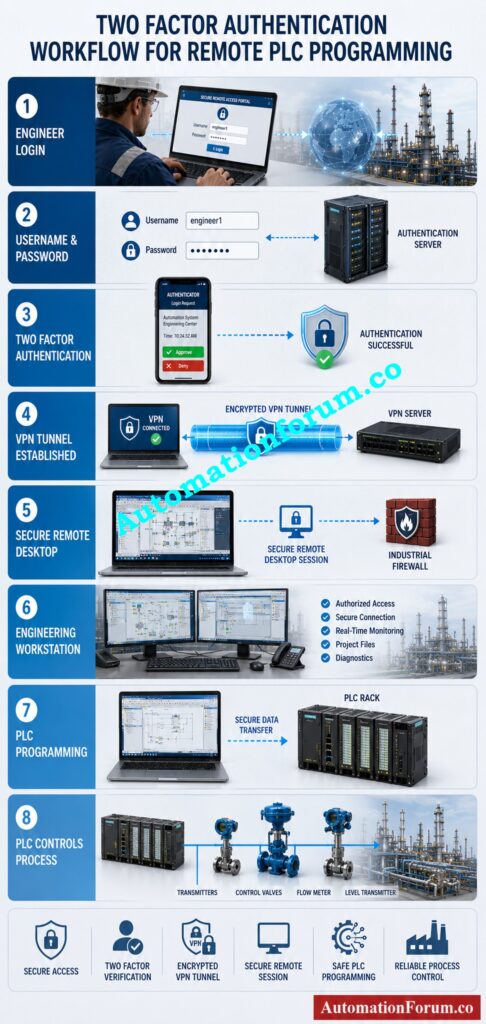
Step by Step VPN Authentication Workflow for PLC Engineers
A Virtual Private Network remains one of the most common methods for providing Secure Remote PLC Access.
A typical workflow follows these steps.
Step 1
The engineer launches the approved industrial VPN client from the engineering laptop.
Step 2
The engineer enters the specified username.
Step 3
The account password is keyed and checked.
Step 4
The authentication server prompts for a second authentication factor.
This can include:
- Approve notification on a mobile authenticator application
- Entering One Time Password
- With a hardware security key
- Biometric verification when applicable
Step 5
If verification is successful, an encrypted VPN tunnel is formed.
Step 6
Step 7
PLC programming software is opened and connected to the target controller.
Throughout this entire process, the PLC remains completely unaware that Two Factor Authentication has taken place.
The authentication occurs only at the network access layer before communication with the PLC begins.
Build Error Free PLC Records That Simplify Every Project: PLC System Documentation Guide: Essential Records for Industrial Automation
Advantages of VPN with Two Factor Authentication for Industrial Networks
Using VPN with Two Factor Authentication provides several important engineering advantages.
- Encrypted communication across public networks
- Controlled access to Operational Technology assets
- Reduced attack surface
- Centralised user authentication
- Detailed audit logging
- Role based user permissions
- Secure Remote PLC Access from approved locations only
- Improved compliance with industrial cybersecurity requirements
For these reasons, VPN for PLC Programming remains one of the most widely adopted security solutions across manufacturing, oil and gas, power generation, water treatment, pharmaceutical, and process industries.
Understand Remote IO Architecture to Improve PLC System Reliability: Understanding Remote I/O in PLC Control Systems
Secure Remote Access Gateways for PLC and SCADA Systems
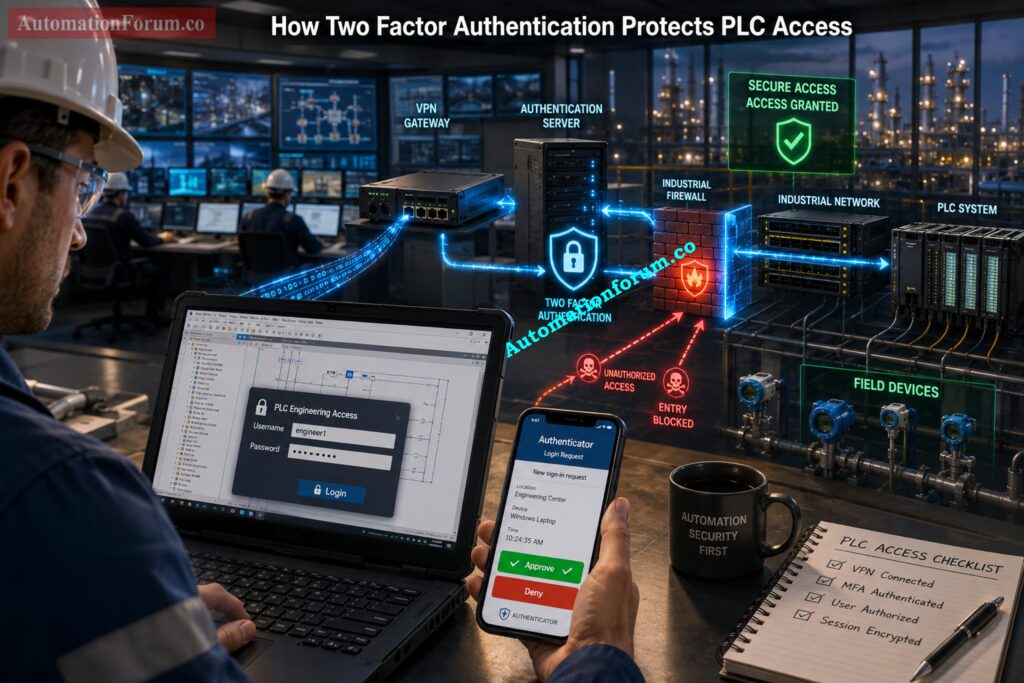
How Industrial Remote Access Gateways Improve Cybersecurity
Many industrial organisations now prefer secure remote access gateways instead of maintaining permanent VPN connections.
Industrial remote gateways are specifically designed for Operational Technology environments and provide controlled remote engineering access without exposing internal industrial networks directly to external users.
Well known examples include solutions from Ewon, Phoenix Contact, and Secomea. Although each platform differs in implementation, they generally follow similar security principles rather than providing unrestricted network access.
Boost PLC Performance with Powerful Speed Optimization Techniques: How to Increase PLC Speed: 7 Optimization Tips + Advanced Programming Guide
Features of Modern Secure Remote Access Gateways
These gateways often provide:
- Authentication based on Cloud
- Two Factor Authentication Support
- Temporary encrypted communication channels.
- Limited engineering time for access
- Permissions based on role
- Vendor approval process
- Thorough audit trail logging
- Recording Session
Why Secure Gateways Are Safer Than Permanent VPN Connections
Unlike permanent VPN connections, secure gateways open communications only when maintenance or troubleshooting actions are allowed. This significantly reduces the time during which Operational Technology assets are exposed to external connections.
As a result, many organisations now view secure remote gateways as an important component of Industrial Network Security, particularly when supporting equipment suppliers, system integrators, and remote maintenance teams.
Master Essential Cybersecurity Skills Before Threats Take Control: Cybersecurity Basics: Types, Threats, and Protection Tips
Using Two Factor Authentication with Remote Desktop Software
How AnyDesk and TeamViewer Protect Remote Engineering Workstations
Many engineering teams use remote desktop applications such as AnyDesk and TeamViewer to perform remote maintenance and troubleshooting. These applications allow engineers to operate an engineering workstation located inside the plant without travelling to the site.
Most modern remote desktop platforms support Two Factor Authentication to strengthen user login security. However, it is important to understand what this authentication actually protects.
Two Factor Authentication provides security for access to the remote computer or engineering workstation, not the PLC itself.
The normal workflow is:
- The engineer launches the remote desktop program.
- The user name and password are input.
- The app requires approval via a mobile authenticator or a one time password.
- The engineer is authenticated.
- Remote desktop session is connected.
- PLC programming software is launched from the engineering workstation.
Extend PLC Module Life with Proven Preventive Maintenance Methods: Proactive Maintenance Strategies for PLC I/O Modules: Reduce Downtime & Improve Reliability
Why Remote Desktop Authentication Does Not Protect the PLC
Although this approach improves Remote PLC Programming Security, it should not be considered a complete Industrial Cybersecurity solution on its own.
Remote desktop software generally does not provide:
- Industrial network segmentation
- Direct PLC authentication
- Operational Technology specific security controls
- Secure access approval workflows
- Comprehensive vendor access management
Best Practice for Combining Remote Desktop with VPN Security
For maximum protection, remote desktop applications should operate through a secure VPN or an industrial remote access gateway. This layered architecture ensures that multiple security controls must be successfully passed before an engineer reaches the control network.
Meet Critical PLC Security Standards Before Compliance Audits Fail: Cybersecurity Standards for PLCs
Practical Industrial Example of Secure Remote PLC Programming Using Two Factor Authentication
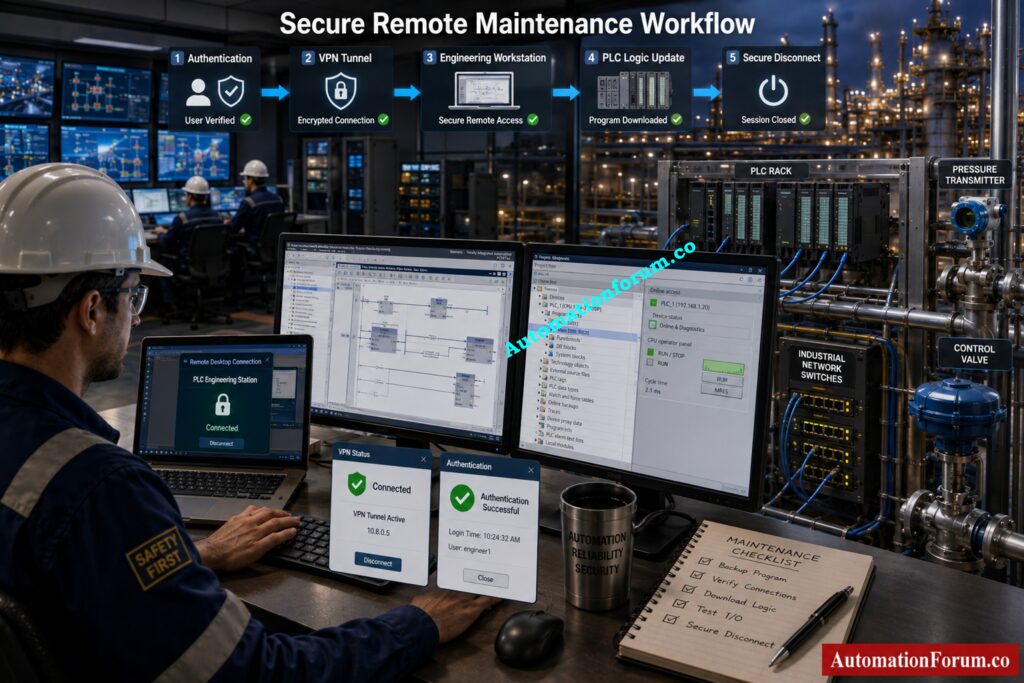
Step by Step Remote Maintenance Workflow in a Process Plant
Think of a refinery where an automation engineer gets a request to change certain PLC logic after a field transmitter has been replaced.
The plant maintenance supervisor approves the remote session first and then the engineer starts the session.
The username and password are put in.
The second authentication factor is a mobile authentication app that requires validation.
If permitted, a secure VPN tunnel is formed between the engineering laptop and the plant network.
The engineer then starts AnyDesk and securely connects to the engineering workstation that resides on the control system network.
The programming software is opened when the required PLC project is verified as available and the required logic alterations are made.
The modified program is tested as part of plant change management procedure prior to downloading to PLC.
Eliminate Analog Signal Errors with Accurate Scaling Techniques: Scaling Analog Values in Industrial Automation (PLC)
Why a Layered Security Approach Provides Better Protection
All along the maintenance activity, authentication records, VPN connection history, engineering workstation access logs and user actions are automatically documented.
Once the testing is done, the PLC project is closed, the remote desktop session is closed, the VPN connection is deactivated and the maintenance activity is logged.
We advocate this layered strategy since it does not rely on any one security control. User authentication, encrypted connection, controlled access to workstations, engineering procedures and audit recording all combine to decrease cybersecurity risk while allowing effective remote maintenance.
Learn Essential OT Security Rules Every Industrial Engineer Needs: Protocols and Standards in Industrial Automation: A Guide to OT Cybersecurity
Benefits of Two Factor Authentication for Process Automation and Industrial Cybersecurity
| Benefit | Industrial Advantage |
| Prevent unauthorised access | Blocks attackers using stolen passwords |
| Improve Industrial Cybersecurity | Adds an additional layer of identity verification |
| Reduce ransomware risk | Makes remote compromise significantly more difficult |
| Protect production | Prevents unauthorised PLC program changes |
| Protect personnel | Reduces the possibility of unsafe equipment operation |
| Improve compliance | Supports company cybersecurity policies and recognised standards |
| Improve auditability | Records user authentication and engineering access activities |
| Secure vendor access | Allows temporary controlled remote maintenance sessions |
| Reduce insider risk | Improves accountability for engineering activities |
| Support IEC 62443 practices | Contributes to a defence in depth cybersecurity strategy |
Prevent Costly Shutdowns with Proven PLC Documentation Best Practices: PLC Alarm and Trip Documentation Procedure – EPC PLC Automation Engineer Guide
Best Practices for Secure Remote PLC Access
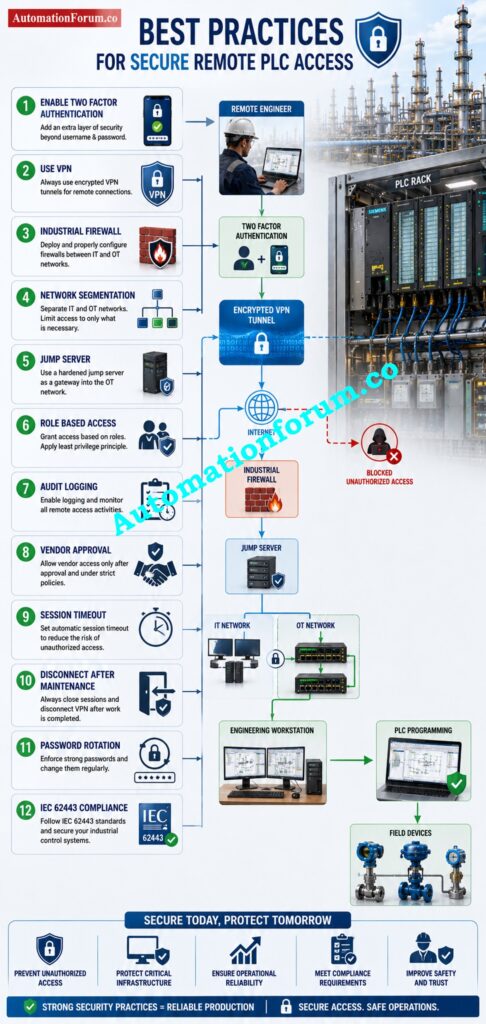
Robust security for remote PLC programming is a matter of both technical safeguards and disciplined engineering methods. No single technology can completely safeguard an industrial control system. Instead, organisations should implement multiple security layers that complement one another.
Choose the Right PLC Redundancy Before System Failure Happens: Understanding PLC Redundancy: Cold, Warm & Hot Redundancy
Engineering Best Practices for Remote PLC Programming Security
Recommended best practices include:
- Always enable Two Factor Authentication for remote engineering access.
- Use a secure VPN before starting any remote desktop session.
- Never directly expose PLCs or engineering workstations to the Internet.
- Remote engineering must be done from designated jump servers.
- Apply the concept of least privilege: users should have only the access they need.
- Configure role-based access for engineers, operators, contractors and vendors.
- Regularly review authentication and audit records.
- Immediately disable any unused or inactive accounts.
- Rotate passwords based on workplace cybersecurity policies.
- Get formal approval before letting vendors in.
- Disconnect VPN and remote sessions right once maintenance is finished.
- Document protocols for cybersecurity and for the emergency response plan.
- Periodically evaluate user accounts and access rights.
Compare Safety PLC Technologies Before Choosing the Wrong System: Difference Between Triconex PLC and Other PLCs: A Complete Guide
How IEC 62443 Supports Secure Remote Access
These suggestions closely follow the concepts set forth in IEC 62443 for the security of industrial automation and control systems. IEC 62443 advocates a defence in depth approach where many security measures complement each other, instead of relying on one security measure.
Two Factor Authentication is not common in PLCs but it is helpful to put it on VPN servers, secure remote gateways, authentication servers and engineering leap servers to ensure that confirmed users can get to Operational Technology assets.
Building a Layered Industrial Cybersecurity Strategy
When combined with industrial firewalls, network segmentation, endpoint protection, centralised identity management, secure engineering procedures and continuous audit logging, Two Factor Authentication becomes an important part of a comprehensive Industrial Cybersecurity programme, rather than a standalone feature.
Remote Engineering Access is further enhanced by periodic checks of engineering accounts, prompt removal of inactive users and prudent management of vendor permissions to lower the probability of cyber issues.
Improve PLC Accuracy by Understanding Resolution Like an Expert: Resolution in PLCs – The Complete Guide for Automation & Instrumentation Engineers
Common Engineering Mistakes That Increase Remote PLC Cybersecurity Risks
| Common Mistake | Possible Consequence |
| Using password only authentication | Increased risk of stolen credentials being misused |
| Sharing engineering accounts | Loss of accountability and traceability |
| Leaving VPN connected after work | Longer exposure to potential cyber attacks |
| Maintaining permanent remote access | Larger attack surface for attackers |
| Using personal laptops for PLC programming | Increased malware and data leakage risk |
| Ignoring authentication and audit logs | Security incidents may remain undetected |
| Granting vendor access without approval | Uncontrolled access to production systems |
| Using weak or reused passwords | Easier credential compromise |
| Failing to review user accounts | Former employees or contractors may retain access |
| Providing no cybersecurity awareness training | Increased likelihood of human error and phishing attacks |
Avoid Expensive PLC Programming Mistakes with Proper Data Selection: PLC Data Types Every Automation Engineer Must Know to Avoid Costly Programming Errors
Conclusion: Why Two Factor Authentication is the Foundation of Secure Remote PLC Programming
Two Factor Authentication for PLC remote programming is one of the most critical cybersecurity controls in modern process automation. With industrial facilities increasing remote engineering capabilities, passwords alone are no longer enough to protect crucial Operational Technology assets.
It is vital to remember that PLCs themselves often do not perform Two Factor Authentication. Authentication is usually performed at the remote access layer (e.g., secure VPN services, industrial remote access gateways, authentication servers, or protected engineering workstations) before any communication to the PLC is made.
Key Takeaways for Protecting PLC and SCADA Remote Access
The most effective security for Remote PLC Programming is achieved using a layered security strategy. Secure VPN connections, Two Factor Authentication, industrial remote access gateways, protected engineering workstations, network segmentation, role based permissions, audit logging and disciplined engineering practices all assist to lowering cyber risk.
Organisations can use these best practices to facilitate secure remote maintenance, protect production and workers, increase regulatory compliance and align their cybersecurity programmes with established standards such as IEC 62443. In the linked industrial world of today Two Factor Authentication is not only an added security feature anymore. It is a crucial prerequisite for secure and safe remote engineering access.
Diagnose PLC Logic Failures Faster Using Proven Troubleshooting Techniques: PLC Permissive Logic Troubleshooting Procedure for Instrumentation Engineers
Frequently Asked Questions About Two Factor Authentication for Remote PLC Programming
What is the two factor authentication for remote access?
Remote access Two Factor Authentication is required for users to authenticate using a password and a second authentication factor before accessing industrial systems.
It dramatically decreases the possibility of illegal access to PLCs, SCADA systems and engineering workstations.
How to get a 2 factor authenticator code?
Use an authenticator app , like Microsoft Authenticator or Google Authenticator . When you set this up, pair it with your account.
Each time you login, the application dynamically produces a one time verification code which is secure.
How to enable two factor authentication in RDP?
Most implementations of Remote Desktop Protocol don’t have native Two Factor Authentication.
This is often done using VPN solutions, Remote Desktop Gateway, Azure MFA or third party authentication services.
How to apply 2 factor authentication?
Before you allow remote engineering access, enable Two Factor Authentication on your VPN, secure remote access gateway or identity management software.
Users enter their login and password, then prove their identity with a second authentication factor.
Is there a free 2 factor authentication app?
Yes, there are a number of reliable authenticator apps available for free on both Android and iOS smartphones.
These apps generate safe one time passwords or approval messages for account verification.
What are the methods of 2 factor authentication?
Common techniques include mobile authenticator software, SMS codes, hardware security tokens, biometric verification and email-based one-time passwords.
Authenticator apps or hardware tokens are generally used by industrial enterprises because they give higher security.
Why is Two Factor Authentication important for remote PLC programming?
Common techniques include mobile authenticator software, SMS codes, hardware security tokens, biometric verification and email-based one-time passwords.
Authenticator apps or hardware tokens are generally used by industrial enterprises because they give higher security.
Does a PLC support Two Factor Authentication directly?
It blocks attackers from accessing engineering systems if login passwords are compromised through phishing or malware.
This extra layer of protection safeguards industrial assets, operational technology networks and essential control systems.
Can Two Factor Authentication prevent ransomware attacks?
This won’t stop ransomware dead in its tracks. But it will seriously restrict the unlawful remote access that is commonly the source of ransomware infestations.
In conjunction with network segmentation and secure engineering techniques, it greatly increases industrial cybersecurity.
Where should Two Factor Authentication be implemented in industrial networks?
It should be used on VPN servers, secure remote access gateways, jump servers and engineering workstation login systems.
In this way the Operational Technology network is accessed before the PLCs communicate.
Is VPN required when using Two Factor Authentication for PLC access?
We strongly propose the usage of a VPN, because it encrypts communications and securely links engineers to the industrial network.
Combining VPN with Two Factor Authentication gives a significantly stronger Remote PLC Programming Security solution.
Can vendors securely access PLC systems using Two Factor Authentication?
Yes, vendors can connect securely via approved VPNs or industrial remote access gateways with Two Factor Authentication enabled.
Remote maintenance is facilitated by temporary access, audit logs, and approval protocols which help to keep things secure.
How does Two Factor Authentication support IEC 62443?
Secure user authentication and regulated remote access is a defense in depth method recommended in IEC 62443.
Two Factor Authentication increases identity verification and helps to comply with modern industrial cyber security policies.
What is the difference between VPN and Two Factor Authentication?
Secure user authentication and regulated remote access is a defense in depth method recommended in IEC 62443.
Two Factor Authentication increases identity verification and helps to comply with modern industrial cyber security policies.
What are the best practices for secure remote PLC access?
Use two factor authentication, VPN, role based permissions, jump servers, audit logging and regular access reviews.
Avoid exposing PLCs directly to the Internet, and stop remote sessions immediately after maintenance is performed.
Refer the below link for the Running Inspection Checklist of PLC Components in Control Panels
