
- What is a Safety Light Curtain?
- Main Components of a Safety Light Curtain
- How Does a Safety Light Curtain Work?
- Diagram Explanation: Beam Grid and Detection Zone
- Types of Safety Light Curtains
- Safety Light Curtain Integration with PLC and Safety Systems
- Safety Light Curtain Standards and Certifications
- Safety Light Curtain Installation and Design Considerations
- Advantages of Using a Safety Light Curtain
- Limitations of Safety Light Curtains
- Safety Light Curtain Applications in Industry
- Troubleshooting Safety Light Curtain Problems
- Safety Light Curtain vs Physical Guard
- Best Practices for Safety Light Curtain Installation
- Frequently Asked Questions About Safety Light Curtains
- Conclusion: Why Safety Light Curtains Are Important in Modern Automation
In today’s automated factories, machine safety is no longer seen as a separate task from productivity. Engineers increasingly expect safety systems to keep workers safe while also making sure that production runs smoothly. The safety light curtain is one of the most used non-contact machine safety sensors. It makes an invisible wall with infrared beams and stops machines right away when that wall is broken.
For instrumentation and automation engineers, understanding how light curtain works in industry is important because these devices are often connected to safety relays, safety PLCs, emergency stop circuits, and industrial safety interlocks. When correctly selected and installed, a safety light curtain improves both protection and productivity. It allows operators to work closer to machines while maintaining a high level of risk reduction.
What is a Safety Light Curtain?
Safety Light Curtain Definition
A safety light curtain is a photoelectric safety device that generates a protected zone using multiple parallel infrared beams between a transmitter and a receiver. If any beam is blocked by a hand, finger, or body part, the system detects the interruption and shuts down the hazardous machine motion.
How a Light Curtain Safety System Protects Operators
Unlike a mechanical guard, which physically blocks access, a light curtain safety system explanation is based on detection. This makes it ideal for applications where frequent material loading, inspection, or maintenance access is needed. It is commonly used in presses, automated assembly machines, palletizers, packaging equipment, and robotic work cells.
A safety light curtain working principle is simple in concept but highly engineered in practice. It replaces physical guarding in many applications where frequent operator access is required, such as press machines, robotic cells, packaging lines, and conveyors. Instead of opening and closing a gate every time, the machine can continue operating with fast, controlled access protection.
Why Safety Light Curtains are Used in Industrial Automation
A light curtain is not a general-purpose sensor. It is a safety-rated device designed to operate with redundancy, self-monitoring, and fail-safe logic. That is why the output is usually based on OSSD output light curtain technology, where the outputs switch off when a fault or beam interruption occurs.
Avoid these costly SIS mistakes: Top Critical Mistakes in Safety Instrumented System Design as per ISA 84 Standard
Main Components of a Safety Light Curtain
A safety light curtain consists of several critical parts, and each one has a defined role in maintaining safe operation.
Transmitter or Emitter
The transmitter sends multiple parallel infrared beams across the protected area. These beams are typically pulsed and synchronized so the receiver can distinguish them from ambient light. The emitter does not simply send one beam; it creates a grid of invisible detection paths.
Receiver
The receiver detects the infrared beams sent by the emitter. If all beams are received correctly, the system considers the safe state active. The receiver provides a stop signal through the safety output circuit if one or more beams are obstructed or if there is a problem.
Safety Relay or Safety PLC
The light curtain output may connect to a safety relay or a safety PLC, depending on how the system is set up. This device takes in the safety signal and tells the machine to stop or not move. In higher-risk systems, the safety PLC is preferred because it allows more advanced diagnostics and logic.
OSSD Outputs
OSSD stands for Output Signal Switching Device. These are safety-rated outputs that turn off in the event of a beam interruption, internal fault, or power loss. OSSD outputs help ensure that the system fails safe rather than failing in an unsafe way.
Safety Relay or Safety PLC
Industrial installations also include cables, connectors, status indicators, test signals, and diagnostic functions. These let maintenance workers easily find electrical problems, dirty lenses, misalignment, or mistakes inside a device.
Refer the below link for the IS Barrier Earth Fault Current Calculator | Intrinsic Safety Loop Design Tool
How Does a Safety Light Curtain Work?
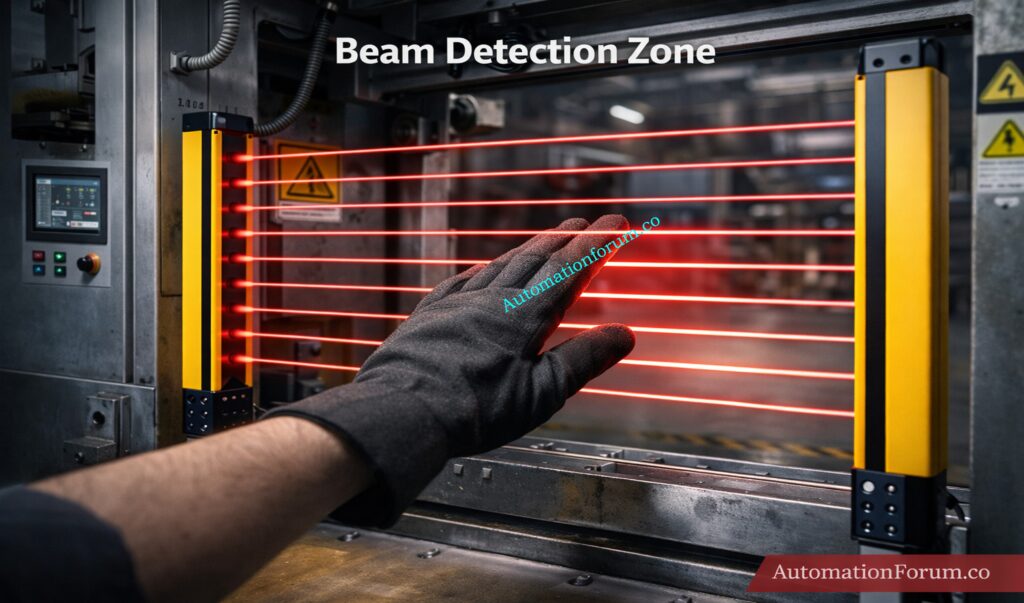
The safety light curtain working principle can be understood in five basic steps.
Safety Light Curtain Working Principle Explained
The transmitter creates a series of parallel infrared beams across the sensing field. These beams form an invisible safety zone between the emitter and receiver. Depending on the application, the beam spacing may be very small for finger protection or wider for hand and body protection.
Infrared Beam Generation in a Light Curtain
The receiver continuously monitors the complete beam pattern. The beams are synchronized and modulated so that the receiver only accepts the correct signal from its paired transmitter. This prevents interference from sunlight, reflective surfaces, or other industrial light sources.
Beam Interruption and Hazard Detection
One or more beams are broken when an operator’s hand, arm, or body enters the protected area. The receiver immediately recognizes the beam loss as an unsafe condition. This is the key point in how light curtain works in industry: interruption equals hazard detection.
OSSD Output and Machine Shutdown
As soon as a beam is blocked, the OSSD outputs switch off. The connected safety relay or safety PLC receives the stop command and removes power or enables a safe stop function. The machine must stop before the operator can reach the dangerous motion zone.
Self-Monitoring and Fail-Safe Operation
A major advantage of modern safety light curtains is self-diagnostics. The device continuously checks for internal faults, output discrepancies, synchronization errors, and wiring problems. If a fault is detected, the system goes to a safe state. This fail-safe design is essential in industrial safety interlocks.
In simple terms, the system is always watching itself. If anything is wrong, the safest action is to stop the machine.
Learn bypass risks during maintenance: IEC 61511 Safety Bypass And Override in Instrumentation and Control System Maintenance
Diagram Explanation: Beam Grid and Detection Zone
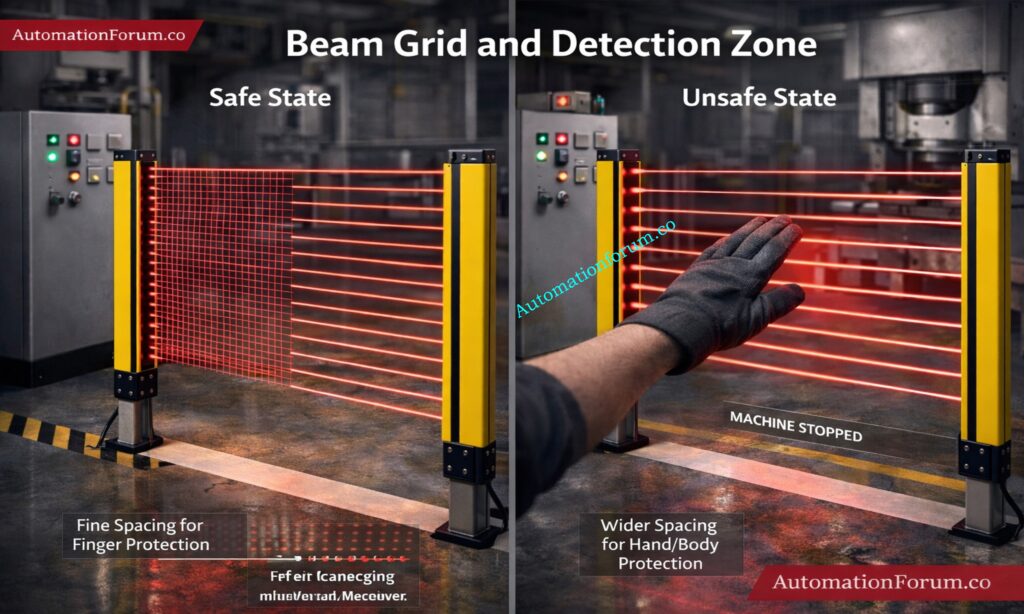
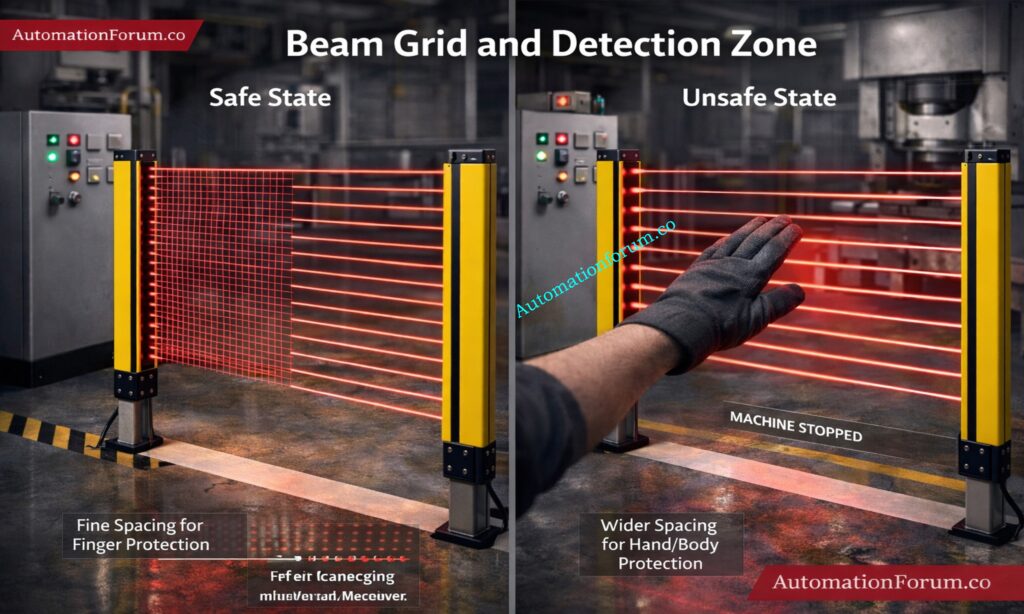
Think of the light curtain as a vertical curtain comprised of lines that you can’t see. The transmitter and receiver are on opposing sides of the opening, which makes a grid of beams across it.
The detecting zone is the safe area where any break in the beam is seen as a safety event. In a safe condition, all beams reach the receiver. In an unsafe condition, one or more beams are broken, and the safety output turns off.
This concept is important for engineers because the physical layout of the beam grid determines what size object can be detected. Fine beam spacing is used for finger protection, while larger spacing may be enough for hand or body protection.
A good installation makes sure the beam grid fully covers the hazardous access point without leaving gaps where an operator could reach through.
Understand IS classifications clearly: Intrinsic Safety Protection Systems: Understanding Ex ia, Ex ib, and Ex ic
Types of Safety Light Curtains
The most common classification is Type 2 vs Type 4 light curtains, based on IEC 61496.
Type 2 Safety Light Curtain
Type 2 devices provide basic safety functions and are generally used in lower-risk applications. They may be suitable when the risk assessment confirms that a lower safety category is acceptable. However, they offer less diagnostic coverage than Type 4.
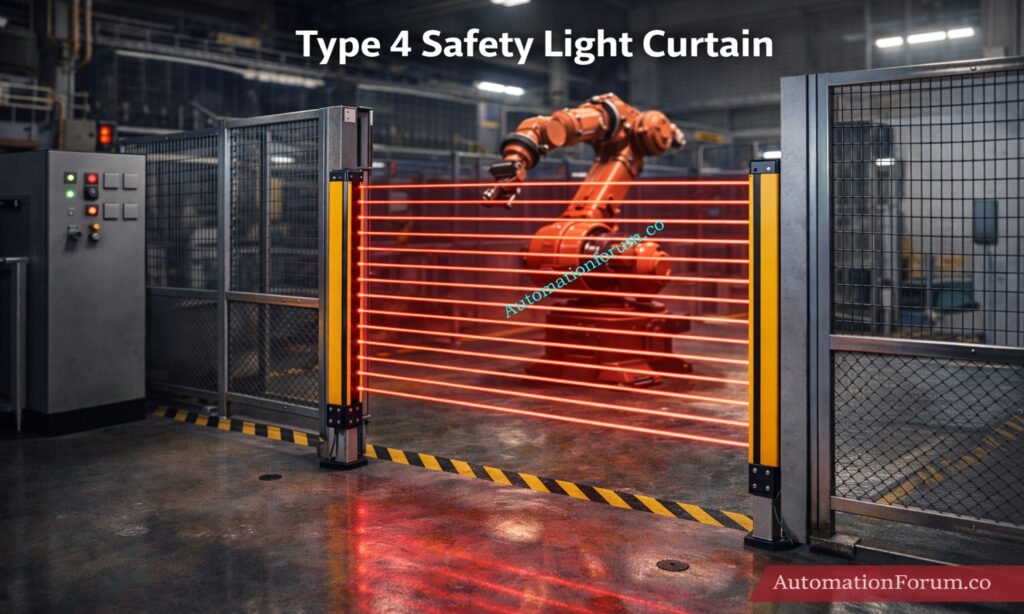
Type 4 Safety Light Curtain
Type 4 light curtains are the highest safety category commonly used in industrial automation. They provide greater fault detection, higher reliability, and are used in more demanding applications such as presses, robotic cells, and high-risk machinery.
Finger Protection, Hand Protection and Body Protection
The beam resolution determines what size object can be detected. A tighter beam spacing is used for finger protection, while wider spacing is used for hand or body protection. This selection must match the hazard and the required stopping performance.
Choosing the wrong resolution can create a false sense of safety or unnecessary nuisance trips.
Prevent dangerous SIS design errors: Top Critical Mistakes in Safety Instrumented System Design as per ISA 84 Standard and How to Avoid Them
Safety Light Curtain Integration with PLC and Safety Systems
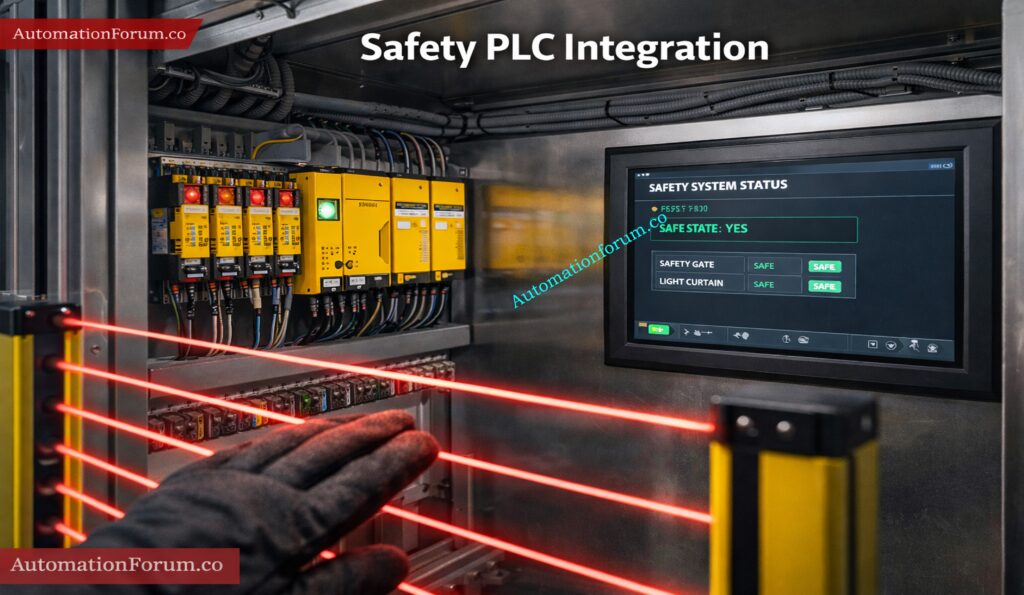
Safety light curtains are often integrated with a PLC, safety relay, or safety PLC. In standard industrial practice, the light curtain is not connected directly to the control logic that runs the machine sequence. Instead, it is connected to a dedicated safety circuit.
A simple logic example is:
- Beam OK → Machine RUN
- Beam Broken → Machine STOP
In real systems, this logic is implemented through safety-rated hardware and software, not ordinary PLC code alone. The safety circuit may control contactors, enable drives, or trigger a safe torque off function.
For complex machines, the light curtain may be integrated with emergency stop circuits, guard door switches, and muting logic. In a safety PLC environment, the system can also report diagnostics to the HMI or SCADA system without compromising safety integrity.
This is one reason why safety light curtain in PLC systems has become a standard topic for automation engineers. The control system must remain productive, but the safety function must always take priority.
Protect plants with setpoint control: Alarm & Trip Setpoint List in Instrumentation Engineering: The Most Critical Document for Plant Safety
Safety Light Curtain Standards and Certifications
Several international standards govern the design and application of these devices.
IEC 61496 for Safety Light Curtains
This is the main standard for electro-sensitive protective equipment, including safety light curtains. It lays out safety classifications like Type 2 and Type 4, as well as functional requirements and test procedures.
ISO 13849 for Functional Safety
This standard talks about the safety portions of control systems and introduces Performance Level, or PL. Engineers generally figure out the PL that is needed by looking at the machine risk assessment.
IEC 61508 and Safety Integrity
This is the foundational standard for functional safety and introduces the concept of SIL, or Safety Integrity Level. While light curtains are usually specified through IEC 61496 and ISO 13849, SIL concepts are often used in broader safety system design.
OSHA Machine Guarding Requirements
In many workplaces, OSHA regulations also influence machine guarding and operator protection requirements. Even when local regulations differ, the principle remains the same: machinery must be guarded or protected by equivalent safety measures.
For engineers, it is important to understand that safety devices are not selected only by price or brand. They must be selected based on standards, risk level, stopping time, and application suitability.
Master SIS, SIF, and SIL: What is SIS, SIF and SIL? An In-Depth Guide to Functional Safety in Process Industries
Safety Light Curtain Installation and Design Considerations
A proper installation requires more than mounting the sensor and wiring it into a panel.
Minimum Safety Distance Calculation
The most critical design factor is minimum safety distance. The light curtain must be placed far enough from the hazard so that the machine stops before a person can reach the danger zone. This calculation must include response time, machine stopping time, and the possible approach speed of the operator.
Response Time of Safety Light Curtains
Every safety light curtain has a response time. Faster devices allow shorter safety distances, but the total system response must include the relay, PLC, contactors, and machine deceleration.
Installation Height and Beam Positioning
The mounting height should match the expected access point. A poorly positioned curtain may leave an unsafe gap at the top or bottom of the opening.
Environmental Factors Affecting Performance
Dust, oil mist, vibration, steam, and bright ambient light can affect performance. In harsh environments, the enclosure rating, alignment stability, and cleaning schedule become very important.
The main rule is simple: minimum distance must consider machine stopping time and human reach distance.
Compare standard and safety PLCs: Difference Between Standard and Safety PLCs: Features, Applications & Future Trends
Advantages of Using a Safety Light Curtain
Safety light curtains offer several major benefits in industrial automation.
They do not require a physical barrier, so operators can access machines faster and more easily. That improves cycle time and reduces repetitive manual handling effort. They also reduce the need for opening and closing gates, which lowers operator fatigue and improves workflow.
In many applications, they provide a better balance between safety and productivity than traditional guards. They are also flexible to install because they can protect wide openings, access points, and transfer zones without major mechanical redesign.
Test your intrinsic safety knowledge: Advanced Quiz on Intrinsic Safety Instrumentation Circuits in Oil & Gas Process Industries
Limitations of Safety Light Curtains
Despite their advantages, light curtains are not perfect for every environment.
They may not perform well in areas with heavy dust, oil contamination, or vibration if the installation is poor. Misalignment between transmitter and receiver can cause frequent trips. Dirty lenses can block beams and trigger unwanted stoppages. Reflective surfaces near the sensing field may also create problems.
Another important limitation is that a light curtain is only one part of the safety design. It can’t take the place of a competent risk assessment, analysis of stop time, and machine control architecture. Engineers shouldn’t think that just one safety sensor makes the system safe.
Explore the complete safety guide: S84 / IEC 61511 Standard for Safety Instrumented Systems – Complete Guide
Safety Light Curtain Applications in Industry
Safety light curtains are popular in the process and manufacturing industries because they protect people without touching them and let operators work with machinery when they need to. They don’t block access like physical guards do, which makes them great for situations where you need to load, unload, or make changes often. Because they are so flexible, they are seen to be vital machine safety sensors in modern automation systems.
Safety Light Curtains in Press Machines
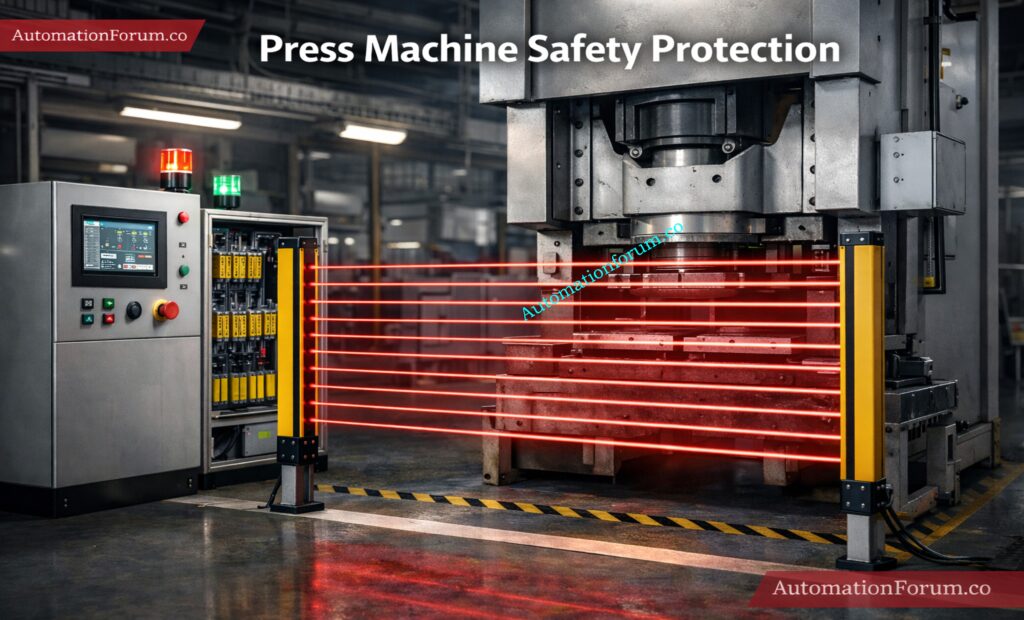
Safety light curtains are put in place at the front access point of press machines, where operators put in materials or take out produced pieces. These machines work with a lot of power and cycles that go very quickly, therefore it’s very important to protect the operator.
The light curtain keeps an eye on the opening all the time. If a hand goes into the danger zone, it stops the machine cycle or stops the press from stroking right away. This makes sure that the operator can’t get to the dangerous location while the machine is running, which greatly lowers the chance of getting hurt.
Safety Light Curtains in Robotic Cells
Light curtains are often used to protect the edges and access ports of robotic cells. Industrial robots move quickly and can be very dangerous if a person gets in their way.
The light curtain makes it safe to load and unload. The mechanism stops safely if someone crosses the protected zone while the robot is working. This makes sure that people and machines can interact safely without having to have full protection in all circumstances.
Download key safety terminology: Functional Safety Terminology – Excel Download for Industrial Automation
Safety Light Curtains in Packaging Lines
Packaging lines operate all the time, and operators often have to step in to clear jams, align products, or switch over to a new line. Light curtains are put up around conveyors, sealing equipment, and filling systems to keep people from getting in.
The light curtain picks up on the disruption when an operator reaches into the machine and safely stops the motion. This lets you act quickly while still getting work done, which is very important in fast-paced production settings.
Understand intrinsic safety basics quickly: What is Intrinsic Safety? Definition, Working Principle, Standards and Applications
Safety Light Curtains in Conveyor Systems
Transfer points, infeed/outfeed areas, and accumulation sections are all dangerous areas in conveyor systems. These places are dangerous because they could trap or get stuck.
Safety light curtains keep an eye on these areas and halt the conveyor when the beam is broken. Compared to fixed guards, they provide easier access for maintenance and operation while still ensuring safety.
Safety Light Curtains in Material Handling Equipment
These applications clearly demonstrate how light curtains function as effective industrial safety interlocks. They lower the chance of accidents, make it easier for operators to go to work safely, and keep production going.
Safety light curtains are an important part of modern industrial automation because they combine quick reaction, non-contact sensing, and easy interaction with control systems.
See why IS is preferred: Why Choose Intrinsic Safety (IS) for Hazardous Area Instrumentation?
Troubleshooting Safety Light Curtain Problems
If a light curtain malfunctions or trips a lot, it’s usually because of one of the following:
- Misalignment between emitter and receiver
- Dirty or scratched lenses
- Loose wiring or damaged cables
- Interference from reflective surfaces
- OSSD output faults
- Incorrect safety distance or mounting height
Before replacing the device, a disciplined maintenance crew should verify the alignment, cleaning condition, wiring integrity, and diagnostic signs. Installation problems, not product failure, are what generate a lot of false trips.
Discover the best detector choice: Why 3-Wire Type Fire and Gas Detectors are the Preferred Choice in Industrial Safety?
Safety Light Curtain vs Physical Guard
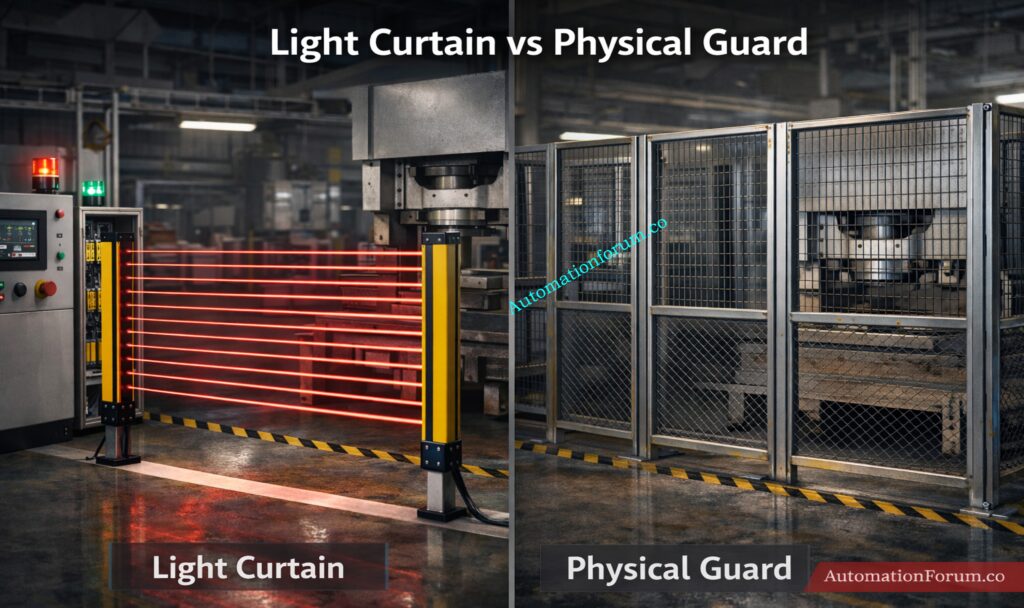
A physical guard is a solid barrier constructed of metal, mesh, polycarbonate, or similar hard material. The major thing it does is keep people from getting directly into the dangerous region. It’s simple, sturdy, and easy to grasp since it keeps the operator and the machine apart. It works well in situations where you don’t need to get to it while it’s running.
A safety light curtain, on the other hand, doesn’t physically obstruct entry. Instead, it uses infrared beams to make a safe area that you can’t see. The device will stop the machine right away if someone enters that area. This makes it better for equipment where workers have to load, unload, examine, or change materials often.
| Feature | Light Curtain | Physical Guard |
| Access | Easy | Restricted |
| Safety | High | High |
| Productivity | High | Low |
| Maintenance | Medium | Low |
| Flexibility | High | Low |
Access Control Comparison
A light curtain lets people in without having to open or move a barrier. This is useful when operators need frequent interaction with the machine. A physical guard restricts access more strongly, so the operator must usually stop the machine and remove or open the guard before entry.
Safety Performance Comparison
Both solutions can provide high safety when correctly designed. A physical guard prevents contact by blocking the hazard directly. A light curtain protects by sensing intrusion and stopping motion before contact occurs.
Challenge your SIS expertise now: Test Your Expertise in Safety Instrumented Systems (SIS): Knowledge Quiz
Productivity Comparison
Light curtains usually support higher productivity because they reduce the time needed for access. When loading, unloading, or setting up, operators can get more done. Physical guards can slow down production since they have to be opened, closed, or taken off every time someone needs to get to something.
Maintenance Comparison
Because they are passive and don’t have electronics, physical guards normally need less upkeep. Light curtains need periodic checks for alignment, contamination, wiring issues, and correct operation of the safety circuit.
Flexibility Comparison
Light curtains are more versatile since they can protect open areas, transfer points, and access zones without completely closing them off. Physical guards are less adaptable, and if the layout of the process changes, they often need to be redesigned mechanically.
A physical guard is strong and easy to use, but it might slow things down. A light curtain is easier to use and more flexible, but it needs to be designed correctly, have the right safety distance, and be checked on a regular basis to stay safe.
Know why safety relays matter: What is Safety Relay? Why is a Normal Electromechanical Relay not Considered Safe?
Best Practices for Safety Light Curtain Installation
Before you install, always check the safety distance. Make sure the curtain resolution matches the real danger and need for access. Use a safety PLC or safety relay for critical applications rather than standard control logic. Test the system regularly and document inspection results. Never bypass or jumper the device during production.
For long-term reliability, train operators and maintenance staff to understand the light curtain function, so they do not treat it as a nuisance device. In reality, it is part of the core safety architecture of the machine.
Prepare with safety PLC Q&A: Safety PLC Interview Questions and Answers
Frequently Asked Questions About Safety Light Curtains
How does a safety light curtain detect objects?
It sends and receives signals using more than one infrared beam. The system knows that an object is blocking a beam and sends a stop signal.
What is OSSD in a light curtain?
OSSD stands for Output Signal Switching Device. It is a safety output that switches off when the curtain detects a fault or beam interruption.
Can light curtains replace safety guards?
In many applications, yes, but only after a proper risk assessment. They are not suitable for every hazard or environment.
What is safety distance calculation?
It is the minimum separation between the light curtain and the hazard so the machine can stop before the operator reaches danger.
Where are light curtains used in industry?
They are used in press machines, robotic cells, packaging systems, conveyors, and automated material handling equipment.
How does a safety light curtain operate?
A safety light curtain uses several infrared beams between a transmitter and a receiver to make an invisible wall of protection. If any beam is broken, the machine gets a stop signal right away to keep people from getting hurt.
What is a safety light curtain used for?
In industrial settings, a safety light curtain is utilized to keep people safe from dangerous machines. It keeps people out of harmful places by stopping machine operation and detecting entry.
What are the benefits of using a safety light curtain?
Safety light curtains improve operator safety while allowing easy and fast access to machines without physical barriers. They increase productivity, reduce downtime, and provide flexible installation in automation systems.
What is Type 4 safety light curtain?
A Type 4 safety light curtain is a high-quality safety equipment that can monitor itself and has backup systems. It is made for use in high-risk situations. It satisfies the greatest safety standards, such SIL 3, and gives you the most reliable protection.
What is the difference between Type 2 and Type 4 light curtains?
Type 2 light curtains are for lower-risk situations when basic safety features are needed. Type 4 light curtains, on the other hand, have more extensive diagnostics and can handle more faults. Type 4 is better for important machines that need more safety.
What is an alternative to a safety light curtain?
A physical guard, like safety fencing, gates, or mechanical obstacles, can be used instead of a safety light curtain. These safeguard by physically limiting access instead of using electronics to find intruders.
Learn how safety barriers work: What is a Safety Barrier? & how does Safety Barrier work?
Conclusion: Why Safety Light Curtains Are Important in Modern Automation
A light curtain can be a reliable part of the entire risk reduction plan if it is chosen correctly, installed with the right safety distance, and connected to safety PLCs or relays. This is the kind of smart protection that keeps factories running securely, efficiently, and with less downtime in Industry 4.0 settings.
Refer the below link to Compare Zener and galvanic isolation: Understanding Zener vs Galvanic Isolation in IS Loops for 4 to 20 mA Systems
