
- Introduction to Control Valve Selection in Process Industries
- What is a Globe Valve Working Principle Applications Advantages and Limitations
- What is a Ball Valve Working Principle Applications Advantages and Limitations
- What is a Butterfly Valve Working Principle Applications Advantages and Limitations
- Globe vs Ball vs Butterfly Valve Detailed Comparison and Key Differences
- Throttling vs On Off Valve Applications in Process Industries
- Pressure Drop and Energy Efficiency in Control Valves
- Application Based Valve Selection Guide for Process Industries
- Common Mistakes in Control Valve Selection and How to Avoid Them
- Expert Tips for Selecting the Right Control Valve
- When Not to Use Globe Ball and Butterfly Valves
- Control Valve vs Isolation Valve Key Differences
- Future Trends in Control Valve Technology and Smart Valves
- Quick Selection Chart for Globe Ball and Butterfly Valves
- Globe vs Ball vs Butterfly Valve Selection Summary
Introduction to Control Valve Selection in Process Industries
Why Control Valve Selection is Critical for Process Performance
Picking the right control valve in process industries is a big technical decision that affects how well the complete plant works, how efficiently it runs, and how reliable it is.
Impact of Valve Selection on Energy Efficiency and System Stability
Valves are more than just mechanical parts; they have a direct effect on:
- The stability and reaction time of process control loops.
- The amount of energy that compressors and pumps use.
- How often maintenance is done and how long the plant is down.
- Safety and compliance with operational standards.
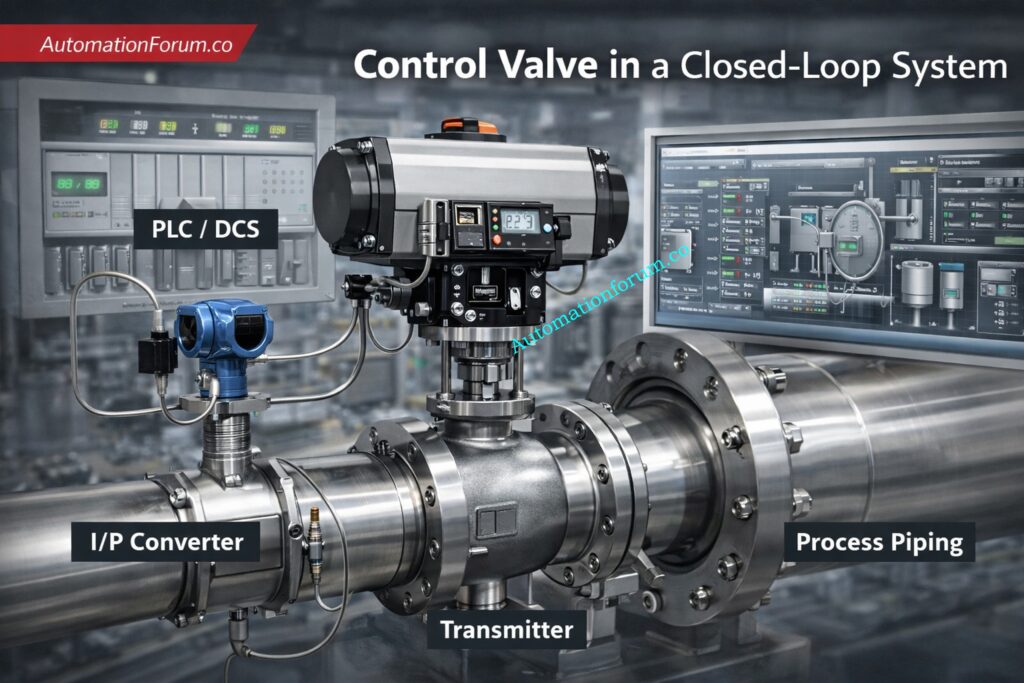
Overview of Globe Ball and Butterfly Valves in Industrial Applications
In most industrial applications, engineers must choose between:
- Globe valve for precision control.
- Ball valve for tight shutoff.
- Butterfly valve for large flow systems.
Key Challenges in Selecting the Right Control Valve
A wrong selection can lead to:
- Poor PID control tuning and oscillations.
- Excessive pressure drop and energy losses.
- Erosion of the valve and early failure.
- Higher costs of doing business.
Importance of Control Valve Types Comparison for Engineers
To make sure that you know how to compare different types of control valves, you need to:
- The best precision for flow control.
- Lowest cost over the life of the product.
- The system works at its best.
Ultimate Control Valve Body Material Selection Guide: Control Valve Body Material Selection Guide for EPC Design Instrumentation Engineers
What is a Globe Valve Working Principle Applications Advantages and Limitations
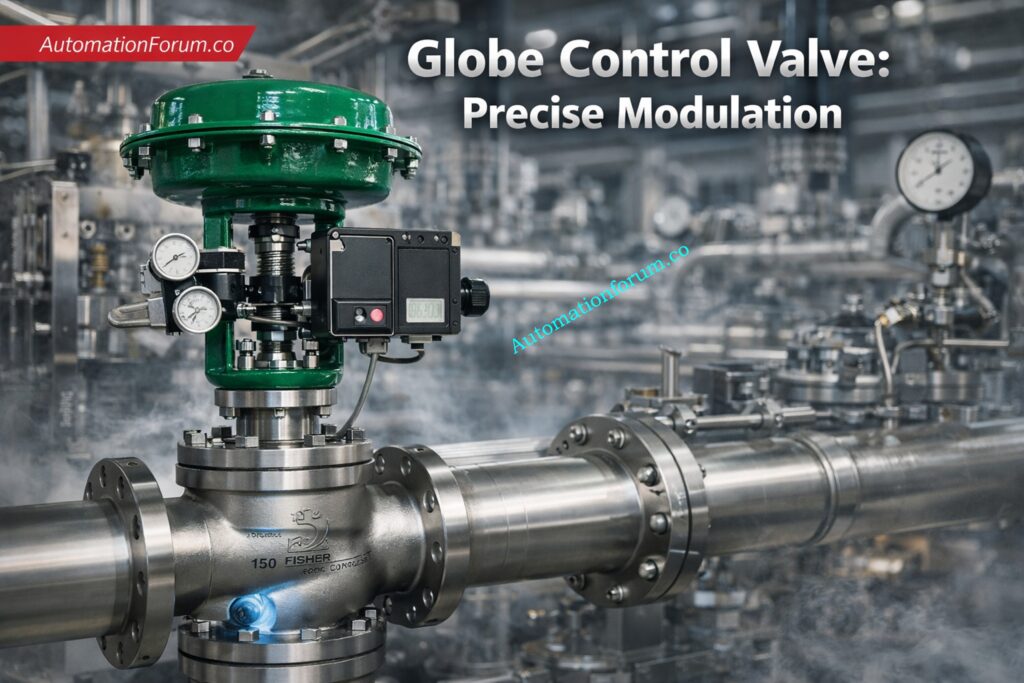
A globe valve is a linear motion valve specifically designed for accurate throttling and continuous flow control.
Globe Valve Working Principle and Flow Control Mechanism
- Flow is controlled by a plug or disc moving linearly.
- Fluid passes through a tortuous S shaped path.
- Flow restriction is created by adjusting plug position.
- The valve opening directly influences flow rate.
Key Components of a Globe Control Valve
- Valve body with a wall within that changes the direction of flow.
- Seat ring that makes a sealing surface.
- Plug or disc responsible for throttling.
- Stem that connects plug to actuator.
- Bonnet assembly ensuring pressure containment.
Typical Industrial Applications of Globe Valves
- Steam control systems in power plants.
- Boiler feedwater regulation.
- Chemical dosing and injection systems.
- High precision flow control loops.
- Oil and gas refining processes.
Why Globe Valves Cause High Pressure Drop
- Globe valves provide excellent throttling performance.
- They naturally cause a large drop in pressure since the flow direction changes.
Globe Valve Advantages in Flow Control Systems
- Gives PID loops very precise and steady flow control.
- Supports rapid opening and linear equal percentage features.
- Reliable for use in high-pressure and high-temperature situations.
- Keeps up the same level of performance no matter what the flow conditions are.
- Perfect for applications that need constant modulation.
- Under controlled settings, it is less likely to cavitate.
- Good for important control loops where stability is a must.
In-Depth Rangeability vs Turndown Explained: Understanding Rangeability vs Turndown Ratio in Control Valve Sizing
Globe Valve Limitations and Engineering Constraints
- A high pressure drop makes the pump use more energy.
- Compared to other valves, this one is bigger and heavier.
- Because of flow resistance, it needs more actuator force.
- Higher expense since the interior design is more complicated.
- Maintenance required due to seat and plug wear.
- Not cost-effective for pipes with big diameters.
- Flow turbulence may lead to noise and vibration.
Complete Control Valve Hunting Due to PID Guide: Control Valve Hunting Due to PID Controller: Causes, Effects, Root Analysis and Complete Troubleshooting Guide for Industrial Process Control Systems
What is a Ball Valve Working Principle Applications Advantages and Limitations
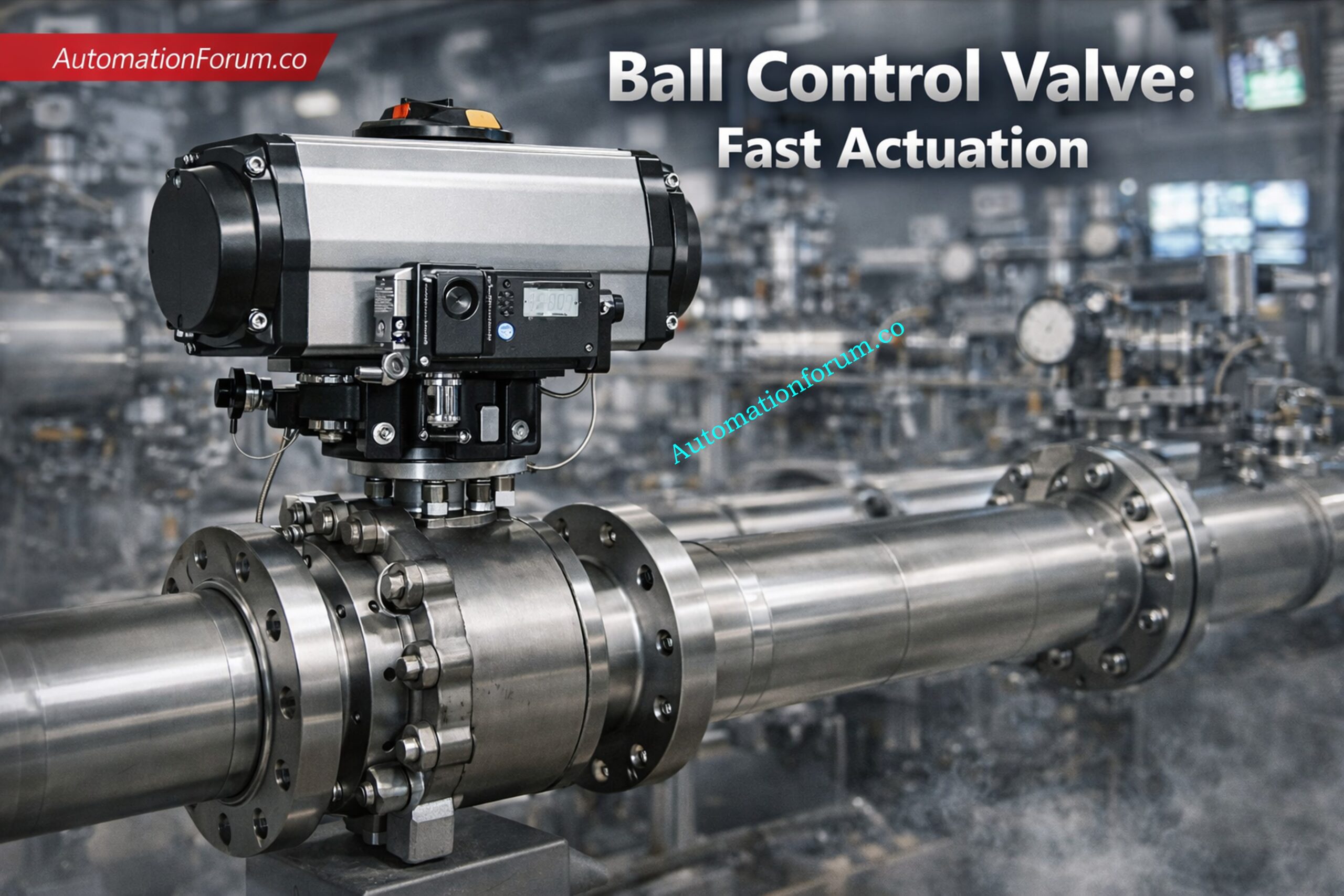
A ball valve is a type of rotary valve that turns a quarter turn. It is mostly used for isolation and quick shutoff.
Ball Valve Working Principle and Quarter Turn Operation
- Uses a rotating spherical ball with a central bore.
- 90 degree rotation aligns or blocks flow.
- Provides a straight through unobstructed flow path.
Full Bore Design and Flow Efficiency of Ball Valves
- Oil and gas pipeline isolation.
- Emergency shutdown systems.
- Utility services such as air water and gas.
- Chemical transfer lines.
- High pressure applications.
Why Ball Valves Provide Low Pressure Drop
- Ball valves provide very low pressure drop due to full bore design.
- Flow coefficient Cv is significantly higher than globe valves.
Advantages of Ball Valves for Isolation and Shutoff
- Provides a bubble-tight shutdown with no leaks.
- Very little drop in pressure, which makes it energy efficient.
- Quick operation that is good for emergency situations.
- Compact design reduces installation space.
- Long service life due to simple mechanism.
- Suitable for high pressure and temperature conditions;.
- Can handle liquids gases and some slurry applications
- Easy automation with electric or pneumatic actuators.
Limitations of Ball Valves in Throttling Applications
- Not good for control or throttling uses.
- Seat damage can occur during partial opening.
- Poor flow control characteristics especially near closed position.
- Risk of cavitation and flashing in throttling service.
- Limited ability to maintain stable intermediate flow.
- Running control service a lot shortens its life.
- Not the best for controlling flow exactly in process loops.
Definitive ESDV vs EBDV Fail Close vs Fail Open: ESDV vs EBDV – Fail Close vs Fail Open | Emergency Shutdown Valve vs Emergency Blowdown Valve
What is a Butterfly Valve Working Principle Applications Advantages and Limitations
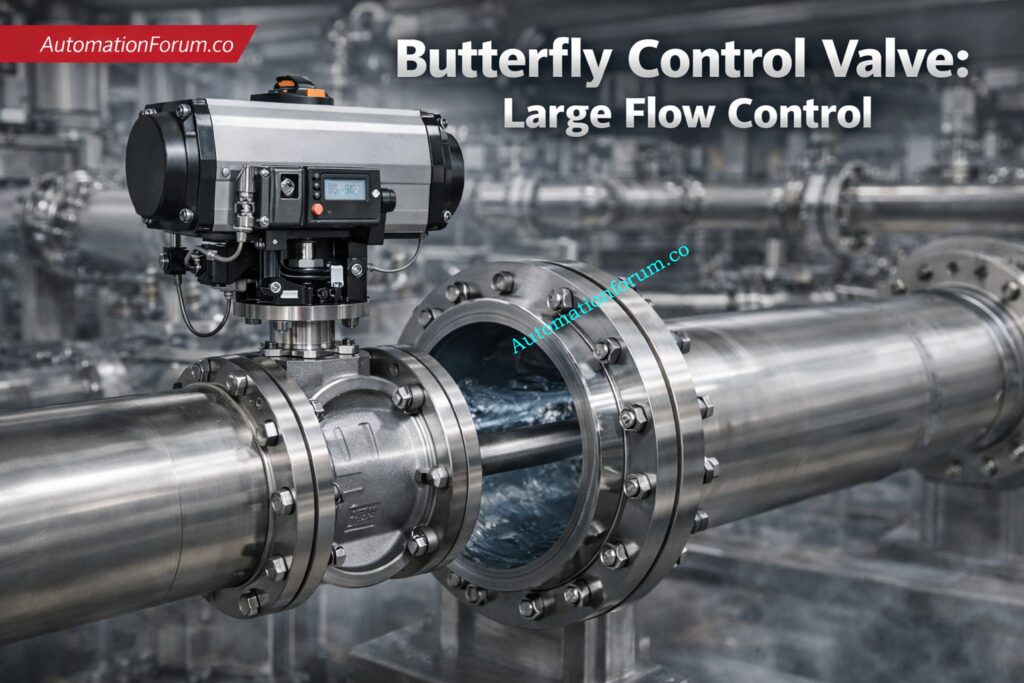
A butterfly valve is a type of rotary valve that can handle a lot of flow at a cheap cost.
Butterfly Valve Working Principle and Disc Rotation Mechanism
- It has a revolving disc in the flow channel.
- The disc turns 90 degrees to control the flow.
- Disc remains partially in flow even when fully open.
Industrial Applications of Butterfly Valves in Large Pipelines
- Water treatment plants.
- HVAC chilled water systems.
- Cooling water distribution networks.
- Large diameter pipelines.
- Wastewater and utility systems
Professional Control Valve Sizing Calculator ISA Guide: Control Valve Sizing Calculator: Complete ISA S75.01 Cv Calculation Guide for Instrumentation Engineers
Impact of Disc Obstruction on Flow Performance
- Butterfly valves offer low cost and lightweight construction
- They introduce moderate pressure drop due to disc obstruction.
Advantages of Butterfly Valves for Cost Effective Flow Control
- Very cost-effective, especially for valves with large diameters.
- Lightweight means that less support is needed for the structure.
- The small size makes installation easier.
- Quick operation with low torque requirement.
- Suitable for large flow capacity applications.
- Easy maintenance due to simple design.
- Good choice for low to medium pressure systems.
- Works well in water based and utility systems.
Limitations of Butterfly Valves in Precision Applications
- Limited throttling precision compared to globe valves.
- Disc obstruction causes continuous pressure loss.
- Not ideal for high accuracy control loops.
- Performance decreases under high pressure conditions.
- Potential leakage in high pressure applications.
- Not suitable for pigging operations due to obstruction.
- Flow characteristics are non linear and less predictable.
Practical Control Valve Not Responding Troubleshooting: Field Troubleshooting Guide: Control Valve Not Responding in Process Area
Globe vs Ball vs Butterfly Valve Detailed Comparison and Key Differences
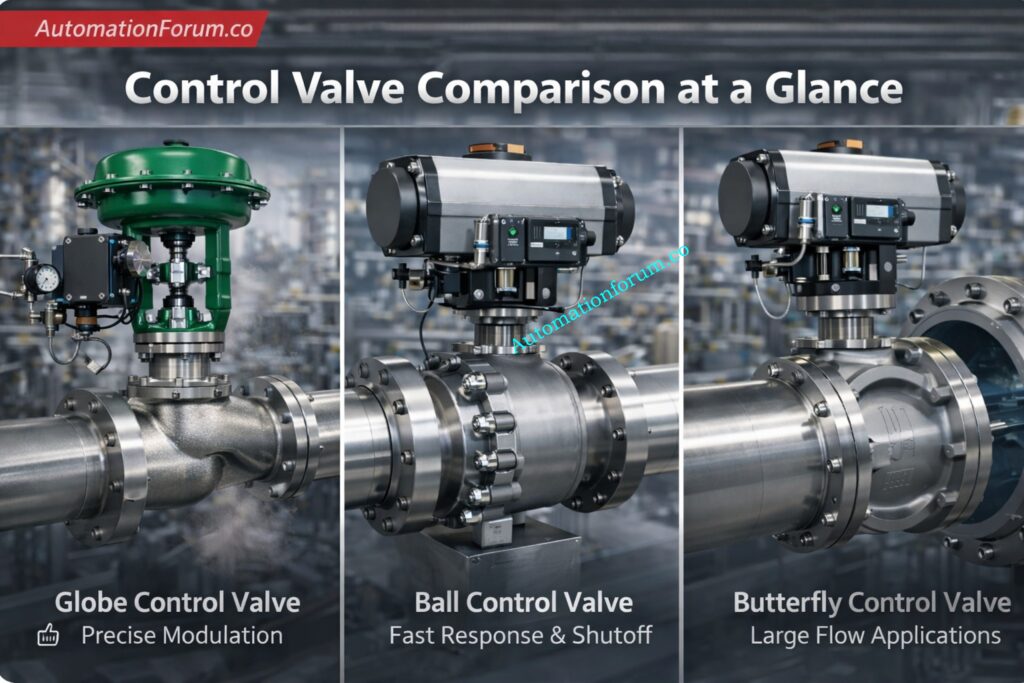
| Parameter | Globe Valve | Ball Valve | Butterfly Valve |
| Valve Type | Linear motion control valve | Quarter turn rotary isolation valve | Quarter turn rotary flow valve |
| Working principle | Linear plug movement against seat | Rotating spherical ball with bore | Rotating disc in flow path |
| Flow path geometry | S shaped multi directional path | Straight full bore flow | Disc always in flow path |
| Flow behavior | High turbulence improves control | Laminar low resistance flow | Moderate turbulence due to obstruction |
| Flow control capability | Excellent precise control | Poor mainly on off | Moderate coarse control |
| Throttling performance | Best for continuous modulation | Not suitable for throttling | Limited throttling capability |
| Control accuracy | Very high and stable | Very poor in mid position | Moderate accuracy |
| Control stability | Highly stable for PID loops | Unstable during partial opening | Moderately stable |
| Flow coefficient Cv | Low to moderate | Very high | Medium to high |
| Flow characteristics | Linear equal percentage | Quick opening | Non linear |
| Shut off performance | Very good sealing | Excellent bubble tight sealing | Good depends on seat design |
| Leakage class | Class IV to V typical | Class VI tight shutoff | Class II to IV |
| Pressure drop | High due to flow direction changes | Very low due to straight flow | Low to moderate due to disc |
| Energy efficiency | Low | Very high | High |
| Cavitation resistance | Good with proper trim | Poor in throttling | Moderate |
| Flashing resistance | Good | Poor | Moderate |
| Noise generation | High due to turbulence | Low | Moderate |
| Vibration tendency | Moderate to high | Low | Moderate |
| Operation speed | Slow multi turn operation | Fast quarter turn | Fast quarter turn |
| Actuation force | High thrust required | Low torque required | Very low torque required |
| Automation suitability | Excellent for control valves | Excellent for isolation automation | Excellent for large automated systems |
| Size suitability | Small to medium pipelines | Small to large pipelines | Medium to very large pipelines |
| Size and weight | Heavy and bulky | Compact | Very lightweight |
| Installation space | Requires more space | Moderate space | Minimal space required |
| Maintenance frequency | Moderate to high due to wear | Low maintenance | Low maintenance |
| Maintenance complexity | Higher due to internal parts | Simple design | Very simple design |
| Seat wear | High in throttling service | Low in on off service | Moderate |
| Durability | Moderate under continuous throttling | High durability | High for utility service |
| Fluid compatibility clean fluids | Excellent | Excellent | Excellent |
| Fluid compatibility slurry | Poor due to clogging risk | Moderate | Excellent |
| Pigging suitability | Good | Excellent | Poor due to obstruction |
| High pressure suitability | Excellent | Excellent | Limited unless high performance design |
| High temperature suitability | Excellent | Excellent | Moderate |
| Cost initial | High | Medium | Low |
| Lifecycle cost | High due to energy loss | Medium | Low |
| Energy loss impact | High operating cost | Minimal energy loss | Moderate energy savings |
| Industry usage | Control loops and regulation | Isolation and shutdown | Bulk flow and utilities |
Comprehensive Partial Stroke Test PST Guide: What is Partial Stroke Test (PST)? A Complete Guide for Shutdown and Control Valves
Engineering Insights
| Engineering Aspect | Key Insight |
| Control Performance | Globe valve provides the highest accuracy due to linear motion and precise throttling |
| Energy Efficiency | Ball valve offers maximum efficiency due to straight flow path and minimal resistance |
| Cost Efficiency | Butterfly valve provides best cost advantage especially in large diameter systems |
| Pressure Drop Impact | Globe valve has highest pressure loss while ball valve has the lowest |
| Best Use Case | Globe for control, ball for isolation, butterfly for large flow systems |
| Selection Strategy | Always balance precision, energy efficiency, and cost based on process requirements |
Core Control Valve Characteristics Explained: Why Control Valve Characteristics Matter in EPC Instrumentation and Control Engineering
Throttling vs On Off Valve Applications in Process Industries
Why Globe Valves are Best for Throttling Applications
- Globe valve is the preferred option because it provides smooth and continuous flow modulation where the valve position directly controls flow rate.
- It makes sure that Cv control is precise, so that flow varies in direct proportion to valve travel. This lets you size things correctly and know how they will work.
- Keeps the control loop behavior consistent, which cuts down on oscillations, hunts, and problems with PID tuning that happen too often.
- Supports linear and equal percentage features, which are important for keeping process control steady.
- Can handle variations in pressure, temperature, and fluid characteristics without becoming unstable.
- Offers a wide range of flow rates, thus it can work well from very low flow to very high flow.
- Unlike on-off valves, which wear out when they are partially open, these are made to handle continuous throttling duty.
- Can handle applications with a lot of pressure drop, and has features like anti-cavitation trims for heavy use.
- Lessens the chance of seat erosion since flow is spread out over the plug and seat instead of being focused.
- Often used in important control loops such controlling steam flow, pressure, temperature, and chemical dosing.
Proven Control Valve Passing Root Cause Analysis: How to Troubleshoot a Control Valve Passing Problem after Overhauling: Complete Root Cause Analysis
Why Ball Valves are Preferred for On Off Isolation
- People like ball valves because they shut off tightly with almost no leaks, which keeps the process safe and the isolation intact.
- It can be fully open or fully closed, which makes it better for isolation than modulation.
- Makes sure that emergency shutdown systems (ESD) respond quickly when immediate isolation is needed.
- Works with a quarter-turn action, which makes it easy and quick to use with little torque.
- Keeps working reliably over many cycles, especially in situations where it needs to be opened and closed often.
- When fully open, it has a very low pressure drop, which makes the system work better and saves energy.
- It doesn’t become worn out as quickly because it’s not always in a state of throttling.
- Good for isolating high-pressure and high-temperature systems, notably in oil and gas systems.
- Because it is easy to build and has fewer moving parts, it doesn’t need much upkeep.
- Often utilized in safety shutdown systems, fuel systems, utility lines, and pipeline isolation.
Step-by-Step Control Valve Datasheet Preparation: How to Prepare Control Valve Datasheets: A Step-by-Step Procedure for EPC Instrumentation Engineers
When to Use Butterfly Valves in Intermediate Applications
- When you need to handle a lot of flow quickly, you should use a butterfly valve.
- Perfect for big pipes where globe valves are too big and costly.
- Used when moderate control is okay, but high precision control is not.
- Offers a cost-effective alternative, especially in larger sizes, when compared to globe and ball valves.
- Has a small, light design that takes up less room and puts less stress on the structure.
- Needs little torque to work, which makes it good for big automated systems.
- Brings about a modest drop in pressure, which is fine for utility systems.
- Good for water, air, gas, and slurry services, especially when they aren’t very important.
- Provides quick operation similar to ball valves, with simple actuation.
- Commonly used in cooling water systems, HVAC, wastewater treatment, and utility pipelines.
High-Precision Control Valve Noise Calculator IEC 60534: Control Valve Noise Prediction Calculator – IEC 60534 Based Engineering Tool
Real Plant Examples of Valve Selection in Industry
- Steam turbine control systems use globe valves because they require precise flow modulation, stable pressure control, and high temperature capability.
- Boiler feedwater control loops rely on globe valves to maintain accurate flow and avoid thermal imbalance.
- Ball valves are used in gas pipeline isolation systems because they need to shut off right away, not leak, and be very safe.
- Ball valves are used in firewater and safety systems because they respond quickly and work well to isolate things.
- Butterfly valves are used in cooling water headers because they can manage huge flow rates at a low cost and with little space needed.
- HVAC chilled water systems employ butterfly valves because they are easy to install and work well for controlling.
- Chemical dosing systems use globe valves for precise injection and flow regulation.
Expert Control Valve Selection for Harsh Conditions: Control Valve Selection and Recommended Practices for Harsh Process Conditions
Cv Characteristics and Flow Behavior in Different Valve Types
- Globe valves have Cv characteristics that are steady and predictable. This means that flow changes in a way that is proportionate to the valve position, which makes control easier.
- Ball valves have very high Cv values, which means they can handle a lot of flow, however they don’t work well when they are just partially open since the flow suddenly increases.
- Butterfly valves have a moderate Cv and behave in a non-linear way, which makes them good for mid-range control but not for precision applications.
- Flow characteristic curves like linear, equal percentage, and rapid opening tell control valves how to work. These curves show how the valve position affects the flow rate.
- Quick opening is usually utilized for on-off applications, while linear and equal percentage are employed for throttling.
- A greater Cv means a bigger flow capacity but a lesser control resolution.
- A lower Cv means that the system is easier to operate, but it also means that the pressure drop is higher.
- Choosing the right Cv is very important for sizing valves, making control loops work better, and making the whole system work better.
Essential Control Valve Accessories for Reliability: Essential Control Valve Accessories for Reliable Process Control
Pressure Drop and Energy Efficiency in Control Valves
Flow Path Impact on Pressure Drop in Globe Ball and Butterfly Valves
- Because the flow direction changes a lot, the globe valve creates a lot of turbulence, which makes it hard to go through the valve.
- The S-shaped flow route makes friction losses and energy loss happen more often while the machine is running.
- The ball valve lets full-bore flow go right through, which reduces blockages and keeps flow conditions close to those of a pipe.
- This straight approach makes the system more efficient by reducing turbulence and head loss.
- The disc of a butterfly valve makes it impossible for the valve to be fully open.
- The disc causes some turbulence and flow separation, which makes the pressure drop.
- The way the flow behaves has a direct effect on pressure drop, energy use, and system performance.
- More turbulence makes it easier to regulate things, but it makes them less efficient. Less turbulence makes things more efficient, but it makes them less precise.
Smart Control Valve Sizing for Maximum Efficiency: How to Properly Size Control Valves for Maximum Efficiency?
Engineering Impact of Pressure Drop on Pumps and Compressors
- Globe valves make the pressure drop more since the flow path is twisted, which makes it harder for the valve to work.
- A bigger reduction in pressure leads to:
- Need for higher pump discharge pressure.
- Gas systems have higher compressor loads.
- Less availability of downstream pressure.
- Ball valves cut down on losses because:
- The full bore design gets rid of flow restrictions.
- Fluid flows with little loss of energy.
- Good for systems where keeping pressure is very important.
- Butterfly valves lower pressure by a reasonable amount, which strikes a balance between cost and efficiency.
- The pressure loss across butterfly valves gets bigger when:
- Valve closing position.
- Flow velocity and turbulence.
- In big systems, a drop in pressure has a direct effect on:
- Pump sizing
- Pipe sizing
- Overall plant energy consumption.
Refer the below link to test your knowledge with our Control Valve Hunting Troubleshooting – Advanced MCQ Quiz
Energy Efficiency Comparison of Different Valve Types
- A significant pressure drop means that the pump needs more head, which means it uses more power.
- Increased energy consumption results in:
- More expensive to run.
- Less efficient system.
- Industries that use a lot of energy have a bigger carbon footprint.
- Globe valves are less energy efficient because they naturally limit flow, but they are needed when precise control is important.
- Ball valves are the most energy-efficient because they let almost little resistance flow when they are fully open.
- Butterfly valves are great for systems with a lot of flow because they strike a good compromise between:
- Acceptable pressure drop
- Reduced installation cost
- Lower overall energy consumption
- Using globe valves in big pipes can greatly raise the cost of energy over the life of the valve, making butterfly valves a better choice.
- Choosing the right valve can cut down on:
- Pump operating cost
- Maintenance frequency
- System inefficiencies
Critical Importance of Control Valve Cv Measurement: Why Measuring Control Valve Cv is Essential for Proper Valve Sizing ?
How Valve Selection Affects Operating Cost and Energy Consumption
Use globe valve when:
- More crucial than energy efficiency is the accuracy of flow control.
- In control loops, a high pressure drop is fine.
Use ball valve when:
- Minimum pressure loss is critical.
- System efficiency and energy savings are priority.
Use butterfly valve when:
- Large flow systems require cost and energy balance.
- Moderate pressure drop is acceptable.
- Always evaluate pressure drop as part of valve sizing, not as an afterthought.
- Incorrect valve selection can lead to:
- Oversized pumps
- Increased energy bills
- Reduced system performance
Role of Pressure Drop in Valve Sizing and System Design
- Pressure drop is not just a hydraulic parameter it directly affects energy efficiency, operating cost, and equipment sizing.
- Globe valve equals high control with high energy loss.
- Ball valve equals maximum efficiency with minimal loss.
- Butterfly valve equals balanced performance for large scale systems.
Key Role of Control Valve Actuator Bench Set: Why is Control Valve Actuator Bench Set Important ?
Application Based Valve Selection Guide for Process Industries
Valve Selection in Oil and Gas Industry Applications
- Globe valve used for precise flow control in process units.
- Ball valve used for isolation and emergency shutdown.
- Butterfly valve used in pipeline networks.
Valve Selection in Power Plants and Steam Systems
- Globe valve used in steam and feedwater control.
- Ball valve used for fuel isolation.
- Butterfly valve used in cooling water systems.
Reliable Control Valve SAT Procedure Guide: Control Valve Site Acceptance Test (SAT) Procedure – Step-by-Step Field Guide
Valve Selection in Water Treatment and Utility Systems
- Butterfly valve used in large pipelines.
- Ball valve used for isolation.
- Globe valve used for chemical dosing.
Valve Selection in HVAC Systems
- Butterfly valve used for chilled water circulation.
- Globe valve used for temperature control loops.
Valve Selection in Chemical and Process Plants
- Globe valve used for reaction control.
- Ball valve used for safety isolation.
- Butterfly valve used for utility services.
Powerful Benefits of Control Valve Positioners: Why You Should Use Control Valve Positioners?
Common Mistakes in Control Valve Selection and How to Avoid Them
- Using ball valve for throttling leading to seat damage.
- Ignoring pressure drop resulting in energy inefficiency.
- Selecting based only on cost instead of performance.
- Incorrect valve sizing affecting control accuracy.
- Not considering fluid characteristics such as solids or corrosive media.
- Using butterfly valve in precision control loops.
- Overlooking actuator sizing requirements.
- Ignoring lifecycle cost and maintenance factors.
Detailed Control Valve Leakage Testing Guide: Control Valve Leakage Testing, Types, and Calculation Standards
Expert Tips for Selecting the Right Control Valve
Selecting Based on Flow Control Requirements
- Choose globe valve for precise control.
- Choose ball valve for isolation.
- Choose butterfly valve for large flow.
Choosing Valve Based on Line Size and Pipe Diameter
- Small lines use globe or ball.
- Large lines use butterfly.
Considering Fluid Type and Process Conditions
- Clean fluids allow all valve types.
- Slurry applications favor butterfly valves.
Correct Forward vs Reverse Acting Valve Selection: When to Choose Forward and Reverse Acting Control Valves for Design Engineer
Evaluating Pressure Drop and Energy Efficiency
- Use ball valve where pressure loss must be minimal.
- Accept globe valve where control is critical.
Budget vs Performance Tradeoff in Valve Selection
- Low budget choose butterfly.
- Medium budget choose ball.
- High performance choose globe.
Maintenance Accessibility and Lifecycle Considerations
- Limited access choose ball or butterfly.
- Accessible systems allow globe valves.
Common Control Valve Actuator Problems and Solutions: Common Challenges and Solutions for Industrial Control Valve Actuators
When Not to Use Globe Ball and Butterfly Valves
When Not to Use Globe Valves
- Avoid in large diameter pipelines.
- Avoid where energy efficiency is critical.
- Avoid where low pressure drop is required.
When Not to Use Ball Valves
- Avoid in throttling applications.
- Avoid where precise flow control is required.
- Avoid in applications with continuous modulation.
When Not to Use Butterfly Valves
- Avoid in high precision control systems.
- Avoid in very high pressure applications.
- Avoid where zero leakage is mandatory.
Clear Cv vs Kv Relationship in Control Valves: Relationship Between Cv and Kv in Control Valves
Control Valve vs Isolation Valve Key Differences
| Parameter | Control Valve | Isolation Valve | Hybrid Application (Butterfly Valve) |
| Primary Function | Continuous modulation of flow | Complete shutoff of flow | Can perform both functions with limitations |
| Operation Type | Throttling and regulation | On off operation only | Limited throttling and isolation |
| Flow Control Capability | High precision control | No control only open or close | Moderate coarse control |
| Positioning Requirement | Requires accurate positioning for control loops | No intermediate positioning required | Limited positioning capability |
| Control Accuracy | Very high suitable for PID loops | Not applicable | Moderate accuracy |
| Valve Type Preferred | Globe valve | Ball valve | Butterfly valve |
| Shutoff Performance | Good but not always zero leakage | Excellent zero leakage | Moderate depends on design |
| Leakage Class | Class IV to V typical | Class VI tight shutoff | Class II to IV |
| Pressure Drop | High due to throttling | Very low in full open condition | Low to moderate |
| Energy Efficiency | Lower due to pressure drop | High efficiency | Moderate efficiency |
| Actuation Requirement | Precise control actuator required | Simple actuator sufficient | Low torque actuator required |
| Typical Applications | Flow control loops temperature pressure level control | Isolation in pipelines emergency shutdown systems | Utility services HVAC water systems |
| Reliability in Service | High in modulation applications | High in repeated open close cycles | High in utility applications |
| Maintenance Requirement | Moderate to high due to continuous operation | Low due to simple operation | Low maintenance |
| Suitability for Critical Systems | Best for control critical processes | Best for safety and isolation critical systems | Suitable for non critical applications |
| Limitations | Higher cost energy loss and maintenance | Cannot be used for throttling | Limited precision and sealing capability |
Right Control Valve Bonnet Selection Guide: How to Choose Right control Valve Bonnet for your Application?
Key Engineering Insight
- Control valves such as globe valves are designed for precise modulation and process stability.
- Isolation valves such as ball valves are designed for tight shutoff and safety.
- Butterfly valves act as a hybrid solution, suitable where cost, size, and moderate performance are acceptable.
Fast On Off and Shutdown Valve Troubleshooting: How to Troubleshoot On-Off / Shutdown Valve
Future Trends in Control Valve Technology and Smart Valves
- Smart valves with digital positioners and diagnostics.
- Integration with industrial IoT systems.
- Predictive maintenance using sensor data.
- High performance triple offset butterfly valves.
- Automated ball valves with fail safe mechanisms.
- Advanced materials improving durability and corrosion resistance.
Top Causes of Control Valve Hunting Explained: What are the main causes of control valve hunting?
Quick Selection Chart for Globe Ball and Butterfly Valves
| Requirement | Best Valve |
| Precise flow control | Globe |
| Tight shutoff | Ball |
| Large flow systems | Butterfly |
| Low pressure drop | Ball |
| Cost effective large pipelines | Butterfly |
Effective Maintenance of Stuck Control Valves: How to do maintenance on struck control valve?
Globe vs Ball vs Butterfly Valve Selection Summary
The globe valve vs ball valve vs butterfly valve comparison clearly shows that each valve serves a unique purpose.
- Globe valves provide best in class control accuracy but at the cost of higher pressure drop.
- Ball valves provide excellent shutoff and energy efficiency.
- Butterfly valves provide cost effective solutions for large flow systems.
Best Control Valve Calculators and Excel Tools: Top Essential Control Valve Calculators and Excel Tools for Instrumentation Engineers
Final Recommendation for Valve Selection
- Globe equals control.
- Ball equals shutoff.
- Butterfly equals large flow systems.
The best valve selection depends on balancing control accuracy energy efficiency and cost, ensuring optimal performance in process industries.
Refer the below link for the Accurate Control Valve Calibration Procedure
