
- Why ISO Standards For Instrumentation Calibration Matter In Process Industries
- Key ISO Standards For Instrumentation Calibration and Their Application
- Detailed ISO 9001 Calibration Requirements For Process Plants
- ISO IEC 17025 Expectations For Calibration Laboratories
- Traceability In Calibration and Hierarchy Of Standards
- Measurement Uncertainty In Calibration Practical Guidance
- Calibration Documentation Requirements and Operational Template
- Step By Step Instrument Calibration Procedure as Per ISO
- Common Audit Findings In Calibration And How To Prevent Them
- Difference Between ISO 9001 and ISO IEC 17025 In Calibration
- Best Practices for Sustaining ISO Compliance In Process Plants
- ISO Based Calibration for Audit Ready Measurement Systems
- FAQ On ISO Standards for Instrumentation Calibration
Instrumentation underpins safety, product quality and process control in heavy industries. Ensuring measurement instruments are calibrated and that calibration is performed to recognised ISO standards reduces production risk, improves compliance, and preserves contractual and legal defensibility. This guide translates the relevant ISO requirements into practical, step-by-step actions you can apply on the shop floor and in the calibration lab. You will get clear coverage of ISO standards for instrumentation calibration, including ISO 9001 (monitoring & measuring resources), ISO/IEC 17025 for calibration laboratories, ISO 10012 measurement management guidance, and how NABL accreditation interacts with lab competence and traceability.
Precision in pressure measurement starts with correct sensor trimming: Smart Pressure Transmitter Sensor Trim Guide with Diagrams & Calibration Steps
Why ISO Standards For Instrumentation Calibration Matter In Process Industries
Key Benefits Of ISO Based Calibration Programs
Reliable measurements protect safety product quality and regulatory compliance. In process industries a single misreading can cause product off spec plant trips environmental release or safety incidents ISO based calibration programs reduce these risks by standardizing how instruments are controlled calibrated and recorded Key benefits include:
- Demonstrable legal and contractual compliance.
- Improved process safety and reduced production risk.
- Consistent quality assurance across shifts sites and vendors.
- Simplified supplier qualification when using accredited laboratories.
Risks Of Non Compliance In Calibration Activities
Failing to meet ISO standards for instrumentation calibration leads to common failures such as missed calibrations, untraceable records, lack of uncertainty data and instruments left in service without verification. Consequences include failed audits production losses safety investigations and contractual disputes.
If your reference standard is wrong every calibration after it is wrong: Why Calibrating your Calibrators is Critically Important: Accuracy, Compliance and ISO 17025 and NIST Traceability
Key ISO Standards For Instrumentation Calibration and Their Application
ISO 9001 Monitoring and Measuring Resources Clause 7.1.5
ISO 9001 requires organizations to determine monitoring and measuring resources and ensure they remain suitable for their intended purpose. This includes identification calibration verification protection and maintenance. Clause seven point one point five is the plant level requirement that drives policies for instrument control tagging calibration intervals and record retention.
ISO/IEC 17025 Calibration Laboratory Competence and Reporting Requirements
ISO IEC 17025 is the international benchmark for calibration and testing laboratories. It covers technical competence method validation measurement uncertainty environmental controls equipment traceability and the content and format of calibration certificates. When you use in house or external laboratories ISO IEC 17025 alignment ensures reported values and uncertainties meet international expectations
ISO 10012 Measurement Management System Guidance
ISO 10012 provides guidance for establishing a measurement management system It helps organizations plan measurement activities select measurement processes and perform metrological confirmation. The standard complements ISO 9001 and ISO IEC 17025 when an organization performs measurements as part of its quality system.
Correct span and range settings ensure reliable transmitter output: Transmitter Calibration Span, LRV and URV Value Calculator from Measured 4 to 20 mA
NABL Accreditation And Scope Of Calibration Laboratories
Strong calibration governance strengthens audit readiness: Instrument Calibration in Process Industries – Complete Guide
ISO 45001 and ISO 14001 Relevance In Calibration Activities
ISO 45001 promotes safe working practices for calibration tasks such as isolation lock out tag out working at height and confined space entries ISO 14001 provides guidance on environmental handling such as disposal of calibration fluids and chemical wastes. Both standards are relevant to ensure calibration work does not create safety or environmental liabilities.
Changing range does not restore measurement accuracy: Why Calibration Isn’t the Same as Re-ranging in Process Instrumentation
Detailed ISO 9001 Calibration Requirements For Process Plants
Calibration Interval Planning Using A Risk Based Approach
Set calibration intervals based on instrument criticality manufacturer recommendations historical drift data and process risk. Consider the following
- Safety critical instruments require more frequent verification.
- Trending of as found values helps justify interval extension or reduction.
Document the rationale for intervals in the calibration plan to satisfy audits and to enable continuous improvement.
Refer the below link for the Free Instruments Calibration Procedures: 60+ Step-by-Step Methods for Pressure, Temperature, Flow & Level
Instrument Identification Tagging and Record Linking
Every instrument must have a unique tag or code that links to its calibration record in the equipment management system. Labels should clearly show current calibration status and the next due date. Use barcodes or QR codes where possible to speed field access to records.
True instrument accuracy must be calculated properly: Instrument Accuracy Calculator
Traceability and Calibration Record Retention
Traceability in calibration requires an unbroken documented chain from the device under test through working and master standards to national standards. Record certificate numbers dates scopes and uncertainty values at each level. Protect and back up records and define retention period in the quality manual. Common retention times are three to seven years but may be longer for regulated products.
Correct test point planning improves calibration accuracy: Online Calibration Test Points Value Calculator
Control Of Non Conforming Measuring Equipment
Define a workflow for devices found out of tolerance Include quarantine labeling risk assessment root cause analysis corrective action and disposition options such as repair recalibration or replacement. Keep records of decisions and impacts on products and processes.
These calibration mistakes are the reason audits fail: Top 15 Common Calibration Mistakes in Industrial Instruments
ISO IEC 17025 Expectations For Calibration Laboratories
Personnel Competence Training and Proficiency Testing
Laboratory staff must hold documented qualifications training and competence evidence. This includes a competence matrix periodic assessments and records of proficiency testing or inter laboratory comparisons that demonstrate technical ability.
Verification confirms that calibration is truly acceptable: Instrument Calibration Verification Calculator
Measurement Uncertainty Evaluation and Reporting
Laboratories are expected to evaluate uncertainty for each measurement result. Use the GUM approach identify type A and type B uncertainty components quantify standard uncertainties combine them by root sum square and report expanded uncertainty with a coverage factor commonly k equals 2 for approximately 95 percent confidence. Include the uncertainty budget method assumptions and sensitivity coefficients in laboratory records.
Always quantify deviation before correction: Calibration Error Calculator for Instruments
Environmental Controls and Equipment Traceability
Control ambient conditions that affect measurements and log temperature humidity and any relevant environmental parameter during calibration Masters and working standards must have valid certificates and scheduled verification routines. Record storage conditions and handling procedures for master standards.
A calibration certificate is a technical and legal document: What is a Calibration certificate ?
Mandatory Calibration Certificate Content and Format
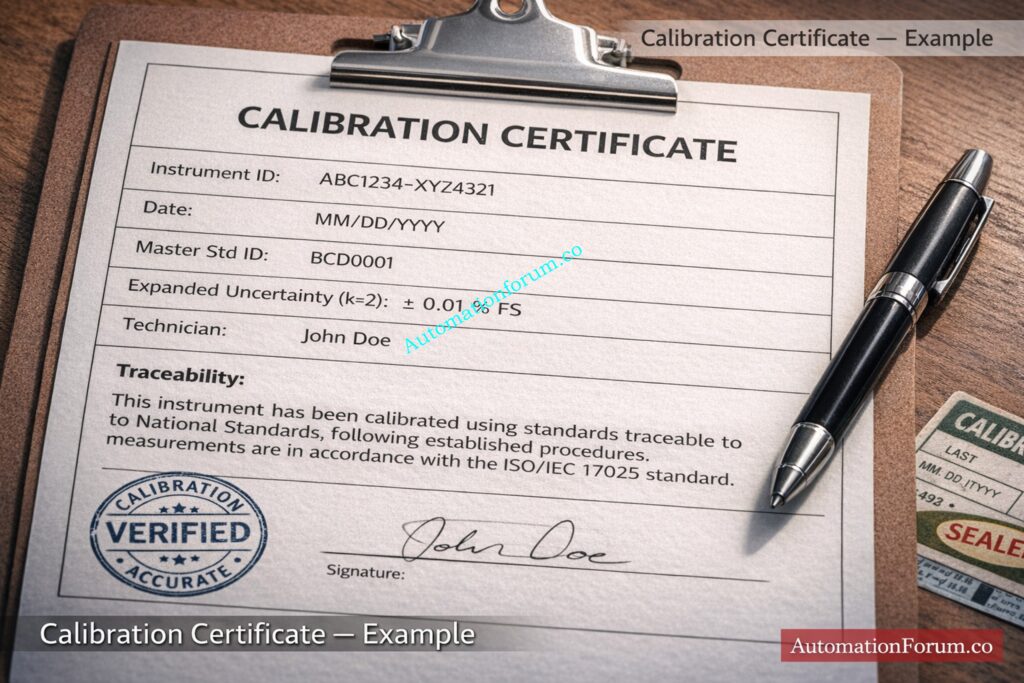
A compliant calibration certificate should include the following elements
- Unique instrument identification and serial number.
- Calibration method and reference standards used with certificate identifiers.
- Date of calibration and environmental conditions during calibration.
- As found values and as left values when applicable.
- Expanded uncertainty with coverage factor and brief explanation of uncertainty evaluation.
- Traceability statement showing link to national or international standards.
Include a concise statement when an instrument is calibrated but not adjusted and note any limitations or deviations from standard methods.
A structured calibration system protects your plant from risk: Calibration Guidelines
Traceability In Calibration and Hierarchy Of Standards
National Standards Accreditation and Laboratory Scope Verification
Traceability requires a documented chain of comparisons to national or international standards. In many countries a national accreditation board such as NABL accreditation in India assesses laboratories against ISO IEC 17025 and records scopes of accreditation that define the measurement ranges and quantities for which the lab is competent. When selecting an external provider verify its scope matches your measurement requirement.
Master calibrators define measurement confidence: Master Pressure Calibrators: Precision Tools for Accurate Pressure Instrument Calibration
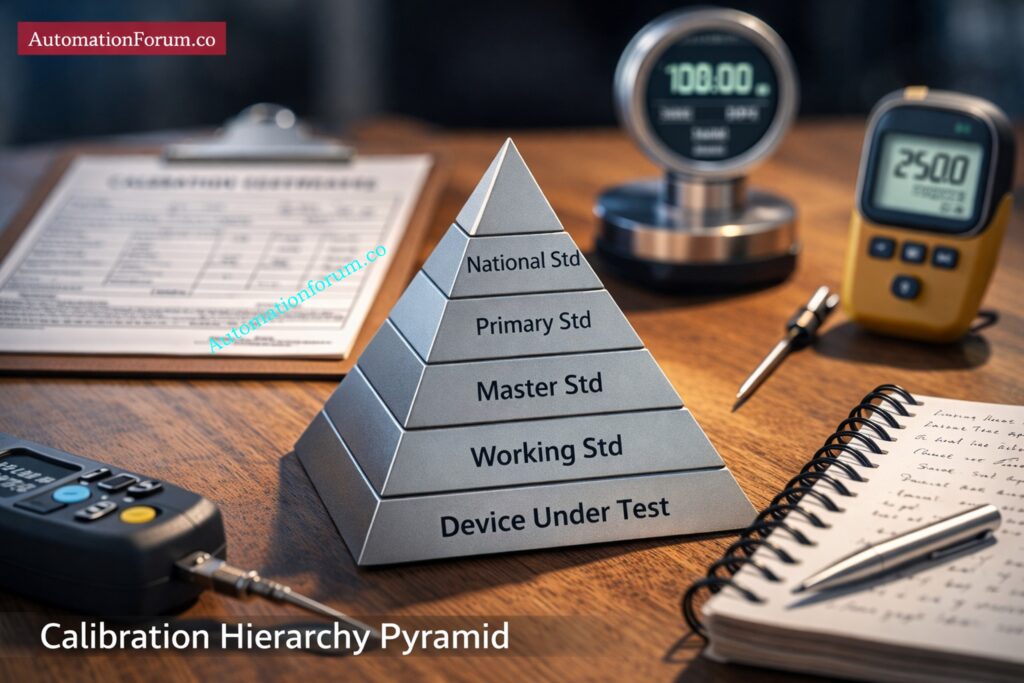
Calibration Hierarchy Pyramid Explained
The practical hierarchy is national standard to primary standard to master standard to working standard to device under test. Maintain certificates for each level and record certificate identifiers and calibration dates. This chain underpins the traceability statement on calibration certificates.
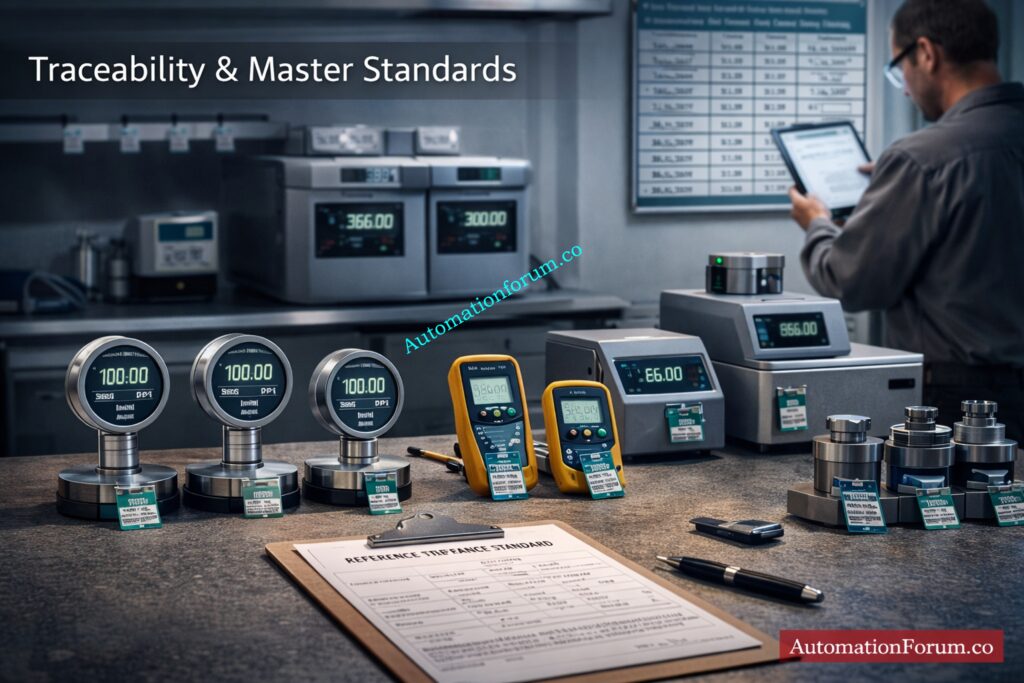
Working Standards and Master Standards Management
Maintain a register for all master and working standards that includes storage conditions last calibration date uncertainty and custodian name. Protect masters against environmental stress and log any comparisons between masters and working standards.
The right calibrator determines the quality of your results: Different types of Calibrators and their Calibration Procedures
Measurement Uncertainty In Calibration Practical Guidance
Test Uncertainty Ratio TUR and Acceptance Criteria
Test Uncertainty Ratio TUR is the ratio of allowable tolerance to calibration uncertainty. A common guideline is the four to one rule which suggests calibration uncertainty should be at least four times smaller than device tolerance. This rule reduces false accept risk but is only a heuristic Use a risk based decision that accounts for safety and quality consequences when setting acceptance rules.
Manual tracking of calibration data increases audit risk: Best Calibration Management Software
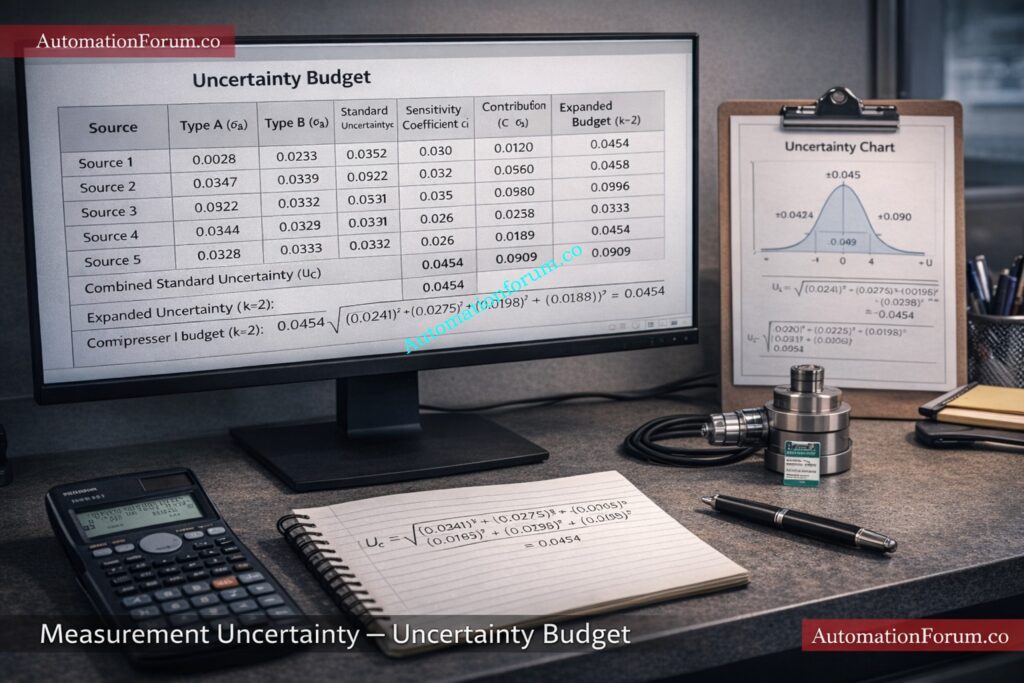
Step By Step Measurement Uncertainty Evaluation Process
- List all significant uncertainty components including instrument noise reference standard uncertainty environmental effects and resolution.
- Quantify type A components by statistical analysis and type B components by reasoned estimates or manufacturer data.
- Combine standard uncertainties by root sum square to generate combined standard uncertainty.
- Multiply by coverage factor to produce expanded uncertainty and document the method.
Provide uncertainty budgets for critical measurements and reference them in calibration certificates or in linked laboratory documents.
Weighing accuracy directly impacts compliance and profitability: Weighing System Calibration Procedure
Calibration Documentation Requirements and Operational Template
Core Data Fields Required For Each Calibration Event
The following table outlines the minimum records to capture for traceability auditability and trending.
| Instrument ID | Instrument type | Range | Accuracy specification | Calibration interval | Date calibrated | Standard used with certificate ID | Traceability reference | Expanded uncertainty k equals two | As found value | As left value | Technician | Approver |
| PT 101 | Pressure transmitter | 0 to 100 bar | 0 point 25 percent of span | 12 months | 01 January 2026 | Master gauge MG 001 cert 2025 045 | NABL traceable via primary lab cert 789 | 0 point 10 bar | 99 point 8 bar | 100 point 1 bar | A Kumar | S Rao |
Absolute pressure transmitters require disciplined calibration: Step-by-Step Procedure to Calibrate an Absolute Pressure Transmitter
Integrating Calibration Records With CMMS Or Calibration Management Software
Use this template as a spreadsheet that feeds your maintenance or calibration management system. Include validation for date formats pick lists for types and automated reminders for upcoming due dates. The table helps technicians capture consistent information in the field and supports rapid audit evidence assembly.
Analytical instrument accuracy defines product credibility: Analytical Instruments Calibration Procedures
Step By Step Instrument Calibration Procedure as Per ISO
Pre Calibration Checks and Planning
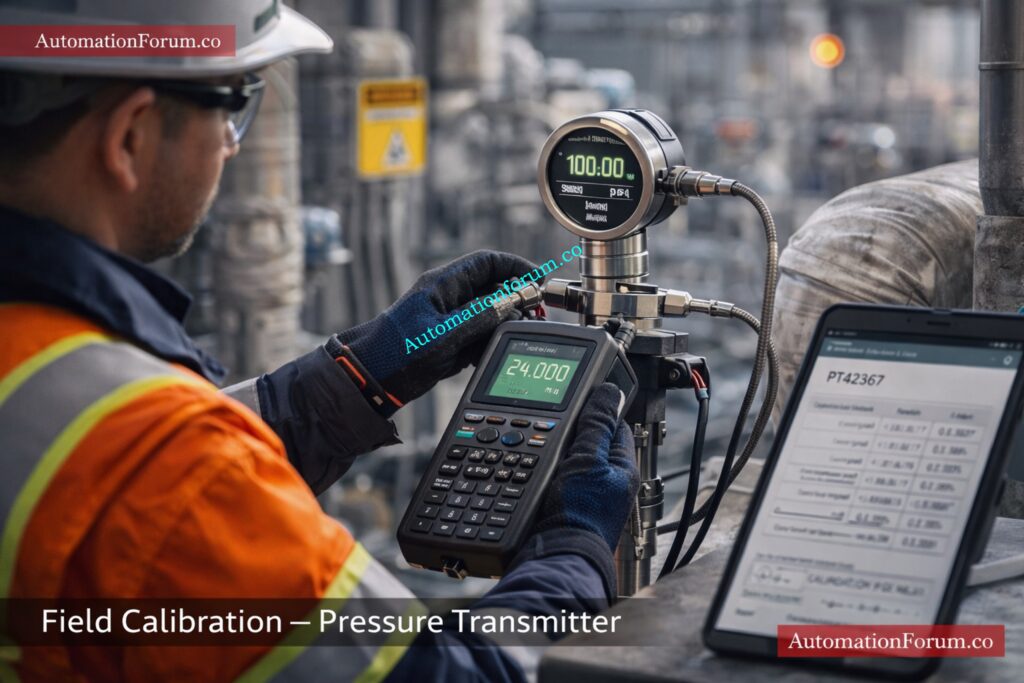
Verify the instrument identity confirm isolation and permits and review previous calibration history. Capture process conditions and any known failure modes. Plan for required tools references and environmental checks.
Environmental Verification and Measurement Conditions
Record ambient temperature humidity and supply conditions if they influence measurement outcomes. Ensure conditions meet procedural limits and document any deviations.
Validation and calibration serve different technical purposes: Differences Between Validation and Calibration
As Found Measurement and Adjustment Rules
Record instrument readings before any adjustment These as found values support trending and root cause analysis. If adjustment is allowed follow manufacturer procedure or plant SOP. Document steps taken and rationale for adjustment.
Flow measurement must be traceable and defensible: ISO Standard Calibration Procedures for Flow Measuring Instruments
As Left Measurement Documentation and Status Update
Record as left values confirm acceptance criteria are met and update the equipment record. Attach or issue a calibration certificate that contains traceability uncertainty and signatures. Update the asset tag or CMMS with next due date and status.
Disposition Process for Out Of Tolerance Instruments
If an instrument cannot be adjusted into tolerance perform an impact assessment. Decide on quarantine repair replacement or increased monitoring and record the corrective action and effect on past product and process data.
Valve performance depends on proper calibration discipline: Control Valve Calibration Procedures
Common Audit Findings In Calibration And How To Prevent Them
Frequent Non Conformance Examples In Calibration Audits
Auditors often find missing traceability records expired master standards no uncertainty calculations and unlabeled instruments. Prevent these by maintaining the master register enforcing record retention performing internal proficiency checks and using a central calibration tracking system.
Pressure accuracy is critical for plant safety: Calibration Procedures for Various Pressure Measuring Instruments
Practical Audit Prevention and Internal Review Checklist
- Use periodic internal audits to check record completeness and traceability chains.
- Implement a scheduled verification program for masters and working standards.
- Require uncertainty budgets for critical calibrations and review them during technical reviews.
Displacement measurements must be verified not assumed: Displacement Measurement Instrument Calibration Procedures
Difference Between ISO 9001 and ISO IEC 17025 In Calibration
Comparison Of Scope Focus and Compliance Requirements
| Topic | ISO 9001 (Clause 7.1.5) | ISO/IEC 17025 |
| Primary audience | Organization-level quality management (plant/process) | Calibration & testing laboratory competence |
| Focus | Control of monitoring & measuring resources (identification, calibration, verification) | Technical competence, uncertainty evaluation, method validation |
| Certification/Accreditation | Certification to ISO 9001 by certification bodies | Accreditation to ISO/IEC 17025 by accreditation bodies (e.g., NABL) |
| Measurement uncertainty | Required to ensure equipment is suitable for intended use (risk-based) | Mandatory evaluation and reporting for each calibration/test. |
| Traceability | Demonstrate equipment is controlled and calibrated | Demonstrate traceability to national/international standards with documented chain |
Signal integrity depends on calibrated conversion devices: Signal Convertors Calibration Procedures
Best Practices for Sustaining ISO Compliance In Process Plants
- Build a risk based calibration plan that ranks instruments by safety quality and production impact.
- Use accredited laboratories for high risk or high accuracy measurements to strengthen traceability claims.
- Centralize records in a configuration controlled repository and keep electronic backups with restricted edit rights.
- Maintain a competence program for technicians with training assessments and documented proficiency tests.
- Protect master standards with controlled storage and scheduled checks and record custodianship.
Temperature measurement errors quietly destroy product quality: Temperature Calibration Procedure
ISO Based Calibration for Audit Ready Measurement Systems
Adopting ISO standards for instrumentation calibration brings structure traceability and technical rigor to measurement management. When you align plant procedures with ISO 9001 calibration requirements and use ISO IEC 17025 accredited laboratories for technical competence you create an audit ready measurement system that supports safety product quality and regulatory compliance. Maintain clear traceability to national standards manage uncertainty in a documented way and run a risk based calibration plan to keep instruments reliable and claims defensible. Implement the documentation templates and the instrument calibration procedure as per ISO to reduce audit findings and to demonstrate measurement assurance across your operations.
Reliable level measurement requires systematic verification: Calibration Procedures for Level Measurement Devices
FAQ On ISO Standards for Instrumentation Calibration
What is The ISO Standard for Instrument Calibration?
There is no single ISO standard exclusively for instrument calibration. ISO 9001 covers calibration control under monitoring and measuring resources, while ISO IEC 17025 defines competence requirements for calibration laboratories.
What are ISO 45001 and ISO 14001 Standards?
ISO 45001 is an occupational health and safety management standard that ensures safe working conditions. ISO 14001 is an environmental management standard focused on controlling environmental impacts and regulatory compliance.
What is ISO IEC 17025 Calibration?
ISO IEC 17025 calibration refers to calibration performed by a laboratory that meets international requirements for technical competence, traceability, and measurement uncertainty evaluation.
What is The Difference Between ISO 17025 and ISO 10012?
ISO IEC 17025 applies to testing and calibration laboratories and focuses on technical competence and uncertainty reporting. ISO 10012 provides guidance for organizations to manage measurement processes within a quality management system.
What are the Five Requirements for a Calibration Standard ?
Key requirements include traceability to national standards, defined calibration intervals, documented procedures, evaluation of measurement uncertainty, and proper calibration records with identification and approval.
Is ISO IEC 17025 Mandatory?
ISO IEC 17025 is not legally mandatory in most cases, but it is often required by regulators, customers, or contracts when laboratory competence and traceable calibration results must be demonstrated.
Refer the below link for the Collection of Instrument Calibration Activity Calculators for Accurate Adjustments
