
- Why Understanding Fieldbus and HART Matters in Industrial Automation
- Overview of HART Communication Protocol
- Overview of FOUNDATION Fieldbus Communication Protocol
- HART vs FOUNDATION Fieldbus: Detailed Technical Comparison
- Practical Guidelines – When to Use HART and When to Choose Fieldbus
- Key Advantages Summary – HART vs Fieldbus Side-by-Side
- Implementation Challenges with FOUNDATION Fieldbus
- Comparison Table – HART Communication vs FOUNDATION Fieldbus
- The Role of Asset Management Integration in Digital Communication
- Coexistence of HART and Fieldbus in the Future of Process Automation
- FAQ on Fieldbus and HART Communication Protocols
- Test your skills with this a Closed-Loop Control Valve Troubleshooting: HART, Fieldbus and Diagnostics
Why Understanding Fieldbus and HART Matters in Industrial Automation
Communication between field instruments and control systems is very important in modern process automation. Over the years, HART (Highway Addressable Remote Transducer) and FOUNDATION Fieldbus (FF) have become two of the most prominent digital communication protocols in the instrumentation world.
Both platforms let you talk to field devices in an intelligent way, but their structures, data handling methods, and control capabilities are very different. For instrumentation and control engineers, especially those managing industrial networks in refineries, chemical plants, or power stations, understanding these differences is essential for effective design, commissioning, and maintenance.
Overview of HART Communication Protocol
What is HART (Highway Addressable Remote Transducer)?
The HART protocol came out in the early 1980s and is still one of the most popular standards for industrial communication. It adds digital communication to the standard 4–20 mA analog signal, which lets devices send both analog and digital data at the same time.
There are more than 10 million HART devices in use globally, making it the backbone of many legacy and brownfield plants.
How Does the HART Communication Protocol Work?
- HART superimposes a 1,200 bps digital signal (using FSK modulation) on the 4–20 mA analog loop.
- The analog signal still shows the main process variable (PV), and the digital layer conveys data about configuration, diagnostics, and subsidiary variables.
- HART works in a master/slave paradigm, which usually means that there is one main master (DCS/PLC) and one secondary master (handheld communicator or asset management software).
Learn about the four key process variables (PV, SV, TV, QV) in HART transmitters: Explained: The Four Main Process Variables (PV, SV, TV, QV) in HART Transmitters – Complete Guide for Instrument Engineers
HART Network Topology Explained
Key Advantages of HART Protocol in Process Industries
- Works with current 4–20 mA systems
- Technology that is easy to understand
- Handheld communicators are easy to set up and fix.
- Great for small updates in brownfield projects
- All major DCS/PLC vendors support it.
Explore the complete installation and commissioning guide for HART and WirelessHART devices: Step-by-Step Guide for Installing and Commissioning HART and WirelessHART Devices for Engineers and Technicians
Overview of FOUNDATION Fieldbus Communication Protocol
What is FOUNDATION Fieldbus in Process Automation?
FOUNDATION Fieldbus (FF) is a fully digital, two-way communication protocol that was first used in the late 1990s. It was made just for process automation. Fieldbus does away with the need for analog signals altogether. All data transfer, control, and diagnostics happen digitally over a single cable pair.
There are more than 10,000 systems in the globe that use Fieldbus devices.
How FOUNDATION Fieldbus Works – Architecture and Data Flow
Fieldbus has a real multidrop architecture, which means that more than one device can use the same wire segment. It sends power and digital signals over the same pair of wires, and each segment can accommodate up to 32 devices.
Fieldbus is over 25 times quicker than HART since it can send data at 31.25 kbps. This greater bandwidth makes it possible to control things in real time and talk to each other at the same time.
Key Features and Benefits of FOUNDATION Fieldbus
- Digital connectivity and the ability to control things in the field (CIF)
- Support for several variables and devices on one pair
- Time synchronization and event time-stamping at the device level
- Advanced diagnostics and predictive maintenance
- Vendor independence and interoperability
- Updates to firmware and settings online
HART vs FOUNDATION Fieldbus: Detailed Technical Comparison
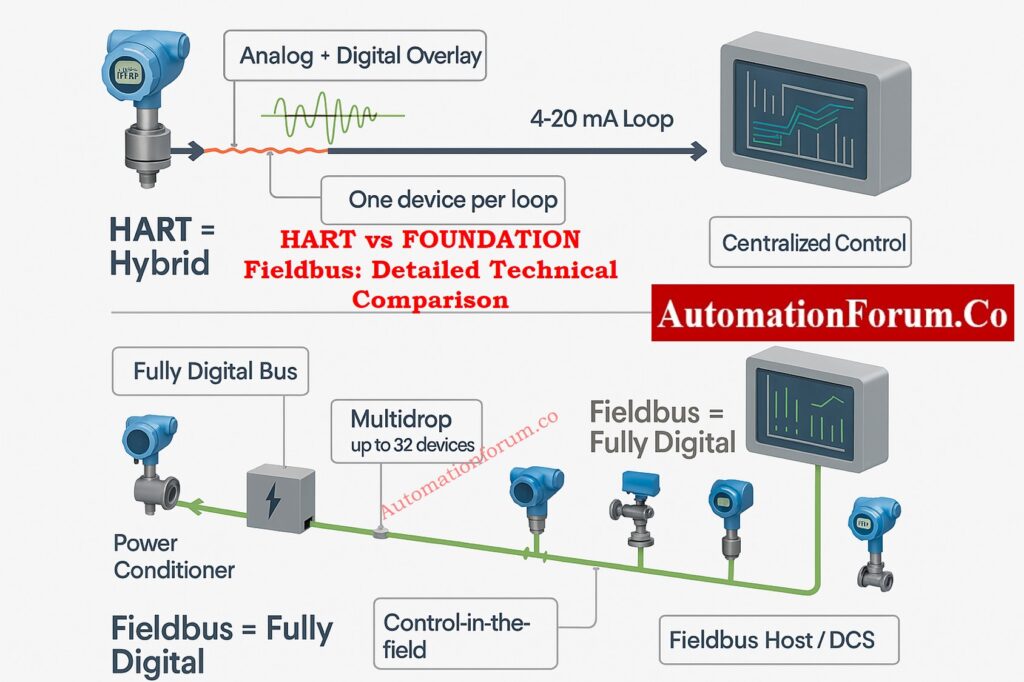
Communication Architecture and Topology
| Feature | HART | FOUNDATION Fieldbus |
| Type | Hybrid (Analog + Digital) | Fully Digital |
| Communication Speed | 1,200 bps | 31,250 bps |
| Topology | Point-to-point or limited multidrop | True multidrop (up to 32 devices) |
| Control Type | Centralized in DCS | Distributed (control-in-the-field) |
| Signal Carrier | 4–20 mA loop | Powered bus segment |
Understand why the 250-ohm resistor is critical in HART communication loops: Why is a 250-Ohm Resistor Important for HART Communication?
Power Supply and Energy Availability
HART devices can use about 35 mW of power, which is enough for basic diagnostics and sending parameters.
Fieldbus, on the other hand, can handle up to 2 A at 12–32 V, which gives modern processors and multivariable sensors a lot more power, even when they are in intrinsically safe (IS) mode.
With this increased power budget, the gadget can do more complicated things like statistical monitoring or valve signature analysis.
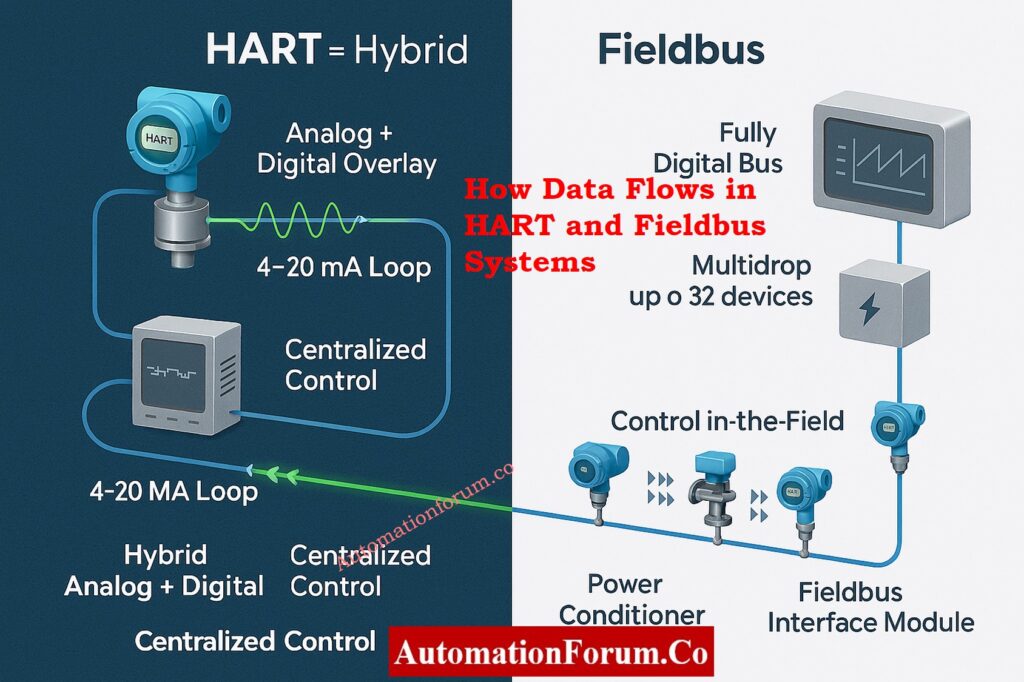
Data Communication Speed and Performance
- HART: The modest baud rate causes delays when polling hundreds of instruments because each one has to be asked one at a time.
- Fieldbus is a deterministic, planned communication structure (based on the publisher-subscriber paradigm) that makes sure updates happen quickly and in sync among devices.
Fieldbus lets network engineers use buses better and regulate loops in real time out in the field, which makes them less dependent on DCS scan rates.
Diagnostics, Predictive Maintenance, and Asset Monitoring
HART can diagnose problems with devices, including whether a transmitter has to be calibrated or has an internal issue.
Fieldbus, on the other hand, lets devices talk to each other, which makes it possible to monitor the health of the whole plant, diagnose valve problems, and do predictive analytics.
Advanced diagnostics running at 20–100 Hz in Fieldbus devices can detect subtle process or equipment issues that HART’s slower polling might miss.
Example:
A HART transmitter might report an intermittent fault that disappears before the system polls it. A Fieldbus device would push a timestamped event instantly to the host, ensuring no diagnostic data is lost.
Discover the essential Foundation Fieldbus installation and wiring best practices: Foundation Fieldbus Installation and Best Practices – Complete Guide for EPC and Maintenance Engineers
Control Strategies – Centralized vs Distributed (Control-in-the-Field)
This is a major differentiator.
- HART: Acts as a data layer; all control happens in the DCS using 4–20 mA loops.
- Fieldbus: Supports PID, logic, and arithmetic function blocks directly within field devices.
Control in the field reduces latency, improves reliability, and allows distributed control architectures a key design advantage for future-ready plants.
Device Configuration and Plug-and-Play Flexibility
HART configuration typically requires a handheld communicator or DCS with HART-enabled I/O modules.
Fieldbus, on the other hand, supports automatic device recognition, online configuration, and firmware upgrades directly through the network.
Engineers can replace or upgrade a device without rewiring or recalibrating the loop dramatically cutting commissioning time.
Multivariable Transmission Capabilities
While HART supports multiple variables (in digital mode only), Fieldbus devices can natively transmit several process parameters (e.g., flow, temperature, pressure) simultaneously and in real-time.
For instance, a single FF transmitter can potentially report level, density, and temperature on the same line, reducing the number of instruments and signal conditioners required.
Challenge yourself with this advanced Foundation Fieldbus communication quiz: Test your Knowledge on Foundation Fieldbus Communication Protocol: Advanced Quiz for Instrumentation Engineers
Commissioning and Maintenance Efficiency
Commissioning a HART-based loop requires physical verification, manual signal sourcing, and time-consuming calibration — typically up to 4 hours per loop.
Fieldbus commissioning, when engineered per FF AG-181 guidelines, can be up to six times faster because multiple devices are configured over the same segment, often in minutes.
This digital commissioning also integrates directly into asset management systems, simplifying documentation and maintenance scheduling.
Integration with Safety Instrumented Systems (SIS)
Currently, HART remains the practical choice for Safety Instrumented Systems, as FF-SIS adoption is still limited.
The Fieldbus Foundation has set standards for FF-SIF (Safety Instrumented Function) integration, which makes it possible for fully digital safety loops.
Firmware Upgrade and Future-Proofing Capabilities
- HART: Because of ASIC-based design, firmware upgrades need the electronics module to be replaced in person.
- Fieldbus: You can download firmware over the bus from a distance, which means you can add new features in the future without changing the hardware.
This feature makes Fieldbus a great long-term investment for plants that are going through a digital transition.
Understand the FISCO model for intrinsically safe Foundation Fieldbus H1 and Profibus PA systems: Fieldbus Intrinsically Safe Concept (FISCO) Model for Foundation Fieldbus H1 and Profibus PA
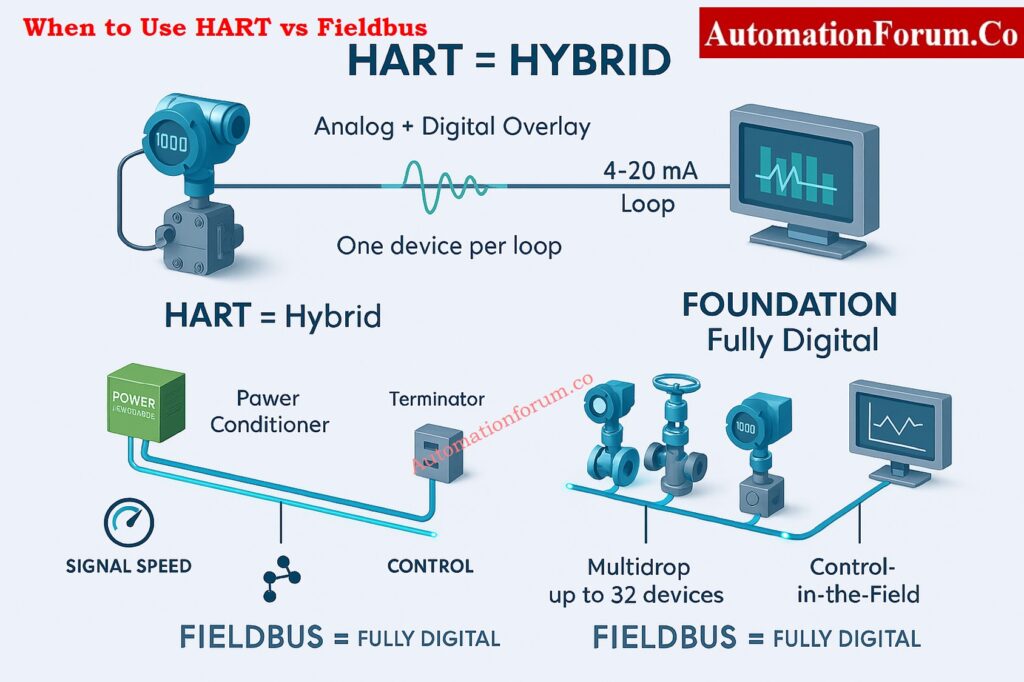
Practical Guidelines – When to Use HART and When to Choose Fieldbus
HART for Brownfield Projects (Existing Plants)
HART for Brownfield Projects (Plants that are Already There)
For incremental upgrading of old process facilities, HART communication is still the best and most affordable option. It works perfectly with the old 4–20 mA analog infrastructure, so factories may get the benefits of digital data without having to replace their existing wiring, junction boxes, or I/O cards.
HART helps maintenance teams enhance dependability and cut down on manual calibration work by supporting SIS (Safety Instrumented System) upgrades, device diagnostics, and remote configuration. Most plant technicians already know how to use HART portable communicators, so there is no need for a lot of retraining or software changes.
In brief, HART provides a low-risk modernization path that delivers enhanced insights while keeping proven analog reliability.
Recommended for:
- Upgrading and retrofitting instruments and systems
- Changes to brownfields and small-scale plant expansions
- Updating SIS and combining device diagnostics
- Facilities that already have 4–20 mA infrastructure
FOUNDATION Fieldbus for Greenfield Projects (New Plants)
For new installations and automation methods that put digital first, FOUNDATION Fieldbus is a good investment for the long term. As a totally digital, two-way communication protocol, it cuts down on the need for wire, control cabinet space, and marshalling hardware by a lot. This can save up to 40% on installation expenses.
Fieldbus lets you operate things in the field, so smart transmitters and positioners can run control loops locally. This reduces the strain on the DCS and speeds up the system’s reaction. It also allows condition-based maintenance and has built-in predictive diagnostics. This cuts down on unplanned downtime and maintenance expenses.
From design to commissioning, Fieldbus simplifies loop documentation, device calibration, and troubleshooting. It is ideal for plants that want integrated digital communication across the entire control hierarchy—forming the foundation for smart plants, Industry 4.0, and IIoT (Industrial Internet of Things) architectures.
Recommended for:
- Greenfield process units and new control systems
- Digital transformation and smart plant projects
- Facilities targeting reduced lifecycle cost and improved uptime
- Complex automation networks with advanced diagnostics and control.
Check out the detailed HART pressure transmitter calibration wiring diagram: Wiring Diagram for Pressure Transmitter Calibration in Workbench using HART
Key Advantages Summary – HART vs Fieldbus Side-by-Side
| Aspect | HART | FOUNDATION Fieldbus |
| Communication Type | Hybrid (Analog + Digital) | Fully Digital |
| Speed | 1.2 kbps | 31.25 kbps |
| Topology | Point-to-point | True Multidrop |
| Control Capability | DCS-based only | Control in the field |
| Power Budget | ~35 mW | Up to 2A shared segment |
| Diagnostics | Device-level | Network-wide advanced |
| Commissioning Time | Slower | 6× faster |
| Firmware Upgrade | Physical | Online |
| Multivariable Support | Limited | Full native support |
| Future Readiness | Moderate | High |
Follow this step-by-step guide on how to calibrate Foundation Fieldbus transmitters: How to calibrate Fieldbus transmitters?
Implementation Challenges with FOUNDATION Fieldbus
While Fieldbus offers impressive benefits, it’s technically complex. Engineers require training in digital network design, power conditioning, and function block configuration.
Initial setup issues, software bugs, and interoperability mismatches can occur if engineering practices or device testing are inadequate.
However, as device interoperability standards and engineering tools (like EDDL and FDI) have matured, FF adoption has become significantly easier and more reliable in recent years.
Get a clear explanation of the HART communication protocol basics: What is HART Protocol?
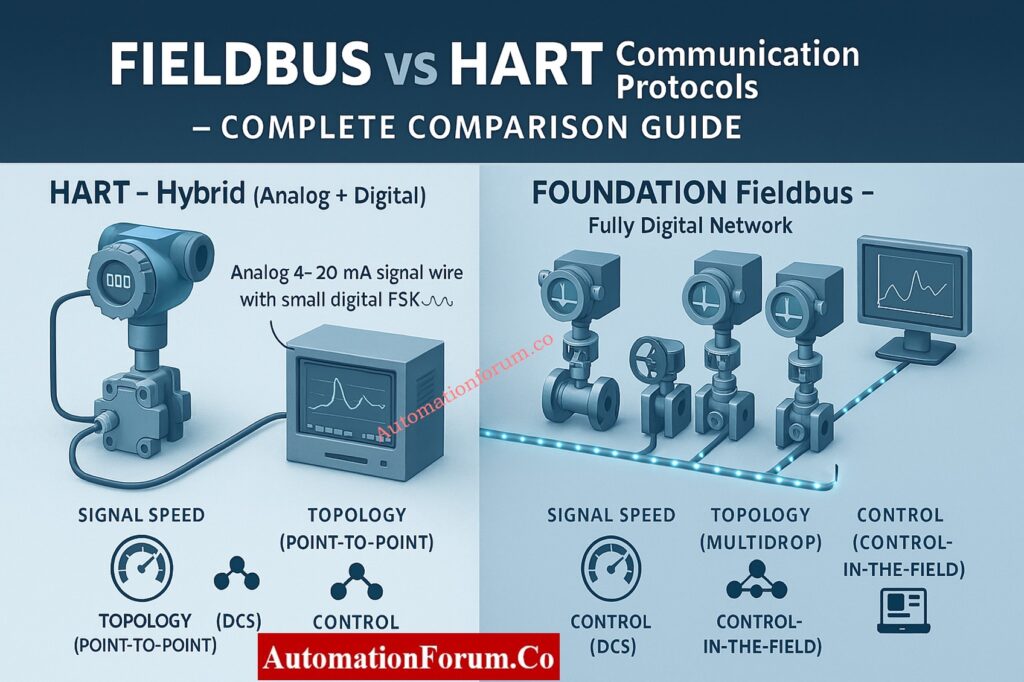
Comparison Table – HART Communication vs FOUNDATION Fieldbus
| Parameter | HART Communication | FOUNDATION Fieldbus |
| Communication Type | Hybrid (Analog 4–20 mA with digital overlay) | Fully digital, bi-directional communication |
| Signal Transmission | Analog + digital signal superimposed | Pure digital signal over twisted pair cable |
| Control Architecture | Centralized control (in DCS/PLC) | Distributed control (control-in-the-field) |
| Device Addressing | Point-to-point | Multi-drop network with multiple devices per segment |
| Data Handling | Limited digital data (process variable + diagnostics) | Complete data exchange including control parameters, diagnostics, and configuration |
| Power and Communication | Separate power and signal | Power and communication combined on the same pair |
| Wiring Requirements | Individual cable per device (analog loop) | Shared bus cable for multiple field devices |
| Installation Cost | Lower initial cost for small upgrades | Higher upfront cost but lower lifecycle cost |
| Maintenance | Familiar tools, simple troubleshooting | Requires trained staff and digital configuration tools |
| Diagnostics Capability | Basic device diagnostics | Advanced, predictive diagnostics and asset management |
| Response Time | Fast for individual loops | Deterministic but slightly slower due to bus scheduling |
| Compatibility | Backward compatible with analog systems | Requires Fieldbus-compatible instruments and DCS |
| Typical Applications | Brownfield retrofits, simple loops, SIS upgrades | Greenfield plants, smart plants, large digital automation projects |
| Lifecycle Advantage | Easy integration with legacy systems | High scalability, long-term efficiency and cost savings |
Prepare with our top 25 advanced Foundation Fieldbus MCQs for instrumentation pros: Foundation Fieldbus Network Protocol: Top 25 Advanced MCQ
The Role of Asset Management Integration in Digital Communication
For maximum benefit, both HART and Fieldbus should integrate into a Plant Asset Management (PAM) system.
HART in Plant Asset Management Systems
- HART is best for keeping track of basic calibration data and the status of devices.
FOUNDATION Fieldbus in Advanced Asset Analytics
- Fieldbus lets you keep an eye on conditions all the time, do predictive maintenance analytics, and back up your configurations automatically.
Integration Through OPC and DCS Platforms
Using OPC servers or native DCS interfaces to connect different systems makes sure that maintenance and reliability teams have access to real-time field intelligence.
Learn the fundamentals of Foundation Fieldbus H1 technology and communication layers: Foundation Fieldbus H1 Technology
Coexistence of HART and Fieldbus in the Future of Process Automation
For specialists who work in process automation, both HART and FOUNDATION Fieldbus is very important for industrial networking:
- HART remains the workhorse for legacy systems and incremental upgrades.
- Fieldbus is the basis for the next generation of digital plants. It provides real-time, coordinated, and power-efficient control from the field level up.
Digital technology is definitely the future of process automation. HART will be around for a long time, but Fieldbus technology has the scalability, diagnostic depth, and control flexibility that smart, connected, and efficient industrial operations need.
Start with the essential Foundation Fieldbus protocol basics explained clearly: Foundation Fieldbus Protocol Basics
FAQ on Fieldbus and HART Communication Protocols
What is the difference between Fieldbus and HART?
HART sends an analog 4–20 mA signal with a digital overlay for limited data. Fieldbus, on the other hand, is a fully digital network that lets devices talk to and control each other.
What is the difference between Fieldbus and Modbus protocol?
Fieldbus is a digital control network that works in real time and lets computers talk to each other. Modbus is a simplified master-slave protocol that is mostly used to send data.
What is the difference between Fieldbus and PROFIBUS?
Fieldbus has a lot of different types, and PROFIBUS is one of them. Fieldbus is the name for a group of industrial digital networks that includes PROFIBUS, Foundation Fieldbus, and others.
What is the difference between Fieldbus and Ethernet?
Fieldbus is made for deterministic, real-time control in automating processes. Ethernet is a universal data network that has been changed for use in industry with variants like PROFINET and EtherNet/IP.
Test your skills with this a Closed-Loop Control Valve Troubleshooting: HART, Fieldbus and Diagnostics
Refer the below link to Test your skills with this a Closed-Loop Control Valve Troubleshooting: HART, Fieldbus and Diagnostics Skills with our Quiz
