
- What Is Thermocouple Wire? (Thermocouple-Grade Wire)
- Characteristics of Thermocouple Wire
- What is Thermocouple Extension Wire?
- Characteristics of Extension Wire
- Where Extension Wire is Commonly Used
- Why You Should Never Use Copper Cable Instead of Extension Wire
- Importance of Cold Junction Compensation (CJC)
- Best Installation Practices for Thermocouple and Extension Wires
- Core Differences Thermocouple Wire and Extension Wires
- FAQ Section on Thermocouple Wire and Extension Wires
- Test your Knowledge on Thermocouple
In industries like oil and gas, pharmaceuticals, power plants, chemical plants, steel, cement, and food processing, process control depends on being able to measure temperature accurately. Thermocouples are the best temperature sensors because they are easy to use, tough, and can monitor very high temperatures.
But one mistake that happens a lot in the field is mixing together thermocouple wire and thermocouple extension wire. Even though they may seem the same and have the same color coding, they do very distinct things. Using the improper wire can cause big mistakes in measurements, drift, and expensive repairs.
This article explains the distinction in a simple, easy-to-understand way that is great for technicians, engineers, and maintenance workers.
What Is Thermocouple Wire? (Thermocouple-Grade Wire)
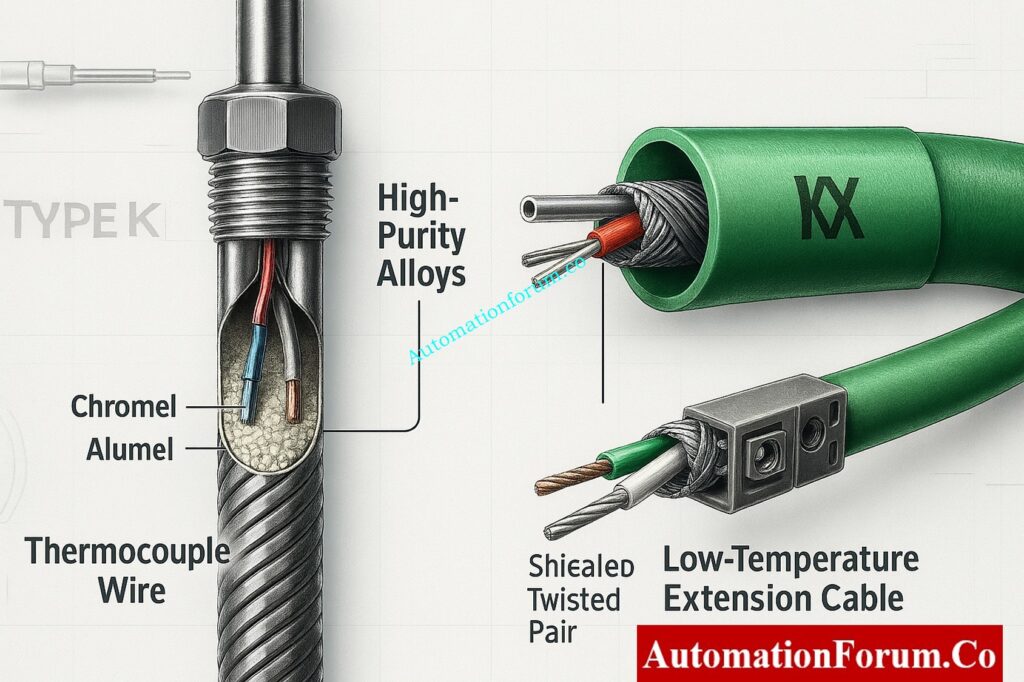
Thermocouple wire is the actual sensing material that makes up the thermocouple junction. The Seebeck effect turns temperature into a tiny voltage (EMF). This cable is what makes the temperature readout precise, steady, and dependable. Because of this, thermocouple wire is made from high-purity alloys that are very carefully monitored and meet tight performance standards.
Quick Thermocouple Troubleshooting Guide: Check List: How to Troubleshoot a Thermocouple?
Characteristics of Thermocouple Wire
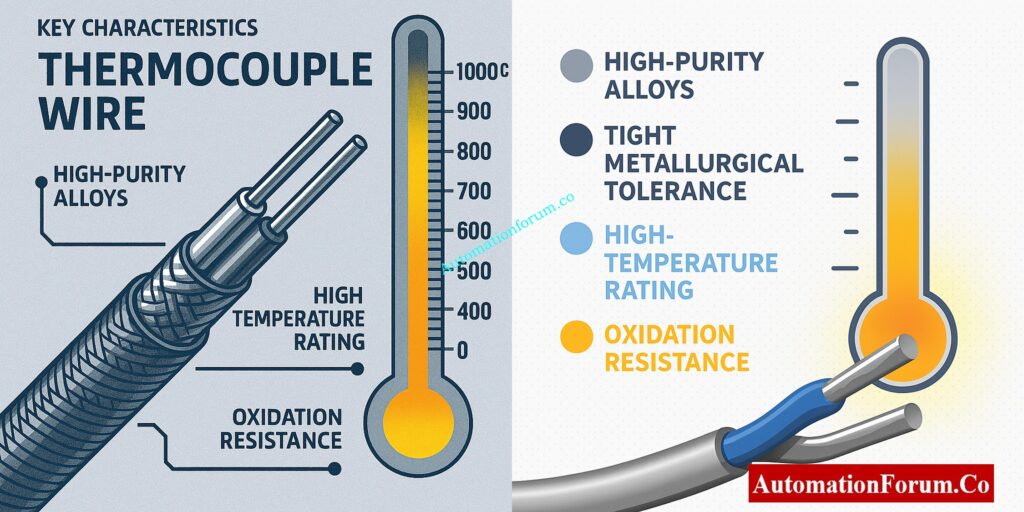
- Made from alloys with a high level of purity and control: Even little changes in the alloy’s makeup can vary the EMF output. Examples:
- Type K: Chromel & Alumel
- Type J: Iron & Constantan
- Type T: Copper & Constantan
- Type N: Nicrosil & Nisil
- Made with very precise metallurgical tolerances: Keeps the relationship between EMF and temperature stable and in line with IEC/ANSI regulations.
- Made for use in high-temperature settings: Thermocouple wires can handle temperatures of up to 1000°C or higher, depending on the kind. This makes them good for very hot process conditions.
- Used right at the point of sensing: Installed in thermowells, MI cables, probes, furnaces, reactors, kilns, and any other hot zone where the wire is exposed to genuine process temperatures.
- Cost goes up because of the quality of the alloy: Thermocouple wire costs more than extension wire because it has to be made to exacting standards and can handle high temperatures.
- Makes EMF output that is stable and correct: High-quality thermocouple wire reduces drift, oxidation errors, and instability over time.
- Available in a number of tolerance classes: For example, IEC Class 1, Class 2, or ANSI Special Limits of Error let engineers pick how accurate they need to be dependent on the process.
- Good resistance to oxidation: This is especially true for Type K and Type N, which are often utilized in tough, oxidizing settings.
Complete Thermocouple Commissioning Checklist: Thermocouple Commissioning Checklist
Where Thermocouple Wire is Used
- In the thermocouple probe or mineral insulated (MI) cable.
- At the heated junction, which is the place of measurement.
- To make or fix thermocouple sensors.
- In high-temperature situations where extension wire won’t survive.
The wire that makes the temperature indication is thermocouple-grade wire.
Because the whole measuring loop depends on it, it has to be pure, steady, and able to handle high temperatures.
Simulate Sensors Using Calibrator: How to simulate RTDs and Thermocouples using Multifunction calibrator?
What is Thermocouple Extension Wire?
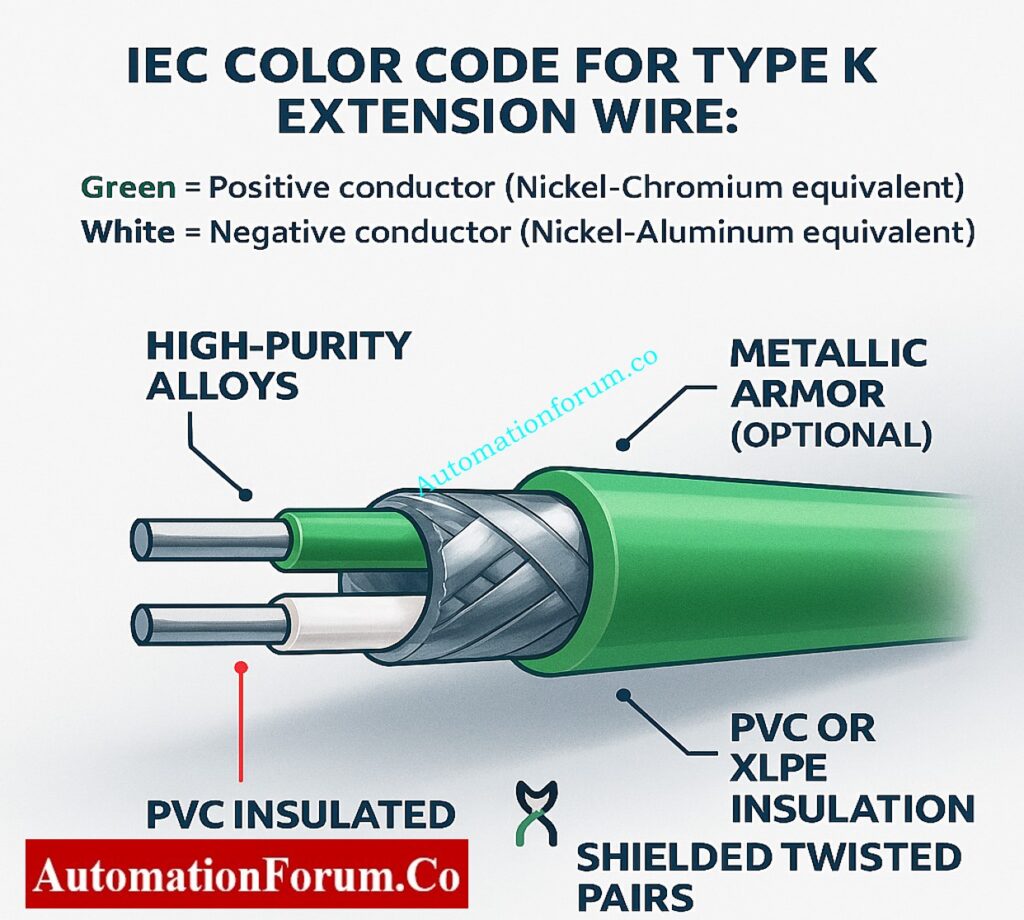
A thermocouple extension wire is a unique type of cable that sends the EMF signal from a thermocouple sensor to a measuring device. It doesn’t make voltage that changes with temperature; instead, it makes sure that the small voltage that comes from the thermocouple junction gets to the instrument correctly and without distortion.
Functions of Thermocouple Extension Wire
Extension wire connects thermocouples to devices like :
- Temperature transmitters
- PLC or DCS input cards
- Temperature indicators and recorders
- Data acquisition or historian systems
Thermocouples are commonly put in hazardous or high-temperature places, and measuring instruments are usually in remote control rooms. Because of this, extension wire is needed for long-distance, noise-free, and cheap signal transmission.
Choose the Right Thermocouple Easily: How to Select the Right Thermocouple for Temperature Measurement Applications?
Characteristics of Extension Wire
- Made from alloys that act like thermocouples: The thermoelectric properties of extension wire alloys are quite similar to those of thermocouples, but only over a small temperature range (typically 80°C–200°C).
- Not made for places with high temperatures: Do not put extension lines close to hot areas, reactors, or furnaces. They are for cooler paths, like cable trays and junction boxes.
- Standardized color coding (IEC/ANSI): Technicians can immediately tell what sort of wire and polarity it is by looking at the clear color markings. This eliminates wiring mistakes.
- Available in a range of industrial settings: Includes twisted pair, shielded, armored, and multi-core designs that can handle tough environments, places with a lot of electromagnetic interference (EMI), or the need for mechanical protection.
- Less expensive than thermocouple-grade wire: Their cheaper alloys make long-distance routing possible without losing the accuracy of measurements.
- Stops undesired thermocouple junctions: Using the right extension wire makes sure that no additional junctions of different metals are created.
- Good for sending signals across great distances: Extension wire can safely deliver microvolt signals across distances of tens to hundreds of meters.
- When insulated, it has good noise immunity: In plants with VFDs, high-power connections, motors, and EMI sources, shielded versions are very necessary.
- Lower temperature rating: Made just for colder places like control panels, marshalling rooms, and cable trays.
Easy Millivolt Conversion Method: Converting Thermocouple Millivolts to Temperature: Methods and Examples
Where Extension Wire is Commonly Used
- From the thermocouple head to the neighboring marshalling cabinet
- From field junction boxes to the main control rooms
- Inside control panels for connecting analog input cards
- Across extensive cable tray paths in big factories
- In test benches, labs for instrumentation, and settings for calibration
Extension wire doesn’t make the thermocouple signal; it just carries it. It also makes sure that the signal is accurate and stable over extended distances.
Refer the below link to Follow This 8-Step Calibration Procedure for Thermocouple
Why You Should Never Use Copper Cable Instead of Extension Wire
One of the most common and harmful mistakes people make while measuring temperature is using copper cable instead of thermocouple extension wire.
Copper wire and thermocouple metals make thermoelectric connections by accident. Each connection makes its own EMF, which changes the initial reading.
Problems Caused by Copper Cable
- Adds more metal connections that change the EMF signal
- Causes voltage discrepancies that are hard to predict as the temperature changes
- Causes readings drift and be unstable
- Causes noise and poor signal quality to make transmitter measurements change.
- Leads to wrong control responses, which degrades the quality and safety of the process.
- Adds 5 to 10 degrees or more of inaccuracy to sensitive processes
Instant Thermocouple Conversion Tool: Thermocouple Voltage ↔ Temperature Calculator
Where Copper Wire Is Acceptable
- At the instrument’s input terminals
- Inside transmitters or PLC cards that have CJC (Cold Junction Compensation)
Bottom line:
Never use copper in the thermocouple circuit at all, except at the ends of the measuring instrument.
Check Your Sensor Selection Skills: Quiz on RTD and Thermocouple Selection for Instrumentation Design Engineers
Importance of Cold Junction Compensation (CJC)
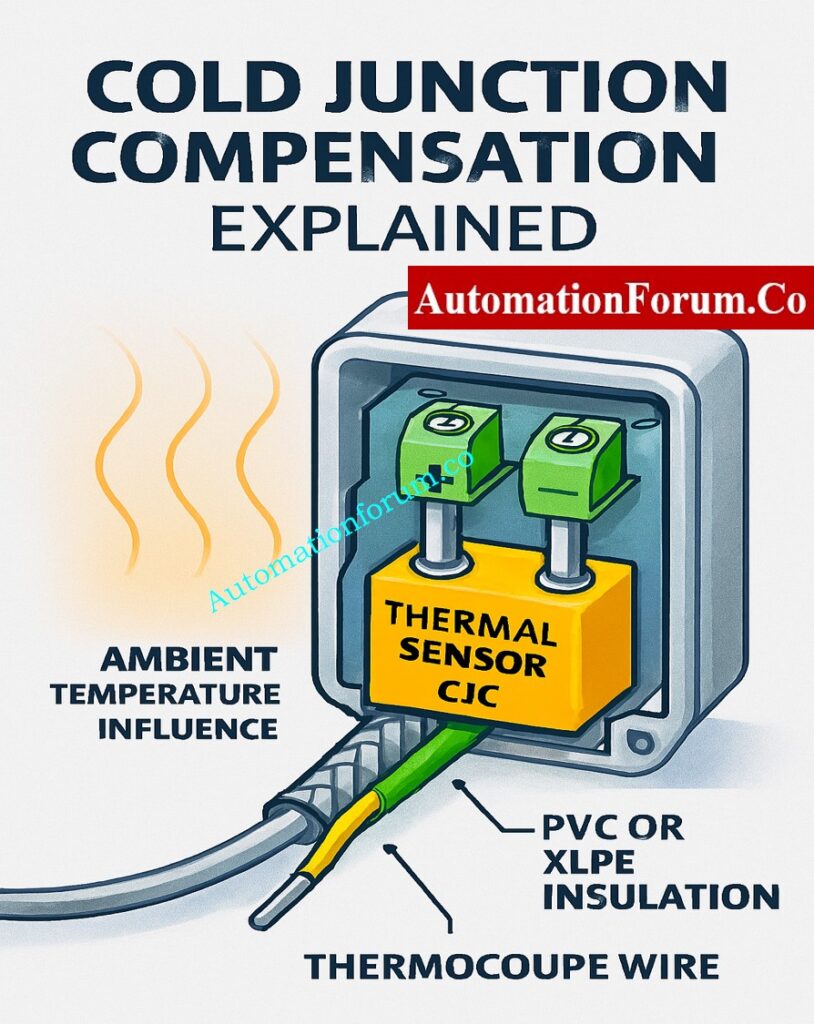
Every thermocouple circuit needs a reference junction that is at a known temperature. Most of the time, this is given by:
- Transmitter terminals
- Temperature input cards
- Dedicated thermocouple input modules
What Happens If CJC Is Not Working?
If CJC isn’t working right:
- A thermocouple loop that is fitted correctly will nonetheless give you the wrong results.
- The temperature measurements will change when the temperature around them changes.
- Over time, mistakes can add up, especially in control panels that don’t get enough air.
Best Practices for Ensuring Proper CJC
- Make sure that terminals are clear of dirt and rust.
- Only use the right thermocouple terminal blocks.
- Don’t put transmitters in enclosures that get too hot.
- Make sure that grounding and shielding are done correctly.
Learn Millivolt Conversion Steps: How to Convert Thermocouple Millivolts to Temperature: A Step-by-Step Guide
Best Installation Practices for Thermocouple and Extension Wires
To make sure that process plants can accurately measure temperature, undertake these steps:
- Only use extension wire in places where the temperature is low, like cable trays and panels.
- Always use the same type of thermocouple throughout the loop (K with KX, J with JX, T with TX, etc.).
- Follow color coding rules to keep the right polarity.
- Don’t combine different types of wire or use the wrong alloys, as this can change the readings.
- Make sure that the connections are strong and safe from moisture, rust, and vibration.
- Keep track of the wire type and route for each loop in the right way.
- To reduce electrical noise, use the right grounding and shielding methods.
- To keep extension wire accurate, keep junction boxes away from places that get very hot.
- Periodically recalibrate the whole loop, especially when it is used in applications with high temperatures.
Step-By-Step Transmitter Calibration: How to calibrate Thermocouple Transmitter?
Core Differences Thermocouple Wire and Extension Wires
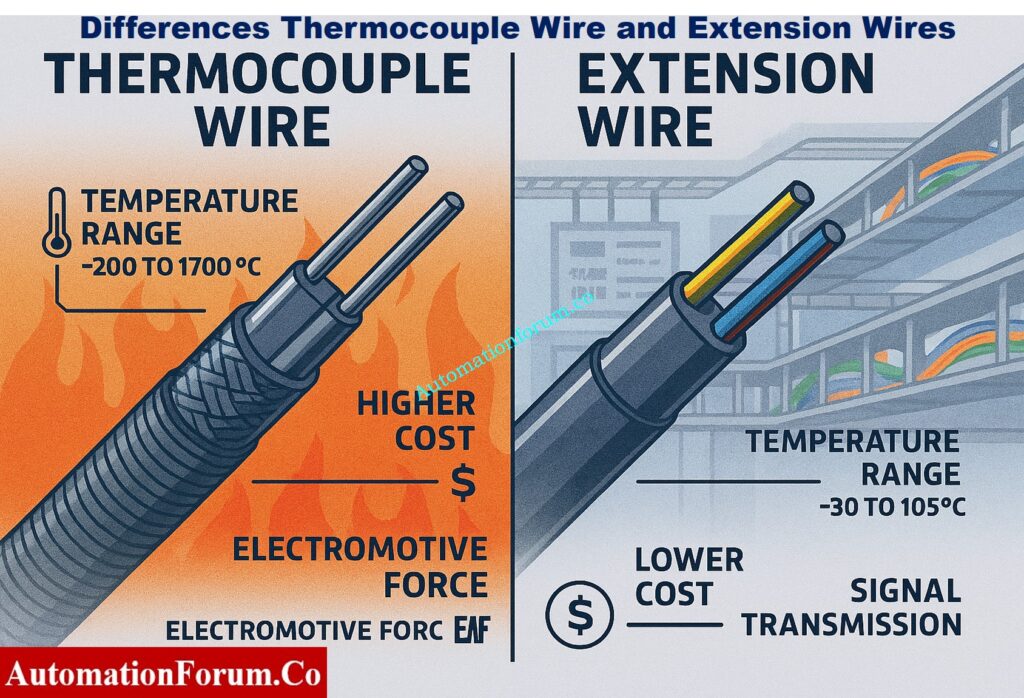
| Feature | Thermocouple Wire | Extension Wire |
| Purpose | The actual measurement connection (hot junction) where the temperature is measured is made of thermocouple wire. It makes the EMF that matches the temperature of the process immediately. | The only job of the extension wire is to convey the EMF signal from the thermocouple sensor to the device. It doesn’t measure temperature; it only sends data. |
| Alloy Quality | Made from high-purity alloys that are rigorously regulated to match the specific Seebeck properties needed for precise temperature measurement. Any change influences the EMF output. | Uses cheaper alloys that act like the thermocouple’s EMF, but only in a small range of temperatures. Not good for sensing at high temperatures or with great accuracy. |
| Temperature Range | Depending on the kind, they can handle very high temperatures. For example, kind K and Type N can work at temperatures above 800°C to 1200°C or higher. Great for direct exposure to the process. | Works only in places where the temperature is low, usually between 80 and 200 degrees Celsius. Put in places that are cooler, like cable trays and control rooms, where temperature changes don’t have much of an effect. |
| Accuracy Requirement | Must fulfill exceedingly strict standards for accuracy (IEC Class 1, ANSI Special Limits). The temperature readout changes when the alloy composition changes. | Needs to be moderately accurate, just enough to send the EMF without making big mistakes. The accuracy stays the same as long as the wire stays within its rated temperature range. |
| Cost | It costs a lot more since it has a high-purity alloy composition, good metallurgical control, and can handle high temperatures. | It costs a lot less, which makes it possible to route great distances between field locations and instrumentation panels. |
| Location | Thermocouples can be installed in places like thermowells, probes, furnace walls, reactors, or any other place where the tip is exposed to process temperature. | Installed in places where the temperature is low, like cable trays, marshalling cabinets, field junction boxes, and control panels. |
| EMF Generation | Yes. The Seebeck effect makes the thermoelectric voltage happen in the thermocouple wire. Any change in the alloy will affect the EMF, which will modify the temperature reading. | No. Extension wire doesn’t make EMF; it only carries the voltage that the thermocouple makes. Its only job is to send signals without making any unwanted connections. |
Understand CJC for Accurate Measurement: Why Thermocouple Reference Junction Compensation(CJC) is Essential for Accurate Temperature Measurement ?
FAQ Section on Thermocouple Wire and Extension Wires
What is the difference between thermocouple wire and thermocouple extension wire?
The thermocouple wire is the part that senses temperature and makes the hot junction. It makes EMF based on the temperature. Extension wire doesn’t monitor temperature; it just sends the EMF signal from the sensor to the instrument. Thermocouple wire can handle high temperatures, however extension wire is only good for routing cables at low temperatures.
What is the difference between thermocouple compensating cable and extension cable?
A compensating cable is made of cheap alloys that are similar to the EMF properties of a thermocouple. It only works in a small range of temperatures. Extension cables use alloys that are similar to the materials used in thermocouples, which makes them more accurate and stable. Extension cables are more accurate, while compensating cables cost less.
Why are two different wires used in thermocouples?
To make the Seebeck effect, which makes a voltage that changes with temperature, you need two different metals. There would be no voltage and no way to detect temperature if both cables were the same.
What is the extension cable of a thermocouple?
A thermocouple extension cable is a low-temperature-rated cable that extends the thermocouple signal from the sensor head to the measuring instrument without losing accuracy or causing undesired junctions.
Can I extend a thermocouple wire?
Yes, but only if you use the right extension wire that works with the thermocouple type. Using the wrong sort of wire (like J-type extension wire for a K-type sensor) or copper wire will make your measurements very wrong.
What is the purpose of extension wire?
The objective of extension wire is to send the thermocouple’s EMF signal across long distances without adding more thermoelectric junctions or mistakes. It makes sure that the sensor and the instrument detect the temperature correctly.
Complete Field Guide for Engineers: Testing a Thermocouple With a Multimeter: A Complete Field Guide for Instrumentation Engineers
Test your Knowledge on Thermocouple
Refer the below link to Challenge Your Thermocouple Expertise
