
- What Is Valve Torque and Why Is It Important?
- How Valve Torque Causes Control Valve Actuator Failure
- Four Types of Valve Torque Every Engineer Must Understand
- What Causes High Valve Torque?
- Understanding the Control Valve Torque Curve
- How to Calculate Valve Torque for Actuator Selection
- Common Valve Actuator Sizing Mistakes
- How to Troubleshoot a Valve Actuator That Cannot Operate the Valve
- Practical Example of Control Valve Actuator Failure Due to High Torque
- Engineering Takeaway: Always Size the Actuator for the Maximum Valve Torque
- Frequently Asked Questions About Valve Torque and Actuator Failure
- Why does an actuator fail to open a valve?
- How is valve torque related to actuator sizing?
- What causes high valve torque?
- What is the difference between breakaway torque and running torque?
- How much safety margin should be considered when selecting a valve actuator?
- What causes an actuator to fail?
- What is a torque actuator?
- What is the formula for calculating actuator torque?
- What is the function of a valve actuator?
- What are common valve actuator problems?
- What is the main purpose of an actuator?
- Why is valve torque important for actuator selection?
A control valve can have the correct size, pressure rating, actuator mounting and control signal, yet still fail during actual plant operation. One common reason is insufficient actuator torque. An actuator that produces enough torque during workshop testing may struggle when the valve operates against real differential pressure, temperature, fluid resistance, seat friction, corrosion or deposits.
This is why control valve actuator failure due to valve torque deserves careful attention during valve selection, engineering review, commissioning and troubleshooting. Valve size alone cannot determine whether an actuator is suitable. The actuator must produce enough torque to overcome the highest valve resistance throughout the complete operating cycle. The engineering basis for this selection should come from actual valve torque requirements and reliable manufacturer data.
What Is Valve Torque and Why Is It Important?
What Is Valve Torque in a Control Valve?
Valve torque is the rotational force required to move the valve shaft or stem and operate the valve under the actual process conditions.
Torque becomes particularly important for quarter turn valves such as butterfly valves and ball valves. The actuator rotates the valve shaft through its operating range, and the required torque can change considerably between the beginning, middle and end of valve travel.
Verify Valve Leakage Properly Using Industry Accepted Methods: Control Valve Leakage Testing, Types, and Calculation Standards
Why Valve Size Alone Cannot Determine Actuator Size?
The actuator output torque must be greater than the valve torque requirement at every demanding point of operation. If the valve requires more torque than the actuator can provide, the actuator may stall, operate slowly, fail to reach the commanded position or experience excessive mechanical loading.
Why Is Valve Torque Important for Instrumentation Engineers?
For instrumentation engineers, this means actuator sizing should never be based only on valve diameter. Pressure, fluid conditions, seat construction and the complete torque profile must also be evaluated.
Refer the he below link for the Air Consumption Calculator for Pneumatic Control Valves, Actuators and Instrument Air System Sizing
How Valve Torque Causes Control Valve Actuator Failure
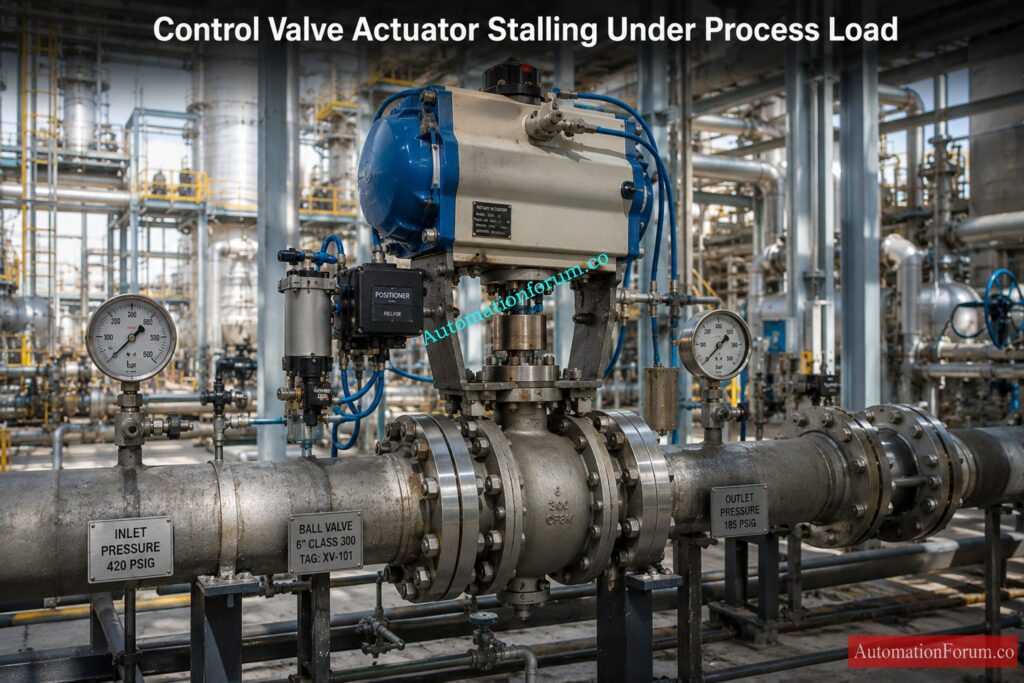
What Happens When Actuator Torque Is Too Low?
An actuator converts energy into mechanical movement. A pneumatic actuator uses air pressure, while an electric actuator uses electrical power and a motor. Regardless of the actuator type, the available output torque must overcome the resistance produced by the valve.
How an Undersized Actuator Fails Under Process Conditions
An undersized actuator can appear healthy during a no load test. Once the valve is connected to the process and exposed to actual differential pressure, temperature and fluid conditions, the required torque may increase significantly.
Recover Stuck Control Valves Before Expensive Process Disruptions: How to do maintenance on struck control valve?
Common Symptoms of Control Valve Actuator Failure
Typical symptoms include:
- The actuator stalls before reaching the required position.
- The valve fails to open from the closed position.
- The valve does not close completely.
- Valve movement becomes slow or inconsistent.
- The actuator experiences excessive loading.
- Valve shaft, coupling or internal components experience abnormal stress.
- Repeated operation causes premature wear.
- Emergency shutdown operation becomes unreliable.
Why an Actuator May Work During Workshop Testing but Fail in the Plant
This difference between workshop testing and plant operation is especially important during commissioning. A valve that passes a functional test without process load may still have an actuator sizing problem when placed into service.
Master Reliable MOV Installation Before Commissioning Problems Appear: Motor-Operated Valve Actuator Installation Procedure with Checklist
Four Types of Valve Torque Every Engineer Must Understand
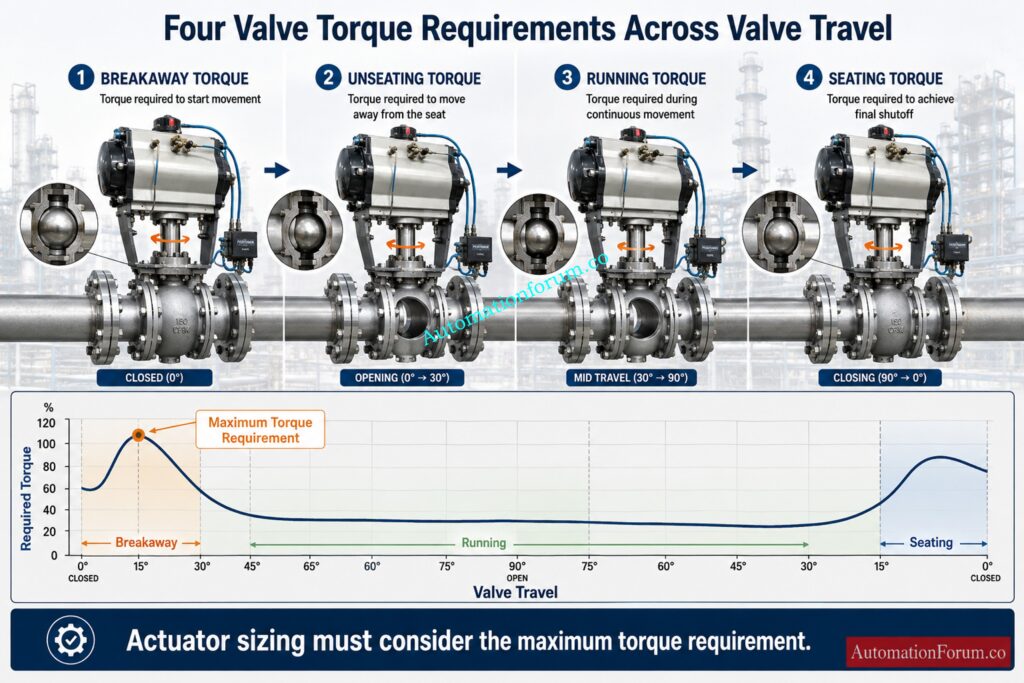
What Is Breakaway Torque?
Breakaway torque is the torque required to start moving a stationary valve from its closed or resting position.
This can be one of the highest torque requirements because static friction must first be overcome. Seat loading, pressure effects, deposits, corrosion and long periods without movement can increase the required breakaway torque.
An actuator selected using only running torque may therefore fail to move the valve when the plant operator first commands it to open.
What Is Running Torque?
Running torque is the torque required while the valve is moving through its operating range.
The required value depends on valve design, process pressure, fluid properties, seat construction and mechanical condition. Running torque may be lower than the torque required to initially break the valve free.
For control valve actuator sizing, engineers should obtain the complete torque data rather than assuming that one torque value represents the entire valve travel.
What Is Seating Torque?
Seating torque is the torque required to move the valve into its final closed position and achieve the required shutoff.
This is especially significant when tight shutoff is required. If the actuator cannot generate adequate torque near the final closing position, the valve may stop before reaching the required position and allow unwanted process flow.
Excessive seating torque can also create unnecessary mechanical stress, so the actuator and valve must be selected as a compatible system.
What Is Unseating Torque?
Unseating torque is the torque required to move a closed valve away from its seat.
Pressure differential and seat friction can make this point particularly demanding. A valve may remain closed successfully but require substantially more torque to begin opening.
The actuator therefore needs sufficient output torque at the most demanding point of the complete valve travel.
Discover Proven Fixes For Costly Actuator Performance Problems: Common Challenges and Solutions for Industrial Control Valve Actuators
What Causes High Valve Torque?
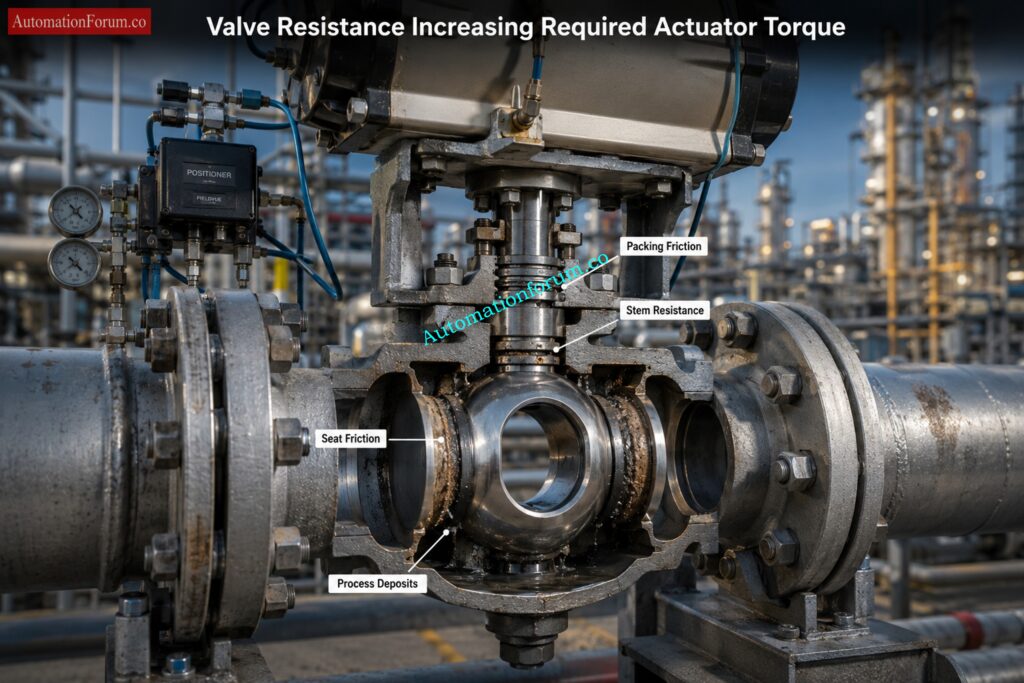
Valve torque is not a fixed number. Actual requirements can change with operating conditions and valve condition.
Effect of Valve Size on Torque
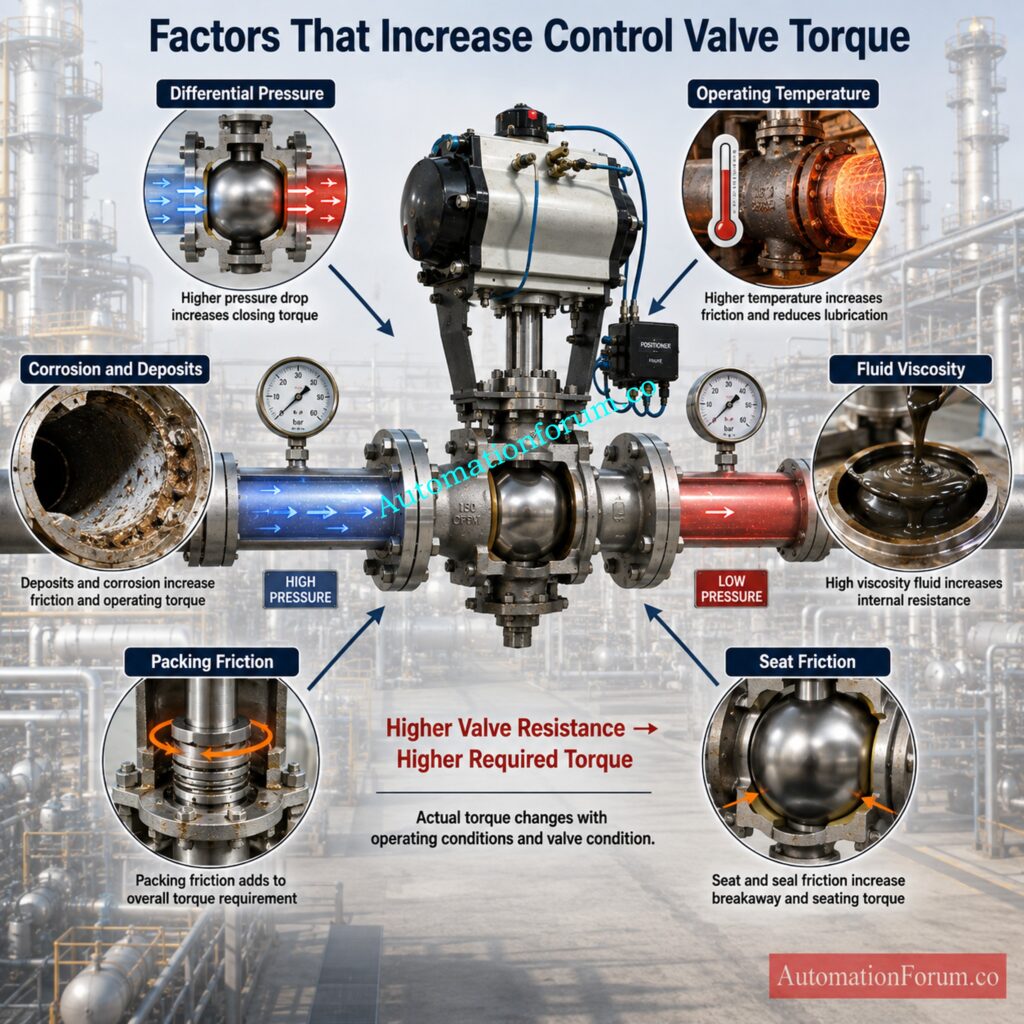
Larger valves generally have greater mechanical requirements, but size alone does not determine actuator torque. Valve design, pressure, seat construction and service conditions must also be considered.
Effect of Differential Pressure on Valve Torque
Differential pressure across the valve can significantly affect the force acting on internal components. A valve that moves easily with low pressure differential may require much greater torque under full process pressure.
This is one reason why actuator selection based only on workshop conditions can produce failures after commissioning.
Effect of Operating Temperature on Valve Torque
Temperature can change material properties, clearances, lubrication conditions and seat friction. High temperature service may therefore change the torque requirement from the original design condition.
Understand Bench Set Errors Before Valve Performance Problems: Why is Control Valve Actuator Bench Set Important ?
Effect of Fluid Viscosity on Valve Torque
Viscous fluids can increase resistance to valve movement. Heavy fluids may create greater resistance compared with low viscosity fluids, depending on valve design and service conditions.
Effect of Seat Material on Valve Torque
Seat material has a direct influence on friction and operating torque. Different seat designs can produce different torque characteristics even when the valve size and pressure class are similar.
Effect of Corrosion and Deposits on Valve Torque
Corrosion, scale, contamination and process deposits can increase friction and restrict valve movement. A valve that originally operated correctly can develop high torque after extended service.
Effect of Packing Friction and Seat Friction
Packing friction around the valve stem and friction at the seat can add significant resistance. During troubleshooting, engineers should not assume that the actuator is always responsible for the failure.
Get Actuator Torque Selection Right Before Plant Failure: Valve Actuator Sizing Calculator – Complete Engineering Guide for Torque, Safety Factor & Gear Ratio Selection
Understanding the Control Valve Torque Curve
Valve torque can change throughout the complete valve travel.
- A typical torque profile may show high breakaway torque at the beginning of movement, lower running torque while the valve travels and increased torque again near the final seating position. The exact curve depends on the valve type and operating conditions.
- This torque curve is extremely useful during actuator selection.
- Using an average torque value can result in an undersized actuator because the actuator may need to overcome a much higher torque at one particular position.
- For example, an actuator may have sufficient torque for most of the valve travel but fail when the valve begins opening because the breakaway requirement is higher. Another valve may operate normally during opening but fail to achieve complete closure because the seating requirement is higher.
- Technical bid evaluations should therefore examine the valve torque requirement across the complete operating range.
Compare Actuation Technologies Before Choosing Your Valve Drive: Classification of valve actuators – Electrical, Hydraulic and Pneumatic
How to Calculate Valve Torque for Actuator Selection
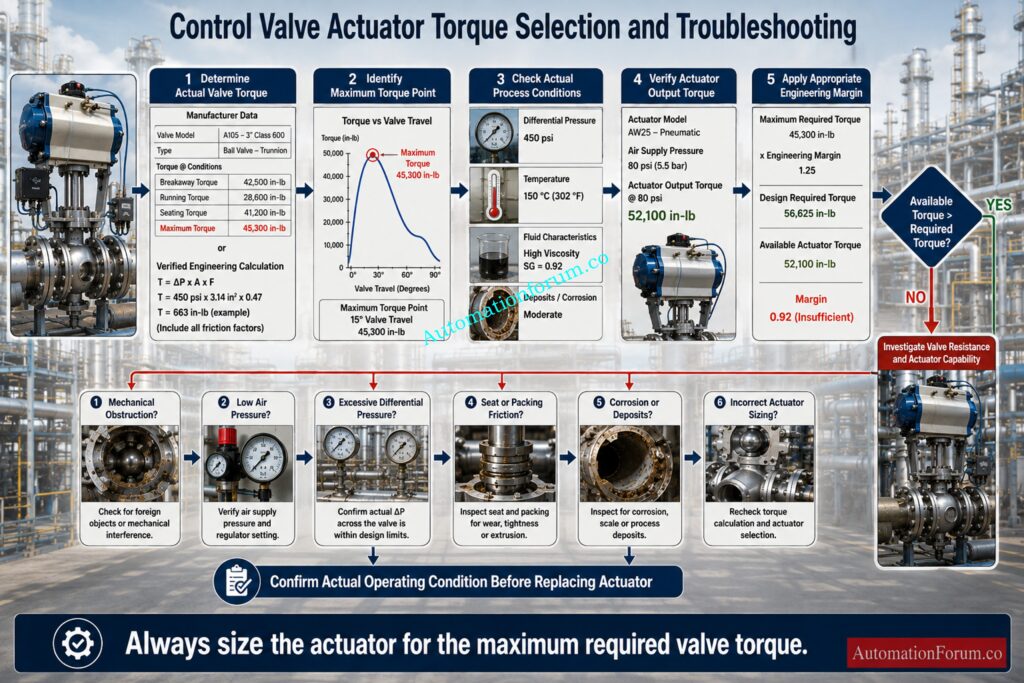
A practical valve actuator selection process should follow a logical engineering sequence.
- First, determine the actual valve torque requirement from reliable valve manufacturer data or verified engineering calculations.
- Next, identify the maximum torque point. Do not assume that running torque is the highest requirement.
- Then evaluate the actual operating pressure, differential pressure, temperature, fluid characteristics, valve construction, seat material and expected process deposits.
- The actuator output torque should then be checked across the complete operating range.
- The basic engineering relationship is simple:
- Available actuator torque must exceed the required valve torque under the relevant operating condition.
An appropriate engineering safety margin should then be applied. The margin should follow project specifications, manufacturer recommendations, valve type and operating conditions. Engineers should avoid selecting an arbitrary margin without considering the actual service.
For pneumatic actuators, available air pressure must also be verified because reduced supply pressure can reduce actuator output torque. For electric actuators, power supply conditions, motor capability and configured torque protection must be checked.
Stop Control Valve Hunting Before It Damages Process Stability: Why Control Valve Hunts in AUTO but Runs Smoothly in MANUAL
Common Valve Actuator Sizing Mistakes
- One of the most common mistakes is selecting an actuator only from the valve size. Two valves with the same nominal size can have very different torque requirements.
- Ignoring differential pressure is another common error. The valve may operate correctly during testing but fail when full process pressure is applied.
- Using only running torque can cause failure during breakaway or seating.
- Ignoring deposits and corrosion can result in an actuator replacement when the actual problem is increased valve resistance.
- Temperature effects can also be overlooked, particularly when actuator selection is based on normal conditions instead of the maximum operating condition.
- Another mistake is using outdated manufacturer torque information. Valve design changes, seat materials and service conditions can alter torque requirements.
- Finally, selecting the lowest cost actuator without checking the complete torque curve can create much higher costs through repeated failures, maintenance and production losses.
Identify Critical Valve Failures Before They Become Shutdowns: What Are the Most Common Failure Modes of Control Valves?
How to Troubleshoot a Valve Actuator That Cannot Operate the Valve
- When an actuator cannot move a valve, replacing the actuator should not be the first action.
- Start by checking the valve mechanical condition. Confirm that the shaft or stem can move and look for mechanical obstruction, corrosion, deposits and abnormal friction.
- Then verify the actuator output capability. For a pneumatic actuator, check actual air supply pressure at the actuator rather than relying only on the header pressure indication. For an electric actuator, verify the power supply and actuator configuration.
- Check the differential pressure across the valve because the actual process condition may be significantly different from the commissioning condition.
- Inspect the seat, packing and shaft condition. Excessive packing friction or seat damage can create a valve torque problem.
- Review the original actuator sizing documentation and compare it with current manufacturer torque data.
- Position feedback, limit switches and torque switches should also be checked. A valve may have adequate mechanical capability but still fail because the actuator control system incorrectly indicates the valve position or interrupts movement.
Finally, compare the actual operating condition with the design condition. This helps distinguish an actuator failure from a valve torque problem.
Stop Dangerous Valve Passing With Proven Troubleshooting Methods: Control Valve Passing Even When Fully Closed: Causes, Symptoms, Troubleshooting and Solutions
Practical Example of Control Valve Actuator Failure Due to High Torque
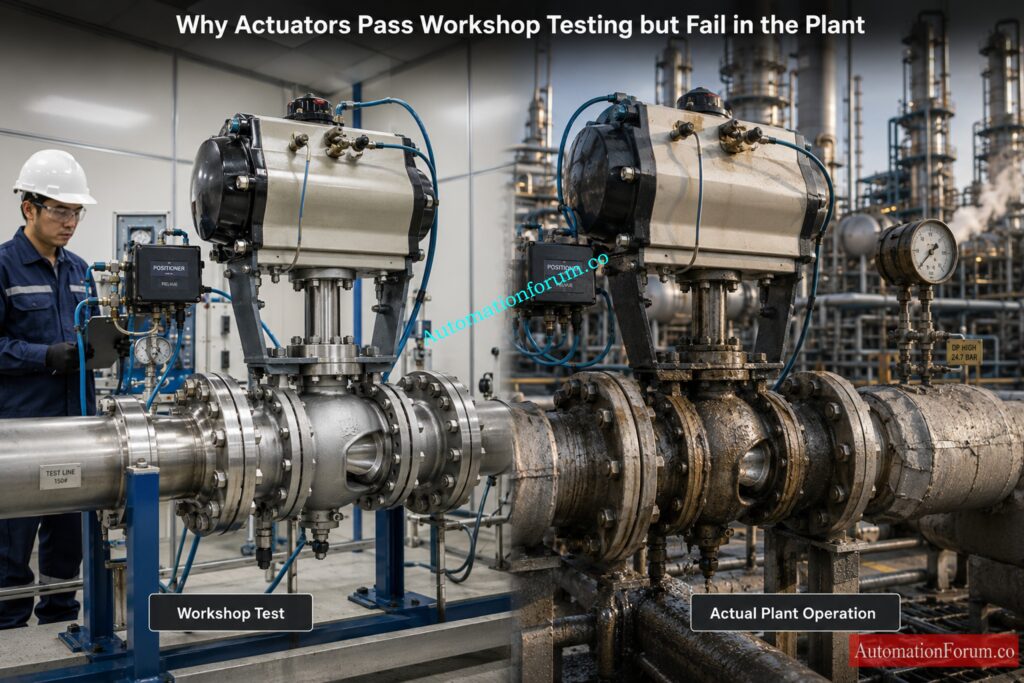
Valve Operates Correctly During Workshop Testing
Consider a quarter turn ball valve that operates correctly during workshop testing. After installation in a process line, the actuator struggles to open the valve.
The control signal reaches the actuator correctly, and the actuator initially begins to move. However, it stops before reaching the required position.
Effect of Differential Pressure and Seat Friction
An investigation shows that the valve is operating with a significantly higher differential pressure than during workshop testing. Additional seat friction and process deposits have also increased resistance.
Identifying the Actual Torque Problem
The actuator was originally selected using a lower torque requirement. The actuator therefore has enough torque for part of the operating cycle but not enough to overcome the maximum torque requirement during actual service.
Selecting a Suitable Actuator
The engineer should first confirm the valve torque requirement under the actual pressure and process conditions. The valve condition should then be inspected for deposits, seat problems and mechanical restriction.
If the valve is mechanically healthy, the actuator should be evaluated against the maximum required torque and an appropriate engineering safety margin. Only then should actuator replacement or modification be considered.
Choose The Right Valve Type For Demanding Applications: Globe vs Ball vs Butterfly Control Valves Complete Comparison Guide for Flow Control Selection and Applications in Process Industries
Engineering Takeaway: Always Size the Actuator for the Maximum Valve Torque
- Reliable valve operation depends on matching actuator capability with the actual valve torque requirement.
- Valve size alone is not an adequate basis for actuator selection. Engineers must consider breakaway torque, running torque, seating torque and unseating torque together with differential pressure, temperature, fluid characteristics, seat material, packing friction, corrosion and deposits.
- The most reliable approach is to identify the maximum required valve torque under the actual operating condition, verify the actuator output torque across the complete travel range and apply an appropriate engineering safety margin.
For instrumentation, control and maintenance engineers, this approach can prevent actuator failures that otherwise appear only after commissioning or during critical plant operation.
Always size the actuator using the maximum required valve torque under the actual operating conditions, together with an appropriate engineering safety margin.
Frequently Asked Questions About Valve Torque and Actuator Failure
Why does an actuator fail to open a valve?
An actuator can fail when its available torque is lower than the valve breakaway or unseating torque.
High differential pressure, seat friction, deposits, corrosion, low air pressure or mechanical obstruction can also prevent opening.
How is valve torque related to actuator sizing?
Actuator sizing must be based on the maximum torque required by the valve under actual operating conditions.
The actuator must provide sufficient torque at the most demanding point of the complete valve travel.
What causes high valve torque?
High valve torque can result from differential pressure, seat friction, temperature, fluid viscosity, packing friction, corrosion and deposits.
Mechanical damage, contamination and changes in process conditions can also increase the required torque.
What is the difference between breakaway torque and running torque?
Breakaway torque is the torque required to start moving a stationary valve from its closed or resting position.
Running torque is the torque required to keep the valve moving through its operating range.
How much safety margin should be considered when selecting a valve actuator?
There is no single safety margin suitable for every valve and application.
The margin should follow project requirements, valve manufacturer recommendations, valve design and actual operating conditions.
What causes an actuator to fail?
An actuator can fail because of insufficient torque, incorrect sizing, low pneumatic pressure, electrical problems or excessive mechanical loading.
Valve obstruction, corrosion, poor maintenance, incorrect installation and repeated operation under excessive load can also cause failure.
What is a torque actuator?
A torque actuator is an actuator designed to produce rotational force for operating a valve shaft.
It is commonly used with quarter turn valves such as ball valves and butterfly valves.
Solve Unresponsive Control Valves With Field Proven Checks: Field Troubleshooting Guide: Control Valve Not Responding in Process Area
What is the formula for calculating actuator torque?
The basic torque relationship is Torque = Force × Lever Arm Distance.
For valve actuator selection, the actual torque requirement should be obtained from verified valve data because valve design and process conditions affect the torque profile.
What is the function of a valve actuator?
A valve actuator converts pneumatic, electrical or other available energy into mechanical movement to open, close or position a valve.
It allows the valve to be operated automatically from a control system or safety system.
What are common valve actuator problems?
Common problems include insufficient torque, incorrect sizing, low air pressure, motor problems, damaged mechanical components and incorrect position feedback.
Valve friction, deposits, corrosion, seat damage and excessive differential pressure can also cause actuator operating problems.
What is the main purpose of an actuator?
The main purpose of an actuator is to provide the mechanical force or torque required to operate a valve.
In an automated process, it enables the control system to move the valve to the required position reliably.
Why is valve torque important for actuator selection?
Valve torque determines how much output force the actuator must produce to move and position the valve safely.
Ignoring the maximum torque requirement can result in incomplete movement, actuator overload, premature failure and unreliable plant operation.
Refer the below link for theControl Valve Calibration Procedures
