
- Hybrid Level Measurement in EPC Projects
- What Is Hybrid Level Measurement in Instrumentation Engineering
- Importance of Hybrid Level Measurement in EPC Instrumentation Design
- Objectives of Hybrid Level Measurement Design
- Hybrid Level Measurement Selection Procedure
- When to Choose Hybrid Level Measurement
- Typical Hybrid Level Measurement Applications in Process Plants
- Simple Process Example of Hybrid Level Measurement
- EPC Design and Documentation Considerations
- Control System Integration Strategy for Hybrid Level Measurement
- Lifecycle and Maintenance Benefits of Hybrid Level Measurement
- Common EPC Mistakes to Avoid in Hybrid Level Measurement Design
- Hybrid Level Measurement Selection Checklist for EPC Engineers
- FAQ on Hybrid Level Measurement Selection
Hybrid Level Measurement in EPC Projects
In modern process plants, especially those built by EPC companies that are complicated, high-risk, and safety-critical, hybrid level measurement has become an important feature of instrument design. When choosing the right level measuring technology for today’s process industries, precision is no longer the only thing that matters. It has a direct effect on the safety of the plant, the reliability of operations, the availability of resources, compliance with regulations, and the long-term cost of ownership.
In a lot of industrial settings, using a one level measurement concept isn’t enough because process conditions are always changing, the environment is quite harsh, and safety standards are very high. Different levels of temperature, pressure, density, phase behavior, foam formation, turbulence, and the shape of the inside of the vessel can all make individual level measurement methods fail or drift. In these cases, hybrid level measurement is a strong, dependable, and well-designed answer.
The article goes into great detail on how to choose a hybrid level measuring method in a way that is practical and focused on EPC. It clearly explains when and why hybrid level measurement should be used, as well as how it should be designed during the FEED, basic engineering, detailed engineering, commissioning, and handover stages of EPC projects. Instrumentation engineers, lead engineers, and project specialists who work on refinery, petrochemical, chemical, power, LNG, and offshore projects should use this information as a reference.
Capacitance vs Guided Wave Radar in Hybrid Level Measurement: Hybrid Level Measurement: Capacitance + Guided Wave Radar (GWR) Technology
What Is Hybrid Level Measurement in Instrumentation Engineering
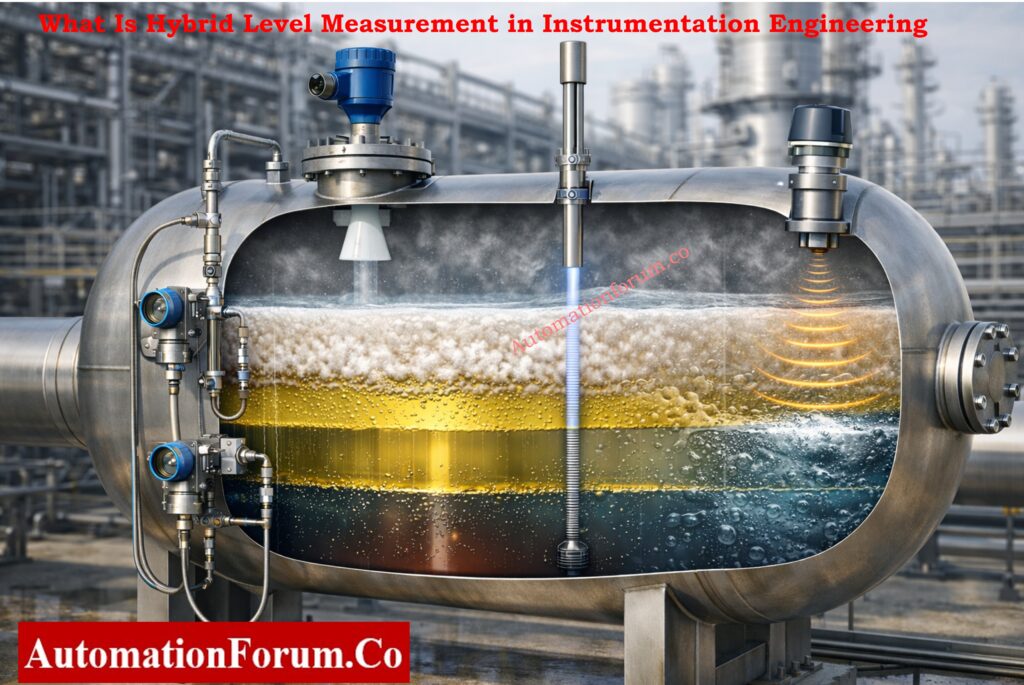
Hybrid level measurement is when two or more different level measurement technologies are used on the same vessel, tank, or process system on purpose to make the measurements more reliable, accurate, available, and safe. Diversity is the main idea behind hybrid level measuring.
Different physical principles are used by each level measurement technology. The system uses a mix of different technologies to make sure that a single process state, mechanical failure, or environmental factor doesn’t effect all measures at once. This greatly cuts down on failures caused by the same thing and makes level indication more reliable.
It is vital to tell the difference between hybrid level measurement and basic redundancy. Putting up two similar radar level transmitters or two differential pressure transmitters does not make a hybrid system. These kinds of setups merely add extra copies, not different ones. True hybrid level measurement uses a combination of technologies, such as differential pressure, non-contact radar, guided wave radar, ultrasonic, displacer, or capacitance level measuring, in a planned and structured way.
In EPC projects, hybrid level measurement is used when the conditions of the process are very harsh, change a lot, or are very important for safety, and when relying on just one measuring approach poses an unacceptable operational or safety risk.
Hybrid Level Measurement System Explained for Process Plants: What is Hybrid level measurement system?
Importance of Hybrid Level Measurement in EPC Instrumentation Design
From the point of view of EPC instrumentation design, level measurement failures are one of the most common reasons for plant problems, false alarms, safety accidents, and complaints after commissioning. Choosing the wrong or not enough level measurement can cause unstable control loops, frequent false trips, constant operator intervention, too much maintenance, and, in the worst circumstances, catastrophic vessel overfill or dry-run conditions.
EPC engineers may make their designs more durable at the design phase with hybrid level measurement, instead of having to rely on operational workarounds or retrofits after commissioning. EPC teams may greatly improve plant safety, reliability, and availability by dealing with measurement problems early in the project lifecycle.
Hybrid level measurement is especially important in EPC projects that include refineries, petrochemical complexes, chemical plants, power generation units, LNG facilities, offshore platforms, and large storage terminals. This is because process upsets can have very bad effects on safety, the environment, and the bottom line.
Radar Level Measurement Performance Checklist for Engineers: Checklist for Best Radar Level Measurement & Control System Performance
Objectives of Hybrid Level Measurement Design
Reliability, safety, and operational continuity are the main goals of hybrid level measurement in instrumentation engineering. A well-designed hybrid level measuring system makes sure that the level indication is correct and steady in all situations, such as normal operation, startup, shutdown, and abnormal upset conditions.
From an EPC execution point of view, hybrid level measuring helps meet international safety standards, project specifications, and client needs while reducing delays in commissioning, operational issues, and changes after handover.
Tank Level Calculation Using Radar Level Transmitters: Radar Level Transmitter Calculator for Tank Level Measurement
Hybrid Level Measurement Selection Procedure
Process Condition Analysis for Level Measurement Selection
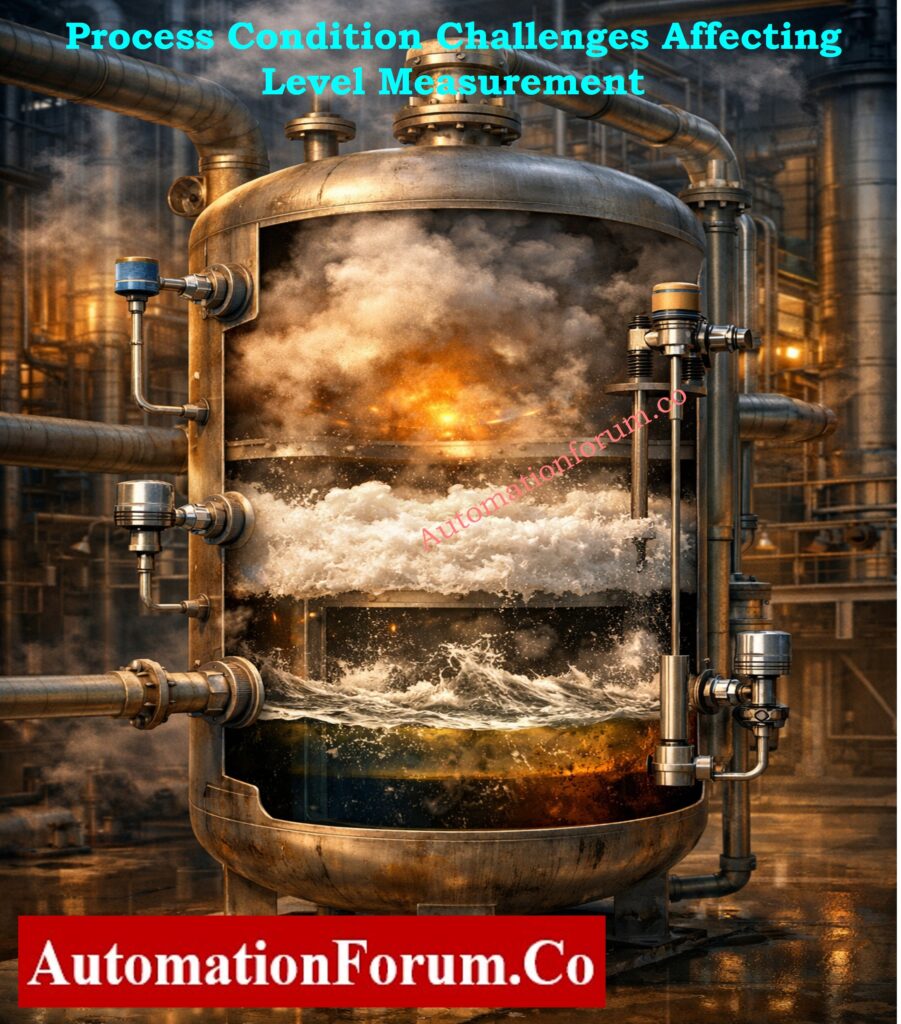
A thorough process condition analysis is the first and most important step in choosing a hybrid level measurement. Instrumentation engineers need to look at the whole working environment of the vessel or system, not just the steady-state circumstances.
Some important factors are the operating pressure, temperature, density variation, phase changes, vapor presence, foam formation, turbulence, internal obstructions, coating potential, and fouling tendencies. Startup, shutdown, trip situations, and process upsets are examples of abnormal and temporary conditions that need extra care.
When process circumstances change in a way that impacts different measuring methods in different ways, hybrid level measurement should always be used.
Evaluation of Single Level Measurement Technology Limitations
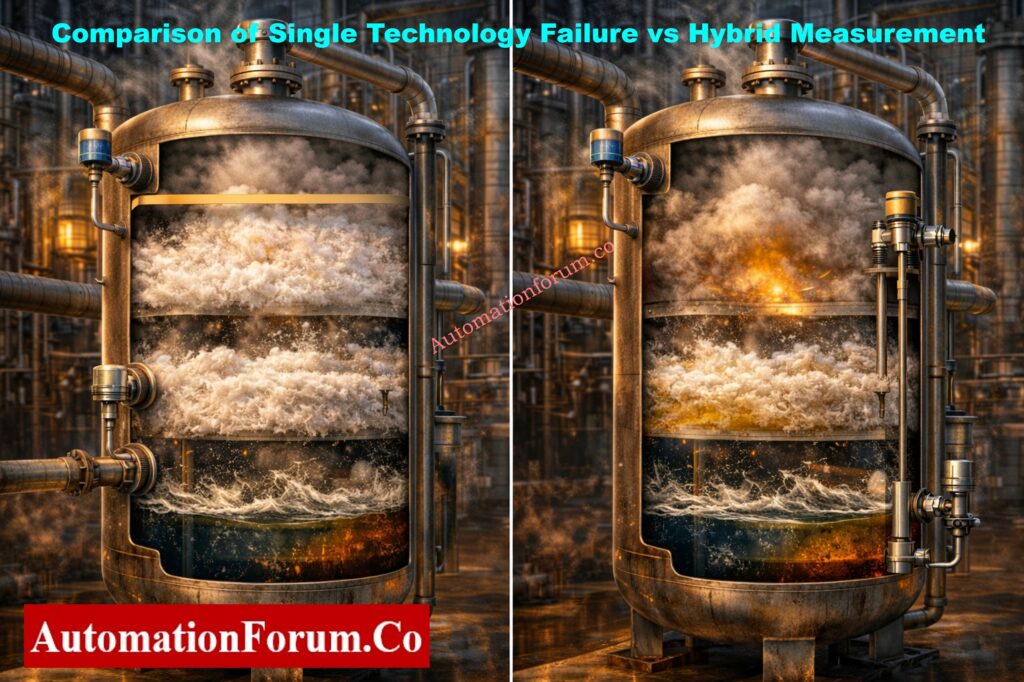
There are limits to every level measurement technology. Stable fluid density and dependable impulse lines are very important for differential pressure level measurement. Foam, thick mist, condensation, or interior vessel features can all affect how radar level monitoring works. Ultrasonic level measurement is affected by variations in pressure, temperature, and the composition of the vapor. Displacer level measurement depends on buoyancy that stays the same, but changes in density and wear and tear on the machine can change it.
When no one technology can meet the needs for accuracy, dependability, and availability in all operating scenarios, hybrid level measurement is needed. It is important to find these limits early on in FEED and basic engineering in order for EPC to work.
How to Select Interface Level Measurement – 2025 Guide: Interface Level Measurement Selection Procedure – Complete 2025 Guide for Process Engineers
Risk and Safety Assessment for Hybrid Level Measurement
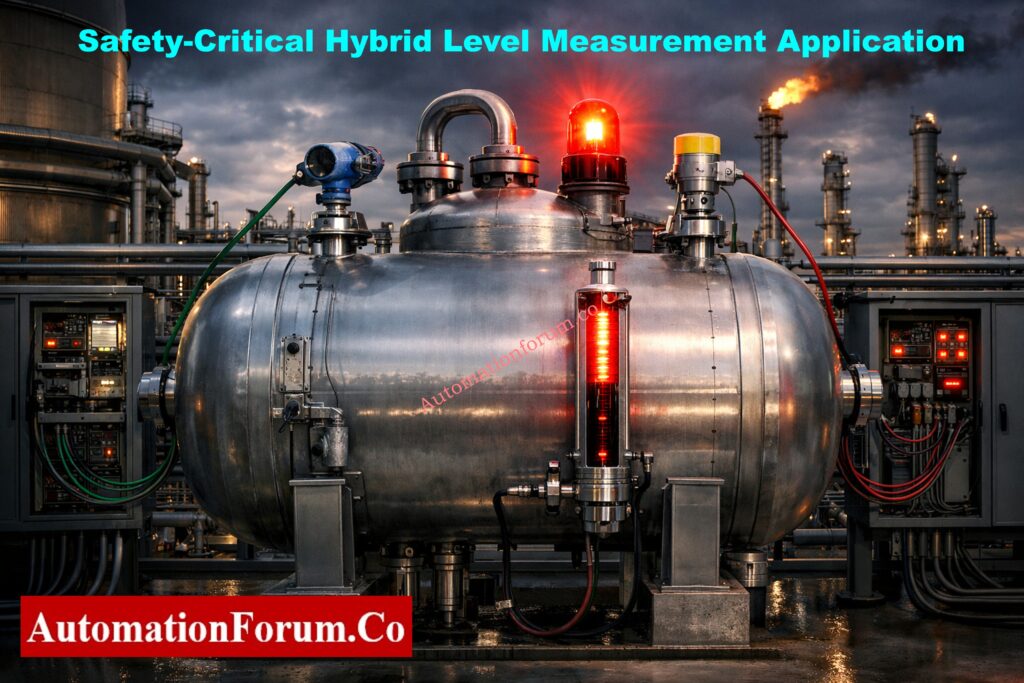
For safety-critical applications where a level measurement failure could lead to serious risks, hybrid level measuring is highly recommended. These are things like overfilling a vessel, flooding a reactor, running a pump dry, exposing a heater, and letting out dangerous or combustible fluids.
Hybrid level measurement lowers the likelihood of common-mode failure in safety instrumented systems by employing different sensing techniques. Usually, one instrument is used to regulate the main process, while a second, separate technology is employed to provide safety protection, start the shutdown or check the alert.
Functional Role Definition in Hybrid Level Systems
Every instrument in a hybrid level measuring system needs to have a clear job to do. One transmitter may be the main control input, and the other transmitter may confirm it independently, send high-high or low-low warnings, or start a safety interlock.
Clear functional separation keeps things running smoothly and stops commissioning arguments. EPC documentation must clearly state how each measurement is used and what to do when measurements don’t match.
Selection of Complementary Level Measurement Technologies
For hybrid level measurement to work, you need to carefully choose complementary technologies that react differently to process problems and failure mechanisms. The goal is not to copy, but to be different.
Some common hybrid combinations are differential pressure with radar, radar with guided wave radar, displacer with electronic level measurement, and capacitance with radar. The choice should be based on how the process works, how the vessel is designed, how the inside is shaped, and how the company operates, not on the vendor’s desire.
What Affects Ultrasonic Level Measurement Accuracy: Understanding the Factors Influencing the Accuracy of Ultrasonic Level Measurement
When to Choose Hybrid Level Measurement
Choose hybrid level measurement when the density of the fluid changes a lot because of changes in temperature, pressure, or composition. In these situations, only density-dependent devices can keep their precision.
Hybrid level measurement is a good choice for applications that involve foam production, heavy vapor, or turbulent liquid surfaces. In certain situations, one technology may be affected while the other still gives accurate information.
For pressurized tanks and high-temperature services where sensors can wander or wear out over time, hybrid level measuring is very important. You should always check for hybrid level measurement on safety-critical equipment such separators, reactors, boiler drums, and tanks for storing dangerous materials.
Hybrid level measuring strategies are also very useful for batch processes, starting and stopping activities, and vessels that change their operating mode often.
Complete Overview of Industrial Level Measurement Technologies: Mastering Level Measurement Technologies: A Comprehensive Guide
Typical Hybrid Level Measurement Applications in Process Plants
Separators, surge vessels, reflux drums, distillation columns, reactors, storage tanks, and boiler drums all use hybrid level measurement a lot. These applications frequently encompass many phases, density fluctuations, foam, or interior structures.
Hybrid level measurement makes ensuring that containers with internals like trays, coils, agitators, or baffles work reliably even when signal interference affects one technology.
Why Cable Shield Grounding Is Done Only at One End: Why the Cable Shield is Grounded Only at the PLC or Control Panel Side
Simple Process Example of Hybrid Level Measurement
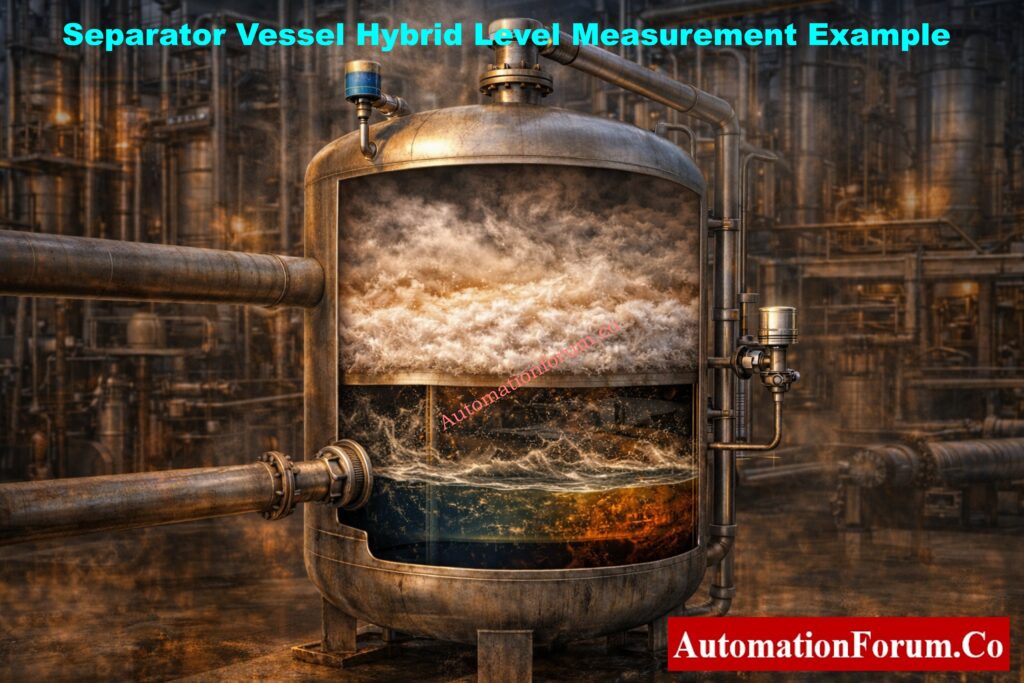
Separator Vessel Hybrid Level Measurement Example
A separator vessel used in refineries, gas processing plants, and chemical plants is a typical and useful example of hybrid level measurement.
A mix of gas and liquid goes into the separator. Flow, pressure, temperature, and composition all change throughout operation, which changes the process conditions all the time. These changes make the inside of the vessel less dense, create foam, and make the surface turbulent.
When the density of the liquid varies, the level reading becomes wrong if simply a differential pressure level transmitter is utilized. Using merely a radar level transmitter can give you incorrect level readings if there is foam or heavy vapor.
A hybrid level measurement system is chosen to make sure that level measurement is accurate no matter what the operating conditions are.
A radar level transmitter measures levels continuously during normal operation, while a differential pressure level transmitter measures levels independently and is accurate even when process conditions vary.
The separator level stays accurate, steady, and safe throughout regular operation, startup, and upset conditions because it uses two independent ways to measure levels. This easy hybrid method stops overfilling, keeps downstream equipment safe, and makes the whole process more reliable.
How to Select Cable Glands for Hazardous Areas: Cable Gland Selection for Hazardous Area Installations – Complete 2025 Guide
EPC Design and Documentation Considerations
EPC deliverables must explicitly show how to measure hybrid levels. Instrument datasheets must say what each transmitter is for. P&IDs must show the right places for nozzles and elevation references. Control philosophies must explain how measures are used and what to do when they don’t match up.
During detailed engineering, you need to think about maintenance access, isolation valves, calibration needs, and signal routing. One of the most prevalent reasons why people misuse hybrid systems while they are running is because of bad documentation.
Role of 250-Ohm Resistor in HART Communication: Why is a 250-Ohm Resistor Important for HART Communication?
Control System Integration Strategy for Hybrid Level Measurement
To avoid conflicting control actions, hybrid level measurement must be carefully integrated into the control system. It is important to choose one measurement as the main control signal. The second measurement can be used to set off alarms for deviations, safety interlocks, or to ensure that the operator is correct.
You should not switch between measures automatically unless it is properly specified and tested. Operators need to always know which measurement is in use.
Step-by-Step Level Transmitter Selection for EPC Projects: Level Transmitter Selection Checklist for EPC Engineers – Step-by-Step Guide
Lifecycle and Maintenance Benefits of Hybrid Level Measurement
Even though hybrid level measuring costs more to set up, it saves a lot of money over time by cutting down on unexpected shutdowns, making troubleshooting easier, and improving diagnostics. Hybrid systems also make calibration intervals longer and make measurements more stable over time.
This means that EPC businesses have less problems after handing over the project, fewer warranty claims, and happier clients.
Common Problems in Guided Wave Radar Level Transmitters: Guided Wave Radar Level Transmitters: Complete Troubleshooting & Maintenance Guide
Common EPC Mistakes to Avoid in Hybrid Level Measurement Design
It’s typical to choose two tools that use the same measurement principle. When designing, not taking into account startup and shutdown conditions can often lead to measurement failure during commissioning. Logic that is too convoluted and doesn’t have a clear practical purpose causes confusion and alarms.
During engineering, not commissioning or operations, the principle behind hybrid level measurement must be set.
EPC engineers that work on complex and safety-critical process plants need to include hybrid level measurement as a key part of their instrumentation design. It combines different level measurement methods to give you reliable, precise, and safe level indication in all situations.
EPC instrumentation engineers may create systems that work well for the whole life of the plant by following a defined process for choosing hybrid level measurement and knowing when it is needed. Hybrid level measurement is not a luxury in today’s industrial projects; it is necessary for safe, strong, and efficient plant operation.
How Boiler Drum Level Is Measured Using DP Transmitters: Understanding Boiler Drum Level Transmitters: Accurate DP Measurement Explained
Hybrid Level Measurement Selection Checklist for EPC Engineers
In process plants, hybrid level measurement is necessary since a single level measurement system can’t always handle changing process conditions, safety threats, and operational uncertainties. This Ultra-Detailed Hybrid Level Measurement Selection Checklist helps EPC instrumentation engineers by giving them an organized and useful way to look at process conditions, technology limits, safety needs, and control strategies.
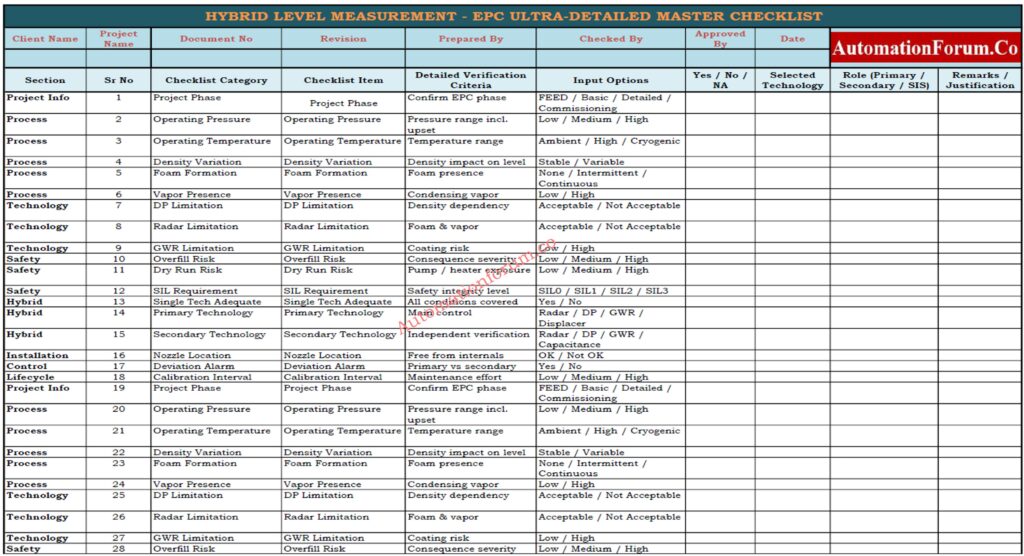
The checklist comes as a single sheet Excel tool with built-in drop-downs, conditional formatting, SIL logic indicators, and document control fields. This makes it useful for FEED, engineering, HAZOP, SIL investigations, and commissioning.
Radar Level Transmitter Troubleshooting Steps: Step-by-Step Guide for Troubleshooting Radar Level Transmitters
FAQ on Hybrid Level Measurement Selection
How do you choose a level transmitter?
When choosing a level transmitter, you need to think about things like pressure, temperature, density changes, foam, turbulence, and the shape of the vessel. First, you need to decide what the measurement is for (control, alert, or safety) and how accurate it needs to be. There is no one technique that works for all applications, thus radar, differential pressure, ultrasonic, or guided wave radar are chosen based on how well they work. For services that are really important or hazardous, hybrid level measurement is better..
What are the different types of level measurements?
There are numerous types of level measurement, such as differential pressure, radar (both non-contact and guided wave), ultrasonic, displacer, and capacitance level measurement. Other ways to monitor levels are with nuclear level measurement, magnetic level gauges, and float or conductivity switches. Combining different methods into hybrid level measurement makes them more reliable for complicated or high-risk tasks.
What is the level measurement of a flotation cell?
It’s hard to estimate the level of a flotation cell because of the froth, air bubbles, turbulence, and fluctuations in density. Because they work better with foam, non-contact radar level transmitters are often employed. Radar is widely used with pressure-based measurement in important mineral processing applications to keep level control steady.
How Tank Geometry Impacts Level Measurement Accuracy: Effect of Tank Design on Accuracy of Level Measurement
What is the best material for level sensors?
The best material will depend on the fluid and the conditions under which it is used. People utilize stainless steel a lot for everyday things. Hastelloy, Monel, or PTFE coatings are needed for corrosive services. Ceramic or hardened metals are used in abrasive slurries, while polished stainless steel with sanitary approvals is needed for hygienic uses.
Where and Why Submersible Level Transmitters Are Used: Submersible Level Transmitters: Applications, Working Principles, and Benefits
