Home Blog Page 235

Components of Pneumatic Control System

0


Pneumatic Control System 

What is pneumatic ?

Pneumatic is the technology that makes use of gas or pressurized air.

Components of Pneumatic control system

1.Directional control Valves
 
These are functional valves used in logic implementation.
Divided according to the number of ports / passages available and number of valve positions
2.Two Way Valves
Has two ports
Are Manually operated , Pilot operated or Solenoid operated
Either Normally Open or Closed
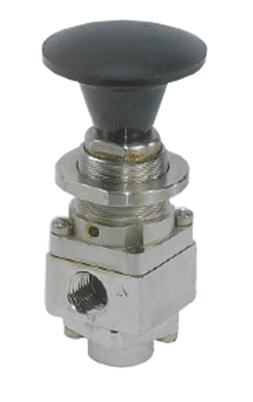
Two Way Valves

In one position IN and OUT ports are connected

In another position, IN and OUT ports are isolated
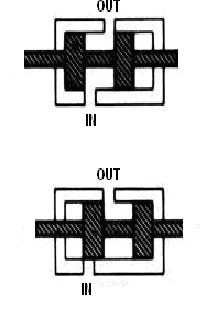
Connection of Two way valve
3.Three way valves
The mostly used logical component.
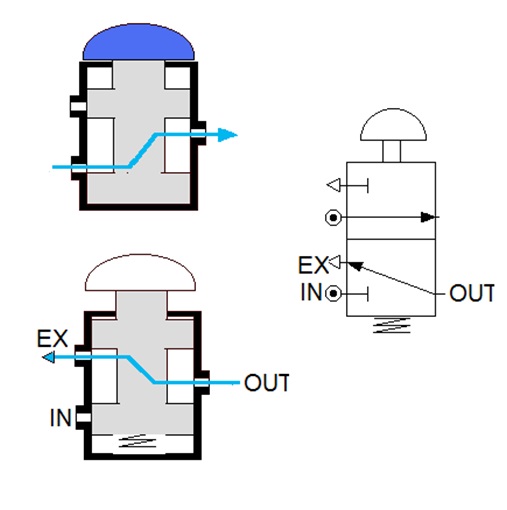
In one position IN is blocked and OUT connected to Exhaust
In another position IN gets connected to OUT and the EX port blocked
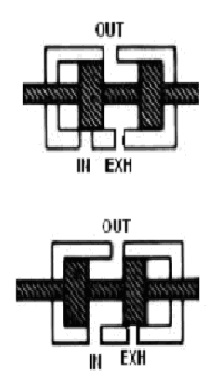
Three Way Valve
4.Manually Operated 3 Way
Manual ‘push’ changes the normal position of the valve
In a spring return valve, position returns to normal condition on manual release.
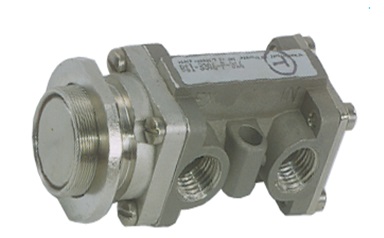
Manually Operated 3 way
3 way Valve Paths
 
3 way valve paths
5.Pilot Operated 3 way
The pilot is opposed by a spring tension, which returns the valve to its normal position on pilot removal
Pilot Operated 3 way
6.Pilot Operated Pilot Return
No spring to return the Valve
2nd Pilot used to return the valve
Port configuration is stay put until next pilot
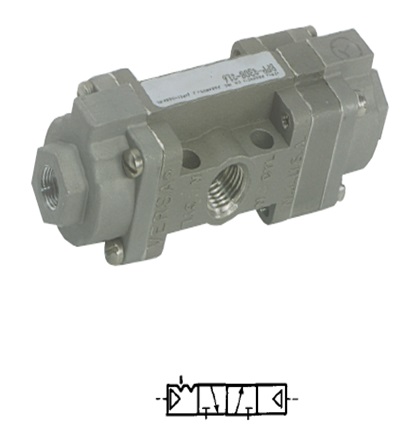
Pilot Operated Pilot Return
7.Solenoid Operated 3 Way
Piloting done by solenoid
The solenoid coil is magnetized by applying electric power
8.Solenoid operated solenoid return
Used Where electric pulse is preferred over continuous supply
Solenoid operated solenoid return
9.Manual Reset Valve
 
Manual Reset essential to effect the pilot
Auto trip on loss of pilot
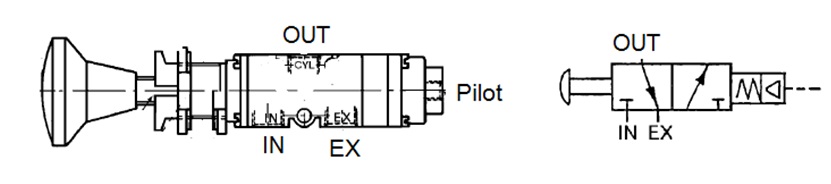
Manual Reset Valve
10.Manual Reset valve with indicator
Indicates the Status of signal presence
Manual Reset Facility
Auto Trip
Manual Reset valve with indicator
11.Flow Control Valve
Used for achieving delayed responses
Allows free flow in one direction while restricting flow in other direction
Flow Control Valve
12.Panic Valves
 
Also called ESD Valves
Are 2 port 2 Position NC type
Panic Valves
13.Shuttle Valve
Pneumatic equivalent of electronic OR gate
Presence of any one input yields an output.
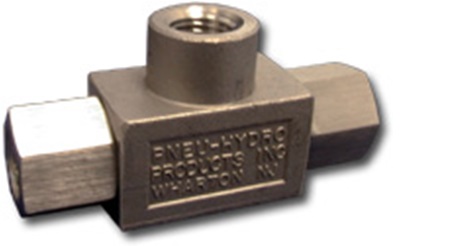
Shuttle Valve
14.Amot Indicators
Indicates the status of control pressure
Provides first-out and thus easy trouble shooting
Can be used also as a logical component.
Amot Indicator
15.Check Valves
Also called non-return valves
Allow flow in one direction and blocks reverse flow
Check Valves
16.Relief Valves
Used in Hydraulic circuits
Functions as a back pressure regulator
Relief pressure ranges from 100 to 10,000 PSI
Relief Valves
17.Quick Exhaust Valve
 
Is a 2 position high flow control valve
Assures rapid closure of a Shutdown Valve
Quick Exhaust Valve
18.Hydraulic dump Valve
Also called hydraulic interface valve
Establishes high pressure hydraulic output
Optional manual override facility available
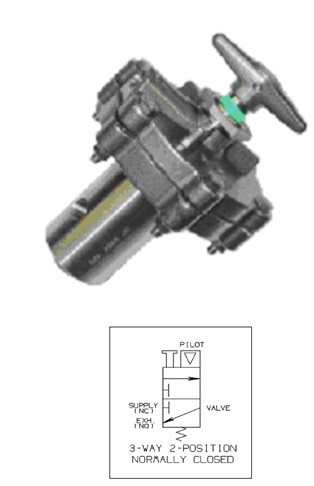
Hydraulic dump Valve
19.Sigma Master Reset Valve
 
Used as an interface between shutdown panel and shutdown valve
Often referred to as two phase relay
Capable of maintaining higher supply pressure with lower pilot pressure
Field Reset and Shutdown facility
Blocks inlet when supply falls below 40 PSI
Sigma Master Reset Valve
20.Pressure Switch- High , Low
Combination of two 3 Way components
Low switch is connected to NC port while High switch connected to NO port
Standard supply and outlet pressure is 50 PSI
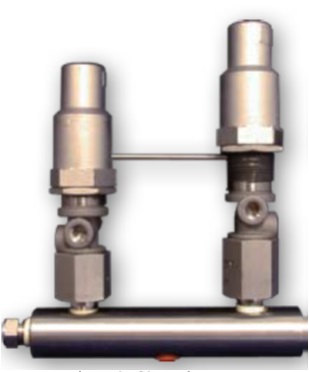
Pressure Switch- High , Low
21.Hydraulic Accumulators
 
Stores large amount of energy in smaller volume
Used in primary hydraulic header of SDP-100
Helps to absorb pressure shoot up due to temperature effect.
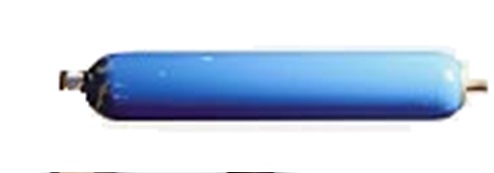
Hydraulic Accumulators
22.Haskel Pumps
 
Converts pneumatic force into hydraulic force.
The nominal pressure ratio is indicated by the pump model number
huskel pump


How to use a HART Communicator (Emerson – 475)

0

How to calibrate a Rosemount DP (Differential Pressure) transmitter with a HART Communicator ?

Steps involved in the calibration

1.Connect the DP transmitter (Rosemount) to a power supply
2.Connect the HART
3.Connect test pressure gauge
4.Calibrate zero and span of transmitter

 1.Connecting the power supply to DP transmitter :

In order for you to be able to communicate with the DP transmitter you have to install a resistor in series with your power supply.

HART recommends a 250 ohm resistor After you have the resistor in series and the power supplyconnected,connect your HART 475 noting polarity.

2.Connecting with HART 475 :

The HART 475 leads have to be inserted into the HART side of your communicator.

HART 475 Communicator

3.Connect Test Gauge :

When dealing with a DP transmitter you always want to connect to the “High side” with your pump to apply pressure (PSI).

Make sure low side is vented to atmosphere .

Precautions need to be taken :

If you are dealing with a DP transmitter in the the correct way to test is to always have the transmitter in bypass and notify the control room operator of what is about to be done.

The very first thing to do is equalize the manifold 

Isolate the process pressure

Vent the pressure 

Separate the high and low sided and connect to the high side and have the low side vented to atmosphere 

It is very important to follow these steps failure to properly equalize will most likely result in deformation of the DP transmitter sensing element.

4.Connecting HART Communicator :

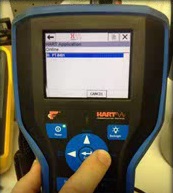
When you are all powered up turn on your HART 475 on the first screen select HART.Next you want to press right arrow when the HART 475 sees your instruments Use right arrow key to select your next option or OK button on touch screen.

Connecting HART Communicator
Pressure calibration with HART 475

Go to the following menu.

Service tools>Maintenance >Pressure Calibration>

Now start with your zero calibration.Make sure you are vented on low side and the high side is vented on the test pump.

Now its time to span the meter.

Make sure your test pump meter is reading zero when open then close the vent on your test pump.

Select Upper using one on the the keypad or while selected the right arrow and follow the prompts on screen.

Now its time to apply the upper range input.

Start slow with the pump up to see how fast the pressure rises.Over ranging will cause damage.

Apply the correct pressure

Select “OK” and follow prompts on the screen.

After you select OK when the pressure is stable the next screen will allow you to tell exactly what it is reading.

Enter in the text box the exact reading on your test pump the moment you pressed ok for the pressure being stable.

Select “ENTER”  and follow the prompts on screen

Go to “Home” .Then go to “Overview”  and verify the calibration

InstaConvert Update Released – Tool for Converting Instrumentation standard signals and Process Variables (Instrumentation Unit Converter)

0
Unit Conversion tool built by automationforum.in made for Instrumentation and Automation Engineers releases started rolling out updates.

The latest updates includes a calibration tool too.

Updates – 0.1.0

  • Removed Ads – Courtesy for automationforum.in users who sends feedback.
  • History – Option to save and view conversions done.
  • Calibration – x – y range to percentage
  • New UserInterface
  • Search for units

Send your feedback : forumautomation [at] gmail.com

 Get it on Google Play
instaconvert unit conversion tool for calibration %'s
Calibration range to 25%, 50%, 75%
Calibration Search for units Instacovert
Search for Units
instaconvert unit conversion log
Conversion History
InstaConvert - Settings
Settings

Free PID Loop Simulation – Office Excel

0

PID Loop tuning is one of the important activity carried out by instrumentation or process engineers  during plant startup and day to day instrumentation maintenance activities.

Several PID loop tuning spread sheets are available in the internet.We are discussing about some of the best PID loop tuning spreadsheet.

PID Loop Tuning Spreadsheet by Engineers-Excel .com 

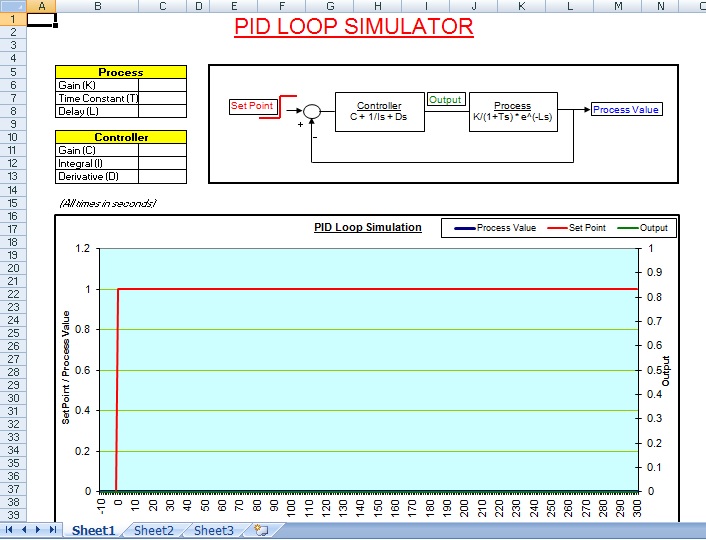
PID Simulator Spreadsheet Free


This spreadsheet simulates a control loop consist of a first order process with deadtime and a PID controller.

How to use tune PID controller with the help of PID simulator spreadsheet?

Step 1: Do a step test in manual mode and collect test data.

Step 2: Identify process model parameter

Step 3: Tune offline

Step 4: Implement in controller and fine tune if required .

You can find more documentation and spreadsheet for download from following link : Download link

Free PID simulator by Carnegie Mellon University

This PID simulator spreadsheet is absolutely free . You can download it from Automationforum

Related topics :
Instaconvert – Instrumentation signal converter 
Unit Conversion
PID Tuning rules
PID Tuning


InstaConvert – Android Application to Convert Instrumentation standard signals and Process Variables (Instrumentation Unit Converter)

0
InstaConvert is an android application to convert Instrumentation Standard Signals and Process variables.InstaConvert is absolutely free. You can download it from Google Play Store.

https://play.google.com/store/apps/details?id=com.infohe.simplyconvert&hl=en

Following parameters can be converted with InstaConvert

Instrumentation Standard Signals

4-20 ma to Percentage
3-15 psi to Percentage
0-20 ma to Percentage
0-25 ma to Percentage

Process Variables (Unit Converter)

Temperature
Pressure

Other Parameters

Length
Mass
Speed
Volume
Area
Fuel Consumption
Time
Digital Storage
Energy
Power
Force
Electric Current

More updates are coming soon .Waiting for you feed back.

InstaConvert unit converter is designed for Instrumentation and electrical engineers.

Download it from Google Play store : InstaConvert

Instrumentation Unit Converter - Instrumentation Standard signals and Process Variable

Keywords – Unit Converter ,Instrumentation Signal Converter , Process Variable Unit Converter .

Pressure Measurement – Bourdon Gauge -Working Principle Advantages and Disadvantaged

0

Working Principle Of Bourdon Gauge 

If a tube having oval cross section is subjected to pressure its cross section tends to change from oval to circular.

working principle of Bourdon Gauges


Construction of a Bordon Gauge 

Bourdon tube gauges consist of a circular tube.

One end of the tube is fixed while the other end is free to undergo elastic deformation under the effect of pressure.

Fixed end is open and pressure which is to be measured is applied at the fixed end.

Free end is closed and undergoes deformation under the effect of pressure.

Due to applied pressure the circular tube tends to uncoil and become straight along the dotted line.

Bourdon Gauge Construction


Working of Bourdon Gauge 

As the pressure is applied at the fixed end free end undergoes deformation.

The free end is attached with sector which further meshes with the pinion on which pointer is mounted.

Deformation of the pointer is transferred to pointer via this mechanism.

As a result point undergoes deflection and shows the pressure reading on calibrated dial.

Advantages of Bourdon Gauges 

1.Inexpensive
2.Simple Design
3.Good accuracy except at low pressure.
4.High-pressure range.
5.It can be easily used with electrical devices like LVDT.

Disadvantages of Bourdon Gauges.

1.Susceptible to shock and vibration
2.Gauges are subjected to hysteresis

Related Topics
Basics of Pressure Measurement 
Pressure Measurement – Manometer 
Classify Pressure Measuring Instruments 

Differential Pressure flow measurement – How it works ? Advantages and Disadvantages of DP flow measurement

0


Working Principle of Differential Pressure Flow Measurement 


Flow measurements are essential to  run a plant efficiently and safely.There are no real flow measurement technologies available including differential pressure flow also known as DP flow which utilizes a variety of measurement instruments.

DP flow is measured with the combination a primary element and a secondary elements.

The primary element is placed in the pipe to create a differential pressure and connecting
the secondary element to the process.

The secondary element or transmitter takes measurements from the primary element and converts them into useful quantitative values and transmits those values to a control system.
There are many types of  primary elements including traditional orifice plate cone venturi nozzle wedge
Primary elements differential pressure flow measurement


How to select a differential pressure flow measurement Primary element?

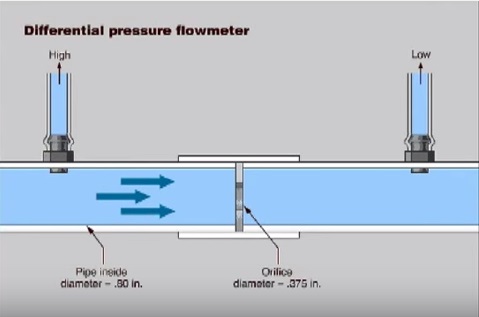
Primary element selection is dependent on process conditions.All these different primary
elements have one thing in common, they constrict the flow in a pipe causing a pressure
drop from one side to the other. the difference in pressures is the differential pressure.
The square root DP is proportional to the flow rate.
Working Principle - Differential pressure Flow Measurement
Traditionally transmitters were connected to the process with external impulse piping.
Modern DP Flow Transmitters -The impulse piping is built into the primary element this allows the transmitter to be directly mounted to the process line.Advantages of this type of flow transmitters are Easy installation and reduce maintenance cost
 

Advantages of Modern Differential Pressure Flow Transmitters.

1.Simple technology with no moving part.
2.Compact sensor
3.Configurable for bi-directional flow
4.Usable over a very wide range of sizes
5.Relatively inexpensive

Disadvantages of DP flow measurement.

1.Limited accuracy and turndown range
2.Causes a pressure drop and reduces pipe’s free passage
3.Orifice often a wear-prone point
4.Depends on good pressure sensor practice
5.Changes in liquid characteristics can affect readings.
Related Topics:
 

Variable Area Flow Meter – Application – Working Principle – Advantages

0

Variable Area Flow Meters 

Variable area flow meters are used to measure the volume flows of liquid and gases.

Application of Variable Area Flow Meter – Volume flow measurements of Liquids and Gases

Components –  Vertical Conical Measuring Tube
Mobile Float

It consist of vertical conical measuring tube which widens upwards and a specially formed float which can move up and down freely in the measuring tube.

Working Principle – 

Variable area flow meter working principle


The reference of position of the float to the measuring tube creates a variable ring orifice.The higher the position of the float the larger the ring orifice and therefore the cross sectional area through which the medium come pass through the float.This is the origin of the English designation of the device.

When there is no flow, gravity keeps the float at the bottom end of the measuring tube.
As soon as the medium flows through the tube from bottom to top the float rises again until the acting forces are in balance.

Three main forces act on the movable float.
1. Graviatation force (W = Weight) – Operates downwards as a reset force.
2. Buoyancy force (B)
3. Flow force (D=Drag)

Weight = Drag + Bouyancy

W and B = Constant

The position of the float is a flow indicator.
The physical operating mode shows that the position of the float is a flow indicator.
With glass cones flow rate can be read on a scale on the measuring chip itself.

With the metal cones the float is not visible so they have a magnetic transfer onto the pointer.For this purpose a magnet is built into the float.Through a magnetic coupling installed on the point of axis the linear movement of the float float is converted into the rotary movement of the pointer which displays the flow on a scale.No auxiliary power supply is required.

Advantages of Variable area flow meter


Advantages of Variable area flow meter – Purely mechanical.No auxiliary power is requires.

Related posts – 
Flow transmitter calibration 
Type of Valves

What are the different types of DC Motors and how to select DC motors for your application?

0

The most common DC motors types are

1.The basic brushed DC motors
2.Brushless motor
3.Permanent Magnet motor

Brushed DC motor
In a brushed DC motor, the magnet acts as the stator.The armature is integrated onto the rotor and a commutator switches the current flow.Commutator function is to transfer current from fixpoint to the rotating shaft.Brush DC motors generate torque straight from the DC power supply to the motor by using internal commutation.
Advantages of Brushed DC motors – Low initial cost
                                                            Simple control of motor speed
Disadvantages of Brushed DC motors – At certain period during a DC motor rotation commutator must reverse the current causing reduced motor life due to arching in friction.


Brushless DC motor
A brushless DC motor is essentially a DC motor without mechanical commutation of the brushed DC motor.Brushless DC motors are powered by Direct current and have electronic commutation system. The Permanent magnet is housed in the rotor and the coils are placed in the stator.
Advantages of Brushless DC Motor – Resistant to mechanical wear and tear


How to select DC motor for your application?
 
For selecting motors for your application, you have to have a full understanding of the application parameters including power,speed,torque,physical size,efficiency,lifetime expectations.
Key criteria for selecting a DC motor includes first finding out what voltage is readily available for the application and what physical size the motor needs to be.Torque and speed have an effect in motor frame size.High torque motors are often larger in size than their low torque counterparts.
Related articles:

Level Measurement – Ultrasonic Type Working Principle Application Advantages and Disadvantages

0

Ultrasonic Level Detectors

Ultrasonic sound waves with frequencies of 1 to 5 megahertz can be used to detect liquid or solid levels.

Ultrasonic are sound waves but are at higher frequencies that cannot be detected by the human ear.

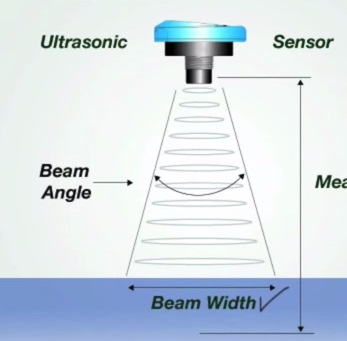
ultrasonic level measurement working principle

The most common kind of ultrasonic transducer consist of a piezoelectric crystal.When a voltage is applied to the plates the piezoelectric crystal expands or contracts.If the voltage is alternating at an ultrasonic frequency,the crystal expands and contracts at same the same ultrasonic frequency.The crystal vibrates and these vibrations can be transferred to a diaphragm to produce ultrasonic sound waves.

Piezoelectric device can be mounted in the bottom or in the top of a vessel.The liquid surface acts as a reflector and the transducer receives the reflection of its transmitted pulses.The transducer is connected to a transmitter and to a receiver,into which the echo is fed.The transmitter and receiver are both connected to an echo timer which measures the amount of time between the emission of the sound wave and the reception of echo.The elapsed time can be converted into units of level of liquid.
Application of Ultrasonic Level detector
 
For situation where it is impractical or undesirable to install an instrument inside a tank ,non penetrating ultrasonic sensors are available.
Advantages of ultrasonic level detectors
1.Can be used in any tank size
2.Can be used in a vacuum
3.Can be used under high pressure
4.Relatively easy to maintain because they don’t have no moving parts.
Disadvantages of Ultrasonic level detectors
 
1.Expensive
2.sensitive to wide range of temperature variations.
Selection consideration – Ultrasonic sensor
 
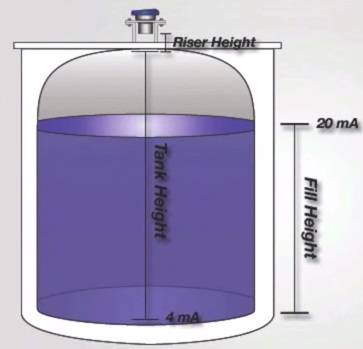
1.Choose a sensor range that at least as tall as the tank,doubling sensor margin to add margin against higher temperatures,condensation and turbulence.
2.Tank height is defined as the distance from the installed face of the transducer down to the bottom of the tank.
3.Riser height is the distance from the face of the transducer to top of the tank.
4.Fill height is defined as the distance from the bottom of the tank,upto the maximum desired liquid height.
5. Deadband is defined as the minimum distance from the face of the transducer from which the sensor can measure.
how to select an ultrasonic level sensor
Related Articles