Home Blog Page 234

Common Control Loops

0


Common Control Loop 

Instrumentation engineering Control loop

1.Flow


Liquid flow processes are fast,  typically 0.5 sec response or less. Gas flow is slightly slower because of the compressibility of the gas. Control components – transmitter, valve and transmission lines –  are the main dynamic elements.  The most common measuring means is the orifice plate and differential pressure transmitter ; flow is proportional to the square root of differential pressure.
If a centrifugal pump is the flow energy source, the throttling valve can be placed in the pump discharge line. If a positive displacement pump is used , then the valve must be in a bypass line; alternately, pump speed or stroke can be controlled instead of bypass flow.
A linear valve should be used in preference to a percentage valve, especially where the pressure drop across the valve varies. This helps counteract the non linearity of the differential measurement. If the measurement is linear    (magnetic flow-meter, turbine meter etc.) an equal percentage valve is probably the better choice.
Flow processes are determined by noise caused by fluid turbulence and equipment vibration. Controller gain is invariably low usually less than 1.0. Reset must be used to overcome offset,  derivative cannot be used.
VARIABLE
PROCESS
 CONTROL  SYSTEM
    FLOW
·         Very fast.
·         Most lags are in the control system.
·         Non-linear (square) measurement common.
·         Noisy.
·         Proportional plus reset  controllers.
·         Low gain, fast reset.
·         Derivative hurts.
·         Linear valves for differential pressure measurement.
·         Equal percentage valves for linear measurement.
·         Valve is the major dynamic element.

2.Pressure

Liquid – Liquid pressure control is very similar to flow control. The system is non-linear : pressure varies as flow squared. Noise is ordinarily present.
Gas – Gas pressure processes are single capacity systems and do not normally present much of a control problem. Self-acting or simple pilot-operated controllers can often be used with good results. (Line pressure is connected to the valve top either directly or through a simple pilot valve.) Gains of these proportional-only controllers are typically 20 to 50 or higher. A pneumatic reducing valve is a simple example of a self-acting pressure regulator.
The important secondary dynamic element is the valve – the process itself is usually a large single capacity element and measurements are fast. Distance-velocity lag is not present.
Proportional control is usually adequate ; reset can be added to completely remove offset. High gains are generally achievable or moderate gains with fast reset if small offsets are a problem.
Vapour – The most important vapour pressure applications involve heat transfer – distillation columns, evaporators etc., where the control system is basically heat balance control. Vapour pressure control loops act like temperature control loops.
        VARIABLE
         PROCESS
      CONTROL  SYSTEM
PRESSURE    Liquid
·         Fast
·         Most lags are in the control system.
·         Non-linear (square).
·         Noisy.
·         Proportional plus reset controllers.
·         Gain near 1,fast reset rate.
·         Derivative of no value.
·         Linear valve.
PRESSURE    Gas
·         Single capacity.
·         No dead time.
·         Linear, no noise.
·         Simple process.
·         Self-acting or high gain proportional controllers.
·         Reset seldom necessary.
·         Derivative unnecessary.
·         Valve characteristic relatively unimportant.
PRESSURE    Vapour
·         Dynamics vary.
·         Dead time possible.
·         Slow compared to other pressure processes.
·         Linear,  no noise.
·         Three-response controllers.
·         Settings vary.
·         Equal percentage valves.

3.Level

Level is a single capacity, integrating system. The tank, capacitance is directly proportional to the vessel diameter. Large diameter tanks with low  thruput present no problem, small diameter, high thruput systems are more difficult to control but not as common. The tank lag is volume thruput.
Level control systems fill into two distinctly different categories : precise control and averaging control.
For precise control, proportional controllers will provide adequate regulation on large capacity systems. As capacity decreases, controller gain must be decreased and reset becomes necessary.
Averaging level systems sacrifice tight control in order to keep output flow rate constant. Typical applications are where the vessels under control are surge capacities between sections of a multi-stage process, their purpose being to absorb changes between stages. Level is allowed to wander between wide limits, with corrective action applied gradually so long as the level remains safely between the limits. Low gain, reset controllers do the job. Special dual-gain or dual-reset controllers are sometimes used. They have low gain or reset in the safe mid-level area, switch to higher gain or fast reset if the level strays too fat.
    VARIABLE
          PROCESS
        CONTROL  SYSTEM
           
LEVEL
·         Single Capacity (integrating)
·         No dead time.
·         Linear.
·         Infrequent noise.
·         Precise control:
High gain or proportional plus reset controllers.
·         Averaging control:
       Low gain proportional                plus reset or specialised controllers.
·         Valve characteristic unimportant.

4.Temperature

Temperature Control  systems vary  from simple to very difficult and there is no such thing as a typical temperature application. Almost all temperature control problems
are heat transfer problems and are characterised by long time constants and slow reaction rates. Distance-velocity lag is common . The measurement lag can pose a serious problem, especially if the thermal system is protected with a well. The measurement time constant depends on the mass and surface area of the bulb (or the well), the fluid being measured and its velocity past the bulb. Special care should be taken in locating the bulb to maximise heat transfer.


Temperature control problems are complicated by nonlinearities. Heat transfer processes have parameters which vary with flow, so that time constants and distance-velocity lag vary with load or operating point.
 
Processes dominated by one large capacity – as large temperature baths or air heating systems -can be controlled with on-off controllers. Some cycling results, but is in the order of 1% of the span.
 
Proportional plus reset control is used in smaller capacity systems where load changes are large and where distance-velocity or measurement lags are important. Most shell and tube heat exchangers fall into this category.
 
Derivative is helpful, provided the distance-velocity lag is not the dominant secondary dynamic element. Shell and tube heat exchangers or plate heaters have large effective dead time so that derivative is of limited value. But other temperature systems such as batch reactors are dominated by linear lags and derivative is very helpful. 
      VARIABLE
          PROCESS
   CONTROL  SYSTEM
  TEMPERATURE
·         Multiple capacity system.
·         Dead time possible. (especially heat exchangers).
·         Non-linear.
·         No noise.
·         Three-response controllers.
·         Settings vary but gain usually above 1.
·         Derivative of limited value if dead time is large.
·         Equal percentage valves.
Measurement dynamics are important.

5.Composition

Composition Control can be simple mixing problem (blending of lubricating oils to a desired viscosity), a separation problem (product quality control in a distillation column) or a reaction problem (neutralization with pH control). Generalizing on typical dynamics on-line  control is difficult.  
 
On-line analyzer promote simpler control. They are relatively fast and do not require sampling systems. however, they are often noisy. Most analyzers are linear throughout their operating range.  pH is the notable exception. Sampling systems introduce distance-velocity lag into the control loop and the longer the dead time the tougher the control problem. Sampling systems also require careful design to insure that a sample representative of the total process stream is analysed.
 
Analyzers are normally sensitive devices having narrow spans. The high gain element in the loop forces the controller to have a low gain. Reset is an essential control mode. Derivative is sometimes useful. 
    VARIABLE
          PROCESS
   CONTROL  SYSTEM
 COMPOSITION
·         Dynamics vary.
·         Dead time usually present.
·         Usually linear.
·         Sometimes noisy due to poor mixing.
·         Proportional plus reset controllers.
·         Low gain, variable reset rate.
·         Derivative sometimes useful.
·         On-line analysers fast, often noisy.
·         Sampling systems complicate both measurement and control, add dead time.
·         Linear  valves.

What is pH meter ? How pH meter works?

0

pH meter

A pH meter is an electronic device used for measuring pH(acidity or alkalinity) of a liquid.
 
A typical pH meter consist of a special measuring probe connected to an electronic meter that measures and displays the pH reading.

pH meter Probe

 
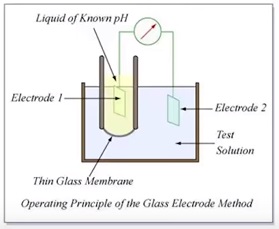
The probe is a key part of a pH meter,it is a rod like structure usually made up of glass.
 
At the bottom of the probe there is a bulb,the bulb is sensitive part of a probe that contains the sensor.
 
Never touch the bulb by hand and clean it with the help of an absorbent tissue paper with very soft hand,being careful not to rub the tissue against the glass bulb in order to avoid creating static.
 
To measure the pH of a solution the probe is dipped into the solution
 
The probe is fitted in an arm known as the probe arm.
pH Scale
pH of different liquids

How does a pH meter works?

 
A pH meters measures the concentration of the hydrogen ions [H+] in a solution
 
An acidic solution has far more positively charged hydrogen ions in it than an alkaline solution,so it has greater potential to produce an electric current under certain conditions
 
It is like a battery that can produce a greater voltage
How pH meter works
A pH meter takes advantage of this and work like a typical voltmeter.
 
It consist of a pair of electrodes connected to a meter capable of measuring small voltages,on the order of mili volts.
 
It measures the voltage (electrical potential) produced by the solution whose acidity we are interested in compares it with the voltage of a known standard solution and uses the difference in voltage (the potential difference) between them to calculate the difference in pH.

pH Meter Calibration and Use

For very precise work the pH meter should be calibrated before each measurement.
 
Calibration should be performed with at least two standard buffer solutions that span the range of pH values to be measured.
 
For general purpose buffers at pH 4.01 and pH 10..0 are acceptable 
 
For more precise measurements,a three buffer solution calibration is preferred
 
The calibration process correlates the voltage produced by the probe (approximately 0.06 volts per pH unit) with the pH scale.

Derivative Or Rate Control

0

Derivative Control

Derivative or rate Control
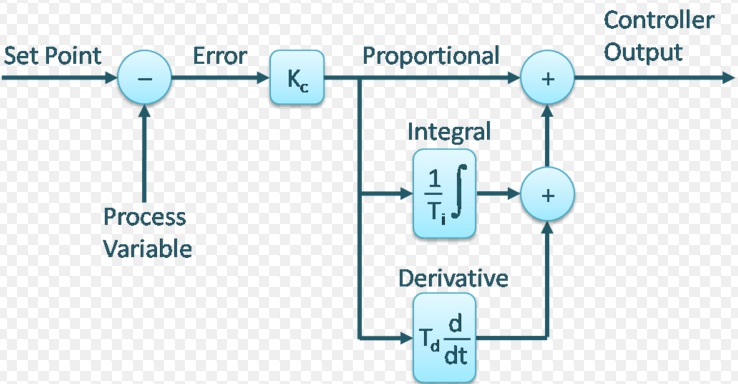
Derivative control (also called rate control) responds to the rate of change of the controlled variable. For example, if the temperature of a process is changing rapidly, the controller must respond quickly to keep the temperature within acceptable limits. In effect, derivative control action uses the rate of change in a process to adjust the output of the controller. How much adjustment is made is determined by how quickly the deviation from the set point is occurring.
 
 
Taking the derivative (or differentiation) is a mathematical computation that determines the rate of deviation from the set point. Using mathematical symbols,  this computation is expressed as d/dx f(x). 


Derivative control is used in process control systems where lag time (the time it takes to measure a change) is large. Derivative control is considered difficult to implement and adjust;  therefore, it is used only when the amount of lag time is extensive. It is typically used in combination with proportional plus integral control (referred to as PID control) for temperature control and other slow applications. PID controllers may be difficult to adjust.

Derivative control is rarely used with proportional control only. Proportional plus derivative control, referred to as PD control, is desirable in processes where there are several different lag times.


Process Control – Integral Control

0

Integral (or Reset) Control

 
Integral Control
 
Integral control (also called Reset control) can be used when unacceptable amounts of offset occur in a process with proportional control. Integral control is used to return the value of the controlled variable to the set point. This mode of control is most often used along with proportional control. For example, if a process needs proportional control but must also be maintained very close to a set point, proportional plus integral control may be used.
In very basic terms, integral control action will combine with the proportional control action to modify (or boost) the normal proportional output of a controller in the proper direction until offset is corrected.
“Integral” is a mathematical term used to describe how this type of control action is accomplished. A mathematical computation, called integration, determines how much to compensate for the offset. Using mathematical symbols, this is  f(x) dx.
The integral value is set into the controller. The value of the manipulated variable is changed in proportion to the amount of offset. So, if the deviation from set point is doubled over a previous measurement, the final control element (a valve, for example) may be moved (closed or opened) twice as fast to compensate. Proportional plus integral control is also referred to as PI control and proportional plus reset control. The use of both means that the advantages of both are present, i.e., the elimination of offset.

What is an RTD ? How RTD works ? Advantages and Disadvantages of RTD?

0


RTD


Resistance Temperature detectors (RTDs) are sensors used to measure temperature.
Generally greater stability,accuracy and repeatability when compared to thermocouples.
Slowly becoming the proffered temperature measurement device in many industrial applications because of high accuracy and therefor suitability for precision applications.

How RTD works?

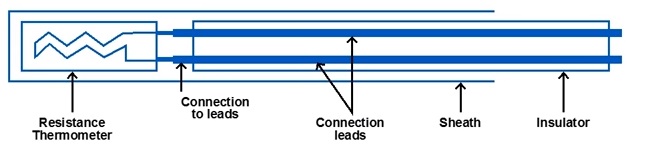
Most RTD elements are made from a length of fine coiled wire of a pure material,typically platinum,nickel or copper wrapped around a ceramic or glass core.
The material has a predictable change in resistance as the temperature changes.
RTD works by correlating the resistance of the element with temperature.The hotter metal becomes,the greater its resistance.
Platinum is typically used.
Advantages of platinum are
1.linear resistance vs Temperature
2.Chemically Inert
3.Stable over temperature
Unlike thermocouple RTD require a small amount of current
The resistance measured correlates to temperature
Lead resistance can contribute to measurement error,especially as wire length increases.

Differnet Types of RTD

Two -Wire
 
Only used when high accuracy is not required.
Resistance of connecting wires is added to that of the sensor,leading to measurement errors.
Two-Wire RTD
Three-Wire RTD
 
The two leads to the sensors are on adjoining arms.
There is a lead resistance each arm of the bridge so that the resistance is cancelled out as long as the two lead resistances are the same.
Four-Wire
 
Four-Wire is most accurate RTD temperature measurement setup
The device measures and removed the lead resistance in both sets of leads.
RTDs are also made from different materials
RTD can be made cheaply in Copper and Nickel but these have restricted ranges because of non-linearity and wire oxidation problems in the case of Copper.
Platinum is the preferred material for precision measurement because in its pure form Temperature coefficient of resistance is nearly linear;enough so that temperature measurement with precision +1 deg C or -1 deg C can be readily achieved with moderately priced device.

Advantages of RTD

1.Stable for long periods of time
2.Ease of recalibration
3.Accurate reading over relatively narrow temperature spans.

Disadvantages of RTD

1.Smaller overall temperature range
2.Higher Initial cost
3.Less rugged in high vibration environments
4.They requirement more complex measurement circuit
5.Self-Heating and lead errors when high accuracy is needed,

Process Control – Proportional Control

0

Proportional Control 


In some processes, the fluctuations around the set point (called oscillation) may be too severe to achieve the desired results. Many processes require a more stable form of control. Proportional control is one way to achieve that stability

Proportional Control Example

 When proportional control is used in a system, the final control element may be in any position within its operating range. For example , a valve may be 75% open, not just 0% or 100% as with two-position control. 


The word “proportional” refers to the fact that there is a continuous relationship between the value of the controlled variable, the deviation and the position of the final control element. This means that as the measured variable  moves away from the set point, the final control element gets adjusted proportionately by the controller to bring the measured variable back to the set point. Proportional control can be used to provide a greater degree of control action than two-position control.

With the proper control setting, proportional control can be used to maintain a balance between the input and output of a system. 

Proportional Band 


The proportional band is the amount of input change (range of the measured variable) needed to provide a full range of output change (range of positions of the final control element) caused by the controller. 
For example, if a steam heating process can vary from 100 oC  to 200 oC, the amount of input change is 100oC (or the range of the measured variable which     200 oC  –  100 oC = 100 oC ). The full range of the output change is a fully closed to a fully opened valve. The controller causes the value to open or close according to the amount of deviation from the temperature set point of 150 oC. The amount of change that the controller causes is called proportional control action. 

Widening the proportional band width means that it will take more of an input change (more of a deviation from the set point) to give a full range of output (fully opened to fully closed). Or think of it this way : the measured variable has to deviate a large amount from the set point to produce a small change in the final control element.

Amount of Proportional Control Action

The amount of proportional control action that is used in a process loop will depend upon the process being monitored. Each process has its own characteristics and variables. Therefore, each process will have a specific proportional band within which the process will operate smoothly and efficiently. 

With a very narrow proportional band, it takes very little change in input (deviation from the set point) to move the valve through its full range. The valve is very sensitive to error signals from the controller. The characteristics of a narrow proportional band are similar to those of two-position control. 

As with two-position control, a narrow proportional band can cause oscillations in the controlled variable. These oscillations in many cases will gate progressively worse, leading to more instability. For many processes, oscillations must be avoided. Therefore, a narrow proportional band would provide too much proportional control action for these processes. 

With a very wide proportional band, the full range of input change moves the valve only slightly.  In effect, this would be similar to opening the valve halfway and leaving it in that position. The temperature is corrected very slowly over a long period of time. 


It is important to remember that each process has an appropriate proportional band setting. The acceptable values of one process may not be acceptable values for another process. Some processes may require a narrow proportional band or a wide proportional band. Others may require a proportional band somewhere between the two.

OFFSET

 
Systems using proportional band control action often exhibit a condition referred to as Offset. After the oscillations have settled out in a process, there may be a difference between the actual value of the controlled variable and the set point. Offset is defined as a constant and steady deviation from the set point.
Offset is a major disadvantage of proportional control. The result is steady and consistent, but not exactly on target. Offset occurs when there is a change in the manipulated variable that cannot be detected by the controller. For example, due to wear and tear, the measurement of the speed of a pump supplying liquid to a blender is off by 5 rpms. The controller has no way of detecting or adjusting for this deviation. The set point remains the same; however, actual supply of liquid is off slightly.

Two-position control

0
ON OFF control system

With two-position control, the final control element may be in only one of two positions. These two positions are sometimes called on/off or open/closed. Consequently, it is often called on-off control. Two-position control is used in many systems, such as heating and air conditioning, water heaters and ovens.

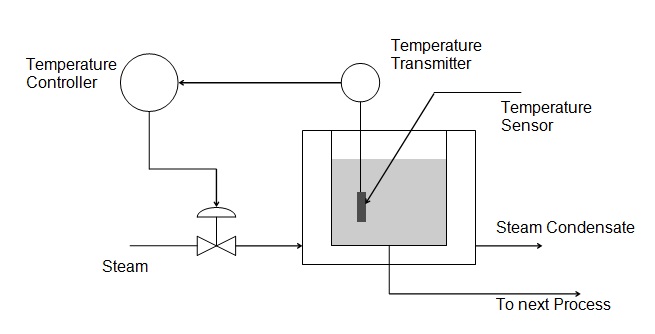
In the example, two-position control is the mode of control. The measured variable is the temperature of the process and the final control element is a steam valve.

Because this system uses two-position control, the valve can be in only one of two positions – usually these are fully open or fully closed. Therefore, when the temperature of the process falls below the set point, the valve will open completely (100%). When the temperature rises above the set point, the valve will close completely (0%).

The instruments used for two-position control are usually inexpensive, rugged and foolproof. In a process using two-position control, the value of the controlled variable will fluctuate around the set point. In the example of the steam heating process, the temperature repeatedly rises above and falls below the set point. Theoretically, the steam valve would have to open and close continually to maintain a constant temperature at the set point. This would cause too much wear and tear on the equipment.

Instead, two-position controllers usually have a dead-band or dead-zone. The dead band is a range of values around the set point. When the controlled variable is within this range, no control action takes place. The dead band reduces wear and tear on the equipment, particularly on the final control element without a dead band, the final control element would cycle continuously.

Dead band is described as a plus (+) or minus (-) about the set point. For example: The set point is a temperature of 100oC and the steam valve opens at 97oC and closes at 103oC. You would describe the dead band as +/- 3o C around 100o C set point.

Instruments Used In Control Loop

0

Instruments 


I hope you have a general understanding what a feedback control loop is, if not please refer the following article – Feedback Control Loop 

Sensors

Sensors used in feedback control system


You have read  that a sensor monitors and measures what is happening in the process. Examples of sensors include: thermocouples, floats, limit switches, pressure switches, pressure switches, moisture meters, and scales.
 
When selecting a sensing device  for a particular application, many instrument characteristics must be considered. Some of those characteristics are discussed below. (Note: These characteristics also apply to other instruments in the loop and the loop as a whole)
Response Time
The amount of time required for a sensor to respond to a change in its input.
Accuracy
How close the sensor comes to indicating the actual value of the measured variable.
Precision or Repeatability
How consistent the sensor is in measuring the same value under the same operating conditions over a period of time.
Sensitivity
How small a change in the controlled variable the sensor can measure
Dead Band
How much of a change to the process is required before the sensor responds to the change
Transmitters
 
Transmitters_Used_in_Feedback_control_loop
 
 
A transmitter carries a signal of the measured variable from the sensor to a controller in the control room. Transmitters are necessary because  sensors and controllers are normally at a distinct place. The transmitter collects the measurement provided  by the sensor , converts it to a standard process signal which can be easily send and easily read, and takes the signal to the controller. Several times sensors and transmitters are combined together.
 In process industry there are two main types of transmitters depending on the signal used for transmitting the parameter
 
A Pneumatic transmitter converts the output of the sensor to air pressure, then sends the signal through a tube to the controller. 
An Electronic transmitter converts the output of the sensor to an electronic Signal, then transmits the signal by wires to the controller 
 
Signals are usually  transmitted within standard ranges. For example:
·         electronic signals have a range from 4-20 mA-dc (milliamperes of direct current)
·         the range of pneumatic signal is 0.2 to 1 Kgf/cm (pounds per square inch gauge of air)
The information transmitted by the transmitter has to cover the entire range of information on the measured variable. You must adjust the transmitter so that its range represents the range of value of the measured variable.
 
Controllers
 
Controllers_Feedback_Control_Loop
 
 
The types of controllers typically used in industry are electronic and pneumatic. The same characteristics of electronic and pneumatic transmitters apply to electronic and pneumatic controllers: that is, speed distance, and flexibility.
Controllers adjust the position of the final control element to eliminate deviations from the set point and maintain the process within acceptable limits. The specific way in which a controller reacts to a deviation and affects the position of the final control element is called the type of control action or mode of controller .
(Deviation = Measured value – set point.)
 
Final control element
 
Final_Control_Element_in_feedback_control_loop
 
A final control elements to is the device that changes the manipulated variable. Examples of final control elements include:
·         Valves – to change the flow rate of liquid in a pipe
·         Pumps – to move liquid into a tank
·         Dampers – to change the rate of air flow to a furnace
Fans – to create a negative pressure in a folder
The final control element must be in he proper position to create the desired change in the process. For example, when the flow rate of a liquid in a pipe is too great, a valve must be properly positioned to decrease the flow rate.
Final control elements can be positioned electrically, pneumatically, or hydraulically. Electrical and pneumatic   positioning are most commonly used in process industries.
 

Basics of Feedback Control – Elements of Feedback control

0

Feedback Control

Feed-back control is gathering information on the controlled variable and comparing it to the set point; making a decision based on that comparison; and taking action to eliminate any differences between the controlled variable and the and the set point

In feedback control, there is a constant flow of information in a closed loop. All of the instruments which work together in the loop to control a process are called the feedback control loop.

Feedback Control System

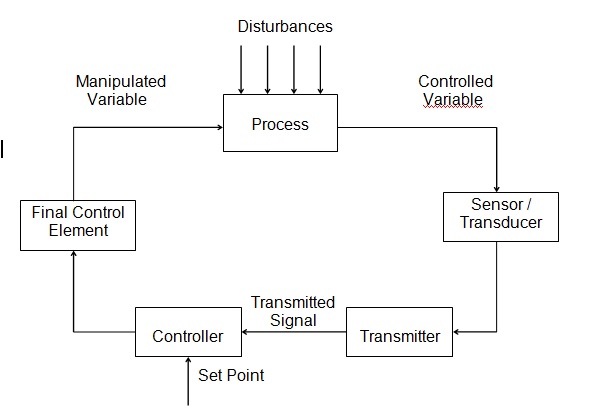
Elements of the Feedback control loop

Instruments are used in the feedback control loop to: monitor and measure process parameters, relay information, determine needed action, cause the action to happen, or take action. The instruments used in a feedback control loop are listed below:

The Sensor
or
Transducer
Monitors and measures the process parameters you want to control, which is the controlled variable
For example, a thermocouple used in a heating process to sense the temperature in a vessel
Relays information about the controlled variable (sensed by the sensing instruments) to a controlling instrument or other instruments in the loop
Using the temperature example, the thermocouple output is picked up by the transmitter which sends a signal to the controller.
Before the signal can be sent, the transmitter first transforms the sensed value into  a signal which can be transforms this into a 4-20 milliampere electric signal which the controller can receive.
Determines needed action by comparing information received from the transmitter to the set point (the desired value of the controlled variable which is entered in the controller). If there is a difference between the set point and the actual value of the controlled variable (the deviation), the controller sends a signal to the final control element.
For example, if the controller determines that the temperature in a vessel is too low. The controller sends a signal to the final control element to increase heat to the vessel.
Takes action to adjust the manipulated variable in the process. This adjustment drives the value of the controlled variable back toward the set point
The final control element in our temperature example could be a gas valve which opens to allow more gas (manipulated variable) in the dryer to increase the temperature (controlled variable)

Other Instruments that support a control loop


In addition to sensors, transmitters and controllers, and final control elements, there are other instruments which support the feedback control loop. These are instruments that provide information to the operator or assist in the control of the process. Typical examples of these instruments are:
·         Recorders
Recorders keep a continuous record of the value of the controlled variable so that operators, instrument  technicians, and managers can evaluate the process over a period of time
·         Indicators
These are lights and displays which graphically show a value of the controlled variable so that  operators and instrument technicians can see at a glance what is occurring in the process.
·         Alarms
Alarms tell the operators and instrument technicians when the value of the controlled variable is out of limits. They alert operators and technicians to problems or potential problems.
·         Interlocks
Interlocks are devices which will not allow one part to function unless another part is functioning. Interlocks are frequently used as safety measures or to protect equipment

Elements of Process Control

0
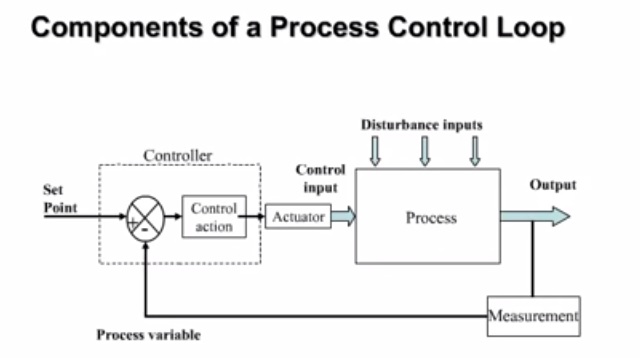
In most processes, there are six basic elements.Process control elements are 
 
Components of a Process control loop


1. Controlled variable

What you want to control (temperature pressure, level, flow rat, dimensions, position, etc.)
 

2. Measured variable

What you observe in order to determine the actual condition of the controlled variable
 In most cases, you measure the controlled variable itself. For instance, if you want to know how fast a car is going, you measure its speed. In other cases, you measure a different variable to determine the condition of the controlled variable. For instance, you can determine the level (controlled variable) of liquid in an open or vented tank by measuring the pressure (measured variable) at the bottom of the tank.

3. Set Point

The desired value of the controlled variable; for example, 70 room temperature

4. Deviation

The difference between the set point and the actual value of the controlled variable (which is the measured variable). For example, if your indoor thermometer reads 65   and you would like a room temperature of 70, the deviation is 5
 Note: Deviation is also referred to as difference or error.

5. Manipulated variable

The variable that is adjusted to close the gap (deviation, difference, or error) between the set point and the controlled variable; for example, the amount of electricity or gas to the heater.

6. Disturbances

Anything that affects the process and could cause deviation from the set point; for example, a window left open, poor insulation, a damaged thermostat.
 
Learn more about Process Variable