
- Alarm & Trip Setpoint Lists in Process Plants
- What Is an Alarm & Trip Setpoint List in Instrumentation and Control Systems?
- Why Alarm & Trip Setpoint Lists Are Critical for Plant Safety and Operations
- Alarm vs Trip in Control Systems: Key Differences Every Engineer Must Know
- Typical Contents of an Alarm & Trip Setpoint List Document
- Alarm & Trip Setpoint List Lifecycle in Design Engineering
- Common Design Engineering Mistakes in Alarm & Trip Setpoint Lists
- Role of Alarm & Trip Setpoint Lists in Modern Alarm Management Systems
- Why Instrumentation and Control Design Engineers Must Own Alarm & Trip Setpoint Lists
- Alarm & Trip Setpoint List Design Checklist for Instrumentation Engineers(Free Download)
- Frequently Asked Questions (FAQ) on Alarms and Trips
Alarm & Trip Setpoint Lists in Process Plants
There are thousands of alarms and trips in every process plant that keep workers, property, and production safe. The alert & Trip Setpoint List is the master document that silently controls how the plant reacts to unusual situations. It is behind every alert and shutdown action.
This paper is not simply another spreadsheet for instrumentation and control experts that work in design engineering. It is the only place where safety studies and real-world control system behavior meet. Any flaw in its conception, review, implementation, or maintenance leads to operational risk right away.
This article talks about why the Alarm & Trip Setpoint List is so important, how it fits into the design process, and what design engineers need to do to make sure it really keeps the plant safe.
Complete List of Instrumentation Engineering Drawings You Must Know: Types of Engineering Drawings and Documents used in Instrumentation
What Is an Alarm & Trip Setpoint List in Instrumentation and Control Systems?

An Alarm & Trip Setpoint List is a regulated engineering document that tells a control system when to warn operators and when to take precautionary action on its own.
It keeps track of all the approved alarm and trip limits that come from safety and process design studies. It also makes sure that these limits are correctly put into the Distributed Control System (DCS) and Safety Instrumented System (SIS). This paper is the guide for design, commissioning, operation, and managing change.
82 Must-Have Instrumentation & Control Documents (Ultimate Checklist): 82 Essential Drawings and Documents for Instrumentation and Control Engineers
Definition of Alarm Setpoints and Trip Setpoints
Alarm setpoints are preset levels at which a process variable goes outside of normal operating conditions and needs the operator’s attention. They give you a heads-up and time to fix the problem.
Trip setpoints are very important safety restrictions. When they go over a certain limit, they automatically start precautionary procedures like shutting down or isolating without the operator having to do anything.
The Alarm & Trip Setpoint List makes it clear where alarms end and trips begin, making sure that warnings are sent out on time and protection is reliable.
Role of Alarm & Trip Setpoint List in DCS and SIS
The Alarm & Trip Setpoint List is the guide for setting up control systems.
It sets alarm limits, priorities, and messages in the DCS.
It sets the safety trip thresholds and the points at which the SIS will shut down.
Control engineers use this document to make sure that the system’s configuration matches the approved design intent exactly.
Why Alarm & Trip Setpoint Lists Are Called the Single Source of Truth
Every alarm and trip set up in the DCS and SIS must be able to be traced back to this document, which is why it is called the single source of truth.
Refer the below link for the PLC System Documents You Must Maintain for Reliable Automation
Why Alarm & Trip Setpoint Lists Are Critical for Plant Safety and Operations
Linking HAZOP, SRS, and Safety Studies to DCS and SIS Configuration
While the project is going on, safety decisions are made in papers like:
- Hazard and Operability Studies (HAZOP)
- Safety Requirement Specifications (SRS)
- Cause and Effect Matrices
- Process design calculations
But these documents don’t directly set up the DCS or SIS. The Alarm & Trip Setpoint List is the link that turns safety intent into real configured values.
If that bridge breaks, the safety intent never gets to the control system.
Preventing Alarm Floods and Improving Operator Response
Alarm setpoints with poor design lead to::
- Nuisance alarms
- Repeated alarm floods
- Operators ignoring alarms altogether
An appropriately designed setpoint list guarantees that alarms are:
- Meaningful
- Actionable
- Timely
This immediately enhances operator response and lowers the probability of incidents in unusual circumstances.
Avoiding Safety Drift Between Documentation and Control Systems
Safety drift, which occurs when documentation and actual system configuration gradually diverge, is one of the most hazardous failure modes in a plant.
Little adjustments add up if the Alarm & Trip Setpoint List is not strictly controlled:
- Alarm limits adjusted during operations
- Temporary bypasses never reversed
- Trip values modified without proper approval
The plant may eventually lose its original level of protection.
Calculate Fire Detector Coverage Accurately with This Professional Tool: Fire Alarm Detector Coverage Calculator – Professional Excel Tool for Accurate Detector Placement
Alarm vs Trip in Control Systems: Key Differences Every Engineer Must Know
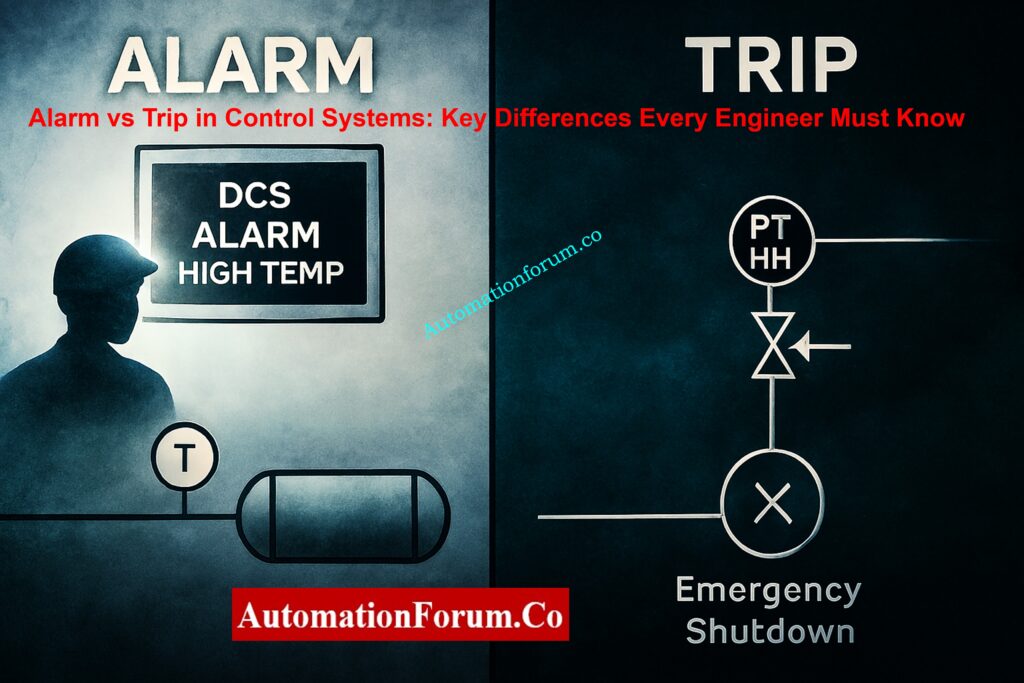
What Is an Alarm in a DCS?
An alarm is a notification to the operator that a process variable has gone beyond its typical operating range and needs to be attended to.
Key characteristics:
- No automatic shutdown
- Requires operator response
- Designed to give time for corrective action
Examples include:
- High temperature alarm
- Low flow alarm
- High vibration alarm
What Is a Trip in a Safety Instrumented System (SIS)?
An automatic safeguard that puts machinery or the procedure in a secure state is called a trip.
Key characteristics:
- Automatic action
- No operator intervention required
- Used when consequences are severe or response time is short
Examples include:
- High-high pressure trip
- Low-low level trip
- Emergency shutdown trip
The Alarm & Trip Setpoint List makes it very evident where the trip starts and the alarm ends.
DCS Alarm Management Checklist for Safer & Smarter Operations: DCS Alarm Management Checklist
Typical Contents of an Alarm & Trip Setpoint List Document
Instrument Tag Number and Service Description
Each line item starts with a distinct instrument tag number and a concise service description. This guarantees clear identification of the process variable and its role in the plant. Traceability between P&IDs, control system databases, and safety documentation depends on accurate tagging.
Normal Operating Range and Design Limits
Each process variable’s typical operating value or range is recorded in the setpoint list. In addition to helping engineers confirm that setpoints are neither too near to typical operation nor outside of safe design bounds, this gives context for alarm and trip limits.
High, Low, High-High, and Low-Low Setpoints
The high, low, high-high, and low-low values of all relevant alarm and trip thresholds are specified. While trip setpoints specify the moments at which automatic protective measures are triggered, alarm setpoints offer early warning of abnormal conditions.
Alarm Priority Classification and Operator Action
Every alarm is given a priority level according to its impact and the time it takes for an operator to respond. Operators can promptly recognize critical alarms and respond appropriately in abnormal situations when prioritization is done correctly.
Engineering Rationale and Safety Justification
The engineering justification is recorded for each alarm and trip setpoint. This provides an explanation for the value’s selection, citing equipment limitations, process limits, or safety study results. For design engineers, knowing the rationale behind a setpoint is just as crucial as the value itself, especially when it comes to reviews, audits, and upcoming changes.
Understanding Alarm, Trip Point & Priority in Control Systems: What are alarm, trip point, and alarm priority in DCS & PLC?
Alarm & Trip Setpoint List Lifecycle in Design Engineering
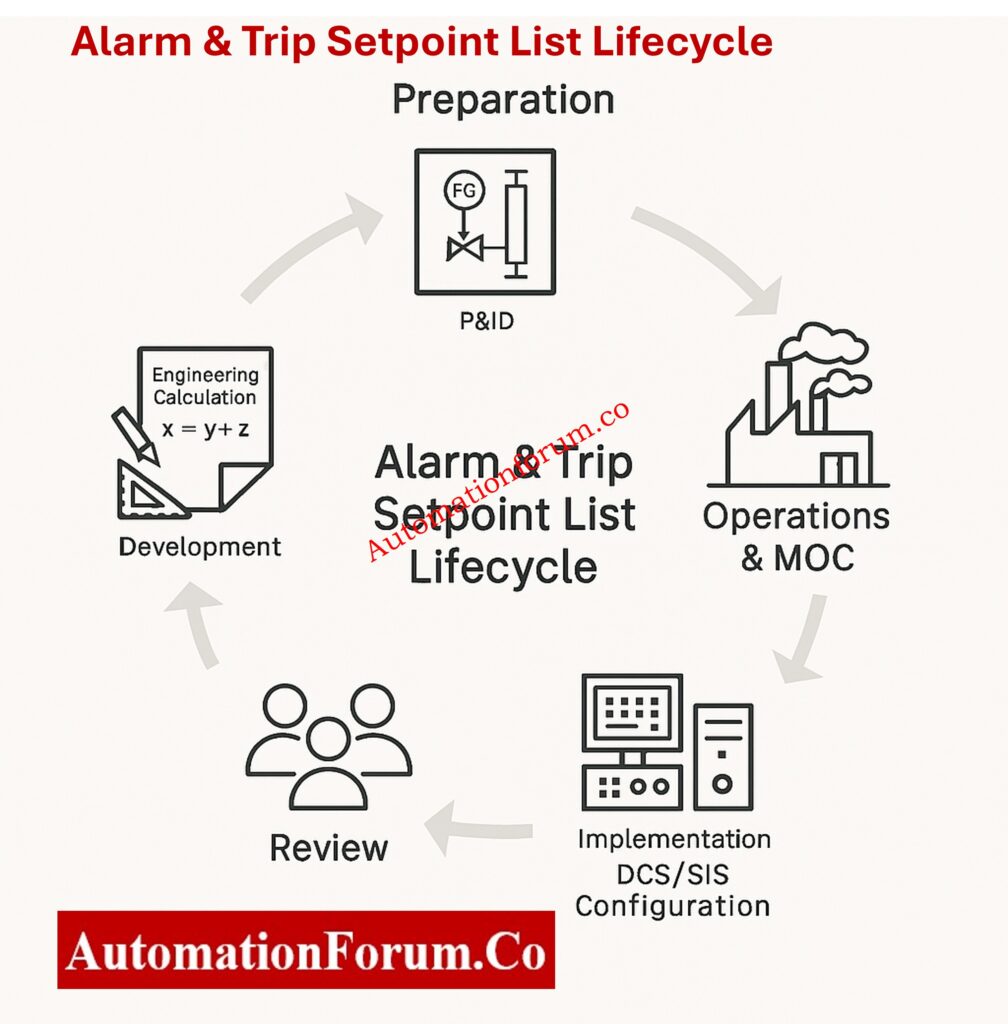
Preparation Phase: Collecting P&IDs, HAZOP, SRS, and Process Data
Long before the control system is configured, the lifecycle starts.
Data is gathered by design engineers from:
- Piping and Instrumentation Diagrams
- Process design documents
- Safety studies
- Cause and Effect logic
This stage establishes what needs to be safeguarded and what deviations are not acceptable.
It is inevitable that missing inputs at this point will result in later trips or missed alarms.
HMI Alarm Management Guide for Operators & Engineers: Human Machine Interface Alarms (HMI Alarms)
Development Phase: Defining Alarm and Trip Setpoints
Every instrument tag is assessed and assigned during development:
- Alarm limits based on operational boundaries
- Trip limits based on safety boundaries
- Appropriate alarm priority
This is where engineering judgment plays a major role. Setpoints must balance:
- Safety margins
- Process variability
- Instrument accuracy
- Operator response capability
It is imperative for design engineers to avoid mindlessly replicating values from previous projects. Every plant is different.
Review Phase: Verification and Validation by Multidiscipline Teams
Review is a safety barrier, not a formality.
Verification
Ensures that:
- Values are correctly transcribed
- Units are consistent
Validation
Ensures that:
- Setpoints make sense for the actual process
- Alarms are not too close to normal operation
- Trips occur before equipment or process limits are exceeded
This phase requires multi-discipline involvement, including process, operations, safety, and control engineers.
Process Switches & Alarms Explained for Industrial Applications: Process switches and alarms
Implementation Phase: DCS Alarm and SIS Trip Configuration
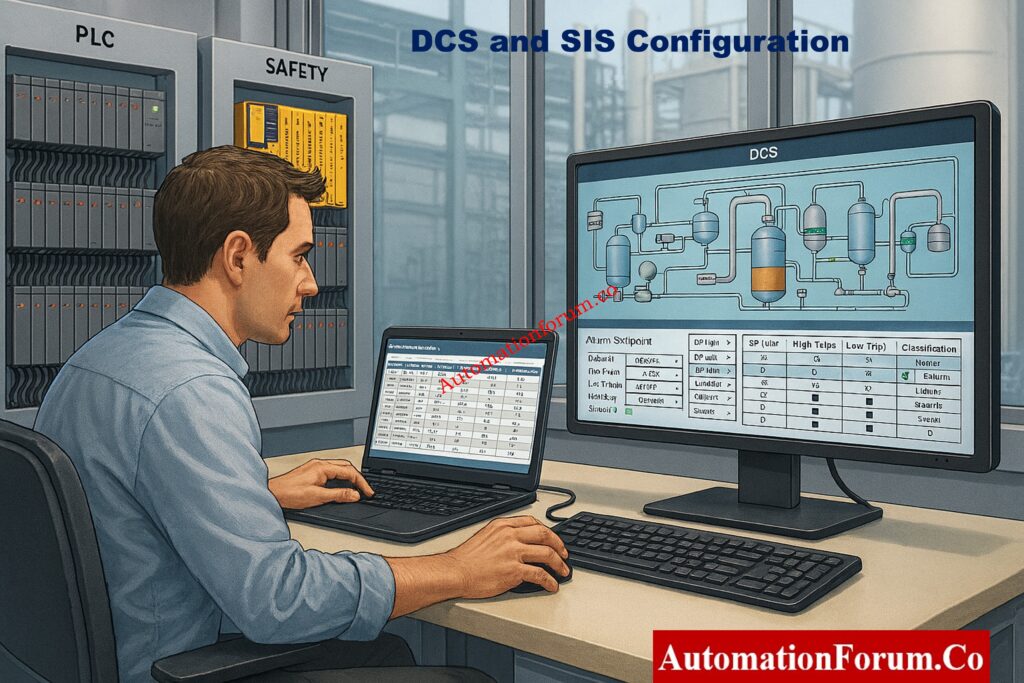
It is used by control engineers to:
- Configure alarms in the DCS
- Configure trips in the SIS
- Assign alarm priorities
- Define alarm messages
Risk is introduced by any discrepancy between the list and the actual configuration. One of the most frequent root causes of incidents is configuration without reference to the approved list.
Operations Phase: Management of Change and Lifecycle Control
The Alarm & Trip Setpoint List does not become outdated after commissioning.
It needs to:
- Reflect every approved change
- Be updated through formal Management of Change
- Remain synchronized with the control system
The setpoint list must be updated first, or at least concurrently, if operations request alarm tuning or trip adjustments.
The plant loses control over its own safety logic when the list and system diverge.
Alarm Management Basics Every Control Engineer Must Know: What is Alarm management?
Common Design Engineering Mistakes in Alarm & Trip Setpoint Lists
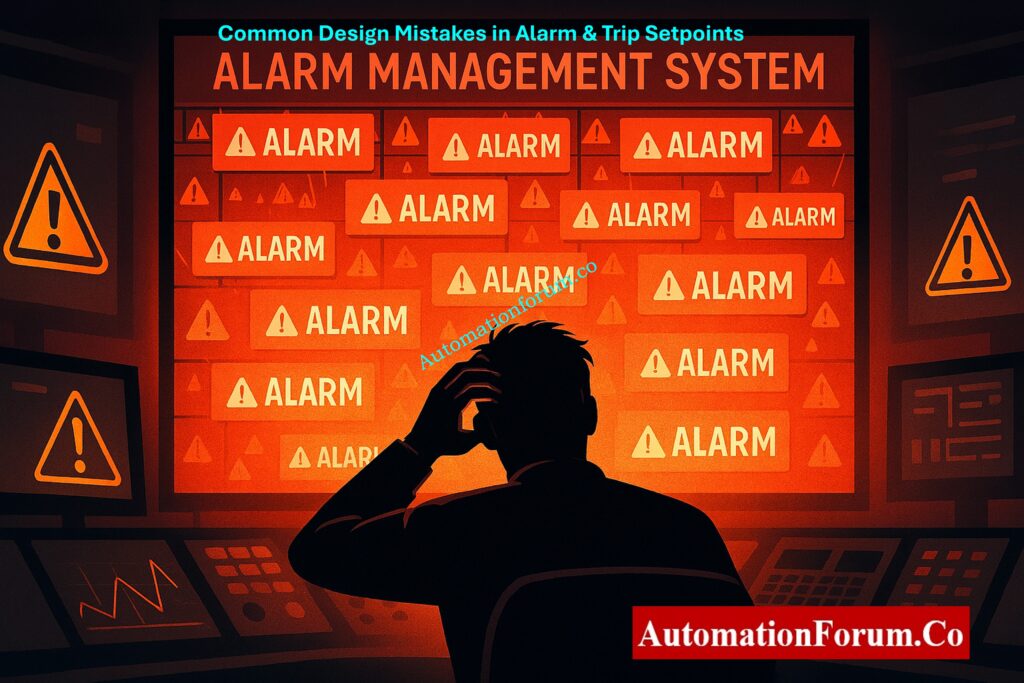
Treating Alarm & Trip Setpoint Lists as Control-Only Documents
Many projects mistakenly give control engineers exclusive ownership of the setpoint list. It is actually a process safety document with control implementation.
Reusing Alarm and Trip Setpoints Without Process Validation
When values are reused without comprehending the new process conditions, it frequently results in:
- Nuisance alarms
- Unsafe margins
- False confidence in protection
Incorrect Alarm Prioritization and Operator Overload
The goal of prioritization is defeated when too many high-priority alarms are assigned. Operators need to know right away which alarms require immediate attention.
Missing or Poor Engineering Rationale
Justification Unjustified setpoints lead to misunderstandings during audits, troubleshooting, and future changes.
Complete Guide to Process Alarms in Control Systems: Guide to Industrial Process Alarms in Control Systems: Types, Classifications, and Management Methods
Role of Alarm & Trip Setpoint Lists in Modern Alarm Management Systems
Alarm management is a quantifiable and auditable safety function in contemporary process facilities. Throughout the plant lifecycle, organizations must show that alarms and trips are appropriately planned, justified, implemented, and maintained. In order to fulfill these expectations, the Alarm & Trip Setpoint List is essential.
Alarm Performance Monitoring and Compliance Audits
Regulatory and Functional Safety Expectations
Traceability from safety studies to system configuration is becoming more and more important to regulatory bodies and functional safety standards. The Alarm & Trip Setpoint List offers documented proof that each setpoint has a distinct safety rationale and that alarm and trip limits are derived from HAZOP, SRS, and risk assessments.
Digital Alarm Management and Lifecycle Traceability
Preserving lifecycle traceability is essential with contemporary digital alarm management systems. Alignment between engineering documentation, DCS and SIS databases, and operational modifications is guaranteed by the Alarm & Trip Setpoint List. Through change management, it facilitates controlled updates and guards against unrecorded changes that could eventually compromise plant safety.
How Permissive Logic and Interlocks Protect Industrial Systems: Understanding Permissive Logic and Trip Interlocks in Industrial Systems
Why Instrumentation and Control Design Engineers Must Own Alarm & Trip Setpoint Lists
The Alarm & Trip Setpoint List is an engineering duty for instrumentation and control design engineers, not just a documentation deliverable. Each alarm and trip that is set up in a control system is an intentional design choice that has an immediate impact on operational integrity and plant safety.
This document’s ownership guarantees that safety intent is appropriately converted into executable control logic and preserved over the course of the plant’s lifecycle.
How Heartbeat Technology Improves Instrument Reliability: Heartbeat Technology in Process Instrumentation – Complete Working, Diagnostics, Verification & Predictive Maintenance Guide
Engineering Accountability for Alarm and Trip Decisions
Every alarm and trip setpoint represents a crucial engineering decision, such as how long an operator has to react, when automatic protection needs to step in, and how equipment is protected in unusual circumstances. It is the responsibility of design engineers to make sure that these choices are supported by safety studies, technically sound, and justified.
Alarm and trip limits run the risk of becoming arbitrary values rather than designed safety barriers in the absence of clear ownership.
Impact on Process Safety, Reliability, and Plant Availability
Alarm and trip setpoint lists that are well-designed reduce nuisance alarms, prevent incidents, and increase operator effectiveness. Setpoints that are properly defined prevent needless shutdowns while guaranteeing quick protection in dangerous circumstances. On the other hand, poorly managed setpoints can result in conditions that greatly raise operational risk, such as alarm floods, missed warnings, or delayed trips.
Long-Term Benefits of Proper Setpoint Management
Long-term advantages of proper alarm and trip setpoint management include enhanced safety performance, more seamless operations, and simpler audits. Design engineers make sure that trips take action when necessary and alarms sound when they should by adhering to the Alarm & Trip Setpoint List’s lifecycle, accuracy, and purpose.
A plant might be able to withstand equipment failure, but it might not be able to withstand a missed trip or a malfunctioning alarm. When properly designed, the Alarm & Trip Setpoint List silently guards the plant every minute of every day.
Smart Instrument Maintenance Checklist with Cybersecurity Focus: Advanced Integrated Field Instrument Reliability & Cyber-Secure Maintenance Checklist for Smart Process Plants
Alarm & Trip Setpoint List Design Checklist for Instrumentation Engineers(Free Download)

Purpose of the Alarm & Trip Setpoint Checklist
To guarantee that the safety intent specified during HAZOP and SRS studies is appropriately implemented in the DCS and SIS, a well-maintained Alarm & Trip Setpoint List is essential. This downloadable Excel checklist offers an organized, lifecycle-based verification tool to assist instrumentation and control engineers throughout the design, review, implementation, and MOC phases.
PLC vs DCS: Key Differences, Applications & Selection Guide: PLC vs DCS – Which One Should you Choose for your Automation System?
When to Use the Checklist in FEED, Detailed Engineering, FAT, and SAT
The checklist, which was created especially for design engineering projects, aids in avoiding typical problems like missing alarms, inaccurate setpoints, inadequate prioritization, and documentation drift between operations and engineering.
It can be used for audits, operational handover, FEED, detailed engineering, FAT, and SAT.
Download the Alarm & Trip Setpoint List Design Checklist (Excel):
Frequently Asked Questions (FAQ) on Alarms and Trips
What is the alarm and trip schedule?
An engineering document that enumerates all alarm and trip setpoints for process instruments is called an alarm and trip schedule. As a guide for DCS and SIS configuration, it specifies when alarms notify operators and when trips start automated safety measures.
What does a trip signal mean?
When a critical limit is exceeded, a trip signal—an automatic control or safety signal forces machinery or a process into a safe state without the need for operator intervention.
What are the three main types of alarms?
There are three typical kinds of alarms:
- High alarms: Show values that are higher than usual
- Low alarms: Show values that are below typical ranges
- Status or deviation alarms: Show unusual signal or equipment conditions
What is the point of Trip A and Trip B?
Safety system redundancy is provided by Trip A and Trip B. They serve as separate trip routes to guarantee that security is preserved even in the event of a channel failure.
What is Trip 1 and Trip 2?
Staged protection levels are represented by Trip 1 and Trip 2. While Trip 2 initiates a more severe or final shutdown to safeguard the plant, Trip 1 starts an early or controlled action.
How to Read HART Diagnostics for Faster Field Troubleshooting: Types of Fire and Types of F&G Detectors Used in Process Industries: Gas Detectors – Working Principles and Industrial Applications
