
- Introduction to SIS Testing and Repair Deferral
- What Is SIS Proof Testing?
- Why SIS Testing May Be Deferred
- Definition of Deferral in Safety Instrumented Systems (SIS)
- Proof Test Deferral vs Repair Deferral
- Approval Hierarchy for SIS Deferrals
- IEC 61511 Guidance on Deferral Justification
- SIS Design Considerations to Reduce Deferral Need
- Role of Functional Safety Management (FSM) in Deferral Control
- Step-by-Step SIS Deferral Process
- Verification Before Approving a Deferral
- Common Audit Findings and Non-Compliance Issues
- Understanding Repair Deferrals in SIS
- Best Practices for Managing SIS Deferrals
- Impact of Deferral on SIL and Functional Safety
- Key Takeaways and Compliance Recommendations
- Download SIS Deferral Procedure Template (IEC 61511 Compliant)
- FAQ on SIS Testing and Repair Deferral
- Test Your Expertise in Safety Instrumented Systems (SIS): Knowledge Quiz
Introduction to SIS Testing and Repair Deferral
Safety Instrumented Systems (SIS) are very important in industrial automation because they keep people, property, and the environment safe from dangerous situations. These systems are the final line of defense when regular process control systems go down. To make sure they work, SIS parts need to be inspected and maintained on a regular basis, as set out in the Safety Requirement Specification (SRS) and IEC 61511 standards.
In real life, though, there are situations when these tests or repairs can’t be done on time. This is called SIS Testing and Repair Deferral.
This article explains everything you need to know about testing and repair deferral in SIS, the IEC requirements, the permission structure, and the safest ways to handle deferral periods.
Master Safety Terms + Free Excel: Functional Safety Terminology – Excel Download for Industrial Automation
What Is SIS Proof Testing?
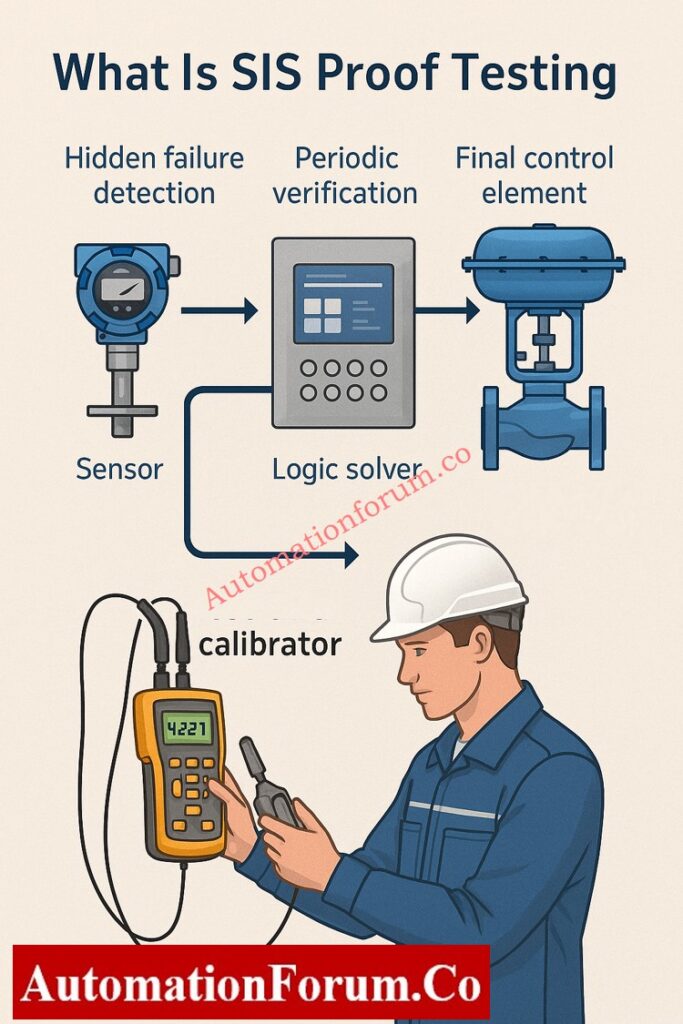
SIS Proof Testing is a regular check that makes sure that each part of a Safety Instrumented Function (SIF) still works as it should. It helps find problems that might not be found during normal operation.
During the design phase of the SIS, the proof test interval (PTI) is set. This has a direct effect on the Probability of Failure on Demand (PFD) of the safety function. Shorter intervals usually represent a lower PFD and more reliability, while longer intervals raise the likelihood of failure.
IEC 61511 says that every SIS shall have a set timetable for proof tests and a written protocol for testing.
Decode ESD Signal Logic Fast: Signals for Emergency Valve Shutdown in Critical Processes
Why SIS Testing May Be Deferred
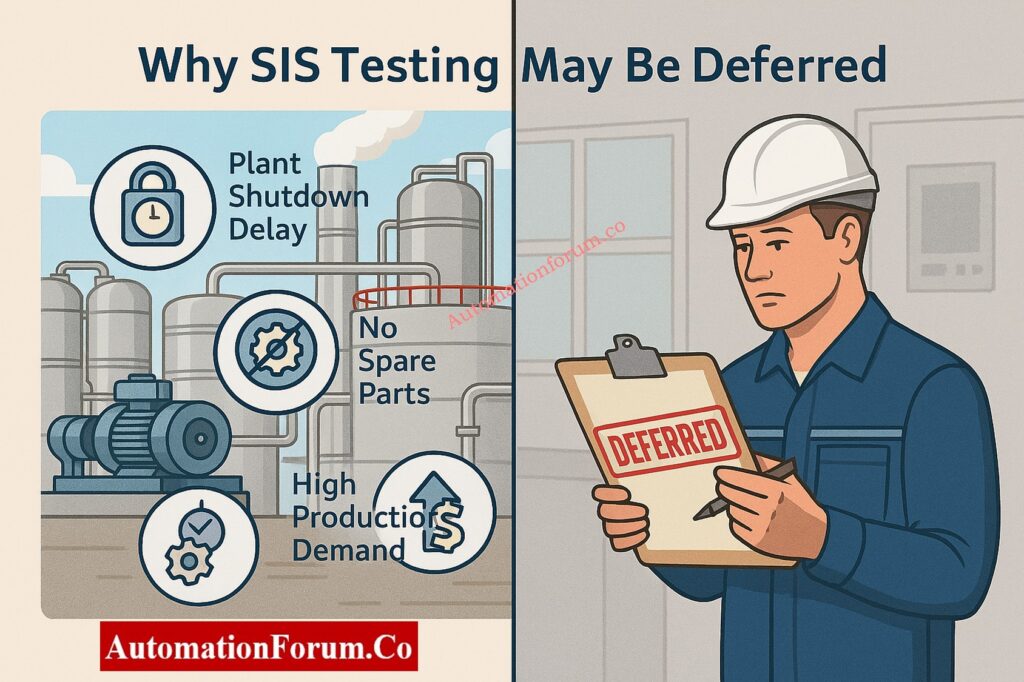
Even with the finest planning, proof tests don’t always go as planned. Some common reasons for putting off the SIS test are:
- Delays in plant shutdowns: Planned turnarounds or maintenance shutdowns are pushed back.
- Operational constraints: Some instruments or valves can only be tested offline, and testing them online isn’t possible.
- Production demand: Plants may put continuous production at the top of their list because of significant market demand or a lack of raw materials.
- Equipment accessibility: During certain process processes, access to important tools may be limited.
- Lack of manpower or spare parts: The skilled workers or spare parts needed for testing are not available within the scheduled time.
In certain situations, a Deferral Process must be started instead of breaking safety rules, as required by IEC 61511-1 Clause 16.3 and the company’s own rules.
Refer the below link tot Explore S84 / IEC 61511 Standard for Safety Instrumented Systems – Complete Guide
Definition of Deferral in Safety Instrumented Systems (SIS)
A Deferral is a formal, time-limited extension that lets you put off a scheduled proof test or repair operation following a suitable risk assessment, technical appraisal, and management approval.
Deferral does not mean taking off the task. It just implies that the system’s functional integrity is temporarily checked using compensating measures until the test or repair can be finished.
A delay is only permitted after checking that extending the time would not put the process’s overall safety at risk.
Proof Test Deferral vs Repair Deferral
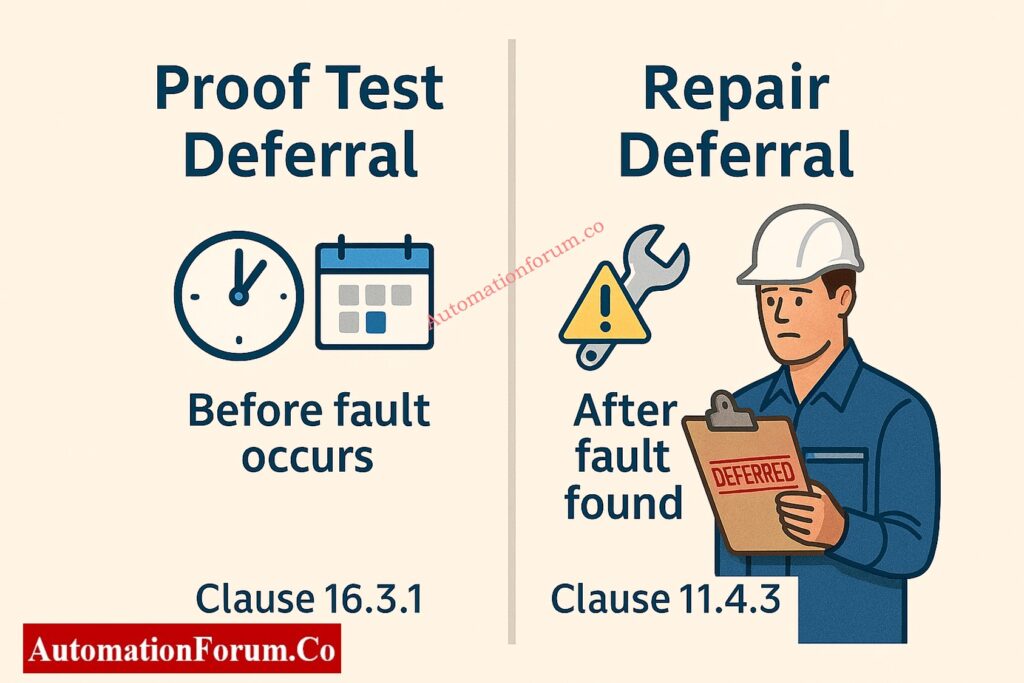
Both proof test and maintenance deferrals put off safety activities, but they do so for different reasons and at different times.
Main Differences and Risk Impacts
| Aspect | Proof Test Deferral | Repair Deferral |
| Purpose | Verification of system integrity | Restoration after detected failure |
| Timing | Before fault occurs | After fault is found |
| IEC Reference | Clause 16.3.1 | Clause 11.4.3 |
| Risk Impact | Increases PFDavg | May impair loop safety |
Knowing this difference helps you figure out the best way to get approval and what to do to make up for it.
Discover Future of Functional Safety: Emerging and Future Concepts in Functional Safety: AI, Digital Twins and Industry 4.0
Approval Hierarchy for SIS Deferrals
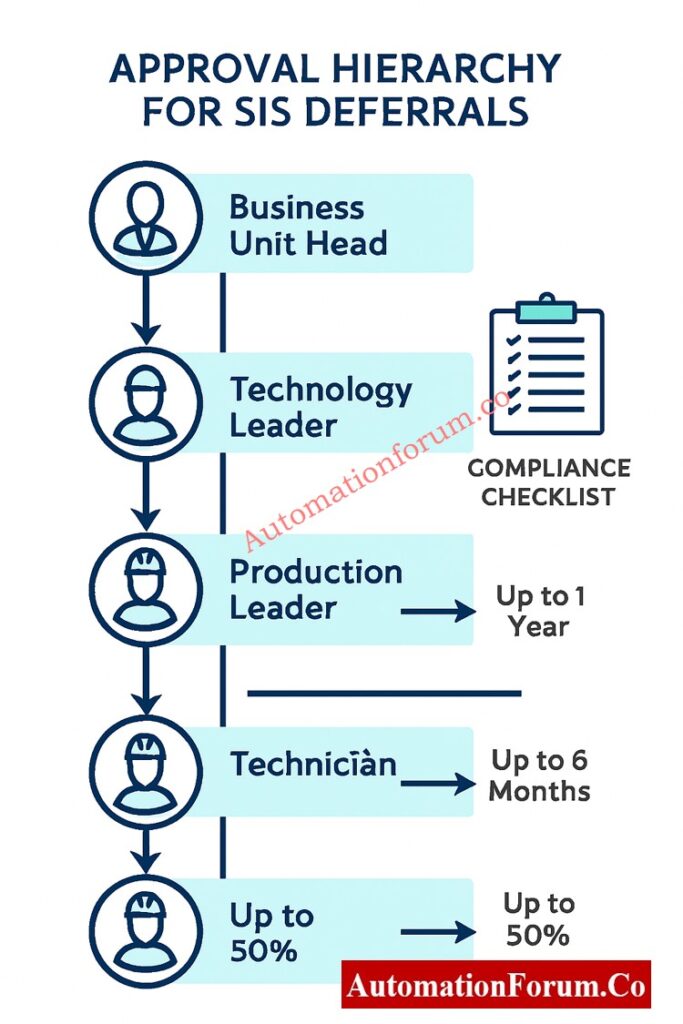
Depending on how long the delay lasts and how risky it is, the deferral procedure has different roles and levels of approval. An approval matrix usually has:
| Deferral Level | Deferral Period | Approval Required From |
| Up to 50% beyond the scheduled interval | Short-term | Production Leader, Safety Leader, Technology Leader |
| Beyond 50% but not exceeding 100% (max 1 year)** | Long-term | Technology Center In-charge, Plant Operations Leader, Business Unit Operation Leader |
Maximum Allowable Deferral Period as per IEC 61511
The IEC and best industry practice say that the longest time you can wait to test SIS evidence is one year. If you keep working without testing after this point, you are breaking the rules and exposing yourself in risk.
IEC 61511 Guidance on Deferral Justification
IEC 61511-1 says that any change from the set proof test or repair interval must be thoroughly explained and recorded.
Key points include:
- For each deferment, write out a risk assessment.
- Make changes to the records for the Functional Safety Lifecycle.
- Use a formal Management of Change (MOC) process to handle things.
- Put all approvals and risk assessments in the SIS file and LOPA documentation.
Deferrals that don’t have a good reason or a way to track their lifecycle are not compliant during safety audits.
Understand 2oo2 SOV Logic: Understanding 2 out of 2 SOV: Working & Configuration
SIS Design Considerations to Reduce Deferral Need
SIS systems should be built with easy access for testing and maintenance in mind to cut down on the requirement for deferrals. Important things to think about when designing are:
- The capacity to test online: Systems should be able to undertake partial or online proof testing without having to stop down completely.
- Set limitations for bypass: The SRS should list the longest time that a SIS loop can stay in bypass while being tested or fixed.
- Redundant architectures: Using redundant logic solvers or final parts lets systems keep working during maintenance without putting safety at risk.
- Clear labeling and documentation: The Maintenance Management System (MMS) should include clear records of tests and identification for SIS parts.
These design practices make sure that SIS can be maintained throughout its life cycle with as little disturbance to operations as possible.
Learn EBV Design & Operation: What is an Emergency Block valve and How does it work
Role of Functional Safety Management (FSM) in Deferral Control
A good Functional Safety Management (FSM) program controls how deferrals are found, looked over, and approved.
FSM ensures:
- sure that every deferral goes through a set approval process.
- All temporary actions are written down and can be traced.
- According to IEC 61508 and IEC 61511, the system should be ready for an audit and follow the entire lifecycle.
Keeping a clear FSM plan makes people more responsible and makes sure that no SIS loop goes beyond an acceptable level of risk.
Ace Your SIS Interview Now: Safety Instrumented System(SIS) Interview Questions and Answers
Step-by-Step SIS Deferral Process
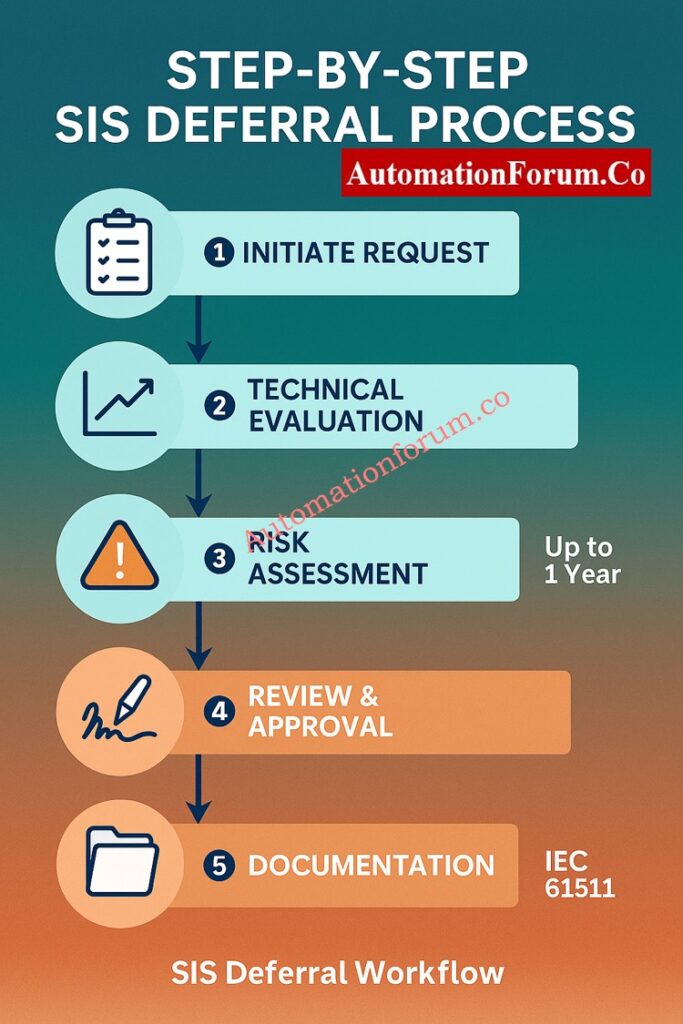
When a test or repair cannot be completed as per the schedule, a formal SIS Test Deferral Process must be initiated. The following steps outline the best practice:
Step 1. Initiate Deferral Request
- Find the exact SIS loop or part that can’t be tested.
- Give a reason for the delay, such as the state of the process, the equipment being used, or production limits.
- Put the due date and rationale in the maintenance management system.
Step 2. Technical Evaluation
- Check the history of the device and any past failures.
- If you can, do a visual check or a test of some of the functions.
- Do new PFD calculations to see how extending the interval may affect the risk.
Step 3. Risk Assessment & Mitigation
- Check how the postponed testing affects the Safety Integrity Level (SIL) goals.
- Put in place temporary fixes, like more alerts, monitoring of operators, or duplicated loops.
Step 4. Review & Approval
- Make sure that the risk assessment is agreed upon by safety specialists, maintenance leaders, and production chiefs.
Step 5. Communication & Documentation
- Tell all the departments that will be affected (Operations, Maintenance, Safety, and Engineering).
- Include the postponement in both the SIS File and the LOPA (Layer of Protection Analysis) papers.
- Make a clear recovery plan to make sure that testing is done in the time frame that was set aside.
Implement Reliable ESD SOV Setup: Implementing a Solenoid Operated Valve for Emergency Shutdown
Verification Before Approving a Deferral
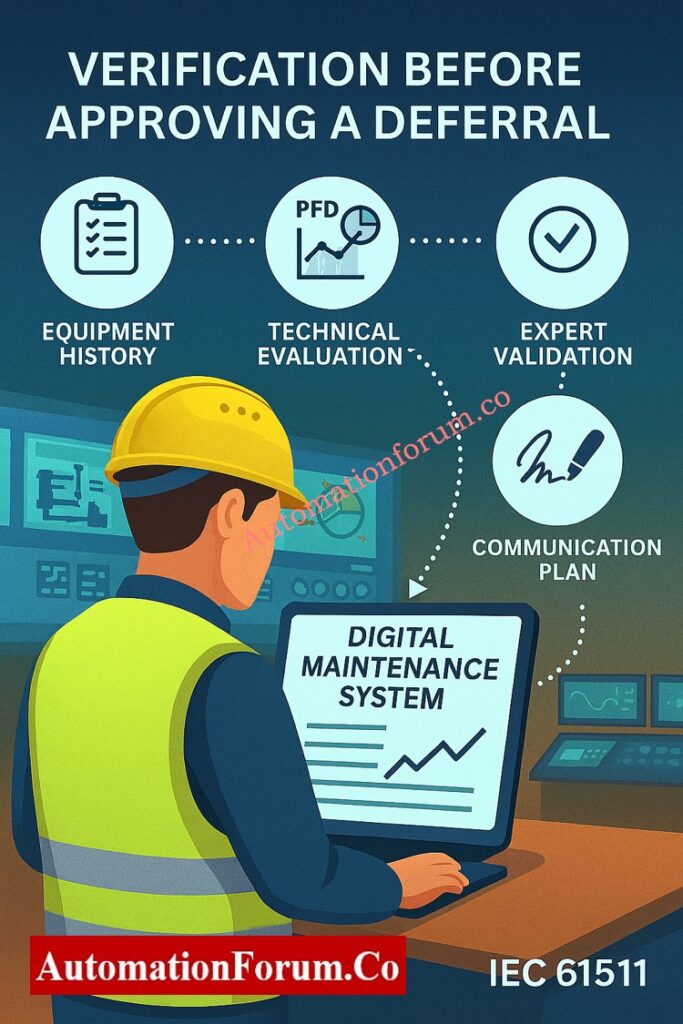
Deferral gives you more options, but it should never put safety at risk. Before giving permission, some actions must be taken to check:
- Look throughout the equipment’s history: Look at the upkeep logs to see if there have been any problems or failures in the past.
- Check the PFD Impact: Update the PFDavg calculations and make sure they are still within the SIL restrictions.
- Expert Validation: Get agreement from a qualified SIS or Functional Safety specialist.
- Communication Plan: Set up a way to keep track of and let stakeholders know about the postponed status.
- System Update: Make sure that all of the deferral information is current in the Maintenance Management System (MMS).
- Formal Documentation: place the signed deferral form in the SIS documentation library.
These processes assist keep track of things and make sure that the IEC 61511 lifespan standards are met.
Common Audit Findings and Non-Compliance Issues
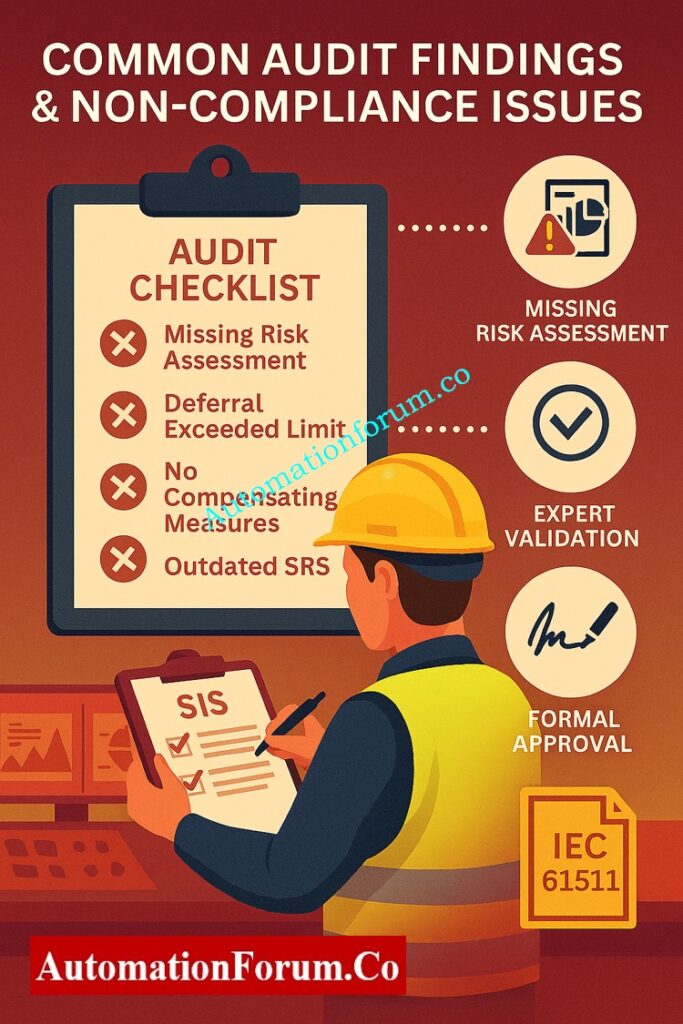
Common audit findings of SIS deferrals are:
- Missing or incomplete documentation for risk assessments.
- Deferrals that go over approved limits without being revalidated.
- There were no compensating measures throughout long periods of time.
- Old SRS doesn’t show changes that have been accepted.
- Bad record keeping in CMMS or safety lifecycle software.
To stay compliant with IEC, regular internal audits should focus on these weak points.
Understand HIPPS Working Easily: How does the HIPPS system work in the Oil and gas Industry?
Understanding Repair Deferrals in SIS
When a failure or malfunction is found in a SIS loop but rapid repair isn’t possible because of operating constraints, repair deferrals apply.
When repair deferral is considered:
- There needs to be a temporary protective mechanism in place, like administrative control or a redundant loop.
- The Business or Operations Leader must give their approval.
- The repair delay must be restricted in time and appropriately recorded in SIS records.
If repairs aren’t done in the period that was permitted and no deferral is granted, the SIS loop is considered “impaired,” and the process must be securely shut down until it is restored.
Note: Repair deferrals only apply to SIS components that are no longer needed and still have at least one active line of protection.
Best Practices for Managing SIS Deferrals
| Best Practice | Description |
| Integrate with CMMS | All test and deferral records should be managed in a centralized Computerized Maintenance Management System. |
| Periodic Review | Conduct quarterly reviews of open deferrals to ensure timely closure. |
| Cross-functional Involvement | Include representatives from Safety, Process, and Maintenance during every deferral approval. |
| Establish Deferral Limits | Define maximum deferral periods for different SIL-rated systems (e.g., SIL-1, SIL-2, SIL-3). |
| Audit Compliance | Periodically audit deferral records to verify adherence to IEC 61511 and company procedures. |
| Training and Awareness | Ensure all responsible personnel understand deferral implications and documentation requirements. |
Following these steps makes sure that SIS testing and repair delays stay safe, compliant, and easy to find.
Master Fail-Safe Logic Design: Understanding Fail-Safe Logic in Industrial Automation Systems
Impact of Deferral on SIL and Functional Safety
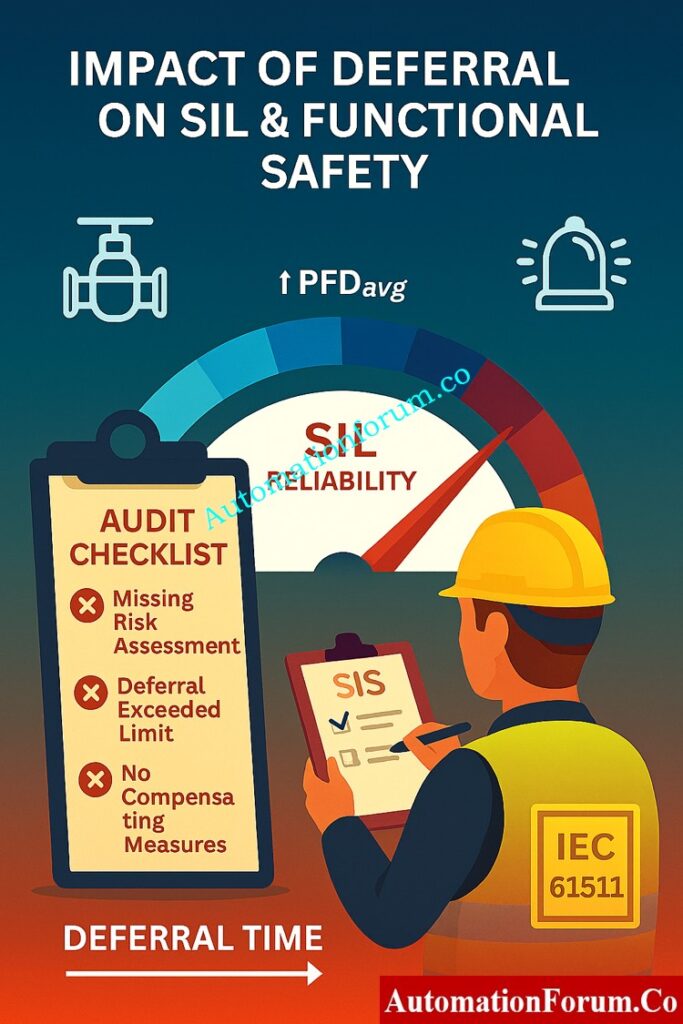
Every time you place off a task, the Probability of Failure on Demand (PFD) goes up for a short time. This could change the computed SIL for the safety function.
If the deferral happens too often or lasts too long, it can lower the SIL, which makes the safety function less dependable.
So, deferrals must always come with:
- New PFD calculations
- Writing down compensating measures
Compare SIS vs PLC vs BPCS: Understanding Differences of SIS, PLC, and BPCS in Industrial Automation
Key Takeaways and Compliance Recommendations
SIS Repair and Testing Deferral is a necessary management step that makes sure that plants are available while also following safety rules. If done right, it lets the system keep running without breaking IEC 61511 rules. But if done wrong, it might put the safety of the whole system at risk.
To make sure that the operation is safe and legal:
- Follow a set process for deferring,
- Keep detailed records and approvals, and check all open deferrals every so often.
Keep in mind that deferral is a privilege, not a habit. It should only be used when necessary and with the greatest care for safety.
Download SIS Deferral Procedure Template (IEC 61511 Compliant)
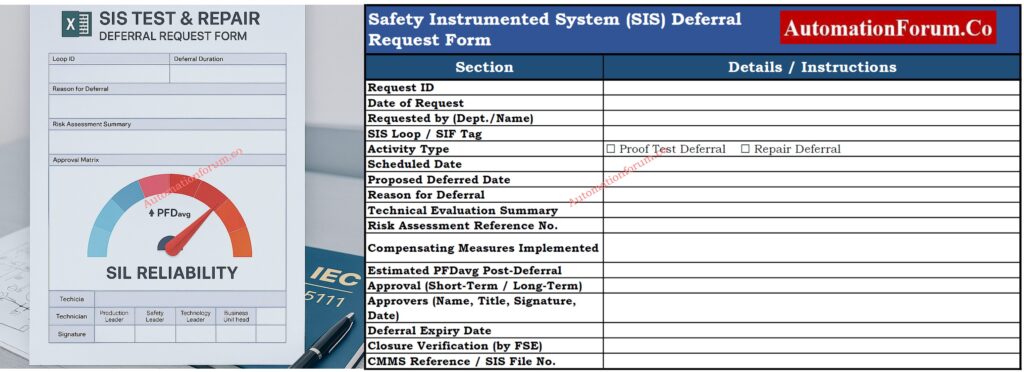
Make sure that all of your Safety Instrumented System (SIS) testing and repair delays are completely documented and meet IEC 61511 standards. This professionally designed template lets you ask for, evaluate, approve, and keep track of all SIS proof test or repair deferrals. It has fields for risk assessment, approval matrix, and closure verification. Great for Functional Safety Management (FSM) and preserving records that are ready for an audit.
FAQ on SIS Testing and Repair Deferral
What is the meaning of SIF testing?
Safety Instrumented Function (SIF) testing checks that each safety loop in a Safety Instrumented System (SIS) works correctly to keep the process safe. It analyzes sensors, logic solvers, and final elements to make sure the system satisfies its SIL (Safety Integrity Level) target, as IEC 61511 says it should.
What is SIS in instrumentation?
SIS, or Safety Instrumented System, is an autonomous control system in instrumentation that finds dangerous situations and automatically puts the process in a safe state. It has sensors, logic solvers, and final parts to keep people, equipment, and the environment safe.
What does SIS mean in manufacturing?
In manufacturing, SIS stands for a safety automation system that stops accidents by taking steps like closing valves or stopping machines when conditions are unsafe. It makes sure that safety regulations like IEC 61508 are followed.
What is a SIS proof test?
A SIS proof test is a regular check to make sure that each Safety Instrumented Function (SIF) works right and lowers risk as planned. It helps find failures that aren’t obvious and keep the SIL performance at the right level.
What is the difference between SIL and SIS?
SIL (Safety Integrity Level) is a measure of how reliable or risk-reducing SIS is. SIS is the system that does safety functions. SIL tells us how safe the SIS needs to be.
What is SIL in instrumentation?
In instrumentation, SIL (Safety Integrity Level) shows how reliable a Safety Instrumented Function (SIF) is inside a SIS. Higher SIL levels (1–4) mean less risk and higher performance standards.
Test Your Expertise in Safety Instrumented Systems (SIS): Knowledge Quiz
Refer the below link for Testing Your Expertise in Safety Instrumented Systems (SIS): Knowledge Quiz
