
- Why Standards Important in Industrial Instrumentation
- IEC (International Electrotechnical Commission) Standards
- ISO (International Organization for Standardization) Standards
- American Standards (ANSI / ISA / API / NFPA / NEMA)
- European Standards (EN / CENELEC / ATEX)
- ISA (International Society of Automation) Standards
- IEEE (Institute of Electrical and Electronics Engineers) Standards
- NAMUR Recommendations for Process Industries
- How Engineers Apply Standards in Real Projects
- Future Trends in Instrumentation Standards
- Deep Dive: IEC 61511 Functional Safety Lifecycle
- FAQ on Key Instrumentation & Control (I&C) Standards
Standards are the language of trust in the fast-paced world of process and industrial automation. Instrumentation & Control (I&C) engineers depend on international standards a lot to make sure that systems are safe, work with other systems, are efficient, and are ready for the future. This is true whether they work in oil and gas, power generation, petrochemicals, water treatment, or manufacturing.
Without these standards, each plant would run on its own, with gadgets that don’t work together, unsafe installations, and designs that aren’t particularly effective. For an instrumentation engineer, learning these standards isn’t just something they do in school; it’s the basis of their work.
This article looks at the most important standards for instrumentation and control from IEC, ISO, ISA, IEEE, NFPA, API, ATEX, and NAMUR. This will be your go-to resource for understanding I&C standards since we will talk about their breadth, importance, and how they may be used in real-world situations.
Why Standards Important in Industrial Instrumentation
Before we go into the details of specific standards, let’s tackle the basic question: Why are standards so important in industrial automation?
- Safety: Process industries work in dangerous places, like places with explosive gases, poisonous chemicals, and high-pressure pipelines. Standards like IEC 61511 and IEC 60079 make sure that safety is built into every layer.
- Interoperability: Interoperability means that devices made by various companies must be able to talk to each other without any problems. Standards like IEC 61850, IEEE 802.x, and ISA-95 make ensuring that systems may work together without being locked into a single vendor.
- Quality & Reliability: ISO and IEC standards make sure that design, calibration, and testing are all done the same way, which makes systems more reliable over time.
- Regulatory Compliance: Compliance with the law: In some places, standards like ATEX and NFPA are required to make sure that the company follows all domestic and international rules.
- Future-readiness: Digitalization, IIoT, and cybersecurity risks are all things that can happen in the future. Modern standards like IEC 62443 and IEC 62828 help keep plants safe.
In summary, standards provide engineers peace of mind since they know their systems are based on frameworks that have been tested.
Understand hazardous area compliance in detail by reading this guide: ATEX vs IECEx Certification: Complete Guide for Hazardous Area Instrumentation
IEC (International Electrotechnical Commission) Standards
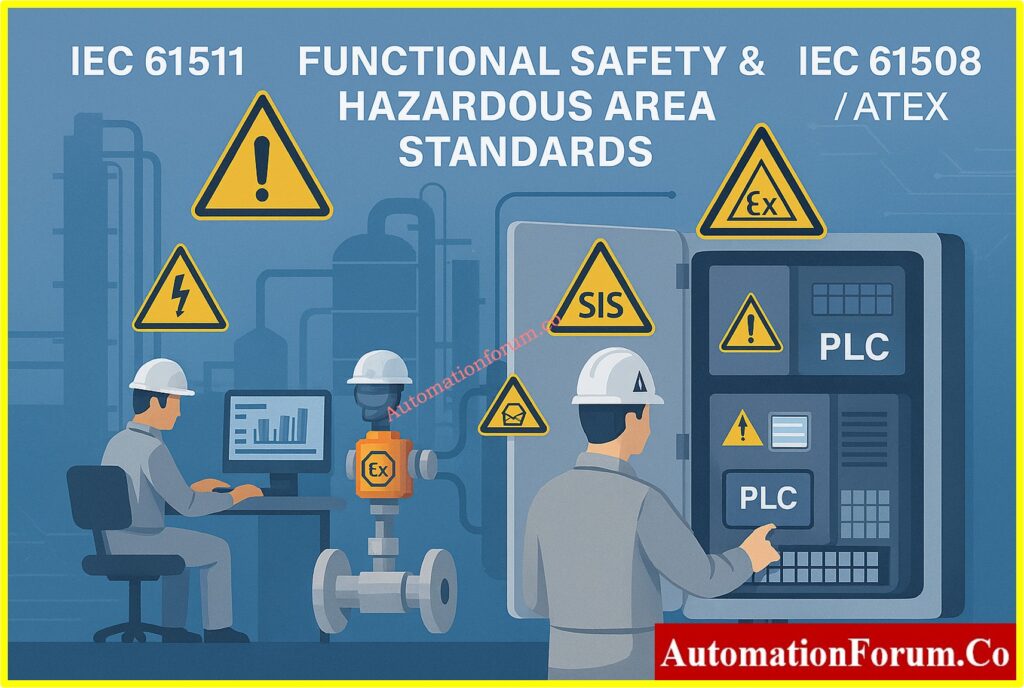
The IEC is probably the most important group for engineers who work with instruments. Some important IEC standards are:
- IEC 60079 – Electrical Equipment for Explosive Atmospheres (Ex):
If you work with flammable gases, vapors, or dusts, you must follow IEC 60079. This series of standards sets rules for electrical equipment that will be used in places where there is a chance of an explosion. It talks about everything from how to classify equipment (Ex d, Ex e, Ex i, Ex n, etc.) to how to install it and what the inspection criteria are.
Instrumentation engineers who operate in the oil and gas, chemical processing, or pharmaceutical industries need to know about Zone classification (Zone 0, 1, and 2 for gases; Zone 20, 21, and 22 for dusts) and how to choose the right equipment to avoid catastrophes.
- IEC 61131 – Programmable Controllers (PLC):
PLCs are very important for modern industrial automation, and IEC 61131 gives them a standard way to be programmed and used. Part 3 of this standard is very important since it lists five programming languages: Ladder Diagram (LD), Function Block Diagram (FBD), Structured Text (ST), Instruction List (IL), and Sequential Function Chart (SFC).
Engineers may write code that is easy to maintain and move around by using these standardized programming methods. This also makes it easier for teams from different countries to work together on projects when each team may have its own programming style.
This standard is used in all industries and is the basis for variants that are special to a certain industry. For instrumentation engineers, it gives them the tools they need to develop systems that consistently and predictably stop or lessen dangerous events.
Explore functional safety requirements with this complete SIS standard guide: S84 / IEC 61511 Standard for Safety Instrumented Systems – Complete Guide
- IEC 61511 – Safety Instrumented Systems (SIS) for Process Industries:
IEC 61511 is based on IEC 61508 and is primarily for Safety Instrumented Systems (SIS) in process industries. Every process instrumentation engineer should pay careful attention to this standard. It gives complete advice throughout the whole SIS lifecycle:
- Safety Requirements Specification: Defining what protection is needed
- Design and Engineering: Choosing the right tools and structures
- Installation and Commissioning: Making sure that systems are set up appropriately
- Operation and Maintenance: Keeping safety performance high over time
- Modification and Decommissioning: Making sure modifications are safe
I can say for sure that IEC 61511 is necessary because I have read it a lot. It goes into great detail about how to implement functional safety, from risk and hazard assessment to proof testing and change management. Not only should every instrumentation engineer who works on process safety know this standard, they should also study it in depth.
- IEC 61850 – Communication Networks for Power Utility Automation:
IEC 61850 sets the rules for communication and data models for substation automation for instrumentation engineers who work in power production, transmission, and distribution. It allows protective relays, meters, and control systems from multiple suppliers to work together, which is a big step forward from proprietary protocols. - IEC 62381 – Factory Acceptance Test (FAT) for Automation Systems:
This standard tells you how to test automation systems before they are delivered to a site. Saves time and stops mistakes that cost a lot of money. - IEC 62443 – Cybersecurity for Industrial Automation & Control:
Cybersecurity has become a major issue as industrial systems grow more networked. IEC 62443 is a complete set of rules for making and keeping industrial automation and control systems (IACS) safe. It talks about security throughout the system’s life cycle and sets security levels, zones, and conduits for network segmentation, which are all important things for modern instrumentation engineers to know. - IEC 62828 – Smart Sensors:
This standard sets standards for digital interfaces for smart sensors used in industry. Very important for engineers who want to work in Industry 4.0 and IIoT.
Key takeaway: The most important thing to remember is that IEC standards form the basis for I&C engineering around the world. They make sure that all industries are safe, work together, and are reliable.
Learn global automation rules through this detailed standards compilation guide: 30+ International Standards for Control Systems: The Complete Guide for Automation & Instrumentation Engineer
ISO (International Organization for Standardization) Standards

ISO standards help with quality management, calibration, and measuring methods for instruments. Some important examples are:
- ISO 9001 – Quality Management Systems:
ISO 9001 principles are used to make sure that engineering projects are of high quality, even though they are not exclusive to instrumentation. Instrumentation engineers can help with continuous improvement projects and keep up with documentation standards if they know the principles of quality management. - ISO/IEC 17025 – Testing & Calibration Laboratories:
Sets standards for what calibration labs need to know and be able to do. This standard must be followed by labs that calibrate transmitters or gauges. - ISO 5167 & ISO 2186 – Flow Measurement Standards:
In process industries, it is very important to quantify flow accurately. These standards set the rules for differential pressure flow meters, such as orifice plates, venturi tubes, and nozzles. Using the right tools makes sure that measurements are accurate and that custody transfer and process control applications follow the rules.
Key takeaway: The main point is that ISO makes sure that measurements are correct and that quality is managed, so that data is accurate and reliable.
Discover why NAMUR sensors are critical in hazardous industries: Why NAMUR Sensors are Essential in Explosive and Hazardous Areas ?
American Standards (ANSI / ISA / API / NFPA / NEMA)
The U.S. has made a lot of progress in setting standards for instruments, and many of them are used around the world:
- ISA-5.1 – Instrument Symbols & Identification:
Instrumentation engineers all speak this standard language. ISA-5.1 tells you what the symbols and characters used in Piping and Instrumentation Diagrams (P&IDs) mean. Engineers that know this standard may properly express their design goals to others in different fields and companies all around the world. - ISA-18.2 – Alarm Management:
Too many alarms might cause problems in the process. ISA-18.2 gives you a complete set of rules for how to build, set up, and keep up alarm systems that work. It stresses how important it is to rationalize alarms, cut down on false alarms, and make sure that operators only get useful, actionable information. - API 551-555 – Process Measurement & Analyzers:
The American Petroleum Institute’s 550-series standards give clear instructions on how to use process analyzers, control systems, and measurement technologies that are particular to oil and gas and petrochemical applications. These practical standards give useful advice on how to put things into practice that goes beyond just general rules. - NFPA 70 (NEC) – National Electrical Code:
NFPA 70 sets the rules for electrical installations for instrumentation engineers in North America. Article 500 is very important for dangerous places. To make sure that installations are safe, you need to know how NEC Class/Division and Zone categorization systems work. - NFPA 72 – Fire Alarm & Signaling Systems:
Very important for engineers that work on safety systems and integrating fire detection. - NEMA Standards – Industrial Control Equipment
The National Electrical Manufacturers Association (NEMA) sets criteria for industrial control equipment, such as enclosure ratings (NEMA 4, 4X, etc.) that instrumentation engineers must choose based on the conditions in which the equipment will be used.
Key takeaway: The main point is that U.S.-based standards like ISA, API, NFPA, and NEMA are very useful and are often used in projects around the world.
Get a quick overview from this IEC instrumentation standards chart: IEC Standards Chart for Instrumentation and Control
European Standards (EN / CENELEC / ATEX)
Europe has its own harmonized standards, many aligned with IEC:
- EN 60079 – Explosive Atmospheres (ATEX compliant).
- EN 61508 & EN 61511 – Functional Safety.
- ATEX Directive (2014/34/EU): Legal requirement for all equipment used in explosive atmospheres within the EU.
Key takeaway: If you work on projects in Europe, ATEX compliance is non-negotiable.
Refer the below link to Understand Codes and Standards for Control Valve Selection in Industrial Applications
ISA (International Society of Automation) Standards
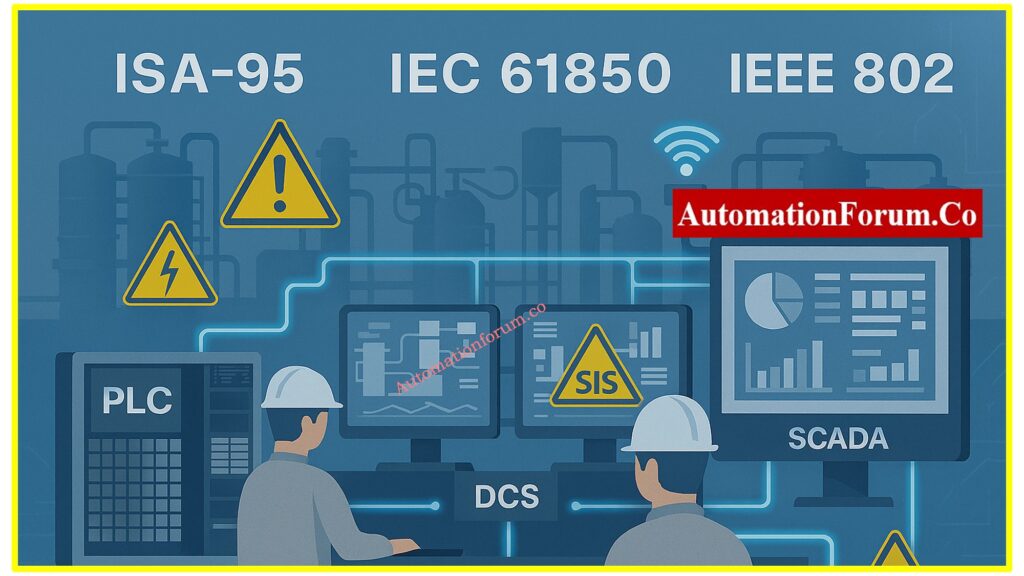
ISA standards are widely respected worldwide:
- ISA-20 – Instrument Specification Forms: Standard templates for datasheets.
- ISA-75 – Control Valve Standards: Defines sizing, testing, and performance criteria.
- ISA-84 – Safety Instrumented Systems: Aligned with IEC 61511.
- ISA-88 – Batch Control Systems: Standard for batch processes (pharma, food, specialty chemicals).
- ISA-95 – Enterprise-Control System Integration: Bridges the gap between ERP and plant control systems (MES/DCS).
Key takeaway: ISA standards are practitioner-friendly and directly applicable to everyday engineering tasks.
Follow correct procedures using this local instrument installation checklist: Checklist for Installation of Local Instruments – Complete Guide for EPC, QA/QC and Commissioning Engineers
IEEE (Institute of Electrical and Electronics Engineers) Standards
While IEEE is more electrical-focused, several standards impact I&C:
- IEEE 260.1 – Letter Symbols for Quantities (used in schematics).
- IEEE 802.x – Industrial Ethernet & Wi-Fi.
- IEEE 1588 – Precision Time Protocol (PTP): Critical for time synchronization in power grids.
- IEEE 1451 – Smart Transducer Interface: Enables plug-and-play sensors.
Key takeaway: IEEE sets the pace for communication and synchronization in industrial automation.
Refer the below link to ensure compliance with this complete intrinsically safe cable checklist for EPC Engineers
NAMUR Recommendations for Process Industries
NAMUR (a German user association for automation technology in process industries) provides practical guidelines and best practices.
- Focus on user needs rather than just manufacturer requirements.
- Widely used in Europe, especially in chemical and pharmaceutical industries.
- Recommendations like NAMUR NE43 (transmitter fault signal) are applied globally.
Key takeaway: NAMUR ensures standards stay practical and user-driven, not just theoretical.
How Engineers Apply Standards in Real Projects
It’s one thing to know the standards; it’s another to use them correctly. Instrumentation engineers apply standards in a number of ways in real-world projects:
- During the design phase, making sure that P&IDs follow ISA-5.1 and that safety systems are made according to IEC 61511.
- When buying things, you need to make sure that the equipment is ATEX/IECEx certified for dangerous regions.
- During Installation: Following NFPA 70 (NEC) and EN 60079 for wiring in areas where explosions could happen.
- During Commissioning: Following IEC 62381 to do FAT/SAT to make sure the system works as it should.
- During Operation: Putting into place alarm management (ISA-18.2) and cybersecurity (IEC 62443) techniques.
- During Maintenance: Making sure that calibration labs follow ISO/IEC 17025 and proof testing according to IEC 61511.
To put it simply, standards aren’t just “books on a shelf.” Engineers utilize them every day to develop, run, and keep factories running smoothly.
Future Trends in Instrumentation Standards
Standards are changing quickly, just like industrial automation. Engineers need to keep an eye on these new areas:
- Digital Twins: Standards will change over time to make sure that the data between real-world objects and their digital copies is the same.
- IEC 62828 and IEEE 1451 are two steps toward making IIoT devices that can be plugged in and used right away.
- Cybersecurity Integration: As cyber threats becoming more advanced, IEC 62443 will need to be updated.
- AI in Automation: Standards will soon spell out the best ways to use AI for predictive maintenance and finding problems.
- Green and Sustainable Engineering: There will be more focus on keeping track of emissions, using less energy, and being responsible for carbon.
This means that young engineers will always be learning. Keeping up with changing expectations is no longer a choice; it’s the key to moving up in your job.
Plan testing effectively with this detailed control valve ITP guide: Inspection and Test Plan (ITP) for Control Valves
Deep Dive: IEC 61511 Functional Safety Lifecycle
IEC 61511 is one of the most important standards that should be mentioned. It talks about the functional safety lifecycle of SIS in process industries, such as hazard and risk assessment (HAZOP, LOPA).
- Hazard and risk assessment (HAZOP, LOPA).
- Safety requirement specification (SRS).
- SIS design and SIL verification.
- Installation, commissioning, and validation.
- Operation, maintenance, and proof testing.
- Decommissioning and modification.
If you operate in oil and gas, petrochemicals, or power plants, you need to study IEC 61511.
Instrumentation and control standards are what make modern industrial automation possible. These standards affect the job of every engineer every day. They include everything from making sure people are safe in explosive environments (IEC 60079, ATEX) to digital integration (ISA-95, ISO 15926) and cybersecurity (IEC 62443).
Young engineers can gain reputation and skills by learning these standards. For professionals with expertise, remaining up to date is important for compliance, safety, and efficiency.
Standards are more than just rules. They represent the combined knowledge of thousands of engineers from around the world and a strategy for plants that are safe, reliable, and ready for the future.
See key differences explained in this IEC safety lifecycle guide: Difference between IEC 61508 & IEC 61511 SLC Version
FAQ on Key Instrumentation & Control (I&C) Standards
What are the standards of instrumentation?
International standards for instrumentation, such as IEC, ISO, ISA, IEEE, NFPA, ATEX, and NAMUR, set rules for how to keep process control systems safe, design them, calibrate them, test them, communicate with them, and integrate them.
What does a controls engineer need to know?
A controls engineer needs to know how to program PLCs and DCSs, follow instrumentation standards, read P&IDs, work with safety systems (IEC 61511), industrial communication protocols, troubleshoot, and put automation systems together.
What skills do instrumentation engineers need?
Instrumentation engineers need to know how to monitor processes, use control systems like PLC/DCS, tune loops, make P&IDs, follow safety requirements, calibrate equipment, fix problems, be aware of cybersecurity, and write project documentation.
What is ICA in instrumentation?
Instrumentation, Control, and Automation (ICA) is the name for the tools, systems, and technologies used to measure, control, and automate industrial processes.
What does I&C technology involve?
To make sure that industrial plants run safely, reliably, and efficiently, I&C technology includes sensors, transmitters, control valves, PLC/DCS systems, SCADA, safety systems, communication networks, and software integration.
Why is IEC 61511 important for instrumentation engineers?
IEC 61511 is important because it sets the standards for the whole functional safety lifetime of Safety Instrumented Systems (SIS) in process industries. This makes sure that systems are built, tested, and kept up to date to provide reliable protection.
What is the difference between IEC 61508 and IEC 61511?
IEC 61508 is a general standard for functional safety in all industries. IEC 61511, on the other hand, is only for Safety Instrumented Systems in the process industry and gives engineers practical advice.
What does the ATEX directive cover in instrumentation?
The ATEX directive (2014/34/EU) makes sure that all equipment and safety systems used in the EU’s explosive atmospheres are tested, certified, and safe to use.
How do NAMUR recommendations help instrumentation engineers?
NAMUR recommendations are useful, user-driven rules for automation and instrumentation in process industries. They focus on how well things work in the actual world, such NAMUR NE43 for alerting transmitter faults.
 that ensure safety, reliability, and compliance in industries.)