Home Blog Page 228

Different methods of temperature measurement

0

IN industries temperature is a major physical quantity . there are different methods of temperature measurement in industries. The different methods of temperature measurement are:
         1. Mechanical

          2. Electrical.

1.Mechanical methods:

Mercury in glass thermometers

This consists of a glass tube of very fine bore joined to a reservoir at the bottom and sealed at the top. A measured quantity of mercury is the enclosed. When the thermometer is heated the mercury expands much more than the
glass and is therefore forced to rise up in the tubing A scale is fixed at the side.

Bimetallic Thermometer

Two metals whose coefficient of linear expansion is different are welded and rolled together to the desire thickness. The actual movement of a bimetal is its flexibility with one end fixed, a straight bimetal strip deflects in proportion to
its temperature, to the square of its length and inversely with its thickens.

Compensated Thermometer System:

Compensations are provided in order to nullify the effect of changes in ambient temperature. The compensation in liquid filled expansions thermal system consists of the second tubing and helical element, both liquid filled.
The two elements are so constructed that the measuring helical floats on a movable base the position of which is governed by the compensating helical. The two tubing and helical are matched in volume so that variation in
temperature at the instrument case and along the capillary tubing, produce equal motion from both helical. Such motion nullity each other so that only motion produced by varying the bulb temperature actuates the recorder pen.

Gas filled Thermometers:

This type depends upon the increase in pressure of a confirm gas (constant volume) due to temperature increase. The relation between temperature and pressure in this kind of system follow Charles law and may be expressed.
The system is filled under high pressure. The increase pressure for each degree of temperature rise is therefore greater than if the filling pressure were low. Nitrogen the gas most after used for such systems, because it chemically
insert and possesses a favorable coefficient thermal expansion.

Vapour – Pressure Thermometers:

Vapour pressure thermometers depend upon vapour pressure of liquid, which only partially fills the system. At low temperatures the vapour pressure increase for each unit temperature charge is small, at higher temperature the
vapour pressure change is much greater.

2.Electrical method of temperature measurement

Thermocouples

It is a simple device consisting of a dissimilar metal wires joined at their ends. When an of each wire is connected to a measuring instrument thermocouples becomes an accurate and sensitive temperature measuring device

To know about thermocouple transmitter calibration

                Thermocouple transmitter calibration 

Resistance – Temperature Detectors (RTD)


RTD’s are generally used for precise temperature measurement. It consists of a five wire wrapped around an insulator and enclosed in a metal. The most sheath of a resistance thermometer resembles that of bimetallic thermometer
bulb.

PRINCIPLE: “Resistance increases as temperature increase”
Rt. = Ro (1 + ? t )
Rt. = Resistance of Temperature to measured.
Ro. = Resistance of zero temperature.
?    = Co. off of thermal (expansion).
t     = Temperature to be measured.

These metals have a positive temperature co-efficient of expansion. Therefore resistance increases as the temperature increases.
Types of material used: (1) Platinum (2) Nickel
These metals have a positive temperature co-efficient of expansion. Therefore resistance increases as the temperature increases.

Calculation of Resistance or Pt100.
 Ro = 100
x for platinum = 0.00385 /c.
To calculate Resistance at 100’c.
R100 = 100 [ 1+ ( 38.5  x 10  4  x 100 ) ]
           = 100 + (100  x  0.385)
R100  = 138.5
Resistance at 100’c = 138.5

How to calibrate RTD transmitter

Calibration procedure of DPT transmitter

0

Introduction

Differential pressure transmitter is an instrument used in industries to measure the flow. Calibration procedure of DPT transmitter is what we are going to discuss

Equipments required

  • 24 VDC power supply
  • Multimeter digital
  • Pneumatic hand pump
  • Low pressure hand pump
  • High precision digital test gauge
  • HART communicator

Calibration procedure of DPT transmitter

  • Remove the differential pressure transmitter from the process
  • Make sure the equalizing valve manifold is closed.
  • Connect the transmitter with the calibration equipments as shown in fig
  • Apply the LRV pressure with the hand held test pump and check the multimeter reading
  • If it is not 4ma then calibration is required

 If transmitter is analog transmitter

  • By applying 0% pressure by test pump adjust the zero pot in transmitter to get 4ma output in multimeter.
  • Apply 100% pressure and adjust span pot to get 20ma in multimeter.
  • Check for 25%,50%,75%.
  • Repeat the process to ensure that no error is occurred.

In case of SMART Transmitter

We have to use HART communicator, connect the communicator with the transmitter select the HART              Communicator Menu for lower range value trim and upper range value trim.

  1. Basic Set up – Calibration – Zero Trim/Sensor Trim —Lower/Upper range value trims.
  2. HART communicator will automatically calibrate the transmitter.
  3. Restore the process connection
  4. Take the transmitter on line. Ensure there is no leak

Pressure transmitter Calibration

Bubbler Level Measurement System

0

Introduction

If the process liquid contains suspended solids or is chemically corrosive or radioactive, it is desirable to prevent it from coming into direct contact with the level transmitter. In these cases, a bubbler level measurement system, which utilizes a purge gas, can be used.


THEORY

As shown in Figure, a bubbler tube is immersed to the bottom of the vessel in which the liquid level is to be measured. A gas (called purge gas) is allowed to pass through the bubbler tube.

Consider that the tank is empty. In this case, the gas will escape freely at the end of the tube and therefore the gas pressure inside the bubbler tube (called back pressure) will be at atmospheric pressure.

However, as the liquid level inside the tank increases,pressure exerted by the liquid at the base of the tank (and at the opening of the bubbler tube) increases. The hydrostatic pressure of the liquid in effect acts as a seal, which restricts the escape of, purge gas from the bubbler tube.

As a result, the gas pressure in the bubbler tube will continue to increase until it just balances the hydrostatic pressure of the liquid. At this point the backpressure in the bubbler tube is exactly the same as the hydrostatic pressure of the liquid and it will remain constant until any change in the liquid level occurs.

As the liquid level rises, the backpressure in the bubbler tube increases proportionally, since the density of the liquid is constant.

A level transmitter (DP cell) can be used to monitor this backpressure.

Level Measurement : What is bubbler system ? Advantages and Disadvantages

Three way Manifold valve.

0

Introduction

A three-way manifold valve is a device that is used to ensure that the capsule will not be over-ranged. It also allows isolation of the transmitter from the process loop. It consists of two block valves – high pressure and low pressure block valve – and an equalizing valve.

Figure shows a three valve manifold arrangement

During normal operation, the equalizing valve is closed and the two block valves are open. When the transmitter is put into or removed from service, the valves must be operated in such a manner that very high pressure is never applied to only one side of the DP capsule

Operational Sequences of Three way Manifold Valving Transmitter Into Service


  1. Check all valves closed.
  2. Open the equalizing valve .this ensures that the same pressure will be applied to both sides of the transmitter, i.e.,zero differential pressure.
  3. Open the High Pressure block valve slowly, check for leakage from both the high pressure and low-pressure side of the transmitter.
  4. Close the equalizing valve .this locks the pressure on both sides of the transmitter.
  5. Open the low-pressure block valve to apply process pressure to the low-pressure side of the transmitter and establish the working differential pressure.
  6. The transmitter is now in service.

Note it may be necessary to bleed any trapped air from the capsule housing.

Removing Transmitter from Service

 Reversal of the above steps allows the DP transmitter to be removed from service.

  1. Close the low-pressure block valve.
  2. Open the equalizing valve.
  3. Close the high-pressure block valve.

The transmitter is now out of service.

Calibration procedure of DPT transmitter

Globe valve, types of globe valve

0

Globe valve is widely used by sliding stem valve or linear motion valve used to regulate flow in a pipeline. Globe valves are named so because of the spherical body shape.

Construction & Working:

The valve plug is the essential part of the globe valve. Because the plug absorbs the pressure of the flow (with a pressure loss across the valve) the plug design is an important consideration in determining the flow characteristics of the valve.

When the actuator moves to close the valve, the plug moves down to the seat closing the seat. The plug closes the seat completely allowing the no fluid to pass further. The actuator rises up, pulling the plug out to pass the fluid through the valve.

Bonnet and the valve body are perfectly sealed and round in shape so that it is called a globe valve. Due to the shape, it has more pressure capacity.

The most widely used valve is the single-stage orifice and plug assembly. Multistage orifice elements are usually found in trim designs to reduce noise, erosion and cavitation.

Cage:

Cage valves use the principle of cage guiding, where the plug rides inside the cage. This is common in most valves. As the plug is aligned by a cage, the valve effectively self-aligns itself so that during assembly all the pieces fit together. The correct alignment reduces the problem of side load. The cage valves are not used for viscous fluids.

The cage valve is characterised by the shape and size of the cage windows.  Cage valves are popular due to the variety of trim types available. The trim type may be selected for various performance such as reducing cavitation (anti-cavitation trim), or for reducing noise.


Types of Globe valve:


There are different types of valves classified based on the valve body design and operation.

Tee/Split body:

The single valve body is formed by joining two different parts, joined by the valve seat as shown in above picture. Because of the T shape, it is called as Tee shape valve.

The design has the lowest coefficient of flow and highest pressure drop.  They are used in severe throttling services, such as in bypass line around a control valve.

Angle valve:

These valves can be likened to mounting a globe valve in an elbow. The exiting flow is 90 degrees to the inlet flow. It can handle slugging effect so they are used for applications that have periods of pulsating flow.

Using this valve can eliminate the elbow. The Angle valve has little restriction on the outflow, so if flashing or cavitation occurs then it tends to do so further downstream from the valve. This saves not only on the maintenance life of the valve but also minimises any degradation in valve performance.

Y-style valve:

The seat and the stem are at 45° angle, this type is an alternative for a the high-pressure drop. Even though the valve stem is at 45°, it has a straight flow path. They are mainly used for drainage applications, operating at or near the closed position.

When installed in a horizontal pipe, the flow is maintained at horizontal direction but stem will 45° inclined maintenance is impaired with the added difficulty of aligning and handling the components.

Double seated globe valve:

Another globe valve body design is double seated, there are two plugs and two seats that operate within the valve body.

All valves mentioned above are the single seated valves. In a single seated valve, the forces of the flow stream can push against the plug, requiring greater actuator force to operate the valve movement. Double seated valves use opposing forces from the two plugs to minimise the actuator force required for control movement. Balancing is the term used when the net force on the stem is minimised in this way.

The double plug system provides two controlled flow stream. The force affected on the upper plug will be balanced by the pressure on the bottom plug. So it can overcome the high-pressure problem and a double plug globe valve provides high control over the high-pressure stream.


Calibration of P/I converter.

0

Introduction

Pressure to current (P/I) converters are  two-wire precision instrument designed to convert standard pneumatic input signals into proportional output electrical signal. They are compact robust instruments suitable for panel or field mounting applications.In this session we are going to discuss the calibration of P/I converter.

 Input signal: 3-15 psig.

 Output signal: 4-20 mA

 DC Supply voltage: 24 VDC

Equipment needed calibration of P/I converter.

Supply voltage 24vdc,pressure source(handheld test pump), multimeter,

 Calibration procedure calibration of P/I converter.

Generally P/I converter is calibrated for standard industrial signals as 3-15 psig input corresponds to 4-20 mA DC output. These are standard factory settings and need not to be changed. To adjust the zero and span settings proceed as follows: Two adjustments for zero and span are provided in front face of unit.

 Calibration procedure calibration of P/I converter

  1. Set digital calibrator on measure mode.
  2. Connect input signal i.e. 3-15 psig.
  3. Set the input signal to 3 psig and check the output current as 4 mA.
  4. If the current is showing more or less than 4 mA then adjust zero pot to make output 4ma.
  5. Set the input pressure signal to 15 psig and check the output current 20 mA.
  6. Turn the span adjustment potentiometer on Converter and adjust 100%.
  7. Repeat step 3 to check that the desired low value (3 psig ~ 4mA) has not changed after adjusting the span.

If necessary repeat steps 3 through 4 to fine-tune the unit.

P/I converter
Ronan’s X55-300 P to I Convertor

I/P converter calibration

level measurement using Pressure gauge

0

Introduction

A simple pressure gauge can be used for level measurement if its scale is properly calibrated for the actual level, inside the tank or vessel

We are considering open tank

Case1

Consider for instance the tank is 1000mm height & is filled with water of specific gravity 1.00 as shown in fig below


Now we will install the pressure gauge on the bottom of the tank .here the tank is 1000mm so we can select the gauge range as 0 to 1000mmwc .in this case if we fill 50% of tank with water the gauge will show 500mmwc which is  direct reading of level which is equal to 500mmWC=50% level. For 100% level  in the tank the gauge will show 1000mmWC

So like that we can measure 25%.50%,75% and so on

For example if 35% of the tank is filled with water the gauge reading will be ((35/100)*1000)=350mmWC

Case 2

Consider the same situation above but the liquid in the tank is different. Other than water consider crude oil whose specific gravity is .800

Then the gauge should be range 0 to (height of tank *specific gravity of liquid inside the tank ) here 1000*.800=800mmWC,thus the range of the gauge should be 0 to 800mmWC for 1000mm height tank installed at the bottom of the tank

Here also for 40% level in the tank the gauge will show a reading of (40/100) of span ie

((40/100)*800)=320 mmWC  reading in the pressure gauge

Displacer type level transmitter calibration /leveltroll calibration

Pitot tube, working, advantages and disadvantages

0

Pitot tube is a device used to measure the fluid flow measurement invented by Henri Pitot, a French engineer in 18th century.

It is widely to measure the airspeed of aircrafts, speedboat speed and for fluid flow measurement in industrial application. Pitot tube measures the pressure point in contact.

 Principle:

The pitot tube is a differential pressure measuring device.

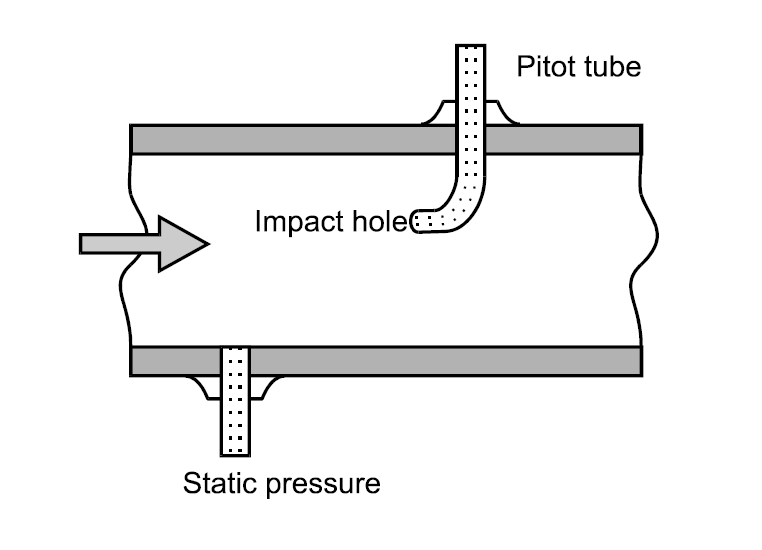
Fig: 1

The pitot tube installed in the flow stream measures the direct pressure at the contact pitot tube hole and a second measurement is required, being of static pressure. The difference between the two measurements gives a value for dynamic pressure. The flow rate, like other devices, is calculated from the square root extractor of the pressure.

In a pitot-static tube, the flow Q is given by:

Q = K?(pS ? pi) 

where K is a constant, pS is the static pressure, and pI is the impact pressure.

Construction and Working:

The pitot meter consists of a tube pointing directly toward the flow. The fluid enters through the impact hole and there can one or two other holes in the pitot tube, which are the static pressure source.

fig:1

For a simple pitot tube (shown in fig:1) we should arrange one another pressure sensing element to measure the static pressure. The axis of tube measuring the static pressure should be perpendicular to the boundary and free from burrs so that the boundary is smooth.

The pitot-static tube that having the static pressure inlet is shown below.

fig: 3


A pitot tube is a simple round cylinder with one end opened with a small hole and other end enclosed. The fluid flowing through the pipeline enters the pitot tube and rest there. There is another chamber within the pitot tube filled with fluid with static pressure. A diaphragm separates both the chambers.

The differential pressure is measured between both the pressures gives the dynamic pressure. The difference in level between the liquid in the tube and the free surface becomes the measure of dynamic pressure. The flow rate, like other devices, is calculated from the square root of the pressure.

In calculating the flow rate from the pressure, the calculation is dependent on such factors as tube design and the location of the static tap. The Pitot-static probe incorporates the static holes in the tube system to eliminate this parameter.

Measuring the static pressure and the impact pressure are connected to the proper differential pressure meter for the determination of flow velocity and thus the flow rate.


Advantages:

  • Small and do not contain any moving parts
  • Low cost
  • Low permanent pressure loss.
  • Ease of installation into an existing system.

Disadvantages:

  • Foreign material in a fluid can easily clog pitot tube and disrupt normal reading as a result.
  • Low accuracy
  • Low rangeability

I/P converter calibration

0

Introduction

Current to pressure converter (I/P) converts an analog signal (4 to 20 mA) to a proportional  pneumatic output (3 to 15 psi).It is one of the main pneumatic instruments used in industries. The most common application of I/P converter is to receive an electrical signal from a controller and provide proportional pneumatic output to control a positioner or a control valve.

Equipments needed

I/P converter, milliamp source,pressure source(20 psi),master gauge.

I/P converter calibration

Note: no need of external power supply (24vdc)for working (neither for calibration)

Procedure of  I/P converter calibration

Generally I/P converter is calibrated for standard industrial signals as 4-20 mA input and 3-15 psi output.

I/P converter calibration

Refer following steps to calibrate I/P converter:


  1. Remove the I/P from the process.
  2. If there is any top cover in I/P remove it.
  3. Connect 20-psi supply pressure and connect a milliamp source to the I/P .
  4. Set the input signal to 4 mA and check the output pressure on gauge as 3 psi.
  5. If the pressure is showing more or less than 3 psi then adjust zero.
  6. Turn zero adjustment screw slowly by very small turn to obtain 3-psi pressure. More turning of zero adjustment may damage the I/P converter.
  7. Counter clockwise rotation increases the pressure, and clockwise rotation decreases the pressure.
  8. Set the input current signal to 20 mA and check the output pressure on gauge as 15 psi.
  9. Turn the span adjustment potentiometer very slowly by small turn to obtain 15-psi pressure. More turning of span adjustment may damage the I/P converter.
  10. Repeat step 4 to check that the desired low value (4 ma ~ 3 psi) has not changed after adjusting the span. If necessary repeat from steps 3
  11. Reconnect the I/P in the process.

I/P converter calibrationI/P converter calibration

Calibration of P/I converter. 

TURBINE FLOW METER

0

Introduction

Flow is an important physical quantity that needs to be controlled,monitored. There are so many flow measuring devices. lets discuss about Turbine flow meter.

Working principle

Turbine flow meter is used for translates the mechanical action of the turbine rotating in the liquid flow around an axis into a user readable rate of flow. Blades on the rotor are angled to transform energy from the flow stream into rotational energy. The rotor shaft spins on bearings. When the fluid moves faster, the rotor spins proportionally faster.

Turbine flow meters measure the velocity of liquids, gases and vapors in pipes, such as hydrocarbons, chemicals, water, cryogenic liquids, air, and industrial gases.

These meters are an ideal solution when high accuracy, compact size and fast response are critical requirements

Theory

Shaft rotation can be sensed mechanically or by detecting the movement of the blades. Blade movement is often detected magnetically, with each blade or embedded piece of metal generating a pulse. Turbine flow meter sensors are typically located external to the flowing stream to avoid material of construction constraints that would result if wetted sensors were used. he flowing fluid engages the vaned rotor causing it to rotate at an angular velocity proportional to the fluid flow rate.

The angular velocity of the rotor results in the generation of an electrical signal (AC sine wave type) in the pickup. The summation of the pulsing electrical signal is related directly to total flow. The frequency of the signal relates directly to flow rate.When the fluid moves faster, more pulses are generated. The transmitter processes the pulse signal to determine the flow of the fluid. Transmitters and sensing systems are available to sense flow in both the forward and reverse flow directions

The output signal voltage of the magnetic coil is approximately sinusoidal. The frequency range of the pulsing signal varies from meter size to meter size. However, standard ranges allow for maximum output frequencies at the nominal linear flow of 250, 500, 750, 1000, 1500, 2000, and 2500 Hz.

STRAINERS/FILTERS

Turbine flow meters are designed for use in a clean fluid service.However, the service fluid may carry some particulate material which would need to be removed before reaching the flow meter.Under these conditions a strainer/filter may be required to reduce the potential hazard of fouling or damage that may be caused by foreign matter.

Parts of  turbine flow meter


1.Permanent conduit connection is standard.

2.ROTOR is pitched and pre-calibrated to determine accuracy.

3.END CONNECTIONS available, flanged or threaded, standard or special.

4.FLOW VANES increase performance at low rates

5.FLOW VANE HUB supports rotor assembly

.6.ROTOR SHAFT, BEARINGS, AND THRUST BALL are tungsten carbide for long service without lubrication other than by the liquid being measured.

7.RETAINING RINGS make disassembly easy.8.FLOW METER BODY is sturdy, one-piece construction, precisionfinished.


Installation

  • The meter should be installed with the arrow on the meter body corresponding to flow direction of the line
  • A 10-diameter length of straight unrestricted pipe must be upstream and a 5-diameter length of straight unrestricted pipe must be downstream of the flow meter. Both pipe sections should be the same nominal pipe size as the flow meter’s end connection.
  • Throttling/Control valves should be located downstream of the flow meter

Applications

  • Water-injection measurement
  • Heater treaters
  • Test and production separators
  • Disposal wells
  • CO2 injection
  • Steam generator fuel and feed water
  • Food and beverage industry
  • Metering liquid fertilizer
  • Water, fuel, and chemical measurement in plant settings
  • Chemical tank loading and unloading
  • Measuring liquid propane

Advantages

  • high accuracy
  • suitable for extreme temperature and pressure
  • it can be used on gas and liquids

Disadvantages

  • only for low viscosity fluids.
  • moving parts
  • sensitive to flow profile
  • Require clean fluids.