Home Blog Page 227

Calibration of Pressure Switch

0

Introduction

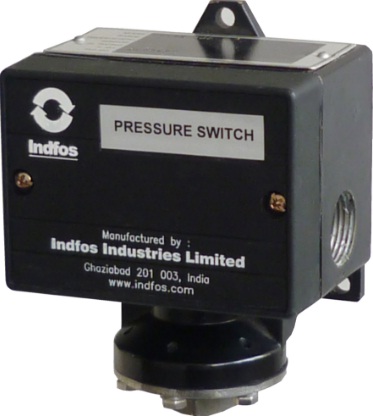
The device contains a micro switch, connected to a mechanical lever and set pressure spring. The contacts get actuated when process pressure reaches the set pressure of the spring. In this session calibration of pressure switch is covered.

  • It can be used for alarming or interlocking purposes, on actuation.
  • It can be used for high / high-high or low /low-low actuation of pressure in the process. The set range can be adjusted within the switch range.
  • The sensing element may be a Diaphragm or a piston

Calibration Procedure of the Pressure Switch

Calibration Procedure of the Pressure Switch

Step 1:

Connect the pressure switch to a hand pressure regulator and test gauge, as shown in the diagram above.

Step 2:

With a Multimeter, set to the continuity range to check and verify that the switch contacts are as indicated: NO (Normally open)  and NC  (Normally close).

Step 3:

Connect the Ohmmeter or DMM between the normally open contacts (NO) and the common terminal (C) of the switch. The meter should read “open circuit”. Adjust the hand pressure regulator to increase the pressure to the set point of the pressure switch until the contacts change over. The meter should now read “short circuit”. Note the pressure reading and write it down. This pressure is the switch set point for a “rising” pressure.

Step 4:

Increase the pressure to the switch to its maximum rating. Slowly reduce the pressure to the switch until the switch changes over from closed to normally open again. Note and write down this pressure reading. This pressure is the switch setting for a “falling” pressure.

When error found, adjust set point by screw adjustment and repeat until desired value obtained

Step 5:

From the readings you have taken work out the pressure difference between the rising and falling pressure settings. This is called the “dead band” of the switch. The dead-band calculated should be equal to or less than the manufacturers’ dead-band. The maximum dead-band is usually stated by the manufacturer.

Pressure Switch Calibration

Pressure transmitter Calibration

P&ID legends

0

INTRODUCTION

As an Instrument Technician trainee you will use Piping and Instrument Diagrams or P&ID’s in your job.  You must be able to interpret the information and symbols shown on the drawing.For that you need the help of P&ID legends.

The P&ID’s on the job site will help you in five different ways:

  1. To identify major equipment used in the process system.
  2. To identify and trace the  flow of the product through the plant.
  3. To identify information  defining pipe sizes and allowable working pressures.
  4. To understand the process that is going on in the plant.
  5. To find the locations of control valves and other instruments where they can be easily seen for preventive maintenance.

SYMBOLS AND ABBREVIATIONS USED IN P&ID legends.

Main Process Lines  are the major pipelines in a process system.  Most P&IDs will show these as heavy lines with arrows on the lines.  The arrows show the direction of flow.

Auxiliary (secondary)  Process Lines are pipes that  feed into the main process line or draw from the main process line. (ie shown in fig below)


Instrument legend


Piping on a  P&ID  is indicated by:

1)     Usage:     For example, process, drain, nitrogen, blowdown, etc.

2)     Line Number:  The identification number of the line on the plant.

3)     Size:        Usually in inches.

4)     Piping Class:    The piping specification, both material and pressure rating


Share this post in facebook


P&ID and Common Abbreviation


P&ID and Common Abbreviation

0

INTRODUCTION

A piping and instrumentation diagram (P&ID) is a diagram in the process industry which shows the piping of the process flow together with the installed equipment and instrumentation. The P&ID are also used to operate the process system. P&ID shows all of piping including the physical sequence of branches, reducers, valves, equipment, instrumentation and control interlocks.In this session we are going to discuss about P&ID and Common Abbreviation.

Based on Institute of Instrumentation and Control, a piping and instrumentation diagram (P&ID)is defined by the diagram which shows the interconnection of process equipment and the instrumentation used to control the process. In the process industry, a standard set of symbols is used to prepare drawings of processes. The instrument symbols used in these drawings are generally based on International Society Automation (ISA) Standard S5.1

Functions of P&ID 

The main function of P&ID is related with a significant role in the maintenance and modification of the process that it describes. It is critical to demonstrate the physical sequence of equipmenvt and systems, as well as how these systems connect. During the design stage, the diagram also provides the basis for the development of system control schemes, allowing for further safety and operational investigations, such as the hazard and operability study (HAZOP).

There are a few rules in preparing a P&ID whereby there are item that should be included and some items should not.

A P&ID should include:

  • Instrumentation and designations
  • Mechanical equipment with names and numbers
  • All valves and their identifications
  • Process piping, sizes and identification
  • Miscellaneous – vents, drains, special fittings, sampling lines, reducers, increasers and swaggers
  • Permanent start-up and flush lines
  • Flow directions
  • Interconnections references
  • Control inputs and outputs, interlocks
  • Interfaces for class changes
  • Seismic category
  • Quality level
  • Annunciation inputs
  • Computer control system input
  • Vendor and contractor interfaces
  • Identification of components and subsystems delivered by others
  • Intended physical sequence of the equipment

 A P&ID should not include: 

  • Instrument root valves
  • control relays
  • manual switches
  • primary instrument tubing and valves
  • pressure temperature and flow data

                               P&ID  Common Abbreviation

AEAOV

BE

CR

DP

DT

FC

FCV

FE

FG

FHC

FHS

FI

FIC

FM

FQR

FQI

FR

FRC

FS

FT

Ftd

HCV

HS

LC

LCV

LG

LHC

LI

LIC

LR

LS

LT

Ltd

MOV

Analyzer Element (Chemical Composition)Air Operated Valves

Burner Element (flame detector)

Conductivity Recorder

Differential Pressure

Density Transmitter

(also specific gravity and Baume)

Flow Controller

Flow Control Valve

Flow Element

Flow Sight Glass

Flow Hand Control (manual)

Hand Switch in Flow Loop

Flow Indicator

Flow Indicating Controller

Flow Meter (Pos. Displ. or Turb)

Flow Qantity Recorder

Flow Quantity Indicator

Flow Recorder

Flow Recorder Controller

Flow Switch

Flow Transmitter

Flow Transducer

Hand operated Control Valve

Hand switch

Level Controller

Level Control Valve

Level Gage Glass

Level Hand Control (manual)

Level Indicator

Level Indicating Controller

Level Recorder

Level Switch

Level Transmitter

Level Transducer

Motor Operated Valve

MTPA

PC

PCV

PdI

pHT

PI

PIC

PIT

PR

PS

PT

PTd

PZV

RO

ST

SV

TC

TCV

TE

TI

TIC

TR

TRAP

TS

TSA

TT

TTd

TW

TY

WE

XA

XVE

XVS

ZV

Motion TransmitterPressure Alarm

Pressure Controller

Pressure Control Valve

Differential Pressure Indicator

pH Transmitter

Pressure Indicator

Press. Indicating Controller

Press. Indicating Transmitter

Pressure Recorder

Pressure Switch

Pressure Transmitter

Pressure Transducer

Pressure Relief Valve

Restriction Orifice

Speed Transmitter

Solenoid Valve

Temp. Controller

Temp. Control Valve

Temp. Element

Temp. Indicator

Temp. Indicating Controller

Temp. Recorder

Steam Trap or Airvent

Temp. Switch

Temp. Switch Alarm

Temp. Transmitter

Temp. Transducer

Thermowell

Relay in Temperature Loop

Weight Measuring Element

Annunciator

Vibration Detector

Vibration Switch

Safety Shut-down (Pilot) valve

Nuclear Level Measurement

0

Introduction

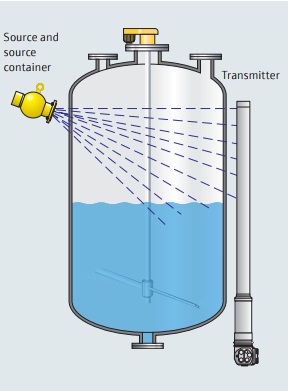
Continuous nuclear level measurement is typically used where most other technologies are unsuccessful. Different radioactive isotopes are used, based on the penetrating power needed to pass through the tank. Radiation from the source is detected on the other side of the tank. Its strength indicates the level of the fluid.

Theory

Nuclear continuous level measurement works by directing a narrow fan of radiation through the vessel to a detector. As the process level rises, it shields the detector from the from the radiation. The more radiation the detector sees, the lower the process level . The less radiation detected, the higher the process level


Source Radioisotopes used for Level Measurement Emit Gamma Radiation that Penetrates the Vessel Wall and process media
•A Target Detector on the Opposite side Measures the Radiation Field Strength and Infers a Level in the Vessel, a transmitter is mounted on the opposite side of the tank or pipe which converts the radiation received into an electric signal
•The Radiometric or Nucleonic Principle is Based on the Fact that Gamma Radiation is Attenuated when it Penetrates a Material 
•Cesium 137 (Half Life 30 Years) and Cobalt 60 (Half Life 5.26 Years) are the Most Commonly Used Industrial isotope.


Advantages

?Sometimes works, when no other method is available
?External mounting often possible
?Easy zero check
?Motor-driven models available for high-accuracy applications

Disadvantages 

?Costly to install

?Requires licensing by regulatory agency

?Dangerous to handle unless precautions are followed

?Original calibration and checkout often difficult and costly

?Errors caused by density variations in measured materials

?Lack of application data

?Difficult to obtain linear readout over wide ranges

?Problems presented by materials that coat walls

Ultrasonic  level Measurement

0

INTRODUCTION

Ultrasonic makes use of sound waves in the 20 – 200 kHz range (above the range for human hearing). A transducer mounted in the top of a tank transmits sound waves in bursts onto the surface of the material to be measured. Echoes are reflected back from the surface of the material to the transducer and the distance to the surface is calculated from the burst-echo timing.Ultrasonic level measurement is one of the modern level measuring techniques.

Principle Of Operation

?Consists of basically a transmitter receiver arrangement working in ultrasonic frequency.
?Transmitter sends an ultrasonic pulse of required frequency and the detector detects the same pulse,which gets reflected back from the liquid surface.
?Timer in the circuit would monitor the time delay between transmission and detection ,from which the distance can be calculated 

The key points in applying an ultrasonic transducer are:

  • The speed of sound varies with temperature. If the transducer does not use temperature compensation and the temperature of the air space in the vessel varies your level readings will not be correct.
  • Heavy foam on the surface of the material can absorb the sound wave bursts resulting in no echo or an echo that is too weak to process.
  • An irregular material surface can cause false echoes resulting in irregular readings.
  • Heavy vapor in the air space can distort the sound waves resulting in false reading.

Advantages of Ultrasonic  level Measurement

?Essentially no moving parts
?Utilizes solid-state circuitry requiring little maintenance
?Accuracy good, where application is suitable
?Applicable to some difficult-to-measure streams such as powders, solids, solids-containing fluids and slurries
?Easy to install

Disadvantages of Ultrasonic  level Measurement

?Insufficient application data
?Tendency to bridge for some sensor typesand for some materials
?Relatively high cost
?Difficulty in fixing distance between transmitting and receiving units in two-element systems this objection is overcome by fixed distances in some models

LASER LEVEL MEASURMENT

0

Introduction

There are different kinds of indirect level measuring methods.In this session we are gonna discuss about laser level measurements.The working principle of laser level measurement is detecting the time taken by laser source for transmission and reflection back from the material surface.

The laser level transmitter either uses triangulation, time of flight or confocal chromatic working principle

Working principle  laser level measurement

Triangulation

One method for accurately measuring the distance to targets is through the use of laser triangulation sensors. They are so named because the sensor enclosure, the emitted laser and the reflected laser light form a triangle.

The laser beam is projected from the instrument and is reflected from a target surface to a collection lens. This lens is typically located adjacent to the laser emitter. The camera views the measurement range from an angle that varies from 45 to 65 degrees at the centre of the measurement range, depending on the particular model.

Time of flight

This technique uses the time light takes to travel to a target and back, but the time for a single round trip is not measured directly. Instead, the strength of the laser is rapidly varied to produce a signal that changes over time. The time delay is indirectly measured by comparing the signal from the laser with the delayed signal returning from the target.

Confocal chromatic:

This uses use a white light source to accurately measure the distance to surfaces. The essence of our confocal chromatic imaging principle is the accurate detection of colours from light that is reflected back from target surfaces.

The white light is focused onto the target surface by a multi-lens optical system. These lenses disperse the light into monochromatic stages (colours) along the measurement axis. A specific distance to the target is assigned to each colour’s wavelength in a factory calibration. Only the wavelength which is exactly focused on the target is used for the measurement. This light reflected from the target surface is transmitted from the probe, through a confocal aperture and onto a spectrometer which detects and processes the spectral changes and calculates distances. These distance measurements are transmitted at high speed via Ethernet communications protocol

Merits of laser level measurement

  • Non contact type
  • Suitable for even vacuum services unlike ultrasonic detector
  • Less interface effects from welding joints and other parts as laser beam runs parallel

Demerits of laser level measurement

  • Shiny surfaces do not offer good results
  • Dusty, smoggy environments are not suitable for this method

Magnetostrictive Level Transmitter calibration

Bubbler Level Measurement System

Magnetostrictive Level Transmitter calibration

0

Introduction

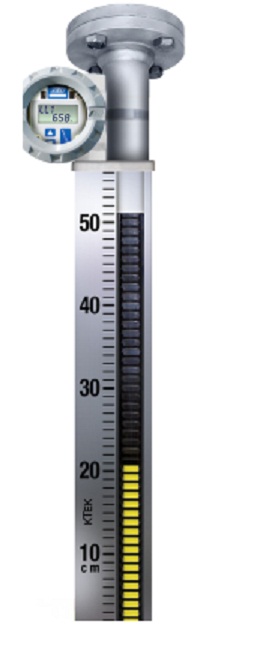
For Level measurement there are lots of methods. Magnetostrictive Level Transmitter is one of the major methods that are used in industries that precision matters so much.This instrument is a two wire, loop powered smart transmitter, designed to measure and transmit an analog 4-20 mA signal and two digital outputs (optional) proportional to liquid level in a tank. In this session we will be discussing about Magnetostrictive Level Transmitter calibration

Working Principle of Magnetostrictive Level Transmitter

Working Principle of Magnetostrictive Level Transmitter

A low energy pulse generated by electronics travels through the length of magnetostrictive wire. When this signal encounters a magnetic float having a magnetic field a return signal is generated from the exact location where the float intersects the magnetostrictive wire. A timer measures the time of generation of electric pulse and the return signal. This time difference is used to calculate the level of the float

Calibration of magnetostrictive level transmitter

Magnetostrictive Level Transmitter calibration can be changed with the unit push buttonsCalibration of magnetostrictive level transmitter

Setting the 4mA point:

-Establish a tank level of 0% or move the float to the desired 0% point

-Enter the calibration mode by pressing the UP & DOWN buttons together for 1 second.

-Press the DOWN button for 1 second to set the output at 4.00mA.

Setting the 20mA point:

-Establish a tank level of 100% or move the float to the desired 100% point

-Enter the calibration mode by pressing the UP & DOWN buttons together for 1 second.

-Press the UP button for 1 second to set the output at 20.00 ma

 Note: The above steps can be repeated as many times as required

level measurement using Pressure gauge

calibration of capacitance type level transmitter

Thermocouple basics and types of thermocouple.

0

What is thermocouple?

A thermocouple is an active transducer which directly converts thermal energy into electrical energy. It is a simple device made by joining to dissimilar metals or semiconductor forming a junction. It produces a voltage when the temperature at the junction changes.

Principle:

The Seebeck Effect:

A thermocouple works on the Seebeck Effect. This is where (as previously mentioned) two wires of dissimilar metals are electrically connected at one end. When the junction is heated or cooled, a voltage is produced which is proportional to the temperature.

The Peltier Effect:

The reverse of Seebeck effect, Releasing or absorption of heat at a junction of thermocouple due to the passage of electric current. That is if the junctions of thermocouple kept at the same temperature and if the current is allowed to pass through then one junction get heated and other get cooled.

Operation:

The two dissimilar metal wires are connected together to form a junction j1 shown in the picture below. A voltmeter is connected across the metal wire to measure the voltage, this a simple thermocouple setup.

The voltmeter shows the change in voltage reading according to the temperature change in the junction J1.

Here comes another situation, the junction j2 forms another junction of two dissimilar metals, One the metal wire(iron in the picture) and the conductor wire. So this dissimilar metal junction also generates a voltage which will oppose the junction voltage at J1. This junction is known as cold junction/reference junction.

So that at room temperature the voltmeter reads 0V because the voltage generated by J1 will be opposed by the voltage generated at the J2 as both junctions are exposed to the same temperature.

For standard measurements and industrial porpuses this can’t be allowed so that the Junction maintained at 0°C as cold junction:

It is impossible to use ice water at industries, but there are many other alternate cold junction compensation techniques. All compensation techniques perform under the same principle to generate an opposing voltage to the cold junction voltage:

Thermocouple types:

Thermocouples exist in many different types, each with its own colour codes for the dissimilar-metal wires, Each type of thermocouples differ in using the different metal combo:

All the negative wires are colour coded as red. Each type is selected based on the temperature range and especially the metals used, for example, metals like iron are easily corroding that can’t be used in corroding situations.

T-type can be used in either oxidising or reducing atmospheres. This type of thermocouple has a high resistance to corrosion due to moisture. They also provide a relatively linear output and perform well from a medium to very low-temperature range.

J-type can also be used in reducing atmospheres and provide a good near-linear output. They are also the least expensive of commercially available thermocouples.

K-type can be used in oxidising atmospheres, and are the most linear thermocouple for general use. These are the most widely used.

E-type is the most sensitive thermocouple available and has the highest change in emf per temperature change, but they tend to drift more. They can be used in oxidising atmospheres.

R-type and B-type thermocouples are suitable in oxidising atmospheres, they are easily contaminated in other atmospheres.

Applications:

  • Manufacturing
  • HAVC systems
  • Thermoelectric cooling
  • Gas appliances safety
  • Thermopile radiation sensor

Advantages:

  • Low cost
  • It is rugged in construction
  • Small size
  • Cover a wide temperature range
  • Calibration can be easily checked
  • Fast response
  • Accurate for large temperature change
  • Reasonably stable

Disadvantages:

  • Very weak output, millivolts
  • Stray voltage pickup is possible
  • In many applications, amplification of required
  • Sensitive to electrical noise
  • Nonlinear
  • Complicated conversion from emf to temperature

To know about  Thermocouple transmitter calibration

Different Types of Orifice Plates Used in Flow Measurement

0

Orifice plates are one of the most widely used primary flow elements for flow measurement in process industries. They are commonly installed in pipelines to measure the flow rate of liquids, gases, and steam using the differential pressure principle.

An orifice plate is a thin, flat metal plate with a precisely machined hole at its center or offset position. When a fluid flows through the orifice, it experiences a restriction, causing a pressure drop across the plate. This pressure difference is proportional to the square of the flow rate and is measured using a differential pressure transmitter.

When fluid passes through an orifice plate:

  • The flow stream contracts after passing the restriction
  • The smallest cross-section of the stream is called the vena contracta
  • The actual discharge is less than the theoretical discharge
  • This reduction is mainly due to flow contraction, not energy loss

In flow measurement systems, the pressure difference created by this contraction is measured and used to calculate the flow rate accurately.

Different industrial fluids have different characteristics such as:

  • Presence of solids
  • Viscosity
  • Wetness (wet steam, oil-water mixtures)
  • Slurry or colloidal nature

To handle these variations and avoid problems like clogging, erosion, and inaccurate measurement, different types of orifice plates are used.

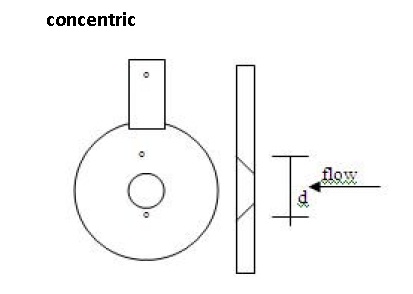
Concentric orifice plate for flow measurement

The concentric orifice plate is the most commonly used type of orifice plate in flow measurement.

  • The orifice bore is centrally located
  • Suitable for clean liquids, gases, and steam
  • Provides high accuracy when flow conditions are ideal

The beta ratio (β) is the ratio of the orifice bore diameter to the internal pipe diameter.

  • Liquids: 0.15 to 0.75
  • Gases & Steam: 0.20 to 0.70
  • Best accuracy range: 0.40 to 0.60

To reduce friction and wear, the upstream edge is sharp while the downstream edge is often beveled at 45°.

  • Clean water
  • Air and natural gas
  • Superheated steam
  • Process liquids without solids
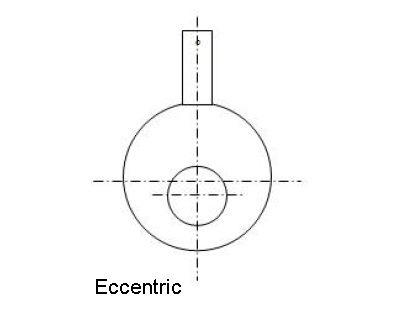
Eccentric orifice plate used for wet steam

An eccentric orifice plate has the bore offset from the center of the plate.

This design prevents the accumulation of:

  • Solids
  • Condensate
  • Gas pockets
  • Bore is positioned at the top or bottom of the pipe
  • Ideal for fluids containing suspended solids
  • Commonly used for wet steam and oil-water mixtures
  • Can use flange taps or vena contracta taps
  • Taps must be located 90° or 180° opposite the eccentric opening
  • Slurry-laden liquids
  • Oil containing water
  • Wet steam service
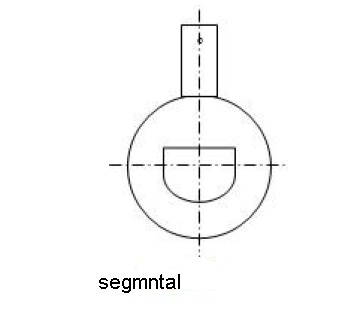
Segmental orifice plate for slurry flow

The segmental orifice plate has a hole shaped like a segment of a circle.

  • Allows solids to pass through easily
  • Reduces the risk of clogging
  • Suitable for high-solids services
  • Pressure taps should be located 180° opposite the segment opening
  • Ensures better measurement stability and accuracy
  • Slurries
  • Colloidal fluids
  • Wastewater
  • Pulp and paper industry

Segmental orifices are especially useful where concentric orifices would fail due to blockage.

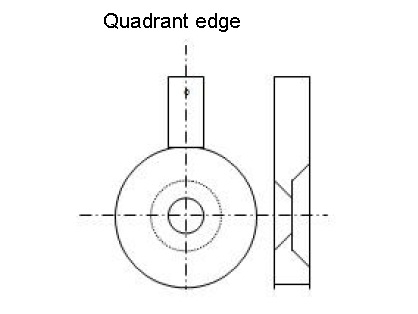
Quadrant edge orifice plate for low Reynolds number flow

The quadrant edge orifice plate features a rounded inlet edge instead of a sharp edge.

  • Produces a stable discharge coefficient
  • Performs well at low Reynolds numbers
  • Commonly used in small pipe sizes
  • Typically used for pipes less than 2 inches
  • Ideal for viscous fluids
  • Suitable for low flow velocities
  • Provides better repeatability than sharp-edged orifices under low-flow conditions
  • Heavy oils
  • Syrups
  • Polymer solutions
  • Low Reynolds number services

Quadrant edge orifices are widely used in Europe for specialized low-flow applications.

Orifice TypeBest ForKey Advantage
ConcentricClean fluidsHigh accuracy
EccentricWet / solids fluidsPrevents buildup
SegmentalSlurriesAnti-clogging
Quadrant EdgeViscous fluidsStable at low Reynolds
  • Simple and rugged construction
  • No moving parts
  • Cost-effective flow measurement solution
  • Suitable for high pressure and temperature
  • Easy installation and replacement

Different types of orifice plates are used in flow measurement to suit specific fluid characteristics and process conditions. While concentric orifice plates are ideal for clean fluids, eccentric and segmental designs handle solids and wet flows more effectively. Quadrant edge orifices are best suited for low Reynolds number and viscous applications.

Selecting the correct orifice plate type is critical for accurate flow measurement, long service life, and reliable plant operation.

Calibration procedure of DPT transmitter

Calibration of control valve positioner

0

Introduction

Positioner is a device put  into a valve to ensure that it is at correct position.An open/close operation of control valve also can be done with an I/P converter but the position of the valve can’t be confirmed. calibration of control valve positioner is crucial calibration that should be done by extreme precision . Positioner senses the valve position with with a feedback link which is its input signal .the purpose of control valve is to improve the accuracy of control valve response. Calibration of control valve positioner is what we are going to discuss.

to know more about control valve accessories check the link Control valve accessories

Calibration of control valve positioner

Equipment needed for Calibration of control valve positioner

positioner, control valve,pressure source

Calibration procedure of control valve positioner(heart type)

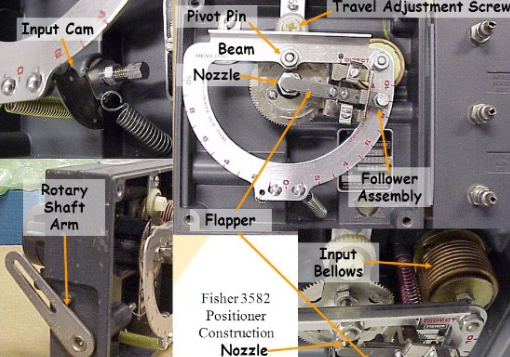
  1. Zero adjustments are done at the nozzle
  2. Span adjustment is done by moving flapper assembly (follower assembly) along the summing beam
  3. Air supply to the positioner is 20 psi.
  4. To calibrate move the flapper assembly to midrange of direct side or about no.6
  5. Increase the input signal to 3 psi
  6. Adjust the nozzle in or out slowly to make the output gauge output 0 psi
  7. Increase the input pressure to 15 psi
  8. If the output saturates too soon (at the output gauge) before giving 15psi move the flapper assembly to smaller number in the summing beam
  9. If the output saturates too late or above 15 psi move flapper assembly to larger number at the summing beam
  10. Every time when you move the flapper assembly reset the nozzle to zero also.

Control valve pressure test

How to control a control Valve using Pneumatic control system