Home Blog Page 221

WHAT ARE LIQUID FILLED TEMPERATURE GAUGES?

0

 INTRODUCTION

The liquid filled temperature gauges are most often used temperature gauges in industries. In this type liquid is filled in the metal tube. most generally used liquids are mercury and alcohol.

OPERATION PRINCIPLE OF LIQUID FILLED TEMPERATURE GAUGES:

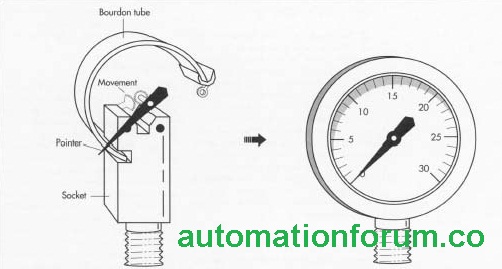
Liquid filled temperature gauges are one of the common temperature measurement techniques  the liquid filled in tube if there is any change in temperature occurred then the level of liquid will be increase or decrease.The tube connected with liquid filled bourdon tube. so, as pressure increase or decrease there will be change in the bourdon tube. As the gauge pressure increases the tube will tend turn coil, while a reduced gauge pressure will cause the tube to coil more tightly.

This motion is transferred through a linkage to a gear train connected to an indicating needle. The needle is presented in front of a card face inscribed with the pressure indications associated with particular needle deflections.The deflection of tube connected with pointer by link.the movement of pointer will indicate the value of temperature This is easy to install.

FEATURES OF LIQUID FILLED TEMPERATURE GAUGES

  • Use of inert gas
  • low cost
  • Rigid stem or capillary type
  •  Rugged stainless steel construction
  •  Dry or liquid (Glycerin/Silicon Oil) filled
  •  With or without thermowell
  •  Suitable for sanitary application

APPLICATIONS OF LIQUID FILLED TEMPERATURE GAUGES

  • Process and Petrochemical Industries
  • Machine & apparatus construction
  •  Food & Beverage Industries

Rotameter basics, variable area flow meter

0


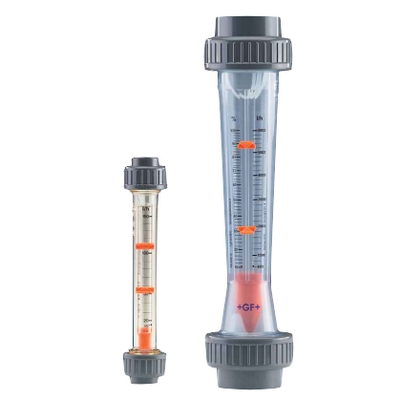
Rotameter is a variable area flow meter, works for measuring the flow of low viscous fluid at high velocity. A variable-area flowmeter is one where the fluid must pass through a restriction whose area increases with flow rate.

Principle:

It works on the principle of upthrust force exerted by fluid and exerted by gravity. The flow stream displaces a float placed in the stream. The rate of flow is related to the area produced by forcing the float up or down and varying the area.

Working and Construction of Rotameter:


Rotameter animation GIF

The rotameter consists of a tapered measuring tube and a float. This arrangement produces a resistance value (coefficient of resistance) for the float, which depends on its position in the measuring tube.

The float is placed inside the tapered tube. The transparent glass tapered tube is marked with a scale which will represent the measure of the flow. The float is constructed of various metals which can float on fluids. The selection of floats is made by considering the fluid density.


As the fluid enters the tapered tube, some fluids directly hit the bottom of the float. At this movement, there are two forces exerting on the float, gravity to downwards and trust of the fluid to upwards. Because of the upthrust, the float raises upward, until the upthrust and gravity force equal at a point. A balance is achieved between the force of the flow stream and the weight of the float. The float positions itself vertically within the measuring tube such that the resistance value is balanced. The vertical position will be pointed to the scale, the distance moved by the float will be the function of flow.

Also, a number of various floats are available. The rotating float is used for direct control. Another type that is available is unaffected by viscosity, and a modification of this is available that magnifies the sensitivity of the operating range by 30%, but is more sensitive to viscosity.


Advantages:

  • Inexpensive
  • The wide range of applications
  • Very basic operation
  • Easy installation and simple to replace

Disadvantages:

  • Limited accuracy
  • Subject to density, viscosity and temperature
  • The fluid must be clean, no solids content
  • Erosion of device (wear and tear)
  • Can be expensive for large diameters
  • Operate in the vertical position only
  • Viscosity > 200cP


Working of I/P Transducer

0
I/P

Introduction

  • I/P Transducer accepts an electrical input signal and produces a proportional pneumatic output.In this session we are going to discuss about how I/P transducer works.

To know about I/P converter calibration

Principle of Operation

I/P transducer

Electronic Circuit

  • The input current signal i.e. 4-20 ma is received by the transducers electronic circuit and compared to the output pressure from the booster stage.
  • A solid-state pressure sensor is part of the electronic circuit and monitors the booster stage output. The silicon-based sensor uses strain gauge thin film technology. The sensor’s pressure signal is fed to a simple internal control circuit.The transducer’s performance is decided by the sensor/circuit combination. Changes in output load (leaks), variations in supply pressure, or even component wear are sensed and corrected by the sensor/circuit combination.

Magnetic Actuator

  • The electronic circuit controls the level of current flowing through the actuator coil, which is located in the pilot/actuator assembly. A change to the level of coil current is made by the electronic circuit when it senses a discrepancy between the pressure measured by the sensor and the pressure required by the input signal
  • The actuator performs the task of converting electrical energy (current) to motion. It uses a , coaxial moving magnet design optimized for efficient operation and is highly damped at its mechanical resonance. A silicone rubber diaphragm protects its working magnetic gaps from contamination.

Pilot Stage

  • The pilot stage contains two opposed fixed nozzles: the supply nozzle and the receiver nozzle. It also contains the deflector, which is the moving element. See figures below The supply nozzles connected to the supply air and provide a high-velocity air stream.
structure pilot stage
  • The receiver nozzle  of I/P Transducer captures the air stream and converts it back to pressure. The receiver nozzle pressure is the output pressure of the pilot stage. To vary the pilot output pressure, the high-velocity stream is diverted away from the receiver nozzle by the deflector, which is a cylindrical; aerodynamic body located between the two nozzles.
  • In response to a change in actuator coil current, the deflector is repositioned between the nozzles. There is a linear relationship between the coil current and the pilot stage output pressure. For direct action units, the power-off, or fail-safe, position of the top of the deflector is near the center of the stream and results in nearly zero pilot output pressure.
  • As the coil is energized, the deflector is drawn out of the stream. For reverse action units, the power-off, or fail-safe, position of the deflector is completely out of the stream. The result is maximum pilot output pressure. As the coil is energized, the deflector moves into the stream, resulting in a decreased pilot output pressure.
Pilot stage

Booster Stage

  • The receiver nozzle pressure controls the booster stage.If the receiver nozzle pressure increases the transducer output will also increases.A decrease in the receiver nozzle pressure positions the valving in the booster stage to allow exhaust to occur, decreasing the output signal.

How does a Bourdon tube gauge work?

0

Introduction

 Bourdon tube uses a coiled tube which as it expands due to pressure increase causes a rotation of an arm connected to the tube

Working principle

The pressure sensing element is a closed coiled tube connected to the chamber or pipe in which pressure is to be sensed. As the gauge pressure increases the tube will tend to uncoil, while a reduced gauge pressure will cause the tube to coil more tightly.
This motion is transferred through a linkage to a gear train connected to an indicating needle. The needle is presented in front of a card face inscribed with the pressure indications associated with particular needle deflections. In a barometer, the Bourdon tube is sealed at both ends and the absolute pressure of the ambient atmosphere is sensed.
Differential Bourdon gauges use two Bourdon tubes and a mechanical linkage that compares the readings.In the following pictures the transparent cover face has been removed and the mechanism removed from the case. This particular gauge is a combination vacuum and pressure gauge used for automotive diagnosis:
  • The left side of the face, used for measuring manifold vacuum,is calibrated in centimetres of mercury on its inner scale and inches of mercury on its outer scale.
  •  The right portion of the face is used to measure fuel pump pressure and is calibrated infractions of 1kgf  /cm²on its inner scale and pounds per square inch on its outer scale

Stationary parts:

  • A: Receiver block. This joins the inlet pipe to the fixed end of the Bourdon tube (1) and secures the chassis plate (B). The two holes receive screws that secure the case.
  • B: Chassis Plate. The face card is attached to this. It contains bearing holes for the axles.
  • C: Secondary Chassis Plate. It supports the outer ends of the axles.
  • D: Posts to join and space the two chassis plates.

Moving Parts:  

1.Stationary end of Bourdon tube. This communicates with the inlet pipe through the receiver block.

2.Moving end of Bourdon tube. This end is sealed.

3.Pivot and pivot pin

4.Link joining pivot pin to lever (5) with pins to allow joint rotation.

5.Lever. This an extension of the sector gear (7).

6.Sector gear axle pin.

7.Sector gear.

8.Indicator needle axle. This has a spur gear that engages the sector gear (7) and extends through the face to drive the indicator needle. Due to the short distance between the lever arm link boss and the pivot pin and the difference between the effective radius of the sector gear and that of the spur gear, any motion of the Bourdon tube is greatly amplified.A small motion of the tube results in a large motion of the indicator needle.

9.Hair spring to preload the gear train to eliminate gear lash and hysteresis. 

Advantages of Bourdon Gauges 

1. Inexpensive
2.Simple Design
3.Good accuracy except at low pressure.
4.High-pressure range.

Disadvantages of Bourdon Gauges.

1.Susceptible to shock and vibration
2.Gauges are subjected to hysteresis

Wire Guided Float Detectors

0

Wire-guided float meter detector is a buoyancy type level measurement technique. For large level measurements (ie. 20m), wire-guided float detectors can be used. Basically, the function of bouncy type meters is that to use floats in the tank and record the float movement as the level in the tank raises.

Working:

The guide wires are connected to top and bottom anchors and assist in positioning the float as it moves with the fluid level. The tape is connected to the top of the float and runs directly up and over pulleys then down to the gauging head which is outside the tank at a suitable level for viewing.

The perforated tape is received in the gauge head by a sprocket counter drive. Any slackness in the tape is taken up by the tape storage reel which is tensioned. Tensioning of the tape storage reel is sufficient to ensure correct measurement, while not affecting the position of the float.

The shaft on the counter drive rotates as the float moves the perforated tape up and down. The rotary motion of the shaft is used to give a metric readout.

In atmospheric conditions, a seal is used to protect the sensing head from the process fluid. However, in pressurised applications, it is better to fill the head with the sensing fluid, particularly if the fluid is clean and lubricating.


Advantages:

  • Large level measurement
  • Intrinsically safe

Disadvantages:

  • Large level measurement
  • Intrinsically safe

How to increase Boiler efficiency?

0

Introduction

Boiler Controls are specifically designed equipments that maximize the efficiency of new and / or existing boiler and burner plant. Boiler Controls equipment is considered to include the following:

Oxygen Trim Controls

Oxygen trim controls automatically monitor the oxygen or carbon monoxide concentration in boiler flue gases and vary the air/fuel supply to the burner to limit excess or low oxygen concentrations in the fuel/air mix.

Oxygen trim controls are a means of controlling air: fuel ratio on a real time basis. The system uses an in situ oxygen probe with an electronic analyzer/controller. Together they provide a control output to the air or fuel controller. The probe is mounted at a representative position in the flue gas path. Care must be taken to ensure that the probe is sited well away from the burner flame paths.

The probe is connected to the analyzer which calculates the oxygen concentration in the flue gases. The control output is passed to a signal limiter containing the desired set point and then to a ratio controller that operates a motorized valve on the fuel line and motorized damper on the air intake to maintain the desired ratio.


 Burner Systems

Burner systems are designed to provide boiler modulation and combustion control through the use of digital microprocessor based systems with the aim of optimizing energy use. New burners with controls or retrofit burner control systems can be fitted.

Burner systems continuously measure either the temperature or pressure in the heating system and modulate the burner to match the measured demand, adjusting the burner from firing at 100% down to 40 – 50% for oil burners and down to 25% for gas burners. The system will also measure the oxygen and carbon monoxide levels in the flue gasses and adjust the air: fuel ratio to maintain preset levels. The system achieves this control through servo actuators connected to all appropriate valves and dampers on the burner and also through variable speed drives (VSD) on the burner fan

Sequencers

sequencer controls optimize fuel usage by managing the firing sequence of different boilers to ensure that the most efficient boiler(s) are selected to match the prevailing load conditions.

Boiler sequencer control systems are microprocessor based systems which measure the heating system flow and return temperatures and then isolate or control multiple boilers to ensure that the most efficient boiler(s) are selected to match the prevailing load conditions. The control system stores and references the control parameters of each individual boiler and uses this data to optimise the firing sequence.


 Metering

Energy meters can track boiler performance and report boiler system energy consumption to the user.

Energy metering systems are microprocessor based systems which measure the appropriate boiler parameters (Flow, temperature, pressure, fuel consumption) and then calculate the associated energy usage. This information is displayed on a local panel and can be logged to a Building Management System (BMS) thus can track boiler performance and report boiler system efficiency to the user.


Typical Energy savings for each of the technologies are listed below:

Oxygen Trim

  • 2 – 5% reduction in fuel costs
  • Typical payback periods 1 – 4 years
  • Reduced carbon emissions

 Burner Systems

  • 25-40% reduction in fuel costs
  • Typical payback periods 2 – 4 years
  • Reduced carbon emissions Sequencers
  • 12-15% reduction in fuel costs
  • Typical payback periods 2 – 4 years
  • Reduced carbon emissions

Metering

  • 2 – 5% reduction in fuel costs, higher when used in conjunction with other technologies
  • Typical payback periods 1 – 4 years
  • Reduced carbon emissions

Working of a Differential Pressure Transmitter Internal Structure

0

Introduction

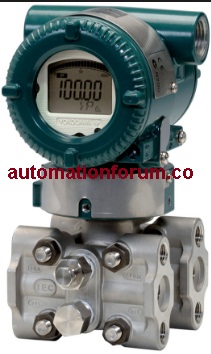
  • Differential Pressure Transmitter convert pressure measurements into a proportional 4-20 mA or a 1 – 5 Vdc output signal that functions as the input to a controller, recorder, indicator or similar device.
  • These transmitters find application in the gas, water, and process industries that require accurate measurements over a wide range of environmental conditions.

Theory of operation

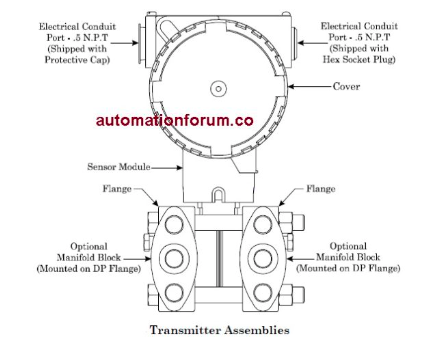
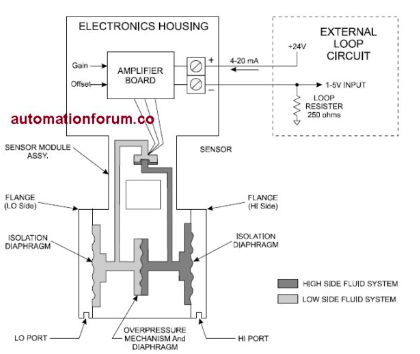
  • The main assemblies of the DP transmitter are the electronics housing, sensor module and process flanges as noted in Figure. The electronics housing encloses the amplifier board and the field wiring terminals as shown in the schematic of Figure.
  • The sensor module contains the pressure sensor, two sealed fluid systems, an over pressure diaphragm, and two isolation diaphragms. The flanges provide the HI and LO port connections and also function as the outer wall of the pressure input chambers
  • The electronic pressure sensor located at the upper part of the sensor module is mounted on a micro diaphragm that serves as a divider between the two fluid systems.
  • One fluid system corresponds to the HI pressure input, and the other to the LO pressure input.
  • The isolation diaphragm of each system isolates the fluid system from the input pressure. When a differential pressure is applied across the HI and LO ports, both isolation diaphragms will compress or retract in response to the change of differential.
  • The movement of these diaphragms causes similar pressure changes in each of the sealed fluid systems that are detected by the sensor.
  • If the differential pressure applied to the HI-LO ports accidentally exceeds the upper limits of the transmitter, an overpressure diaphragm mechanism takes control of the situation. The action of this mechanism prevents the overpressure from reaching the sensor, thereby minimizing the risk of damage
  • Implanted on the sensor’s micro-machined surface are four strain gauge resistors connected in a bridge configuration. This circuit, which is powered by a constant current supply on the amplifier board, produces a mill volt output that is equal to the difference between the two pressure inputs.
  • The output of the sensor circuit is wired to a high-gain, linear amplifier that converts the millivolt signals to a 4-20 mA current output. Figure shows the transmitter output wired to a typical external loop circuit. This circuit uses a 250-ohm load resistor and a 24 Vdc power source.
  • The 4-20 mA amplifier current flowing through the load resistor produces a1-5 V input signal for the external device. The amplifier circuit includes a fine-gain and fine-offset potentiometer for performing minor calibration adjustments. Transmitters also include internal coarse zero and coarse span switches for more extensive range conversion.

Do you want to know more about:

Differential pressure transmitter calibration procedure 

Capacitive type Humidity measurement

0
capacitive-humidity-sensor

Capacitance is one of the most common forms of humidity measurement. Humidity sensors are typically used in building controls. The most effective location for a wall mounted sensor is near the return air duct, where the air leaving the room has the best averaged humidity.

Principle:

Capacitive Humidity instrument uses the principle of capacitance equation

C – capacitance
E – Permittivity of dielectric material between plates.
A – overlapping area of plates
d – Distance between plates


Operation:


Humidity measurement is performed by exposing the dielectric to the moisture in the air. The moisture changes the relative capacitance between the two electrodes, which can be measured.

The dielectric material is the single most important factor affecting the performance of capacitive humidity sensors. Other factors are the processing conditions, the sensor structure and the properties of the water permeable electrode or electrodes.

capacitive-humidity-sensor

Electrodes:

The top electrode are made water permeable. The water permeable top electrode was originally thin gold film, but advances in technology have seen a cracked chromium film now used. Porous metal films is another emerging technology that only allows water to permeate the film, excluding alcohols. This feature improves the stability of the
sensor particularly in applications involving vapours, other than water vapour. This technology also enables an ultra-fast response.

A conductive aluminium base material is typically used as the bottom electrode.

Dielectric:

Aluminium oxide is commonly used as the dielectric medium. Doping of the aluminium oxide may be done with lithium chloride to give a greater operating range, typically down to -70 oC. The use of lithium chloride also requires that the device be individually calibrated, and slows the response.

Advantages:

  • Wide range of sensing
  • Small size

Disadvantages:

  • Non linear
  • Require periodic calibration
  • Not highly accurate


Selection of a pressure gauge

0

Definition

A pressure gauge is a mechanical instrument.  It is designed to measure the internal pressure, vacuum of a vessel or system. There is lots of variety of pressure gauges in the market according to size, styles.

Principles of Operation

Bourdon tubes are the main pressure sensing element used in most of the pressure gauges

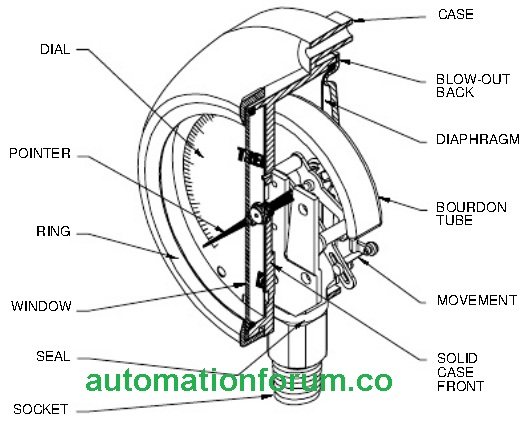
When the pressure is applied to Bourdon tube (sensing element), it flexes and the resulting motion is transmitted as a measurement through a mechanical movement that we can see at the dial face.


Selection of a pressure gauge

Case

Cases are available in a wide variety of materials and configurations. The combination of material and configuration is generally determined by the demands of the application, as well as the interest of the gauge purchaser.

If the pressure gauge is purchased for a severe environment rugged the case construction will be.

Wetted Parts and Pressure Medium

Under normal operating conditions, only the tube and socket assembly (Wetted Parts) of a pressure gauge will come into contact with the fluid being measured(Pressure Medium). The selection of the assembly will be determined by the composition of the medium. Air, gas, steam, water and other non corrosive media are usually satisfied by a bronze or brass bourdon tube and brass socket assembly. Stainless steel or Monel wetted parts are used when the medium contains corrosive elements or when high operating pressures or temperatures will be encountered

Connection and Mounting

The socket connection provides an entrance port for the process medium as well as a means to mount the gauge to a pipeline or vessel. Male connections can be provided with NPT, BSPT, or other thread styles, in sizes from 1/ 8″ through1 / 2″.

Window and Ring

The window provides a means for viewing the measurement, as well as protection of the dial face and pointer of the instrument, and is normally held in place by a ring, which is screwed or snapped to the case of the gauge. Plastic, clear glass and laminated glass are common window materials. Ring styles include threaded, bayonet, friction, crimped and hinged, depending upon the case type.

Pointer

There are essentially three types of pointers available on Pressure Gauges:

  • Micro-adjustable pointer (providing high quality and accuracy)
  • Friction-type pointer (providing adjustability and durability)
  • Plain, non-adjustable pointer (providing economic reliability).

Measurement Range and Dial

The maximum operating pressure of the application should not exceed 75% of the measurement range selected. Therefore, the specified range should be twice the normal operating point of the gauge to avoid damage to the gauge internals. A wide variety of measurement ranges is available, from 30″ Hg vacuum through 20,000psi pressure. Ranges are indelibly presented in black figures and markings upon a white dial face.

Environmental Conditions

Pressure gauge selection will be influenced by the environmental conditions under which the gauge is expected to perform. Condensation or waterproofing concerns can be addressed through the use of hermetically sealed or weatherproofed gauges. Case construction should be considered when selecting a gauge to be used in conditions of extreme or sustained heat or cold, or where the atmospheric environment may contain corrosive elements.

Liquid Filling

Liquid filling (glycerin, silicone or other fills) can prolong the life of a pressure gauge by minimizing wear on the gauge internals resulting from vibration or oscillation. Liquid filling also acts as a permanent lubricant to the moving parts of the instrument.

Do you want to know about  Basics of Pressure Scales ,How to calibrate a Pressure gauge 

What is TORBAR?

0

Introduction

The TORBAR is a multi port self-averaging flow meter. Its designs is similar to the pitot tube (which is used for fluid flow measurement). Many industries have been used TORBAR since 1985

How TORBAR Works

According to the flow rate in the pipeline Torbar produces a differential pressure i.e. proportional to the square of flow rate.

 TORBAR produces an averaged differential pressure (DP) signal proportional to the square of the flow rate. The DP output is piped to a DP transmitter in order to generate an electrical signal (ma) prop. to flow. We can also connect a DP transmitter to TORBAR with the help of manifold valve (3 way).

Construction

  • Outer impact tube – ONE PIECE CONSTRUCTION
  • Head
  • Internal averaging tube
  • Low pressure chamber

  • There are number of pressure sensing holes situated in the outer impact tube, facing upstream which are positioned at equal annular points in accordance with a log-linear distribution.
  • The total pressure developed in the torbar is averaged 2 times.
  • The “total pressures” developed at each upstream hole by the impact of the flowing medium are firstly averaged within the outer impact tube and then to a second order (and more accurately) averaged within the internal averaging tube. This pressure is represented at the head as the high pressure component of the DP output.
  • At the downside of the outer impact tube, the low pressure component is sensed by a single hole.

Features and Benefits 

  • Optional direct mounting transmitter arrangement
  • Low permanent pressure loss means low energy consumption – and significant cost benefits
  • Low installation costs
  • Long term accuracy
  • Low maintenance costs

Applications

  • Oil production (onshore, offshore)
  • Oil refining
  • Chemical
  • Pharmaceutical
  • Power generation