Home Blog Page 220

Working of Pneumatic differential pressure transmitters

0

Pneumatic Differential Pressure transmitter

Pneumatic differential pressure transmitter are designed for measuring the pressure, differential pressure or level of liquids, steam, gas or air. The measured value is transmitted as 3 to 15 psi pneumatic signal to remotely mounted receiving equipment such as recorders, indicators or controllers or combinations of these items.

Principle of Operation

The system is depicted schematically in figure.Referring to the diagram, a pressure or a differential pressure is applied across the bellows capsule; this generates a force at the capsule in the direction of the arrow “A”, and which is applied to the lower end of the transmission bar. This force produces a moment relative to the fulcrum point (fulcrum diaphragm) and thus a moment of the force beam about the fulcrum. This movement, in the direction of the arrow at “B” varies the distance of the flapper,controlled from the upper end of the force beam, relative to the nozzle.

PT

Air is supplied to the nozzle via a fixed restriction orifice and discharges to the atmosphere through the flapper nozzle gap and variations of this gap determine the back pressure value at the nozzle. The nozzle back pressure is sensed by the relay diaphragm which positions the double valve in the relay to allow supply air into the output system of relay. The output pressure from the relay is fed to the feedback bellows (and to the receiving equipment) the pressure rising until the bellows force balances that of the bellows capsule; at this point equilibrium is attained and the output pressure is proportional to and thus representative of the pressure at the measuring unit.

A reduction of the pressure value as sensed by the measuring unit bellows capsule will initiate a train of events in the opposite direction to that given above. As the pressure falls so the flapper nozzle gap widens because of imbalance of the forces on the force bar. To increase of the flapper nozzle gap causes the output pressure to fall reducing as it does so the bellows feedback force on the force bar until equilibrium is again achieved.

The revised output signal will again be proportional to the reduced pressure value.As the flapper movement necessary to vary the output pressure throughout its ranges is only 0.0003 inches (0.005 mm) the force beam remains in a substantially constant position and thus output varies in proportion to the applied forces and thus to the applied pressure.

The measurement span of the transmitter may be varied by positioning the span rider on the feedback beam. This varies the point at which the feedback force is applied to the force bar and thus the feedback movement of the bellows. As the rider is moved away from the fulcrum point to will the effect of the feedback bellows force increase thus the measurement span increases as the span rider is moved upwards along the feedback beam.

Procedure to remove Capsule Assembly from pressure transmitter

0

Introduction

One of the pressure detectors used in the pressure transmitters are capsules .Due to the continuous working there is a chance for damaging the capsule.This section describes the procedures for cleaning and replacing the capsule assembly.

Removing the Capsule Assembly

1) Remove the CPU assembly as shown in figure.

2) Remove the two setscrews that connect the transmitter section and pressure-detector section.

3) Remove the hexagon-head screw and the stopper.

4) Separate the transmitter section and pressure detector section.

5) Remove the nuts from the four flange bolts.

6) While supporting the capsule assembly with one hand, remove the cover flange.

7) Remove the capsule .

8) Clean the capsule or replace with a new one.


 Reassembling the Capsule Assembly

1) Insert the capsule assembly between the flange bolts, paying close attention to the relative positions of the H (high pressure side) and L (low pressure side) marks on the capsule assembly. Replace the two capsule gaskets with new gaskets.

2) Install the cover flange on the high pressure side, and use a torque wrench to tighten the four nuts uniformly to a torque shown below.

3) After the pressure-detector section has been reassembled, a leak test must be performed to verify that there are no pressure leaks.

4) Reattach the transmitter section to the pressure-detector section. Reattach the stopper with the hexagon-head
screw.

5) Tighten the two setscrews. (Tighten the screws to a torque of 1.5 N·m)

6) Install the CPU assembly according to the figure

7) After completing reassembly, adjust the zero point and recheck the parameters

Basics of Needle valves

0

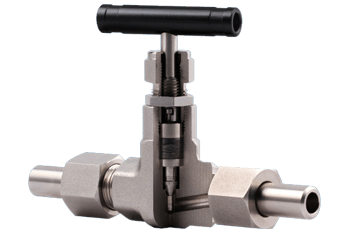
Small sizes of globe valves fitted with a finely tapered plug are known as needle valves. Needle valves are used to control the flow precisely. Needle valves are used in food industries, pharmaceutical industries where precision is important. Needle valves are also used in some components of automatic combustion control systems where very precise flow regulation is necessary.

Design of Needle valves:

The working of the needle valve is similar to the working of the globe valve. When the valve is actuated to open the needle plug will perpendicularly move away from the seat. To close the valve the needle will get seated in the opening perfectly. As the plug is needle-shaped the valve can provide much precise throttling positions. This description also applies to any type of valve incorporating a tapered needle having axial movement relative to the axis of a concentric orifice and thus controlling the effective opening of the orifice.

One type of body design for a needle valve is the bar stock body. Bar stock bodies are common, and, in globe types, a ball swivelling in the stem provides the necessary rotation for seating without damage. The bar stock body is illustrated in Figure:

Three basic configurations are shown in Figure 1: (A) is a simple screw-down valve; (B) is an oblique version, offering a more direct flow path: (C) is another form where the controlled outlet flow is at right angles to the main flow.In these basic versions, a threaded needle is shown, the thread itself acting as a seal to eliminate leakage past the needle. This is normally quite satisfactory in very small sizes or needle, although a more leak-tight arrangement is to mount the needle in an externally threaded end piece (D).

This end piece can also act as a grip for adjustment of the needle. Sealing, in this case, can be further improved if necessary by incorporating an internal seal. such as a 0-ring. The other common form of the needle valve is the float-controlled, carburettor-type valve.


Applications:

  • Automatic combustion control systems
  • Used in pharmaceutical and food industries.
  • For precise flow regulation is necessary.
  • Most constant pressure pump governors have needle valves to minimize the effects of fluctuations in pump discharge pressure.
  • Used in situations where the flow must be gradually halted
  • Needle valves can also be used for precise throttling service.


Procedure to set the range of the pressure transmitter

0

Setting the Range Using the Range-setting Switch

When pressure is applied to the transmitter, the low and high-limit values for the measurement range (LRV and URV) can be changed (re-ranged) using the range-setting switch (push-button) located on the optional integral indicator plate and the external zero adjustment screw. This procedure does not require use of the communicator. However,
changes in the scale range and engineering unit display settings for the integral indicator require use of the communicator. Follow the procedure below to change the LRV and URV settings.In this session we are going to discuss about how to set the range of the pressure transmitter

In this session we are discussing about yokagawa pressure transmitter ,For different transmitters the procedure will be little bit different


Example-Re-range LRV to 0 and URV to 3 MPa.

Procedure

1) Connect the transmitter and apparatus as shown in  and warm it up for at least five minutes.

2) Press the range-setting push-button. The integral indicator then displays “LRV.SET.”

3) Apply a pressure of 0 kPa (atmospheric pressure) to the transmitter.

4)  Turn the external zero-adjustment screw in the desired direction.                                                                                                  The integral indicator displays the output signal in %.

5) Adjust the output signal to 0% (1 V DC) by rotating the external zero-adjustment screw. Doing so completes the LRV setting.

6) Press the range-setting push-button. The integral indicator then displays “URV.SET.”

7) Apply a pressure of 3 MPa to the transmitter.

8) Turn the external zero-adjustment screw in the desired direction. The integral indicator displays the output signal in %.
9) Adjust the output signal to 100% (5 V DC) by rotating the external zero-adjustment screw. Doing so completes the URV setting.

10) Press the range-setting push-button. The transmitter then switches back to the normal operation mode with the measurement range of 0 to 3 MPa.

How to introduce a pressure transmitter into the process

0

Introduction

In this session we are going to discuss about how to introduce a pressure transmitter into the process.Follow the procedures below to introduce process pressure into the impulse piping and transmitter.

 Differential Pressure Transmitters

1) Open the low pressure and high pressure tap valves to fill the impulse piping with process liquid.
2) Slowly open the high pressure stop valve to fill the transmitter pressure-detector section with process liquid.
3) Close the high pressure stop valve.
4) Gradually open the low pressure stop valve and completely fill the transmitter pressure-detector section with process liquid.
5) Close the low pressure stop valve.
6) Gradually open the high pressure stop valve. At this time, equal pressure is applied to the low and high pressure sides of the transmitter.
7) Check that there are no liquid leaks in the impulse piping, 3-valve manifold, transmitter, or other components.

Gauge/Absolute Pressure Transmitters

1) Open the tap valve (main valve) to fill the impulse piping with process fluid.
2) Gradually open the stop valve to introduce process fluid into the transmitter pressure-detector section.
3) Confirm that there is no pressure leak in the impulse piping, transmitter, or other components.

Hey! do you want know about the calibration procedure of pressure transmitter?

Basics of Pinch valves

0

A pinch valve is a simplest valve design. It is a linear motion valve that is used to start, regulate and stop fluid flow. It uses a rubber tube (pinch tube) to control the fluid. Pinch valves are ideally suited for the handling of slurries, liquids with large amounts of suspended solids, and systems that convey solids pneumatically.


Construction and Working:

Pinch valve consists of a length of the elastomeric tube fitted with a pinch bar mechanism incorporating a closure stop to prevent over-pinching of the tube. More usually the moulded rubber tube is housed in a metal body which also incorporates the pinching mechanism

The working element of a pinch valve, also known as a clamp valve, is an elastomeric tube or sleeve which can be squeezed at its mid-section by some mechanical system until ultimately the tube walls are pinched or clamped together producing full closure of the flow path.


The pinch is applied only to one side of the tube, or a differential screw controlling two pinching mechanisms working in vertical opposition. The latter produces lower-stress working of the tube. With a regulated fluid pressure, the valve may be used for throttling as well as shut-off (full closure).

The particular advantage of the fluid-operated pinch valve is that it will still close tight over entrapped solids, making it particularly suitable for handling products with solids in suspension.

Pinch valves with mechanical pinching mechanisms are normally operated by a handwheel and screw mechanism. but may equally well be driven by a powered actuator in larger sizes

Advantages:

  • Suited for handling slurries and liquid with large amount of suspended solids
  • Can be used for corrosive fluids
  • Low maintenance
  • The flow path is straight without any crevice

Disadvantages:

  • Cannot be used in high pressure/ temperature application
  • Cannot be used for gases


Impulse Piping Installation Precautions

0

Impulse Piping Installation Precautions

The impulse piping that connects the process outputs to the transmitter must convey the process pressure accurately. If, for example, gas collects in a liquid filled impulse piping, or the drain of a gas-filled impulse piping becomes plugged, the impulse piping will not convey the pressure accurately. Since this will cause errors in the measurement output, select the proper piping method for the process fluid (gas, liquid, or steam).In this session we are gonna discuss about Impulse Piping Installation

 Connecting Impulse Piping to the Transmitter

(1) Check the High and Low Pressure Connections on the Transmitter 

Symbols “H” and “L” are shown on a capsule assembly to indicate high and low pressure side. Connect the impulse piping to the “H” side, and the low impulse piping to the “L” side.

(2) Changing the Process Connector Piping Connections 

The impulse piping connection distances can be changed between 51 mm, 54 mm and 57 mm by changing the orientation of the process connectors. This is convenient for aligning the impulse piping with the process connectors when connecting the piping.

(3) Tightening the Process Connector Mounting Bolts

After connecting the piping, tighten the process connector mounting bolts uniformly.

(4) Connecting the Transmitter and 3-Valve Manifold

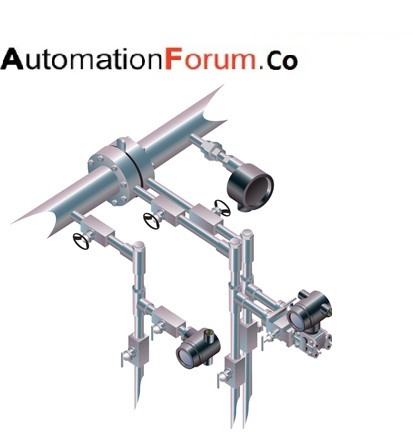
A 3-valve manifold consists of two stop valves to block process pressure and an equalizing valve to equalize the pressures on the high and low pressure sides of the transmitter. Such a manifold makes it easier to disconnect the transmitter from the impulse piping, and is convenient when adjusting the transmitter zero point.

There are two types of 3-valve manifold mounting techniques:

1] The pipe mounting type.

2] The direct-mounting type.

care should be taken with respect to the following points when connecting the manifold to the transmitter

Manifold valve mounting techniques

0

Introduction

There are two ways to mount a 3-way manifold valve mounting techniques:

1] The pipe mounting type 

2] The direct-mounting type

in this session we are going to discuss about Manifold valve mounting techniques

Pipe-Mounting Type 3-Valve Manifold

1) Screw nipples into the connection ports on the transmitter side of the 3-valve manifold, and into the impulse piping connecting ports on the process connectors. (To maintain proper sealing, wind sealing tape around the nipple threads.)

2) Mount the 3-valve manifold on the 50 mm (2-inch) pipe by fastening a U-bolt to its mounting bracket. Tighten the U-bolt nuts only lightly at this time.

3) Install the pipe assemblies between the 3-valve manifold and the process connectors and lightly tighten the ball head lock nuts. (The ball-shaped ends of the pipes must be handled carefully, since they will not seal properly if the ball surface is scratched or otherwise damaged.)

4) Now tighten the nuts and bolts securely in the following sequence: Process connector bolts ? transmitter-end ball head lock nuts ? 3-valve manifold ball head lock nuts ? 3-valve manifold mounting bracket U-bolt nuts


Direct-Mounting Type 3-Valve Manifold

1) Mount the 3-valve manifold on the transmitter. (When mounting, use the two gaskets and the four bolts provided with the 3-valve manifold. Tighten the bolts evenly.)

2) Mount the process connectors and gaskets on the top of the 3-valve manifold (the side on which the impulse piping will be connected).

Vibration fork point level switch

0

Vibration sensing is only suitable for point measurement. The vibration switch working principle is based upon detecting the change in harmonic vibration frequency of the sensing element as a result of the presence of the target media.

Working:


The vibration switch consists of an oscillating or tuning fork which is made to resonate in the air. The turning fork is installed in the tank at a level which the level is to be sensed. The electrically simulated vibration fork vibrated at a particular frequency. The resonance of the fork is caused by the piezoelectric crystal. Another piezoelectric crystal measures the frequency of the vibration.

When the level of liquid in the tank increases the fork will be covered by liquid. The resonance frequency will be reduced when the fork is brought into contact with the product because the dambing effect is produced. The change in resonance frequency is measured by the piezoelectric sensors and which is amplified to measure.


The change in measure activates alarming systems. The type of fork used and its resonant frequency depends on the material to be measured.

Advantages:

  • Wide range of applications
  •  Inexpensive
  • No adjustment or maintenance required

Disadvantages:

  • Grain limited to 10mm in size
  • Same limitation for particles suspended in liquids
  • Vibration level switches are limited to point or level detection

What is a 4-20 mA Current Loop?

0

Introduction

Before the age of electronic circuitry the whole process is controlled by mechanically.Facilities used pneumatic control signals where controllers were powered by varying pressures of compressed air.The 3 -15psi standard became the standard.Easier to differentiate a live zero (3 psi) signal from a failure in the system (0 psi).In the 1950s, as electronic systems became less expensive, current input became the preferred and more efficient process control signal. The 4-20 mA range later became the standard for similar reasons as 3-15 psi did.

What is a 4-20 mA Current Loop?

Consider the simple DC circuit below, consisting of a power supply and three loads. with the voltage of the supply labeled as Vtotal.

Current then flows through the loop, passing through each load. The voltage drop at each load can be calculated from Ohm’s Law. The voltage drop V1 across R1 is:

V1 = I x R1

Every element in the loop either provides voltage or has a voltage drop.

However, the current, I is the same everywhere in the loop. This is the critical principle of the 4-20 mA loop. Current is the same in all places throughout the loop. This is why using current as a means of conveying process information is so reliable.

Why Use a Current Loop?

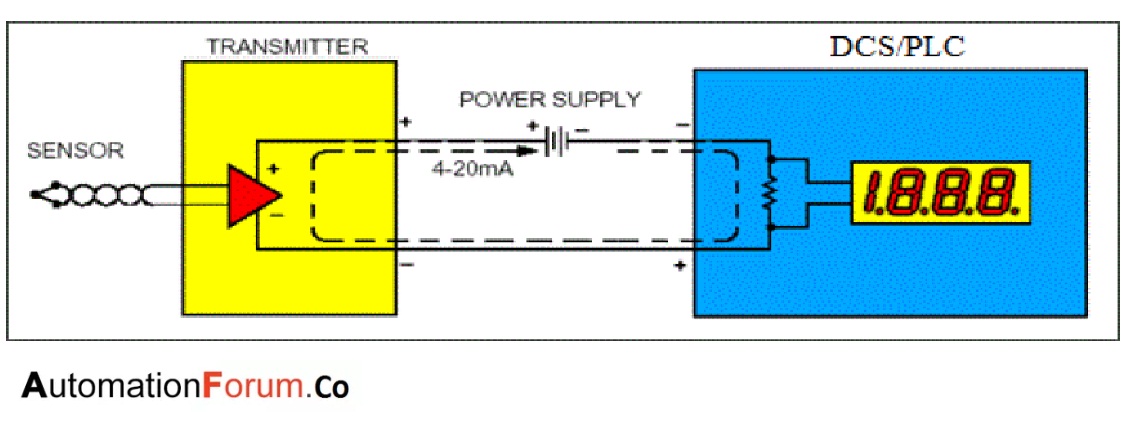
The 4-20mA current loop shown in Figure  is a common method of transmitting sensor information in many industrial process-monitoring applications. A sensor is a device used to measure physical parameters such as temperature, pressure, speed, liquid flow rates, etc.

Transmitting sensor information via a current loop is particularly useful when the information has to be sent to a remote location over long distances (1000 feet, or more). The loop’s operation is straightforward: a sensor’s output voltage is first converted to a proportional current, with 4mA normally representing the sensor’s zero-level output, and 20mA representing the sensor’s full-scale output. Then, a receiver at the remote end converts the 4-20mA current back into a voltage which in turn can be further processed by a computer or display module.

Advantages of 4 -20 ma signals

The 4-20 mA current loop is the dominant standard in many industries.

  • It is the simple
  • reduce initial setup cost
  • It uses less wiring and connections than other signals
  • signal will not loss during long distance transmissions like voltages
  • It is less sensitive to background electrical noise.
  • Since 4 mA is equal to 0% output, it is incredibly simple to detect a fault in the system.

Disadvantages of 4 -20 ma signals

  • Current loops can only transmit one particular process signal.
  • Multiple loops must be created in situations where there are numerous process variables that require transmission.
  • Running so much wire could lead to problems with ground loops if independent loops are not properly isolated. These isolation requirements become exponentially more complicated as the number of loops increases.