Home Blog Page 222

Coriolis mass flowmeter basics

0

Coriolis flowmeters are mass flowmeters, which measure the mass of fluid passing through a pipeline unlike the other volumetric flow meters, which measures the volume of the fluid passing through the pipeline. Coriolis mass flowmeter provides direct, in-line and accurate mass flow measurements that are independent of temperature, pressure, viscosity and density. Mass flow, density and temperature can be accessed from the one sensor. They can also be used for almost any application when calibrated.

Principle of Coriolis mass flowmeter:

When a fluid flows into a pipe and is accelerated by Coriolis by mechanically inserting apparent rotation into the pipe, The amount of deflective force generated by the inertial effect of Coriolis will depend on the fluid’s mass flow rate. If a pipe rotates around a point while the liquid flows through it (toward or away from the centre of rotation), the fluid can produce an inertial force (acting on the pipe) at the right angles to the flow direction.

The basis of the Coriolis meter is Newtons’ Second Law of Motion, where:

Force = Mass x Acceleration

The conventional way to measure the mass of an object is to weigh it. In weighing, the force is measured with a known acceleration (9.81m/sec2). This type of measuring principle is not easy or possible with fluids in motion, particularly in a pipe.

The Coriolis effect causes a retarding force on a rotating section of pipe when a flow is moving outward, conversely producing an advance on the section of pipe for flow moving towards the axis of rotation.


Coriolis flowmeter Construction and working:

Coriolis effect is the principle used to determine the acceleration due to the torque (the amount of twisting). Sensors are used to measure the amount of twist in the flow tubes within the meter as a result of the flow tube vibration and deflection due to the mass flow. The amount of twist measured is proportional to the mass flow rate and is measured by magnetic sensors mounted on the tubes.

The flow through the pipe is separated to flow through two different pipelines in Coriolis flowmeter. The fluid entering the tubes generates oscillation and vibration in a tube at their resonant frequency and sensors are used to detect the movement of the pipe.

When there is no flow, the sensor output for both the tubes will be in same phase. when liquid flows there is a difference between the oscillations of the two pipes. This is caused as the flow is accelerated on the inlet and decelerated on the outlet. The pipes twists, there will be a phase difference in oscillation of two pipes, this difference in the phase of the oscillations is proportional to mass flow.

Tube Design of Coriolis flowmeter:

A tube can be curved or straight, and when placed vertically certain designs can also be self-draining. When the design consists of two parallel channels, the flow is separated into two streams by a splitter at the inlet of the meter and recombined at the outlet. The flow inside the meter is not broken in the single continuous tube configuration (or in two series tubes). Which are illustrated in the below picture:

In either case, the tubes are vibrated by passengers. Such motors are a wire attached to one tube and a magnet connected to the other. The transmitter applies an alternating current to the wire, which draws and repels the magnet by degrees, pulling the tubes to and away from each other.

The sensor will sense the tubes ‘ location, distance, or acceleration.

Applications & Advantages:

Coriolis Mass flowmeters can measure the flow of all liquids, both Newtonian and non-Newtonian, as well as relatively dense gases. For sanitary applications that satisfy clean-in-place criteria, self-draining designs are available.

Some meters are equipped with circuits that are intrinsically safe between the flow tube and the transmitter. Therefore, there is a limited amount of moving force that can be supplied to the flow pipeline.

  • Direct, in-line mass flow measurement.
  • Independent of temperature, pressure, density, conductivity and viscosity.
  • Sensor capable of transmitting mass flow, density and temperature information.
  • High-density capability.
  • Conductivity independent.
  • Suitable for hydrocarbon measurements.
  • Suitable for density measurement.

Disadvantages:

  • Cost.
  • Affected by vibration.
  • Installation costs.
  • Adjustment of zero point

what are ball valves?

0

Introduction

A ball valve is a rotational motion valve .The ball consists of a ball shaped disk .this ball shape disk rotates to stop or start flow. The ball has a hole, or port, through the middle so that when the port is in line with both ends of the valve, flow will occur.The ball performs the same function as the disk in the globe valve.

Working principle

When the valve handle is turned to open the valve, the ball rotates to a point where the hole through the ball is in line with the valve body inlet and outlet. When the valve is shut, the ball is rotated so that the hole is perpendicular to the flow openings of the valve body and the flow is stopped. Most ball valve actuators are of the quick-acting type, which require a 90° turn of the valve handle to operate the valve.

Other ball valve actuators are planetary gear-operated. This type of gearing allows the use of a relatively small hand wheel and operating force to operate a fairly large valve. Some ball valves have been developed with a spherical surface coated plug that is off to one side in the open position and rotates into the flow passage until it blocks the flow path completely. Seating is accomplished by the eccentric movement of the plug. The valve requires no lubrication and can be used for throttling service

The body of ball valves may be made of metal, plastic or metal with a ceramic center. from the point of sealing, the concept of the ball valve is excellent. Ball valves for manual control are therefore best suited for stopping and starting flow and moderate throttling. If flow control is automatic, the ball is continuously on the move, thus keeping this failure from normally occurring. Because the ball moves across the seats with a wiping motion, ball valves will handle fluids with solids in suspension

Ball Valve Stem Design

The stem in a ball valve is not fastened to the ball. It normally has a rectangular portion at the ball end which fits into a slot cut into the ball. The enlargement permits rotation of the ball as the stem is turned

Advantages

A ball valve is generally the least expensive of any valve configuration and has low maintenance costs. In addition to quick, quarter turn on-off operation, ball valves are compact, require no lubrication, and give tight sealing with low torque.

Disadvantages

Conventional ball valves have relatively poor throttling characteristics. In a throttling position, the partially exposed seat rapidly erodes because of the impingement of high velocity flow

How a Globe valve works?


Basics of Control Valves and Parts of Control Valve

How a Globe valve works?

0

Introduction

A globe valve is a linear motion control valve. With globe valves we can start, stop and regulate the flow of fluid. The globe valve disk can be totally removed from the flow path or it can completely close the flow path.

Working principle


When the valve is actuated to open the disk will perpendicularly move away from the seat. When compared to a gate valve, a globe valve generally yields much less seat leakage. This is because the disk-to-seat ring contact is more at right angles, which permits the force of closing to tightly seat the disk.

Globe valves can be arranged so that the disk closes against or in the same direction of fluid flow. When the disk closes against the direction of flow, the kinetic energy of the fluid impedes closing but aids opening of the valve. When the disk closes in the same direction of flow, the kinetic energy of the fluid aids closing but impedes opening. This characteristic is preferable to other designs when quick-acting stop valves are necessary.


Globe body Valve designs

       1.  Z-Body Design

  • The simplest design
  •  Most common for water applications
  • A symmetrical form that simplifies manufacture, installation, and repair.

        2. Y-Body Design

  • This design is a remedy for the high pressure drop inherent in globe valves.
  • The seat and stem are angled at approximately 45
  • The angle yields a straighter flow path (at full opening) and provides the stem, bonnet, and packing a relatively pressure-resistant envelope-body globe valves are best suited for high pressure and other severe services.
  • In small sizes for intermittent flows, the pressure loss may not be as important as the other considerations favoring the y-body design.

       3. Angle valve

  • Simple modification of basic globe valve
  • Both function as valve and piping elbow.
  • Fluid is able to flow through a single 90 degree turn


Disadvantages of Globe valves

  • The most evident shortcoming of the simple globe valve is the high head loss from two or more right angle turns of flowing fluid. Obstructions and discontinuities in the flow path lead to head loss. In a large high-pressure line, the fluid dynamic effects from pulsations, impacts, and pressure drops can damage trim, stem packing, and actuators
  • Large valve sizes require considerable power to operate
  • Especially noisy in high pressure applications.
  • Large openings necessary for disk assembly, heavier weight than other valves of the same flow rating, and the cantilevered mounting of the disk to the stem.


Do you want to know more about Basics of Control Valves and Parts of Control Valve

Control Valve positioners

0

A valve positioner is a final control device used to position the valve actuators correctly at the control position.  In applying a force to an actuator, there is no guarantee that the actuator is in the correct position. Positioners are used to feedback position information and ensure that the valve is in the correct position regardless of the opposing forces.

The purpose of the valve positioner is to improve the accuracy of the valve action. The positioner can reduce the effect of many dynamic variations. Positioners are used where rapid control is required without error.

Valve Positioner working:

For pneumatic control, the positioner attempts to put the valve into the correct position. The output of the control device is not related to the input signal, but relies on the positioner to achieve the correct valve position.


The performance of the positioner is dependent on the accuracy of the position feedback and linkage used. For critical control applications, the linkage needs to be more accurate and robust. Control pressures are generally 3 to 15 psi, but positioners can operate up to 100psi which provide a greater force and a stiffer action that is less sensitive to load changes. Although, high supply pressures can affect stroking response time.

The process controller tells the required position to the positioner, and the positioner senses the current position of the actuator and compares with the required setpoint. Then give the control action through the flapper-nozzle amplification system.

The 3-15 PSI signal from the I/P and using it as a command (setpoint) for valve stem position, applying as much or as little pressure to the diaphragm as necessary to achieve the desired stem position. The flapper nozzle is controlled by the 3-15 psi pressure signal, the valve actuator is stable at postion maintained by a spring. For higher control action as per the pneumatic signal flapper-nozzle opens and close, which give a corresponding pneumatic pressure to the diaphragm.

At an applied actuator pressure of 3 PSI, the diaphragm generates just enough force to exactly overcome the actuator spring’s pre-load force, but not enough force to actually move the plug off the seat.

There are different types of valve positioner based on the control methods used:

  • Force balance positioner
  • Motion balance positioner
  • Electro-pneumatic postioner
  • Digital to pneumatic positioner

Advantages:

  • Assist in overcoming friction.
  • Greater actuating pressures available
  • Accurate valve action
  • Feedback provided

Different types of Manometers

0

Introduction

There are variety of pressure sensing elements. Manometer is one of the pressure sensors used to sense very low level pressure scales.we are going to discuss about manometers in this session

The U Manometer

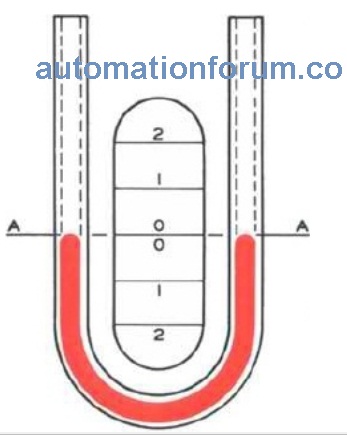
The manometer is a simple device to measure small amounts of pressure.  It consists of a glass tube of a fixed diameter.  It is bent into a U shape with (vertical) sides.  The sides are next to a scale.  The manometer is filled with a liquid, e.g. water or mercury.


  • Absolute Pressure

One side is sealed with a vacuum above the liquid in the manometer.  An unknown pressure is applied to the other side (limb) which forces the liquid down.  The difference in height (H) of the liquid column will give the unknown absolute pressure. 

For example, a 9 inch difference, with water as the liquid, will give an absolute pressure of 9 x 249.1 = 2242 Pa.

  • Gauge Pressure

One side is left open to the atmosphere.  An unknown pressure is applied to the other side.  This pressure will force the liquid in the tube down.  The height of the liquid gives the gauge pressure of the unknown pressure.

  • Differential Pressure

If unknown pressures are applied to both sides the difference in level (H) will give the difference (differential) between the two in absolute pressure.

Do you want to know more about different pressure scales

The Well Manometer

 The well manometer  is like the U tube manometer.  It is used to measure very low pressures.  The pressure is measured in inches of water (H2O).  This measurement is divided by the ratio of the areas A and B.  This gives the unknown pressure.  A single limb manometer in a workshop usually has its scale already calibrated to allow for the ratio of the areas A and B.  So, no calculations are required.

The Inclined Limb Manometer

The inclined limb manometer  is another device for measuring very low pressures.  The unknown pressure is applied to the well and the single limb is tilted.  This makes the scale longer so the pressure can be measured more accurately.  The actual pressure is the height, H.  No calculations are required as the scale is set by the manufacturer to give accurate readings

Dual tube Manometer 

 A dual tube manometer is a manometer that is designed to read very high pressures. A high pressure causes the need for a longer indicating tube, which is very inconvenient to the person reading the manometer. A dual-tube manometer solves this problem by having two tubes to read the pressure, a standard well-type manometer and a well-type manometer with the well at the 100-inch reading on the indicating tube.

Advantages of manometers

  • can read negative measurements.
  • compare 2 liquids.
  • simple construction.
  • Low cost hence easy to buy.

Disadvantages of manometers 

  • Fragile in construction
  • Very sensitive 

 To know more about Pressure measurement 

What are Open Loop & Closed Loop system

0

Introduction

There are two types of control systems namely Open Loop & Closed Loop system                                                         Open loop control systems are non-feedback control systems
  Closed loop control systems are feedback control systems

In this session we are going to discuss about Open Loop & Closed Loop systems

Open Loop (Manual Control)

Figure  shows what is called OPEN LOOP or MANUAL control.  The process is temperature control.  The indicator is a thermometer.  The correcting unit is the gas control valve.  The controller is the operator who uses his own judgement to keep the water temperature constant.

Manual control has its uses as it is cheap to install and maintain, and simple to operate.  However, it is very seldom used in industry because:

  • The operator must remain in position at all times.
  • It cannot be used if the operator is placed in a dangerous area.
  • The process changes faster than the operator can react.
  • A mistake by the operator can have dangerous results.

These problems are avoided by using automatic control (closed loop).  The job of the instrument technician is to make sure that this type of control operates correctly.

Modern household appliances now use automatic control to make work easier.  For example:-

  • Refrigerators and water heaters use automatic temperature control.
  • Washing machines use automatic heating and water control

Advantages

  • simple
  • stable
  • easy construction

Disadvantages

  • Inaccurate
  • unreliable
  • Remove the disturbances occurring from external sources.

To know more about Open-loop controller

Closed Loop (Automatic Control)

Figure  shows a simple automatic controller.  The boiler now has the loop closed and no operator is required.  The following items are added.

  • The temperature transmitter (T.T) which measures (senses) the temperature of the hot water and changes it to a standard signal.
  • A signal line from the transmitter to the controller, the signal may be either pneumatic or electrical.
  • A controller which keeps the temperature of the hot water at a position set by the operator (set point)
  • The controller adjusts the correcting unit (automatic control valve) using an output signal line similar to the input line from the transmitter.
  • The controller may provide alarm signals to alert the operator if the system fails. It may also shut off the gas if the water starts to boil.

Advantages

  • Accuracy
  • Noise reduction ability

Disadvantages:

  • complex  construction
  • reduces the overall gain of the system.
  • less Stable than open loop

To know more about closed loop

 Different types of process controls

Non-contact temperature measurement | Pyrometers

0
??????????????????????????????????????????????????????

Why to use Pyrometers or non-contacting type?

Non-contacting temperature meter or Pyrometers are used to measure temperature without any physical contact with temperature body. In many industrial application with a higher temperature range, where many other temperature meters and human can’t reach non-contacting type pyrometers are employed. They are especially suitable for measuring high temperatures that are beyond the capabilities of contact instruments such as thermocouples, resistance thermometers (RTD) and thermistors.

Principle of Pyrometer:

All objects emit electromagnetic radiation as a function of their temperature above absolute zero, and radiation thermometers (also known as radiation pyrometers) measure this radiation in order to calculate the temperature of the object. The total rate of radiation emission per second is given by

Types of Pyrometer:

There are mainly two types of pyrometers:

  • Optical pyrometer
  • Radiation pyrometer

Optical pyrometer:

The optical pyrometer is designed to measure temperatures, where the peak radiation emission is in the red part of the visible spectrum, i.e. where the measured body glows a certain shade of red according to the temperature. This limits the instrument to measuring temperatures above 600°C.

The instrument contains a heated tungsten filament within its optical system. The current in the filament is
increased until its colour is the same as the hot body: under these conditions the filament apparently disappears when viewed against the background of the hot body. Temperature measurement is therefore obtained in terms of the current flowing in the filament.

As the brightness of different materials at any particular temperature varies according to the emissivity of the material, the calibration of the optical pyrometer must be adjusted according to the emissivity of the target. Range of optical pyrometer is from 1000°C to 5000°C

Anatomy of Radiation thermometer:

Advantages of optical pyrometer:

  • Ability measure high temperature
  • Portable
  • Can be used to measure temperature of moving object
  • Fast response
  • Flexible

Disadvantages of Optical pyrometer:

  • Expensive
  • Emissivity error are introduced
  • Not useful measure continuous measurement

Radiation Pyrometer:

Radiation pyrometer described below have an optical system that is similar to that in the optical pyrometer and focuses the energy emitted from the measured body. However, they differ by omitting the filament and eyepiece and having instead an energy detector in the same focal plane as the eyepiece:

The size of objects measured by a radiation pyrometer is limited by the optical resolution, which is defined as the ratio of target size to distance. A good ratio is 1:300, and this would allow temperature measurement of a 1mm sized object at a range of 300 mm. With large distance/target size ratios, accurate aiming and focusing of the pyrometer at the target are essential.

It is now common to find ‘through the lens’ viewing provided in pyrometers, using a principle similar to SLR camera technology as focusing and orientating the instrument for visible light automatically focuses it for infrared light.

Advantages of radiation pyrometer:

  • Ability to measure high temperature
  • No need for contact
  • Moderate cost

Disadvantages of radiation pyrometer:

  • Non-linear scale
  • Emissivity of target affect measurement
  • Error due to interleaving media

Working of an Override Control  

0

Introduction

The override control concept is a technique by which process variables are kept with in certain limits, usually for     protective purposes. Override control maintains the process in operation but within and under safer conditions.  

Override control

To illustrate override control, consider the simple process shown in Figure

A hot, saturated liquid enters a process surge tank, and then it is then pumped into the process. Normally, the tank operates at the level shown, but if the level gets too low the liquid will not have enough net positive suction head (NPSH), and the pump will start to cavitate. Override control can provide protection; a scheme for this is shown in Figure below.

 The tank level is now controlled. The variable-speed pump will, of course, pump more liquid as the energy input to it increases. It follows that the flow controller must, therefore, be a reverse-acting controller (output increases as input decreases), and the level controller must be a direct-acting (output increases as input increases) controller. The output of each controller is connected to a low-level selector relay, and its output goes to the pump.

Under normal operating conditions, the actual level is above the set point of the level controller, and the level controller will attempt to speed up the pump. Normally, the output of the flow controller will be less, and the low-level selector relay will select the flow controller output to manipulate pump speed. If the flow of hot, saturated liquid slows down and the level drops, the level controller will try to slow down the pump by reducing its output. When the output of the level controller drops below the output of the flow controller, the low-level selector relay will select the output of the level controller to control the pump.

That is how the level controller “overrides” the flow controller. 

Do you want to know more about  How does a process control work?

How does a process control work?

0

Introduction.

Process control is the automatic control of an output variable by sensing the amplitude of the output parameter from the process and comparing it to the desired or set level and feeding an error signal back to control an input variable.

In order to produce a product with consistently high quality, tight process control is necessary.In any process there are a number of inputs, i.e., from chemicals to solid goods. These are manipulated in the process and a new chemical or component emerges at the output. The controlled inputs to the process and the measured output parameters from the process are called variables

Basics of process control.

Controlled or measured variable is the monitored output variable from a process. The value of the monitored output parameter is normally held within tight given limits.

Manipulated variable is the input variable or parameter to a process that is varied by a control signal from the processor to an actuator. By changing the input variable the value of the measured variable can be controlled.

Set point is the desired value of the output parameter or variable being monitored by a sensor. Any deviation from this value will generate an error signal.

 1. Sensor

Sensors are devices that can detect physical variables, such as temperature, light intensity, or motion, and have the ability to give a measurable output that varies in relation to the amplitude of the physical variable.sensors acquires information about the status of the process variables

Typical examples: thermocouples (for temperature measurements), differential Pressure cells (for liquid level measurements), gas/liquid chromatographs (for Composition measurement), etc.

2.Actuators

Actuators are devices that are used to control an input variable in response to a signal from a controller. A typical actuator will be a flow-control valve that can control the rate of flow of a fluid in proportion to the amplitude of an electrical signal from the controller. Other types of actuators are magnetic relays that turn electrical power on and off. Examples are actuators that control power to the fans and compressor in an air-conditioning system in response
to signals from the room temperature sensors.

ie Actuator implements the control command issued by the controller on the process.

3.Controller

The brain or heart of the control system (the decision maker). It is the hardware element with built-in capacity for performing the only task requiring some form of .intelligence. Typical examples: Pneumatic controller, Electronic controllers, digital computers used as controller

4.Feedback Control

The traditional way to control a process is to measure the variable that is to be controlled, compare its value with the desired value (the setpoint) at the controller and feed the difference (error) into a controller, which will change a manipulated variable to drive the controlled variable back to the desired value.

an example of a process control is given below

The importance of these components is that they perform the three basic operations that must be present in every control system. These operations are:

  1. Measurement (M): Measuring the variable to be controlled is usually done by the combination of sensor and transmitter.
  1. Decision (D): Based on the measurements and the set point, the controller must then decide what to do to maintain the variable at its desired value.
  1. Action (A): As the result of the controller.s decision, the system must then take an action. This is usually accomplished by the final control element.

 Different types of process controls 

Mechanical pressure transducers and elements

0

Mechanical Pressure transducers:

In general, transducers are devices which converts one form of energy into another form, a pressure transducer converts pressure into any other measurable form of energy. A mechanical pressure transmitter converts the pressure into mechanical displacement in the system.

Types of Pressure transducers:

  • Bourdon tube
  • Helix and spiral tubes
  • Spring and bellows
  • Diaphragm
  • Manometer

Bourdon tube:

The Bourdon tube works on a simple principle that a bent tube will change its shape when exposed to variations of internal and external pressure. As pressure is applied internally, the tube straightens and returns to its original form when the pressure is released.

The tip of the tube moves with the internal pressure change and is easily converted with a pointer onto a scale. A connector link is used to transfer the tip movement to the geared movement sector. The pointer is rotated through a toothed pinion by the geared sector.

Helix and Spiral Tubes:

Helix and spiral tubes are fabricated from the tubing into shapes as per their naming. With one end sealed, the pressure exerted on the tube causes the tube to straighten out. The amount of straightening or uncoiling is determined by the pressure applied.

The uncoiling part of the tube is mechanically linked to a pointer which indicates the applied pressure on a scale.
This has the added advantage over the C-bourdon tube as there are no movement losses due to links and levers.

Low-pressure elements have only two or three coils to sense the span of pressures required, however, high-pressure sensing may require up to 20 coils

Spring and Bellows:

A bellows is an expandable element and is made up of a series of folds which allow expansion. One end of the Bellows is fixed and the other moves in response to the applied pressure. A spring is used to oppose the applied force and a linkage connects the end of the bellows to a pointer for indication.

The spring is added to the bellows for more accurate measurement. The elastic action of the bellows by themselves is insufficient to precisely measure the force of the applied pressure.


Diaphragm:

Many pressure sensors depend on the deflection of a diaphragm for measurement. The diaphragm is a flexible disc, which can be either flat or with concentric corrugations and is made from sheet metal with high tolerance dimensions.

The diaphragm can be used as a means of isolating the process fluids, or for high-pressure applications. It is also useful in providing pressure measurement with electrical transducers.


Manometer:

The simplest form of a manometer is that of a U-shaped tube filled with liquid. The reference pressure and the pressure to be measured are applied to the open ends of the tube. If there is a difference in pressure, then the heights of the liquid on the two sides of the tube will be different.


Types of pressure gauges