The most common type of incremental encoder uses two output channels (A and B) to sense position.
Using two code tracks with sectors positioned 90 degrees out of phase, the two output channels of the quadrature encoder indicate both position and direction of rotation.
If A leads B, for example, the disk is rotating in a clockwise direction. If B leads A, then the disk is rotating in a counter-clockwise direction.
By monitoring both the number of pulses and the relative phase of signals A and B, you can track both the position and direction of rotation.
Some quadrature encoders also include a third output channel, called a zero or index or reference signal, which supplies a single pulse per revolution.
This single pulse is used for precise determination of a reference position.
Displacement Measurement – Quadrature Encoder
Displacement Measurement – Magnetic Encoder
A magnetic encoder consists of a rotating gear made of ferrous metal and a magnetic pick-up that contains a permanent magnet and the sensing element.
The gear, which is mounted on the rotating shaft, has precisely machined teeth that provide the code pattern. As the disk rotates, these teeth disturb the magnetic flux emitted by the permanent magnet, causing the flux field to expand and collapse. These changes in the field are sensed by the sensing element, which generates a corresponding digital or pulse signal output.
Two kinds of magnetic pick-ups exist:
Hall effect — pick-ups use a semi conducting sensing element that relies on the Hall effect to generate a pulse for every gear tooth that passes the pickup.
Variable reluctance — pick-ups use a simple coil of wire in the magnetic field. As the gear teeth pass by the pick-up and disturb the flux, they cause a change in the reluctance of the gear/magnet system. This induces a voltage pulse in the sensing coil that is proportional to the rate flux change.
Advantages of Magnetic Encoder
Compact
Low cost
Robust
Disadvantages of Magnetic Encoder
High latency time.Not good for high speed application.
Susceptible to EMC
Temperature drift
Limited resolution and accuracy
Displacement Measurement – Optical Encoder
Optical Encoder – Fundamentals
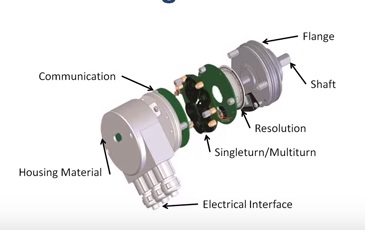
The most popular type of encoder is the optical encoder, which consists of a rotating disk, a light source, and a photodetector (light sensor).
The disk, which is mounted on the rotating shaft, has coded patterns of opaque and transparent sectors. As the disk rotates, these patterns interrupt the light emitted onto the photodetector, generating a digital or pulse signal output.
The encoding disk is made from:
Glass, for high-resolution applications (11 to >16 bits)
Plastic (Mylar) or metal, for applications requiring more
rugged construction (resolution of 8 to 10 bits)
Control Valve – How it works ? Components of Control Valve
Control Valve Basics
A control valve is simply a variable orifice that is used to regulate the flow of a process fluid according to the requirement of the process. They can throttle flow over a range of fully open to fully closed.Â
The control valve is normally used with an electric,pneumatic or hydraulic actuator for automatic or remote control .
Components of a Control Valve
Analytical Instrumentation – Terminology and Basics
Absorption – The “soaking up” of gas, liquids or dissolved substances into a solid material.
Acid – A chemical compound that dissociates in aqueous solution to form hydrogen ions; a proton donor that reacts with a base to form a salt.
Adsorption – The condensation of gas, liquids or dissolved substances on the surface of solids.
Aerobic Gas Mixture – Gas mixture containing oxygen; used for incubation of microorganisms that require oxygen for life.
Air – The mixture of gases that surrounds the earth. The composition of air is 78.08% nitrogen, 20.95% oxygen, 0.03% carbon dioxide, and 0.93% argon. Standard air has a density of 0.075 lb/ft 3 (1.2 kg/m 3 ) measured dry at 70°F (21°C) and 760 mm Hg pressure, M.W. 28.3.
Anaerobic Gas Mixture – A gas mixture containing no oxygen, used for incubation of microorganisms that do not require free oxygen for life.
Anhydrous – A descriptive term meaning without water.
Balance Gas – A gas used to “top off” a gas mixture after individual component gases at specified concentrations are added.
Base – A chemical compound that can react with an acid to form a salt.
Boiling Point – The temperature at which the vapor pressure of a liquid equals the atmospheric pressure (usually given at 760 mm Hg).
Calibration Gas – A gas of accurately known concentration that is used as a comparative standard in analytical instrumentation.
Carrier Gas – Pure gases or gas mixtures used to move a sample to be analyzed through the gas analysis system at an even rate and provide a zero reference (baseline) when a sample is not being detected.
CGA – Short for Compressed Gas Association, an association that recommends cylinder valve outlet connections for specific gas services based on safety considerations.
Compressed Gas – Any material or mixture having in the container either an absolute pressure exceeding 40 psia (3 bar) at 70°F (21°C) or an absolute pressure exceeding 104 psia (7 bar) at 130°F (54°C).
Compressed Gas in Solution – A non liquefied compressed gas that is dissolved in a solvent.
Corrosive – Gases that corrode material or tissue with which they come in contact, or do so in the presence of water, are classified as corrosive. It is essential that equipment used for handling corrosive gases be constructed of proper materials. Proper protective clothing and equipment must be used to minimize exposure to corrosive materials.
How to do pH Electrode Calibration ?
Calibration Procedure – pH electrodeÂ
Select two buffers that bracket the expected sample pH. More buffers can be used for greater accuracy over a wider pH range. For best accuracy, use buffers that are no more than 3 pH units apart.
Step by Step ProcedureÂ
1.Refer PH meter manual for specific details on operating your meter.
2.Remove the electrode and rinse it distilled water. Wipe the electrode with tissue paper to remove excess water and place electrode into the first buffer of pH 7.
3.Calibrate the meter to read the temperature corrected value of the first buffer.
4.Rinse the electrode as before and place in the second buffer.Wait for a stable reading.Calibrate the meter to read the temperature corrected value of the second buffer.
5.Rinse the electrode as before. Place the electrode in the sample and wait for a stable reading.Record the pH and temperature of your sample.
Tips for pH meter/Electrode calibration Â
1.Always use fresh pH buffers.
2.The electrode calibration slope should be 95-102%
3.Remove the electrode filling solution cover when measuring,to ensure a uniform flow of filling solution.
4.Between measurements,rinse the electrode with distilled water and then with the next sample to be measured.
5.Stir all buffers and samples consistently.
6.Place some insulating material between your stirrer and your sample to prevent heating of your sample.
7.Avoid rubbing or wiping electrode bulb.
8.Store your pH electrode properly.
pH meter Calibration ProcedureÂ
Simple Explanation of Construction and Working of LVDT
LVDT – Linear Variable Differential Transformer
LVDT is a passive transducer which measures displacement.
Construction and Working of LVDT.
LVDT consist of a single primary winding and two secondary wingdings.They are wound on a hollow cylindrical bobbin which is non-magnetic and insulating material.The secondary wingdings have equal number of turns and are identically placed on either side of the primary winding .
The primary winding is connected to an alternating current source.A movable soft iron core is placed inside the bobbin. The displacement to be measured is applied to the arm attached to the soft iron core.The rod is slotted longitudinally to reduce eddy current losses.
Since the primary winding is excited by an alternating current source,it produce an alternating magnetic field which in in turn induces alternating current voltages in the two secondary winding.
The differential output across the secondary winding can be measured by voltmeter.
How to Calibrat Temperature Switch ?
Temperature Switch Calibration (Step by Step By Procedure )
Following Precautions needs to be taken-
Use appropriate PPE.
 Isolate Temperature Switch from process.
Equipment required for TemperatureÂ
1.Temperature Bath
2.Switch Contact Monitoring DeviceÂ
Temperature Switch Calibration Procedure Â
1.Remove temperature sensor from process.
2.Connect test equipmentÂ
3.For high Temperature Switch (TSH ),place sensor in a calibrated bath/block test standard at a temperature below the specified trip point and allow to stabilize.
4.For low Temperature Switch (TSL ),place sensor in a calibrated bath/block test standard at a temperature above the specified trip point and allow to stabilize.
5.Slowly increase or decrease temperature to obtain trip point.
6. Slowly decrease or increase temperature to obtain reset point.
7.Repeat “X” times for repeatablyÂ
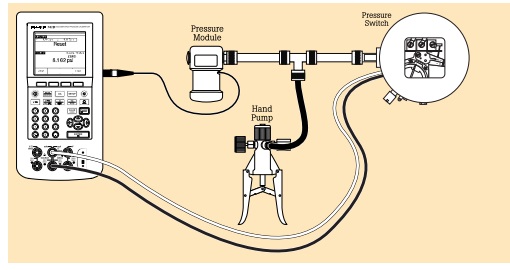
Step by Step Procedure For Pressure Switch Calibration
How to do Pressure Switch Calibration [Step by Step Procedure]
PrerequisitesÂ
1.Safety FirstÂ
-Please follow appropriate safety procedures as required by your company for the pressure range.
-Know the voltage to expect and confirmÂ
-Isolate and Depressurize line
2.Understand the switch configurationÂ
-Trip on decreasing or increasing
-NO or NC contact,Normal status
3. Orientation on test setupÂ
-Keep same orientation when testing pressure.Â
4. Dont change input too fast.
5. Avoid leaking in test connection
Equipment Required For CalibrationÂ
1.Pressure SourceÂ
2.Accurate Gauge
3.Micro switch contact monitoring device.
For high pressure application Hand pump is more suitable.
For low pressure shop air or simple regulated pressure can be used or electronic pressure source can be used.
Pressure should have an accuracy of 0.25 %.
Pressure Switch Calibration ProcedureÂ
1.First step of the calibration is to make sure the switch operating correctly. To test a switch give pressure from zero to full range of the switch.Then return back to zero.Repeat the step for 3 times.
2.To measure an increase in setpoint,start at 0 psi and increase the pressure to the setpoint ,the switch will actuate indicating the NO contact of the switch get closed.
3.To measure the deadband ,slowly decrease the pressure,the switch will actuate indicating switch NC contact is closed.Record the deadband.Â
4.To measure a decrease in setpoint,start at 0 psi and increase the pressure to full range.As the pressure increases the NO contact get closed. Then lower the pressure to reset point.Then NC contact becomes closed.
5.To measure the deadband slowly increase the pressure till the switch gets actuated .
Repeat the steps to verify repeatably.
You can do the adjustment in Pressure Switch as per manual.
Calibration Report Template Can be Downloaded from here.Â
Calibration Report / CertificateÂ
Following information must be present in Pressure Switch Calibration CertificateÂ
1.Unique instrument identifier .Eg: P&ID Tag
2.Mfg,Model,Serial Number,Location
3.Setpoint with units of pressure
4.Reset point (if necessary) or some some way to indicate “trip on increasing input”
5.NO or NC contactsÂ
6.Tolerance with units of measure
7.Test equipment used with unique identifier and next due date
8.As found and As left data
9.Results
10.Technician signature / Date
Â
What is Solenoid Valve ? How it works?
What is Solenoid Valve ? How it works ? Animation
Â
A solenoid is an electrical coil.When a battery is connected to the coil,a magnetic field is created.And pull the plunger or armature back.This opens the valve,allowing high pressure air to flow into the pneumatic cylinder.When the battery is disconnected,the plunger is pushed back closing the valve and blocking the flow of high pressure air,well letting the air flow out of the cylinder.
Read more Direct Acting Solenoid Valve