Home Blog Page 230

Tool to calculate Span and Input/Output relation of an Instrument Transmitter Using LRV and URVURV

0

Instrument Transmitter Span and Input/Output relation Calculator
This tool is used to calculate the Input and output relation from LRV and URV. How to use this tool?

You need the following information to calculate the Span and Input/Output relation.
LRV – Low Range Value.
URV – Upper Range Value.

What is LRV?

LRV stands for Low Range Value.
Let us take a Level transmitter as an example. LRV is the value shown by the transmitter when the level of the tank is zero and at this state the transmitter will give a 4 ma output.

What is URV?

URV stands for low range value. URV is the value show by the transmitter when the level of the tank is 100 % and at this state the transmitter will give a 20 ma output.

What is Span ?

Span is the algebraic difference between URV and LRV.

Span = URV – LRV.

What is Oxidation-Reduction Potential (ORP) ?

0
What is ORP (Oxidation – Reduction Potential) ?

ORP electrodes measure the voltage across a circuit formed by the measuring metal half cell and the reference half cell. When the ORP electrode is placed in the presence of oxidizing or reducing agents, electrons are constantly transferred back and forth on its measuring surface, generating a small amount of voltage.

ORP Measurement

OXIDATION :

Oxidation is the loss of electrons by an atom, molecule, or ion. It may or may not be accompanied by the addition of oxygen, which is the origin of the term.

Familiar examples are iron rusting and wood burning. When a substance has been oxidized, its oxidation state increases. Many substances can exist in a number of oxidation states. A good example is sulfur, which can exhibit oxidation states of

-2 (H2S); 0 (S); +4 (SO2); and +6 (SO4 -2).

Substances with multiple oxidation states can be sequentially oxidized from one
oxidation state to the next higher. Adjacent oxidation states of a particular substance are referred to as redox couples. In the case below, the redox couple is

Fe+2/Fe:
Fe = Fe+2 + 2e-iron ferrous ion electrons

The chemical equation shown above is called the half-reaction for the oxidation, because, as will be seen, the electrons lost by the iron atom cannot exist in solution and have to be accepted by another substance in solution. So the complete reaction involving the oxidation of iron will have to include another substance, which will be reduced. The oxidation reaction shown for iron is, therefore, only half of the total reaction that takes place.

REDUCTION

Reduction is the net gain of electrons by an atom, molecule, or ion.  When a chemical substance is reduced, its oxidation state is lowered. As was the case with oxidation, substances that can exhibit multiple oxidation states can also be sequentially reduced from one oxidation state to the next lower oxidation state. The chemical equation shown below is the half-reaction for the reduction of chlorine:

Cl2 + 2e- = 2Clchlorine

electrons chloride ion The redox couple in the above case is Cl2/Cl- (chlorine/
chloride).  Oxidation reactions are always accompanied by reduction reactions. The electrons lost in oxidation must have another substance as a destination, and the electrons gained in reduction reactions have to come from a source. When two half-reactions are combined to give the overall reaction, the electrons lost in the oxidation reaction must equal the electrons gained in the reduction reaction.

OXIDATION:  Fe = Fe+2 + 2 e-(Half- Reaction)
REDUCTION: Cl2 + 2 e- = 2 Cl- (Half- Reaction)
OVERALL REACTION: Fe + Cl2 => FeCl2

In the reaction above, iron (Fe) reduces chlorine (Cl2) and is called a reductantor reducing agent. Conversely, chlorine (Cl2) oxidizes iron (Fe) and is called an oxidantor oxidizing agent:

ORP Measurement:
ORP technology has been gaining recognition worldwide and is found to be a reliable indicator of bacteriological water quality for sanitation – determine free chlorine parameter. In swimming pool application, the ideal ORP value is approximately 700 mV where the Kill Time of E.Coli bacteria is the fastest to ensure good water quality. However ORP value also depends on the pH of pool water, which is typically between 7.2 and 7.6 pH. 
The pH of pool water has to be maintained at optimum level by dosing appropriate chemicals. If the pH of swimming pool is acceptable and ORP value is below 700 mV, then hypochlorite or other oxidizing chemicals need to be added.
Applicaions of ORP Measurement 
Cyanide Oxidation
Aquarium Monitoring
Chromate Reduction
Drinking Water
Swimming Pool Water
Pulp Bleaching
Cooling Tower
Ozone monitoring
Water pollution monitoring

Troubleshooting Tips for ORP measurement.

These are the problems may occur during the ORP measurement. Slow Response,Noisy Response,Measurement Drift,Incorrect Measurement.
Solution for this problems are given in the table.
ORP measurement - Troubleshooting tips

Optical Pyrometer – Temperature Measurement

0


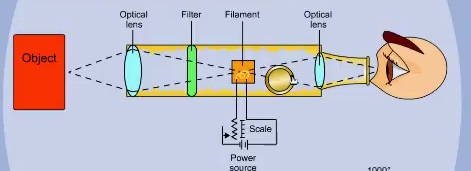
Optical Pyrometer 

An optical pyrometer will measure temperature from a distance.

Optical pyrometer is a filament that has its power supply and as you adjust the resistance the on it the color will change on the filament.Now the idea is when you are viewing through the view piece,it match the filament to the object surface temperature. Which will be a certain a certain amount of current.Now that current will be converted to a display showing the degree of temperature 

Optical Pyrometer - Temperature Measurement


If you use the optical pyrometer to measure temperatures out un the open,your temperature reading will be consistently low. The error varies from a few degrees C for target objects with high levels of radiation to several hundred degrees C for target objects with low levels of radiation.So most outdoor measurements are made with infrared pyrometers.

Advantages of Optical Pyrometer

Flexibility
Portability
Monitor the temperature of moving object

Disadvantages of Optical Pyrometer 

Cannot measure the temperatures of clean burning gases because these gases do not radiate visible energy.
Manual optical pyrometer are unsuitable for measuring the temperature of target object with temperature below 800 degree C because at lower temperatures the radiation emitted is at too low a level to be recorded. 


Radiation Pyrometer – Temperature Measurement

0


What is Infrared ?

Infrared (IR)  portion  of  the  spectrum  spans  Wavelengths between  0. 7  t  1000  microns.  Based on  the principle  that  all objects  warmer than  absolute zero  (  0 ° K)  emit  energy  some where  in  that range. Infrared  thermometers  are  able  to  determine an  object’s  temperature  without  touching  it  by measuring  the  amount  of  infrared  energy being  emitted  from  the  object.  Modern  IR instruments  can  on y  measure  between  0. 7 and  20  microns  because  they  are  not  sensitive enough  to  measure  the  small  amounts  of energy  available  outside  this  range.


Radiation Pyrometer - Infrared Sensors


Basic Components

1. Lens  to  collect Energy   emitted  from  an  object.

2.Detector  to  convert  the  thermal energy to  an electrical  signal with  signal  conditioning ( filters
    and  amplifiers).
3. Emissivity  adjustment  to  correct for  various  surface finish s  and materials.
4. Temperature  TB  ( internal temperature )  must  be  known  or determined  through  prior
    calibration.
 5. Ambient  temperature compensation.
 6. TA ,  the  unknown  temperature ,  is determined  from  the  detector temperature.

Radiation Pyrometer – Fundamentals 

Pyrometry literally means “fire” (pyros) “measuring” (metron). Pyrometers manipulate the fact that all objects above absolute zero temperature 0 K (-273.15 °C; -459.67 °F) radiate and absorb thermal energy. If the relationship between the radiation intensity and wavelength and the temperature can be established, the temperature can be found from the radiation.

Two principal theories are employed by pyrometry: Planck’s law and the Stefan-Boltzmann law. Planck’s law is used in narrow-band pyrometers, where only one or a few specific wavelengths are targeted. The Stefan-Boltzmann law is used in broad-band pyrometers, where a wide range of wavelengths are measured.


Planck’s Law

This is a derived formula,from the german physicist Max Planck,that portrays the amount of radiation emitted by a blackbody as theoretically determined by its temperature. It is an equation that produces a curve,termed Planck’s blackbody radiation curve,which illustrate that the warmer a body is,the greater is its blackbody emission at each wavelength and the shorter is the wavelength at which emission peak.


Stefan-Boltzmann Law  

Stefan-Boltzmann law that relates the energy,E,radiated away from a perfect emitter,to the temperature,T,of that body.It has the form E,T,where E is the energy radiated per unit area per second.T is the temperature and is the Stefan Boltzmann constant. Its value is 5.6697 10 Wm K.The law was derived by the Austrian physicists Josef Stefan and Ludwig Boltzmann.


Radiation Pyrometer - Plancks Law
 
The radiation intensity is a function of wavelength I and temperature T.For a given temperature,there is a particular wavelength associated with the maximum radiation intensity. An approximate equation that relates them is Wein’s Displacement Law.
 
Weins Displacement Law
 
 
Infrared Temperature Sensors
 
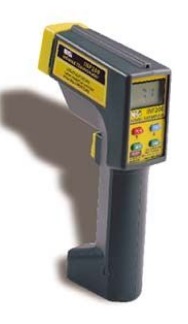
Single-point Infrared Temperature Sensors point Infrared Temperature Sensors
Infrared thermometers measure the surface temperature of objects within their field of view.
Focal length of instrument is important consideration.
 
Non-contact infrared thermometers uses:
 Facility maintenance
 Utilities and electrical inspection
 Medical industry
 HVAC/R maintenance and inspection
 Food safety
 Automotive and diesel maintenance
 Asphalt, cement, and construction materials.
Material Emissivity  :
Material emissivity is subject to a great amount of uncertainty because it depends on surface finish, color, oxidation, aging and several other factors.
 
 Advantages of Infrared Sensors 
 
Infrared thermometers can measure 
Objects that move, rotate or vibrate.
They can measure temperatures > 1500 °C.
They do not damage or contaminate the surface of the
Object of interest (food, painted surfaces).
Response time is in the millisecond range.

Introduction to DCS (Distributed Control System )

0
What is Distributed Control System ?

There are many definitions of distributed control, but the basic concept is always the same: divide a large application into multiple smaller subsystems, each of which carries out a portion of the application, and allow these subsystems to communicate with one another. Distributed control systems have evolved from two older technologies — direct digital control, and hybrid control made up of discrete devices. 

DCS Architecture


Hybrid Control System :

Hybrid control systems include individual discrete-control hardware, typically programmable logic controllers (PLCs) or analog loop controllers, and a computer to collect process information and generate management reports. Panel-board instrumentation, located in a central control room, is typically used as the operator interface. 

While hybrid control systems offer distributed hardware, they do have problems: Each system is custom-designed using controllers made by different vendors, making interfacing difficult. In order to expand a system, specialists in several different technologies are required. Actual control is usually done using an analog controller, which suffers the familiar problem of drift. Installations typically take a long time, due to complexities in interfacing various subsystems together. Because several subsystems are linked, system response is slow and unpredictable. And, lack of a central database makes decision-making more complex. 

Digital Control System :

Direct digital control solves many of the interfacing problems of hybrid control. Using a computer to control an entire process allows information to be collected and reported quickly. A major disadvantage of this approach is that the computer represents a vulnerable point — the entire process could shut down if the computer fails. Redundant control systems that consist of either a second computer or analog instruments are usually installed to protect against a total system shutdown, but these backups add greatly to the cost and complexity of the control. 

Distributed Control System :

With the advent of the microprocessor, true distributed-control systems became practical. This approach to problem-solving combines the best features of hybrid control systems and direct digital control. It allows the application to be broken into subsystems that use digital, rather than analog, control techniques and that can be interfaced together easily. These systems can easily be expanded to accommodate future plant requirements and to take advantage of the latest control technologies. 

Many elements make up the subsystems of the distributed control system (DCS). Typical elements that make up a DCS today include input/output 

(I/O) devices, individual controllers (such as PLCs and loop controllers), operator interfaces (such as color CRT cathode ray tube screens), computers for data manipulation, engineering workstations, and communication networks for remote and local information exchange.

An important concept in distributed control is that of breaking down the software program into logical pieces, independent of system hardware. Doing this makes system design much more efficient, since programs are smaller and, therefore, easier to write, debug and maintain than the larger programs in computer and PLC systems. This concept is known as multitasking. It allows multiple small programs to run on a single processor in a priority-structured manner, which ensures that system response will be repeatable. 

Advantages of DCS

Because a system can be broken down into subsections that communicate freely with one another, DCS makes the design, implementation and maintenance of complex control strategies easier. Although simpler design and (to some extent) implementation appear to benefit primarily the DCS supplier, the user also benefits — from shorter leadtimes, simpler systems, improved reliability, reduced downtime, reduced installation costs due to wire savings, and greater flexibility to make future enhancements. 

Ideally, the DCS will use common hardware throughout. This simplifies the design, since the programming methods and documentation become independent of the subsection that is being designed. 

If the DCS is well designed, the engineer has a great deal of freedom to construct the system in a logical manner, taking into consideration the effects of single-point failures on the operation of the process. Unlike control systems based on other strategies, the DCS can continue to operate in a semiautomatic mode when one control section fails. The process can be kept operational while the failed section is repaired, although the process may operate at less than peak efficiency. 


Vibration Measurement – Accelerometer

0
Accelerometer

Accelerometers are a piezo-electronic (crystal) device. A pre- loaded crystal is charged with current and as the crystal is compressed or de-compressed by vibration an output proportional to g’s (gravity) is provided. 

Accelerometer - Vibration Measurement


A “g” is equal to 9.80 meters/second2 or one (1) standard earth gravity. 
Accelerometers are normally used for high-frequency bearing cap vibration readings (Case/Bearing Cap Absolute on machines using rolling element bearings. Usually the output is integrated electronically to velocity 
(in/sec or mm/sec). Other applications include monitoring Gears and High Frequency Applications.

Accelerometert – Operating Principle

The most obvious starting point in the system is the accelerometer itself. It is simply a transducer that converts an applied acceleration to its body into a proportionate displacement of voltage on its output.

Signal Conditioning 

The Signal Condition Consist 

1,Accelerometer
2.Current Source
3.Grounding
4.AC Coupling
5.Instrumentation Amplifier
6.Low pass filter
7.Simultaneous sample and Hold

The signal conditioning circuitry for measuring vibration is fairly straightforward. It consists of the accelerometer itself, a current source to excite the accelerometer, proper grounding to eliminate noise pick-up, AC coupling to remove DC offsets in the system, an instrumentation amplifier to boost the accelerometer’s signal level, a low pass filter to reduce noise and prevent aliasing in the data acquisition system, and finally, simultaneous sample and hold circuitry to keep the signals properly timed with respect to each other.


Types Of Accelerometers :

Accelerometers come in two axial types. The most common accelerometer measures acceleration only along a single axis. This type is often used to measure mechanical noise levels. 

For example, you may use it on a compressor, and the results may help determine if the compressor is operating properly, or is in need of maintenance.

The second type is the tri-axial accelerometer. This accelerometer is capable of creating a three dimensional vector of acceleration in the form of orthogonal components. This type is used when it is necessary to determine the type of vibration (lateral, transverse, rotational, etc.) that a component is undergoing, or if the acceleration of the component in any direction must be known. Installation of this type of accelerometer must be done more carefully in order to get an accurate indication of the direction of acceleration. This type of accelerometer also has three separate outputs, each output needing its own signal conditioning.

Accelerometer Construction :
Construction of Accelerometer

The active accelerometer contains a piezoelectric crystal bonded to the casing of the accelerometer. Bonded to the other side of the crystal is a small seismic mass. When the accelerometer is moved, this mass either compresses or stretches the crystal, inducing a charge on its surfaces. This charge is picked up by a small charge sensitive amplifier built inside the sensor. This amplifier is powered by an external constant current source, and modulates its output voltage with respect to the varying charge on the piezoelectric crystal. Thus, the accelerometer uses only two wires for both sensor excitation (current) and signal output (voltage).

This also means that the active accelerometer has a relatively low output impedance, usually on the order of a few kilo-ohms.

Advantages and Disadvantages of Accelerometer 
 Advantages and Disadvantages of Accelerometer

The active accelerometer has advantages over the conventional passive element accelerometer. Because the active accelerometer has a relatively low output impedance, it is less sensitive to noise being picked up in its cabling. The built in signal conditioning circuitry further reduces noise pick-up by being placed as close as possible to the crystal. The net result is that the active accelerometer is easier to use, especially in very noisy environments.

Despite these advantages, there are some disadvantages which may prevent one from choosing an active accelerometer. Because the front end circuitry is provided inside the accelerometer, it has a fixed signal sensitivity independent of the excitation current. This circuitry also limits the usable temperature range of the accelerometer since most of the signal conditioning circuitry will fail above approximately 250 °F. 


Accelerometer Parameters :

Active accelerometers have three major parameters to consider when selecting which model to use.

The first parameter is the sensor’s measuring range. This number represents the maximum acceleration that the sensor can reasonably measure, represented in +g’s. (One g is one Earth gravity.) Thus, a sensor with a measuring range of    +5 g’s can measure 5 g’s of acceleration in either direction along its measuring axis.

The next parameter is sensitivity. This is the sensor’s “gain” given as a ration of volts per g. Thus a sensor with a sensitivity of 200 mV/g displaces 300 mV when undergoing 1.5 g of acceleration.

The final parameter is the accelerometer’s resonant frequency. This represents the frequency that the sensor rings at if bumped abruptly, much like a goblet rings when tapped. Because the sensor wants to naturally resonate at this frequency, it is very important to make sure that you do not use the accelerometer to measure any signals near the resonant frequency.


Power Source :
Current Source

The power source to excite the accelerometer is a current source. Most accelerometers can operate on a current between 2 and 20 mA. While it may seem more economical to use a 2 mA source, it should be noted that the maximum frequency and amplitude that an accelerometer can drive is directly related to the current that is exciting it. Thus, long cable lengths need higher currents in order to drive high frequencies at large voltage ranges. Systems with short cables or low frequency measurements can tolerate being driven with lower currents.

In addition to the amount of current the source can supply, it must have a high enough voltage compliancy to power the sensor over its entire operating range. Voltage compliancy is a measure of the voltage range that a current source properly functions. For example, a 24 V compliant current source delivers a constant current over a range of 0 to 24 V across its terminals.

Most accelerometer systems use one of three types of current sources, resistor and a battery, diode and a battery, and active. These will be discussed in detail.

The simplest current source used for exciting accelerometers is a battery and resistor system – three 9 V batteries in series with a resistor. 

While it is very simple and inexpensive, it is also very inadequate. The resistor maintains a constant current flow as long as there is no signal in the system. The moment a signal changes the voltage level at the output terminals, the current also changes in accordance with Ohm’s law. To put it bluntly, the battery and resistor current source is 0 V compliant by its very design! This dynamic changing of current betrays itself as non-linearity in the system’s response. As a result, this current source produces a lot of harmonic distortion.

Active Current Source:-
Active Current Source

The necessarily low value of the resistor to supply the necessary current means that the dynamic impedance of this current source is also quite low, usually around 5 kilo-Ohms. (An ideal current source has an infinite dynamic impedance.)

Finally, the nominal current and peak output from this current source slowly changes over time as the batteries discharge.

The active current source is the best source to use for energizing accelerometers. Its compliancy can be very high, and does not degrade with either time or frequency. There are no batteries to replace, thus eliminating the need to service it. Depending on the complexity of the design, it can have a dynamic impedance on the order of a half a meg-Ohm and up.

The only drawback is that it is more expensive than the other current sources because of its greater complexity.

Sensor Grounding :

Proper grounding is essential to minimizing noise in the vibration measuring system. Improper grounding, however, can cause more noise problems than it can eliminate. There are two main causes of noise as a result of grounding, ground loops or floating nodes.

A ground loop occurs when both the sensor and the signal conditioning input are grounded. The loop forms between the sensor cable and the building ground. This huge loop is perfect for picking up any induced currents produced by machinery, lights, and more. Because the loop resistance is finite, the result is a large 50 or 60 Hz common mode noise signal on the signal conditioning’s input. Thus, a large common mode noise is picked up in the system. If the situation is bad enough, the common mode voltage can get high enough to saturate the signal conditioning’s front end, causing a multitude of noise problems.

Likewise, floating nodes which occur when neither the sensor nor the signal conditioning system are grounded, induced charges can build up on the sensor to the point of overloading the front end of the signal conditioning system.

The solution is simple. Either ground the sensor or the signal conditioning input, but not both.

The AC Coupling :
AC Coupling

The next stage, AC coupling, removes the DC voltage offset that is present on the accelerometer. This dramatically increases the resolution of the system, because the system no longer has to accommodate the offset. For example, an accelerometer with an output voltage swing of +2 V and an offset voltage of    10 V would require a digitizer with a 12 V input range, despite only using 4 V for the actual signal. The same sensor AC coupled would require a 4 V input range on the digitizer, increasing the resolution by a factor of three.

In addition, the AC coupling removes the long term DC drift that accelerometers have due to age and temperature effects.

The only care one needs to have with AC coupling is to make sure that the low frequency roll-off is lower than the range of frequencies desired.

Introduction To Vibration Measurement

0
Measurement Type

Vibration Measurement


Only measurements of the same type can be compared. Bearing Cap or Case Vibration cannot be directly compared to Shaft Relative or Shaft Absolute and visa versa.

1). Case Absolute 

Case or Bearing Cap Absolute is the measurement of the Case or Bearings Caps (Location of Transducer) motion relative to free space (or absolute motion). Case or Cap Absolute is usually used for monitoring Rolling Element Bearings.

2). Shaft Relative

Shaft Relative is the measurement of motion between the Shaft and whatever the measuring devise is mounted to. This measurement is normally taken with a NCPU or Proximity Sensor. Shaft Relative measurements are used for Journal or Sleeve Bearing Applications.

3). Shaft Absolute

Shaft Absolute is the measurement of the shaft’s motion relative to free space (or absolute). Shaft Absolute can be measured two (2) ways, the first being electronically summing the signals  of both a Eddy Probe measuring shaft relative and a accelerometer measuring case absolute, the second being using a shaft rider which is a spring mounted device that physically rides on the surface of the shaft, normally a velocity sensor integrated to displacement is mounted on top of the shaft rider. Shaft Absolute is normally used where the rotating assembly is five (5) or more times heavier than the case of the machine.

Vibration Transducer 

Transducer Type
Three (3) basic types of vibration transducers are available which correlate with the three (3) types of measured physical motion

# Acceleration
# Velocity 
# Displacement.

More about Basics of Vibration Measurement 
Types of Vibration Measuring Instrument 

Dissolved Oxygen Measurement

0
Dissolved Oxygen Measurement 

One of the most important measurements in the determination of the health of a body of water is its dissolved oxygen content. The quantity of dissolved oxygen in water is normally expressed in parts per million (ppm) by weight and is due to the solubility of oxygen from the atmosphere around us. 

The atmosphere consists primarily of nitrogen and oxygen and since both of these gases are soluble in water, they are present in varying amounts in all natural or man-made bodies of water. These amounts are proportional to the solubility and partial pressure of the two gases  


Theory 

The amount of oxygen that a given volume of water can hold is a function of:
1. The pressure the atmospheric oxygen is exerting at the air- water interface.
2. The temperature of the water. 
3. The amount of other substances dissolved in the water. 

Effect of Partial Pressure of Oxygen on Dissolved Oxygen 

A volume of water in contact with air will absorb air and hence oxygen until the pressure the absorbed oxygen exerts at the air-water interface equals the pressure exerted at the same interface by the oxygen in the air. At this point, the water is said to be saturated with oxygen. The amount of oxygen actually absorbed is quite small being of the order of about five or ten parts of oxygen to one million parts of water.

Effect of Temperature on Dissolved Oxygen

As everyone who has ever watched a pot boil knows, bubbles form on the side and bottom of the pot. The number and size of the bubbles increase with temperature. These are bubbles of air that have been dissolved in the water. Figure 1-A represents a beaker of oxygen saturated water at room temperature. The partial pressures of oxygen above and below the water surface are equal. Figure 1-B shows what happens when we begin to heat the system. In essence, we are putting energy into the system. The oxygen molecules which have a low solubility become readily energized by the infusion of energy into the system. The more sluggish water molecules step up their molecular activity at a slower pace. As a result, more oxygen molecules break through the air-water interface to the space above the water surface than water molecules do, leaving fewer oxygen molecules dissolved in the water. When the water boils as is shown in Figure 1-C, all of the oxygen molecules have been driven out of the water and now the water molecules are coming out of the beaker so fast that they form a layer of water vapor immediately above the water surface. This layer effectively isolates the water from atmospheric oxygen and the DO content of the water is zero. 

Methods of Determination:
Dissolved Oxygen Measurement - O2 Sensor

Over the years a number of methods for dissolved oxygen determination have been developed. These methods have been found to vary widely in their sensitivity, susceptibility to electrode poisoning by the presence of undesirable compounds, and, in some instances, sensitivity to a slow flowing or static aqueous media. Some methods require a very clean sample devoid of extraneous chemical compounds, but only a few are adaptable to continuous on-line measurement. The various methods can be divided into three principle categories:

1. Laboratory methods (Winkler Method).The Winkler Method (Iodometric Method) 
The Winkler Method is a more accurate way to determine DO levels, and is used to calibrate DO probes.
2. Electrochemical analysis (conductimetric, voltametric, and galvanic).
3.Membrane electrode methods (galvanic membrane electrodes and amperometric membrane electrodes).

Position Transducer – Displacement Measurement

0
How Position Transducers Work

Position transducers convert mechanical motion into an electrical signal that may be metered, recorded, or transmitted. Position transducers consist of a stainless steel extension cable wound on a threaded drum that is coupled to a precision rotary sensor such as an incremental encoder, absolute encoder, hybrid or conductive plastic rotary potentiometer, RVDT, synchro, or resolver.

position transducer


Operationally, the position transducer is mounted in a fixed position and the extension cable is attached to a moving object. The axes of linear movement for the extension cable and moving object are aligned with each other. As movement occurs, the cable extracts and retracts. An internal spring maintains tension on the cable. The threaded drum rotates a precision rotary sensor that produces an electrical output proportional to the cable travel. The output is measured to reflect the position, direction, or rate of motion of the moving object.

How Position Transducers Are Used in Industry and Science

Position transducers are used in a broad range of position, displacement, and velocity measurement applications to:
Measure distance traveled 
Continually sense location or relative position 
Indicate levels 
Act as limit sensors 
Control actuators through position sensing 
Act as signal generators for recording position versus time, cycle rate, or magnitude of random/cycle events 
Monitor relative motion 
Indicate events 
A Few of the Industries Using Position Transducers
Aircraft/Aerospace 
Robotics 
Automotive/Transportation/Racing 
Space Research 
HVAC 
Test and Measurement 
Entertainment 
Maritime/Naval 
Hydraulics and Pneumatics 
Laboratories 
Industrial Automation 
Motion Control 
Water Service and Treatment 
Medical 
Oil and Gas 
Railroad/Trucking 

Displacement Measurement – Accelerometer

0
Acceleration :
Accelerometers measure acceleration, vibration, and shock. An accelerometer involves the mounting of a seismic mass attached to a damper and a spring inside a solid casing.

Accelerometer - Displacement Measurement
Add caption


The movement of the mass inside the casing is proportional to the force of acceleration on the device. Many accelerometers use either a capacitive or piezoelectric sensor to measure the position of the mass.

Accelerometers are specified by the range, frequency response, and the sensitivity of the device.