Home Blog Page 225

Basics of Butterfly valves

0

The butterfly valve is a rotary control valve. Standard butterfly valves are dampers that are shaped from discs which rotate in the flow path to regulate the rate of flow.

Working and Construction:

Butterfly valves are quite simple to understand: the “butterfly” element is a disk that rotates perpendicular to the path of fluid flow. The butterfly valve consists of a cylindrical body with a disk the same size as the internal diameter of the valve body, mounted on a shaft that rotates perpendicular to the axis of the body. The action is similar to a louvre damper. The disk pivots to the vertical position to shut off any flow, and to the horizontal position when fully open.

Standard butterfly valves are dampers that are shaped from discs which rotate in the flow path to regulate the rate of flow. The disc is quite narrow and occupies little space in the pipeline. The shaft is centred on the axis of the pipeline and is in line with the seal.

The disc pulls away from the seal upon opening. This minimises seal wear and reduces friction. Control of the valve near the closed position can be difficult due to the breakout torque required to pull the valve out of the seat.

The flow characteristics are essentially equal percentage, but the rotation is limited to about 60 degrees as the leading edges are hidden in the shaft area as the disc is rotated further. The Fishtail is one modification of the disc that permits effective control out to 90 degrees of rotation

High-performance Butterfly valve:

The high-performance butterfly valve is a development from the conventional valve where the rotation axis of the disc is offset from both the centreline of flow and the plane of the seal.

The modified shape and contour of the disc are used to reduce dynamic torque and drag. This also permits higher pressure drops. As the disc is never hidden behind the shaft, good control through the 90 degrees of operation is possible with a linear characteristic.

This design produces a number of advantages, including better seal performance, lower dynamic torque, and higher allowable pressure drops. The seal performance is improved because the disc cams in and out of the seat, only contacting it at closure and so wear is reduced.


Advantages:

  • Low cost and weight, low maintenance cost
  • High flow capacity.
  • Pressure drop across valve is less
  • Fire safe design.
  • Used with corrosive and chemical media
  • Low stem leakage
  • Compact, lightweight

Disadvantages:

  • Oversizing
  • Difficult to clean
  • Potential cavitation and choke
  • Unguided disc movement is affected by flow turbulence
  • Throttling limited to low differential pressure


BASICS OF ON/OFF CONTROLLER

0

Introduction

In control theory, an on/off controller, also known as a hysteresis controller, is a feedback controller that switches abruptly between two states. These controllers may be realized in terms of any element that provides hysteresis. They are often used to control a plant that accepts a binary input, for example a furnace that is either completely on or completely off.


For example, a thermostat is a simple negative-feedback control: when the temperature (the “process variable” or PV) goes below a set point (SP), the heater is switched on. Another example could be a pressure switch on an air compressor: when the pressure (PV) drops below the threshold (SP), the pump is powered. Refrigerators and vacuum pumps contain similar mechanisms

Theory of on/off controller

Let us consider a level control system.

The valve in the inflow line to the system is an electrically operated solenoid valve. (Remember an electrically operated solenoid valve has only two operating positions . fully open or fully closed.) Assume that under initial conditions with a demand on the system the level will start to fall and V1 will have to be opened to provide an inflow. This can easily be achieved by mounting a differential pressure switch, P1 at the bottom of the tank to operate when the level falls to L1. When the level is at L1 the liquid will be height h1 above switch. The pressure at the switch will be P1 = ?gh1.

?. The mass density of the liquid

g. The acceleration due to gravity

h1. The height of the liquid


The resulting switch closure can energize the solenoid valve V1 causing an inflow to the tank. Assuming the valve is correctly sized, this will cause a rise in the level back towards the setpoint. In order to arrest the rise in level the built in differential feature of the switch can be employed to de-energize the solenoid valve when level L2 is reached. This system will achieve a mean level in the tank about the desired setpoint. This method is known as ON/OFF control. Clearly it is impossible to maintain the system at the setpoint since there must be a difference in the operating levels L1 and L2 as the valve can only be energized or de-energized. It is often counterproductive to try to reduce the differential between L1 and L2 to too small a value as this will result in excessive cycling, and hence wear, of the valve.

Summary

  • On/off control – control signal is either 0% or 100%
  • Control at setpoint not achievable, a dead band must be incorporated.
  • Useful for large, sluggish systems particularly those incorporating electric heaters.

To know more about BASIC CONTROL PRINCIPLES

Capacitance pressure transmitter

0

Capacitance pressure transmitter is a pressure measurement device which convert applied pressure into a current signal. Capacitive type pressure transmitter is differential pressure type sensor.

Principle:

Capacitive pressure transmitter works under the principle of differential capacitance. Capacitive pressure measurement involves sensing the change in capacitance that results from the movement of a diaphragm.

Generaly the capacitance is defined by the equation:

C = A?/d

C – Capacitance between two connductor

A – Area of overlapping between those conductors

d – Distance seperating the conductors

? – Dielectric permitivity of insulating medium

Permitivity of the medium and the area of overlapping will be constant in this case, the only varying parameter in this case is the distance between the conductors which varies when the pressure varies, which changes the capacitance. So the pressure variation results in the capacitance variation.

Design: 

Two designs are quite common. The first is the two-plate design and is configured to operate in the balanced or unbalanced mode. The other is a single capacitor design.

In two plate design the one plate made fixed and other one is kept movable. The varying process pressure is applied to the movable plate and the plate can be kept fixed by applying constant pressure. There are balanced and unbalanced modes in capacitance pressure measurement. The balanced mode is where the reference capacitor is varied to give zero voltage on the output. The unbalanced mode requires measuring the ratio of output to excitation
voltage to determine pressure

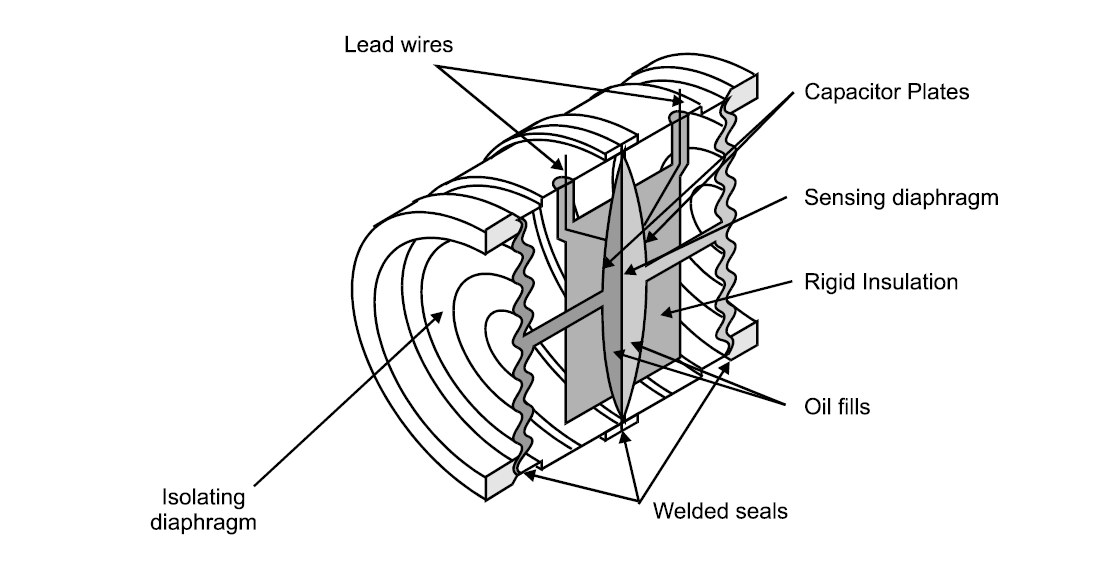
A Rosemount capacitance pressure sensor is shown below:

The capacitance chamber is isolated from the process with a isolation chamber. The pressure applied at the one side, as pressure at the high pressure side increases the isolating diaphragm gets pushed toward the metal frame, transferring its motion to the sensing diaphragm via the fill fluid. The fill fluid will be oil.

A capacitance detector circuit connected to this cell uses a high-frequency AC excitation signal to measure the different in capacitance between the two halves, translating that into a DC signal which ultimately becomes the signal output by the instrument representing pressure.

The simple capacitance detector connection with the electrical circuit is shown below:

Advantages:

  • Inaccuracy 0.01 to 0.2%
  • Linearity
  • Fast response
  • Range of 80Pa to 35MPa

Disadvantages:

  • Temperature sensitivity
  • Stray capacitance problem
  • Vibration
  • Limited overpressure capability
  • Cost


OPEN & CLOSED LEVEL MEASUREMENT

0

Introduction

In industries level measurement is a crucial process.there are different types of storage tanks in this session we are gonna discuss about open & closed tank measurement.

Open Tank Measurement

The simplest application is the fluid level in an open tank. Figure shows a typical open tank level measurement installation using a pressure capsule level transmitter

If the tank is open to atmosphere, the high-pressure side of the level transmitter will be connected to the base of the tank while the low-pressure side will be vented to atmosphere. In this manner, the level transmitter acts as a simple pressure transmitter.

We have:

Phigh = Patm + S?H

Plow = Patm

Differential pressure ?P = Phigh – Plow = S?H

The level transmitter can be calibrated to output 4 mA when the tank is at 0% level and 20 mA when the tank is at 100% level


Closed Tank Measurement


Should the tank be closed and a gas or vapour exists on top of the liquid, the gas pressure must be compensated for. A change in the gas pressure will cause a change in transmitter output. Moreover, the pressure exerted by the gas phase may be so high that the hydrostatic pressure of the liquid column becomes insignificant.

For example, the measured hydrostatic head in a CANDU boiler may be only three meters (30 kPa) or so, whereas the steam pressure is typically 5 MPa. Compensation can be achieved by applying the gas pressure to both the high and low-pressure sides of the level transmitter.

This cover gas pressure is thus used as a back pressure or reference pressure on the LP side of the DP cell. One can also immediately see the need for the three-valve manifold to protect the DP cell against these pressures.

The different arrangement of the sensing lines to the DP cell is indicated a typical closed tank application

We have:

Phigh = Pgas + S?H

Plow = Pgas

?P = Phigh – Plow = S?H

The effect of the gas pressure is cancelled and only the pressure due to the hydrostatic head of the liquid is sensed. When the low-pressure impulse line is connected directly to the gas phase above the liquid level, it is called a dry leg.


DRY & WET LEG LEVEL MEASUREMENT

DRY & WET LEG LEVEL MEASUREMENT

0

Introduction 

There are so many level measuring techniques in present.one of the method is measuring level with the help of DP transmitter.There are 2 methods ;Dry & wet leg level measurement this session we are gonna discuss about that

Dry Leg System

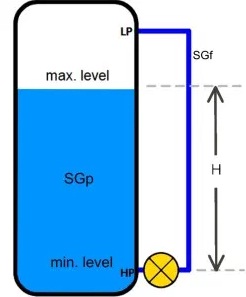
A full dry leg installation with three-valve manifold is shown in Figure below. If the gas phase is condensable, say steam, condensate will form in the low-pressure impulse line resulting in a column of liquid, which exerts extra pressure on the low-pressure side of the transmitter.

A technique to solve this problem is to add a knockout pot below the transmitter in the low-pressure side as shown in Figure. Periodic draining of the condensate in the knockout pot will ensure that the impulse line is free of liquid.


In practice, a dry leg is seldom used because frequent maintenance is required. One example of a dry leg application is the measurement of liquid poison level in the poison injection tank, where the gas phase is no condensable helium. In most closed tank applications, a wet leg level measurement system is used


Wet Leg System

In a wet leg system, the low-pressure impulse line is completely filled with liquid (usually the same liquid as the process) and hence the name wet leg.

A level transmitter, with the associated three-valve manifold, is used in an identical manner to the dry leg system At the top of the low pressure impulse line is a small catch tank. The gas phase or vapour will condense in the wet leg and the catch tank. The catch tank, with the inclined interconnecting line, maintains a constant hydrostatic pressure on the low-pressure side of the level transmitter. This pressure, being a constant, can easily be compensated for by calibration.


If the tank is located outdoors, trace heating of the wet leg might be necessary to prevent it from freezing. Steam lines or an electric heating element can be wound around the wet leg to keep the temperature of the condensate above its freezing point.

Note the two sets of drain valves. The transmitter drain valves would be used to drain (bleed) the transmitter only. The two drain valves located immediately above the three-valve manifold are used for impulse and wet leg draining and filling.


Calculations


Span = (X) (GL)

HW at minimum level = (Z) (GS) + (Y) (GL)

HW at maximum level  = ( Z ) ( GS )  +  ( X + Y ) ( GL )

Where:

G= Specific gravity of tank liquid.

GS   = Specific gravity of seal liquid.

HW = Equivalent head of water.

X, Y & Z are shown

Open tank with X   = 300 inches

Y    = 50 inches

Z    = 10 inches

GL =   0.8

GS =   0.9

Span   = (300) (0.8) = 240 inches

HW at minimum level =   (10) (0.9) + (50) (0.8) = 49 inches

HW at maximum level = (10) (0.9) + (50 + 300) (0.8) = 289 inches

Calibrated range = 49 to 289 inches head of water

Close tank with wet leg:

Span   = (X) (GL)

HW at minimum level    = (Y) (GL) – (d)(GS)

HW at maximum level   = (X + Y) (GL) – (d) (GS)

Where: GL = Specific gravity of tank liquid

GS = Specific gravity of tank liquid

HW   = Equivalent head of water

X, Y and Z are shown below


X = 300 inches

Y = 50 inches

d = 500 inches

GL = 0.8

GS = 0.9

Span = (300) (0.8) = 240 inches

HW minimum level = (50) (0.8)  –  (500) (0.9)  =  – 410 inches

HW maximum level = (300 + 50) (0.8) – (500) (0.9) = – 170 inches

Calibrated range = – 410 to –170 inches head of water.

(Minus sings indicate that the higher pressure is applied to the low pressure side of the transmitter


To know about other level measuring techniques like  LASER LEVEL MEASURMENTUltrasonic  level Measurement

Resistance Temperature Detector ( RTD )

0

Resistance Temperature Detectors (RTD) are temperature measuring transducers used in industrial applications. RTDs are simple in construction with higher accuracy and repeatability and which are used in the applications below 600°C.

Principle:

As the name suggests the RTDs are temperature sensitive resistors. The resistance temperature detector (RTD) measures the electrical conductivity as it varies with temperature. The electrical resistance generally increases with
temperature, and the device is defined as having a positive temperature coefficient.

The sensor is the combination of the transducer and electronics that measure the resistance. The resistance change is measured by the electronic unit of the sensor. The resistance measured will be the function of the temperature.

The electrical resistance of which changes with temperature as approximated by the following formula:

RT= Resistance of RTD at given temperature T (ohms).

Rref = Resistance of RTD at the reference temperature Tref (ohms)

? = Temperature coefficient of resistance (ohms per ohm/degree)

The magnitude of the temperature coefficient determines the sensitivity of the RTD, it depends on the metal used in the RTD

Construction:

The main component of the RTD is the metal used in it. Platinum(PT) is the widely used metal in industries, apart from PT other metal used are Nickel and Copper. Platinum is the most common and has the best linear characteristics of the three, although Nickel has a higher temperature coefficient giving it greater sensitivity.

RTDs are either a metal film deposited on a form or are wire-wound resistors, which are then sealed in a glass-ceramic composite material. The coil is wound to be noninductive. The space between the element and the case is filled with a ceramic powder for good thermal conduction. The element has three leads, so that correction can be made for voltage drops in the lead wires.

Lead compensation techniques are used in RTD connection to reduces the effect of lead wires/ connecting wires.


The RTD connected in the thermowell is shown above, the sheaths are made of materials such as productive tube pyrex glass, Porcelain, quartz or nickel depending on the range of temperature and nature of fluid whose temperature is to be measured.

Requirements of conductor material used in RTD:

  • Change in resistance of material per unit change in temperature should be as large as possible
  • Material should have high value of resistivity so that minimum volume of material is used in its construction
  • Resistance of the material should have a continuous and stable relationship with temperature

What are PT100 and PT1000 in RTD?

In PT100 the ‘PT’ defines that the metal is Platinum and the ‘100’ is the resistance in ohms at ice point (or 0°C). These are generally wire wound and are quite common in industrial uses.

PT1000 exhibits 1000? resistance at 0°C Celsius temperature. These are generally thin film devices and are more expensive.

200 and 500 ohm Platinum RTD’s are available but are more expensive and less common.

Types of RTD :

Platinum is most popular for RTD’s, it has good calibrated accuracy, is quite stable and has good repeatability, but is quite expensive. They are, however, not as sensitive as the Nickel and Balco devices. Nickel is not quite as repeatable but is less expensive.

Advantages:

  • Good sensitivity
  • Linear over wide operating range
  • Uses standard copper wire
  • High temperature operating range
  • Copper RTD’s minimise thermocouple effect
  • Interchangeability over wide range
  • Works in wide temperature ranges

Disadvantages:

  • Bulky in size and fragile
  • Slow thermal response time due to bulk
  • Self-heating problems
  • More susceptible to electrical noise
  • More expensive to test and diagnose


The pneumatic recorder

0

Introduction

The pneumatically operated recorder is still used today, particularly in remote locations.  It does not use electricity so it does not need any special intrinsic safety measures when it is used in hazardous areas.  Examples of the pneumatic recorders are shown below manufactured by Foxboro.  They are the series 120 Consotrol recorder and the series 40 circular chart recorder; both made by Foxboro.

The Foxboro Series 120 Consotrol Recorder

Foxboro produces a range of pneumatic instruments called “Consotrol”.  The Foxboro series 120 Consotrol recorders is one of the most common pneumatic recorders.  It is still manufactured and you can get spares for it.  You may see other types of pneumatic recorders on older sites but they will work in much the same way as the Foxboro.

Operation of the pneumatic recorder:


  1. The incoming pneumatic signal is applied to a bellows unit which works by compression against the range spring.
  2. As the input signal increases the pen is rotated across the scale. The scale indicates from 0 to 100% for an input signal of 0.2 to 1 bar (3 to 15 psi).
  3. The rotating mechanism has span and zero adjustment screws (as shown)
  4. The driving rod from the bellows to the rotating mechanism has a linearity adjustment. This can adjust the linearity of the pen travel from 0-100%.
  5. The recorder can drive a maximum of 4 pens.
  6. The ink of the pens is supplied from bottles which are refillable. The colours available are red, green, blue and violet.

The chart is driven round by a motor (either electric or pneumatic)  at a standard rate of 19 mm per hour.  There is enough paper on a roll or flip chart to record around 30 days of continuous operation.


Circular Chart Recorder

Foxboro also produces a circular chart recorder for field use.  The pen drive system is the same as in the 120 Consotrol recorder.  The chart is normally driven by clockwork.  The instrument technician must wind it up from time to time.  The circular chart completes one revolution every 24 hrs.  The chart can be linear or square root.  The square root chart can be calibrated to give a direct reading of flow rate.


The measurement unit can be selected from various measuring elements, e.g. gauge pressure, absolute pressure, temperature, etc.  The recorder can have a maximum of 4 elements to drive 4 pens.  The newer recorders use disposable fibre tip pens but the older ones use a capillary tube with a refillable ink bottle.

to known about  Pressure Detectors

PROGRAMMING LOGIC DEVICES (PLC)

0

Introduction

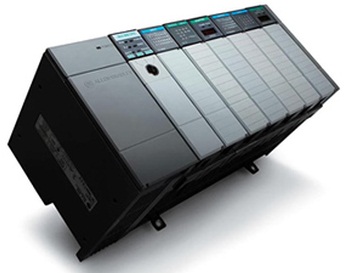
A digitally operating electronic apparatus which uses a programming memory for the internal storage of instructions for implementing specific functions such as logic, sequencing, timing, counting and arithmetic to control through digital or analog modules, various types of machines or process.In this session we are gonna discuss about basics of programming logic devices (PLC)

 Historical Background of programming logic devices (PLC)

Developed to replace relays in the late 1960s, their primary goal was to eliminate the high costs associated with inflexible, relay-controlled systems

  • The controller had to be designed in modular form, so that sub-assemblies could be removed easily for replacement or repair.
  • The control system needed the capability to pass data collection to a central system.
  • The system had to be reusable.

The method used to program the controller had to be simple, so that it could be easily understood by plant personnel

Major Components of a Common PLC

POWER SUPPLY

Provides the voltage needed to run the primary PLC components

I/O MODULES

Provides signal conversion and isolation between the internal logic-level signals inside the PLC and the field’s high level signal

PROCESSOR

Provides intelligence to command and govern the activities of the entire PLC systems.

PROGRAMMING DEVICE

Used to enter the desired program that will determine the sequence of operation and control of process equipment  or driven machine.

I/O Module

  • The I/O interface section of a PLC connects it to external field devices.
  • The main purpose of the I/O interface is to condition the various signals received from or sent to the external input and output devices.
  • Input modules converts signals from discrete or analog input devices to logic levels acceptable to PLC’s processor.

Output modules converts signal from the processor to levels capable of driving the connected discrete or analog output devices


Analog Input

An analog input is an input signal that has a continuous signal. Typical inputs may vary from 0 to 20mA, 4 to 20mA or 0 to10V. Below, a level transmitter monitors the level of  liquid in the tank. Depending on the level Tx, the signal to the PLC can either increase or decrease as the level increases  or decreases.


Digital Output

A discrete output is either  in an ON or OFF condition. Solenoids,  contractors coils, lamps are example of devices connected to the  Discrete or digital outputs. Below, the lamp can be turned ON or OFF by the PLC output it is connected to.


Analog Output

An analog output is an output signal that has a continuous signal. Typical outputs may vary from 0 to 20mA, 4 to 20mA or 0 to10V.

Processor

The processor module contains the PLC’s microprocessor, its supporting circuitry, and its memory system.

The main function of the microprocessor is to analyze data coming from field sensors through input modules, make decisions based on the user’s defined control program and return signal back through output modules to the field devices. Field sensors: switches, flow, level, pressure, temp. Transmitters, etc. Field output devices: motors, valves, solenoids, lamps, or audible devices.

The memory system in the processor module has two parts: a system memory and an application memory.

Areas of Application

  • Manufacturing / Machining
  • Food / Beverage
  • Metals
  • Power
  • Mining
  • Petrochemical / Chemical


to know more about  BASIC CONTROL PRINCIPLES

Basics of Thermistor – Advantages and Disadvantages

0

A thermistor is a semiconductor device formed from metal oxides. thermistors are used in many applications requiring information about process equipment for alarming and indication purposes.

Principle:

The principle of temperature measurement with a thermistor is that its resistance changes with temperature. Most thermistors differ from normal resistors in that they have a negative coefficient of resistance, this means that the resistance decreases with an increase in temperature. Negative (NTC) thermistors are the more common although positive (PTC) are also available.


Construction, selection and sizing:


A thermistor is a bulk semiconductor device, and as such can be fabricated in many forms. The more common include discs, beads and rods. Size does vary from a bead of 1mm to a disc of several centimetres in diameter and thickness.

There are different types of the thermistor, most of them are differ their response to temperature changes.Thermistors are not linear, and their response curves vary for the different types. Some thermistors have a near linear temperature resistance relationship, others are available with a sharp change in slope (sensitivity) at a particular characteristic temperature.

Thermistors have a much higher temperature coefficient than RTD’s, so a small temperature change is easier to detect. However, thermistors do not have the accuracy of RTD’s and this probably accounts for thermistors being limited in process instrumentation. They are available in a large range of resistivities, with varying linearity.

Thermistors are available that perform temperature measurement from -73 to 316°C (-100 to 600°F). It should be noted that many have limited ranges and cannot be used above 120°C (250°F).


Some thermistors have a large change in resistance to a change in temperature. Selecting these types makes for very good narrow span measurement, the temperatureversuss resistance characteristics is shown below.

Advantages:

  • Small size
  • Very high sensitivity (Select range)
  • Polarity insensitive
  • No cold junction compensation
  • Wide selection of sensors
  •  Inexpensive
  • Fast response

Disadvantages:

  •  Not easily interchangeable
  • High resistance, noise problems
  • Non linear
  • Unstable due to drift and decalibration (especially at high temperatures)
  • Narrow span
  •  Fragile

Level Measurement Errors

0

 INTRODUCTION

There are many methods to measure level of a system or a tank (Direct and indirect). Let us discuss about the differential pressure level measurement technique. The indication of fluid level is based on the pressure exerted on a differential pressure (DP) cell by the height of the liquid in the vessel. Level Measurement Errors occur in such technique is what we are going to discuss now

Connections

Many avoidable errors occur because the DP cell had the sensing line connections reversed. In systems that have high operating pressure but low hydrostatic pressure due to weight of the fluid, this is easy to occur. This is particularly important for closed tank systems.

With an incorrectly connected DP cell the indicated level would go down while the true tank level increases.


Over-Pressuring

Three valve manifolds are provided on DP cells to prevent over-pressuring and aid in the removal of cells for maintenance. Incorrect procedures can inadvertently over-pressure the differential pressure cell. If the cell does not fail immediately the internal diaphragm may become distorted. The measurements could read either high or low depending on the mode of failure.

Note that if the equalizing valve on the three-valve manifold is inadvertently opened, the level indication will of course drop to a very low level as the pressure across the DP cell equalizes.

to known more about Three way Manifold valve.

Sensing lines

The sensing lines are the umbilical cord to the DP cell and must be functioning correctly. Some of the errors that can occur are:

1.Obstructed sensing lines

The small diameter lines can become clogged with particulate, with resulting inaccurate readings. Sometimes the problem is first noted as an unusually sluggish response to a predicted change in level. Periodic draining and flushing of sensing lines is a must.

2.Draining sensing lines  

As mentioned previously, the lines must be drained to remove any debris or particulate that may settle to the bottom of the tank and in the line. Also, in closed tank dry leg systems, condensate must be removed regularly to prevent fluid pressure building up on the low-pressure impulse line.

Failure to do so will of course give a low tank level reading. Procedural care must be exercised to ensure the DP cell is not over-ranged inadvertently during draining. Such could happen if the block valves are not closed and equalizing valve opened beforehand.


Displacer type level transmitter calibration /leveltroll calibration