Home Blog Page 224

Magnetic flowmeter

0

Magnetic flowmeters are velocity type of flowmeters. An electromagnetic flowmeter can work with almost all liquids and slurries, as long as the liquid being measured is electrically conductive. Electromagnetic flowmeters can be employed to measure more or less all electrically conducting fluids, pastes, slurries, acids, lyes, juices and emulsions including fluids with a conductivity as low as 0.5µS/cm i.e. 0.5µmhos.

Principle:

As in case of many underlying principles of electromagnetic flowmeter is Faraday’s law of electromagnetic induction.

Faraday’s law of induction:

This law state that if a conductor of length l(m) is moving with a velocity v, perpendicular to a magnetic field of flux density B (Tesla), then the induced voltage e, across the end of the conductor can be expressed by

                e = Blv

Working:

Electromagnetic flowmeter uses Faraday’s law of electromagnetic induction to determine the flow of a liquid through a pipeline. The magnetic flow meters are also known as magmeters.

Electrically conductive process fluid is passed through a magnetic field induced by coils that are positioned around a section of pipe.

The process fluid is electrically insulated from the pipe with a suitable lining, in the case of a metal pipe, so that the generated voltage is not dissipated through the pipeline. The electrodes are located in the pipe and a voltage is generated across these electrodes that are directly proportional to the average velocity of the liquid passing through the magnetic field.

The coils are energised with ac power or pulsed dc voltage, so consequently the magnetic field and resultant induced voltage respond accordingly. The generated voltage is protected from interference, amplified and converted into a dc current signal by the transmitter. Line voltage variations are accounted for by the sensing
circuits.

The advantages of magnetic flowmeters are that they have no obstructions or restrictions to flow, and therefore no pressure drop and no moving parts to wear out. They can accommodate solids in suspension and have no pressure sensing points to block up. The magnetic flowmeter measures volume rate at the flowing temperature independent of the effects of viscosity, density, pressure or turbulence.

Advantages:

  • No restrictions to flow.
  • No pressure loss.
  • No moving parts.
  • Good resistance to erosion.
  • Independent of viscosity, density, pressure and turbulence.
  • Good accuracy.
  • Bi-directional.
  • Large range of flow rates and diameters

Disadvantages:

  • Expensive.
  • Most require a full pipeline.
  • Limited to conductive liquids.

BASICS OF AN INSTRUMENT AIR SUPPLY SYSTEM

0

Introduction

The air used must be cleaned, dry and oil-free to ensure that small lines,  restrictions and nozzles will not be plugged by dirt, oil or water.  In this course you will learn about basics of instrument air supply system.  This unit will teach you what an instrument air system is, what its components are and how they function


The System Concept

Figure shows the components of an instrument air supply.  In this system you see 12 major components.  Instrument air supply systems are not all the same.  But they all perform the same function.  They supply a sufficient  volume of clean and dry air at the constant pressure required by all plant instruments.

The major parts of an instrument air supply system are:

  • The Electric motor
  • The Compressor
  • The Inlet Air Filter
  • The After Cooler
  • The Moisture Separator
  • The Condensate Trap
  • The Air Receiver
  • The Safety Relief Valve
  • The Pressure Gauge
  • The Oil Remover
  • The Dryers
  • The Air Distribution System


The Electric Motor

The primary function of the electric motor is to provide a rotary motion to drive the compressor.

The Compressor

The Compressor converts the mechanical energy provided by a prime mover (e.g.  an electric motor)  into the potential energy of compressed air.

The Inlet Air Filter

This removes dust and dirt from atmospheric air before it enters the suction inlet of the compressor.

The After Cooler

This cools the air leaving the air compressor.  This is done by passing cooling water over the after cooler chamber.

Moisture Separator

This removes most of the moisture from the air.

Condensate Trap

This collects the condensed liquid from the moisture separator and drains the liquid periodically when the Condensate levels gets too high.

Air Receiver

This stores large volumes of the compressed air.  It also provides an emergency supply of air for a short period of time in the event of compressor failure.

Safety Relief Valve

A Safety Relief Valve is used to discharge excess pressure automatically if  maximum pressure develops in the air receiver.

Pressure Gauge

This indicates system output pressure.

Oil Remover

This is used to remove oil carried out by the air during the compression cycle.  If the oil vapour is not removed from the compressed air it slowly forms into droplets large enough to plug up tiny instrument tubings and nozzles.

Dryers

These dry any moisture that is left in the air.

Air Distribution System.

This is the final step in producing a properly balanced instrument air system.  It should provide delivery to all air users with a minimum supply variation of approximately 125 to 150 psi or 8.618 to 10.342 bar of pressure.


what is cascade control?

what are pressure relief valves?

0

INTRODUCTION

Protection against over pressure is one of the most important design tasks in the chemical, petrochemical, oil, and gas industries.pressure relief valves are such instruments that protect the plant form over pressure scenario  The various causes of over pressure fall into two broad categories: fire conditions and process conditions. The purpose of over pressure protection systems is to reduce or eliminate the potential for over pressure-initiated explosions and fires. A pressure relief valves are similar to a fuse in an electrical system.

The Purpose of  Pressure relief valves

Pressure relief valves are commonly installed for one or more of the following reasons:

  1. To guarantee the safety of operating personnel
  2. To prevent the destruction of capital investment as a result of overpressure
  3. To conserve process material from loss during and after an overpressure-related accident
  4. To minimize unit downtime caused by over pressure
  5. To comply with local, state, national, and other court enforceable regulations
  6. To avoid civil suits resulting from property or personal damage external to the plant caused by over pressure By designing and installing reliable over pressure protection systems, the plant will not only obtain favorable insurance treatment, it will minimize pollution (primarily air pollution) by preventing the discharge of over pressure vapors.

CAUSES OF OVERPRESSURE

Overpressure can be caused by fire and by nonfire process causes. In the second category, there can be many potential causes. These will be discussed after the treatment of fire protection that follows in the next paragraph. The potential nonfire causes of overpressure include the following:

  1. Utility failures, which can be the failure of electric power, instrument air, steam, coolant, or fuel
  2. Thermal expansion
  3. Blocked outlets
  4. Valve or process control failure
  5. Equipment failure
  6. Runaway chemical reaction
  7. Human error It should be emphasized that part of the goal of a safe plant design is the goal of minimizing the opportunities for human error.

Working of  Pressure relief valves

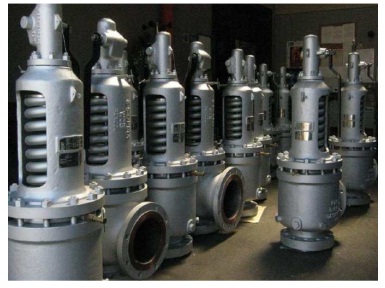
As it is shown in Figure , the conventional  Pressure relief valve is a force balance device that is held closed by a spring when the inlet pressure is below its set pressure. When the set pressure is reached, the upward force overcomes that of the spring, and the valve opens. When the inlet pressure drops below the set pressure by some percentage (this difference is called blowdown), the valve recloses. The housing of the spring is vented to the outlet of the  Pressure relief valves, and therefore the operation of the valve is directly affected by the backpressure

The  Pressure relief valve inlet incorporates a valve seat with a disc for full closure of the inlet port. The disc is usually spring loaded, and the spring force is applied directly on the disc by means of a stem.

To see the animation of working of    pressure relief valves


To know about Pressure Detectors

what is cascade control?

0

A simple control system drawn in block diagram form looks like this:


Information from the measuring device (e.g. transmitter) goes to  the controller, then to the final control device (e.g. control valve), influencing the process which is sensed again by the measuring device. The controller’s task is to inject the proper amount of negative feedback such that the process variable stabilizes over time. This flow of information is collectively referred to as a feedback control loop.
To cascade controllers means to connect the output signal of one controller to the setpoint of another controller, with each controller sensing a different aspect of the same process. The first controller (called the primary, or master) essentially “gives orders” to the second controller (called the secondary or slave) via a remote setpoint signal.


Thus, a cascade control system consists of two feedback control loops, one nested inside the other:

A very common example of cascade control is a valve positioner, which receives a command signal from a regular process controller, and in turn works to ensure the valve stem position precisely matches that command signal. The control valve’s stem position is the process variable (PV) for the positioner, just as the command signal is the positioner’s setpoint (SP). Valve positioners therefore act as “slave” controllers to “master” process controllers controlling pressure, temperature, flow, or some other process variable.


The purpose of cascade control is to achieve greater stability of the primary process variable by regulating a secondary process variable in accordance with the needs of the first. An essential requirement of cascaded control is that the secondary process variable be faster-responding (i.e. less lag time) than the primary process variable.


Strain gauge pressure measurement

0

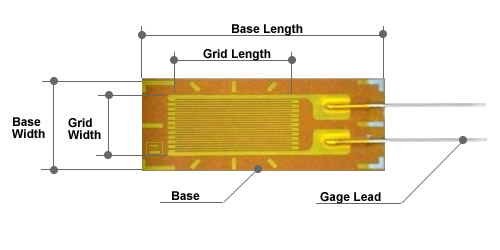
The strain gauge is a passive transducer used to pressure, which converts the change in pressure into a change in resistance as the metal strain gauge deforms because of the pressure applied.

Principle:

The principle of the strain gauge is the Piezoresistive effect, which means “pressure-sensitive resistance,” or a resistance that changes value with applied pressure. The strain gauge is a classic example of a piezoresistive element.

Image result for strain gauge

Electrical resistance of any conductor is proportional to the ratio of length over cross-sectional area (R ? l/A), which means that tensile deformation (stretching) will increase electrical resistance by simultaneously increasing length and decreasing cross-sectional area while compressive deformation (squishing) will decrease electrical resistance by simultaneously decreasing length and increasing cross-sectional area.

The majority of strain gauges are foil type, available in a wide choice and shape and sizes to suit a variety of application.

Working:

Strain gauges in their infancy were metal wires supported by a frame. Advances in the technology of bonding materials mean that the wire can adhere directly to the strained surface. Since the measurement of strain involves the deformation of metal, the strain material need not be limited to being a wire. As such, further developments also involve metal foil gauges. Bonded strain gauges are the more commonly used type.

There is the Wheatstone bridge arrangement where the change in pressure is detected as a change in the measured voltage:


The change in the resistance of the strain gauge breaks the balance of the Wheatstone’s bridge and change the voltage V. The voltage V is proportional to the pressure change in the strain gauge.

Attaching a strain gauge to a diaphragm results in a device that changes resistance with applied pressure. Pressure forces the diaphragm to deform, which in turn causes the strain gauge to change resistance. By measuring this change in resistance, we can infer the amount of pressure applied to the diaphragm.


As strain gauges are temperature sensitive, temperature compensation is required. One of the most common forms of temperature compensation is to use a Wheatstone bridge. Apart from the sensing gauge, a dummy gauge is used which is not subjected to the forces but is also affected by temperature variations. In the bridge arrangement the dummy gauge cancels with the sensing gauge and eliminates temperature variations in the measurement:

Applications:

  • Residual stress
  • Vibration measurement
  • Torque measurement
  • Strain measurement
  • Compression and tension measurement

Advantages:

  • No moving part
  • Wide range, 7.5kPa to 1400 Mpa
  • Inaccuracy of 0.1%
  • Small in size
  • Stable devices with fast response
  •  Good over-range capability

Disadvantages:

  • Unstable due to bonding material
  • Temperature sensitive
  • Thermoelastic strain causes hysteresis


what are venturi tubes?

0

INTRODUCTION

Venturi tubes, flow nozzles, and flow tubes, like all differential pressure producers, are based on Bernoulli’s theorem. General performance and calculations are similar to those for orifice plates. Modern precision manufacturing techniques allow much greater accuracy of the coefficient for venturi tubes and flow nozzles computed from dimensions, and the coefficients are only moderately less reliable than those for orifice plates.

THE CLASSIC VENTURI TUBE

The venturi tube, as designed by Clemens Herschel in 1887.

It consists of

  • A cylindrical inlet section equal to the pipe diameter
  • A converging conical section in which the cross sectional area decreases, causing the velocity to increase with a corresponding increase in the velocity head and a decrease in the pressure head
  • A cylindrical throat section where the velocity is constant so the decreased pressure head can be measured
  • A diverging recovery cone where the velocity decreases and almost all of the original pressure head is recovered

The classic venturi is  manufactured with a cast iron body and a bronze or stainless-steel throat section. At the midpoint of the throat, six to eight pressure taps connect the throat to an annular chamber so that the throat pressure is averaged. The cross-sectional area of the chamber is 1.5 times the cross-sectional area of the taps. Because there is no movement of fluid in the annular chamber, the pressure sensed is strictly static pressure.

Usually, four taps from the external surface of the venturi into the annular chamber are made. These are offset from the internal pressure taps. Throat pressure is measured through these taps. This flow meter is limited to use on clean, noncorrosive liquids and gases, because it is impossible to clean out or flush out the pressure taps if they clog up with dirt or debris.


SHORT-FORM VENTURI TUBE

In the 1950s, in an effort to reduce costs and laying length, manufacturers developed the second-generation or short-form venturi shown in Figure. There were two major differences in this design

The internal annular chamber was replaced by a single pressure tap or, in some cases, an external pressure averaging chamber, and the recovery cone angle was increased from 7 to 21°

The pressure taps are located one-quarter to one-half pipe diameter upstream of the inlet cone and at the middle of the throat section. A piezometer ring is sometimes used for differential pressure measurement. This consists of several holes in the plane of the tap locations. Each set of holes is connected in an annulus ring to give an average pressure. Venturies with piezometer connections are unsuitable for use with purge systems  used for slurries and dirty fluids, because the purging fluid tends to short circuit to the nearest tap holes.

Venturies are built in several forms.

1.These include the standard long-form or classic venturi

2. A modified short form where the outlet cone is shortened , an eccentric form

3.To handle mixed phases or to minimize buildup of heavy materials, and a rectangular form


Installation

A venturi tube may be installed in any position to suit the requirements of the application and piping. The only limitation is that, with liquids, the venturi is always full. In most cases, the valved pressure taps will follow the same installation guidelines as for orifice plates.


 Disadvantages:

  • Calculated calibration figures are less accurate than for orifice plates. For greater accuracy, each individual Venturi tube has to be flow calibrated by passing known flows through the Venturi and recording the resulting differential pressures.
  • The differential pressure generated by a venturi tube is lower than for an orifice plate and, therefore, a high sensitivity flow transmitter is needed.
  • It is more bulky and more expensive.


TO KNOW ABOUT Calibration procedure of DPT transmitter

Radiation level measurement techniques

0

The radiation/nuclear level measurement technique is used to measure the level of fluid or solid in a closed tank using Gamma rays. Gamma radiation sources are chosen for use in level detecting equipment because gamma rays have great penetrating power and cannot be deflected.

Principle:

Level measurement with radiation works on the principle of passing gamma radiation through the material to be measured. As the radiation passes through this material, the level can be determined by the amount of attenuation. The wave attenuates when it passes through materials.

Working and Construction:

The Gamma-ray is emitted from a source to the tank and propagates through the tank. There is a continuous strip detector that detects all the Gamma rays pass across the tank. If the continuous strip detects rays equal to the length and it is in maximum absorption, the tank is empty. As the level rises the absorption level decreases.

Different components of Radiation meter:

The source:

The main component of this type of measuring device is the radioactive source. The two common types of radioactive sources are Caesium 137 (Cs 137) and Cobalt 60 (Co 60). The activity of the radioactive substance decreases with time. The time taken for the activity of such a substance to halve is termed its half-life. Cobalt 60 has a half-life of 5.3 years while Caesium 137, on the other hand, has a half-life of 32 years.

There are strip source and point source:

The stripped source is more accurate as it radiates a long, narrow, uniform beam in the direction of the detector. As the level changes, the detector is covered and protected from the source and the corresponding response changes. The response is uniform and linear over the entire span, producing a linear signal that corresponds with changes in level.

The point source works in a similar way to the strip source system, in that the strip detector measures the radiation from the source. The radiation sensed by the detector is still attenuated with level, however, the point source system produces a non-linear response with level change.

The Strip Detector:

The detector for continuous measurement is a type of scintillation counter and photomultiplier. This type of sensing has the advantage of the high sensitivity of the scintillation crystals (compared to Geiger counters) coupled with the safety and economy of a point source.

The rod scintillation counter is a rod of optically pure perspex within which scintillation crystals are uniformly distributed. In the presence of gamma radiation, the scintillation crystals emit flashes of light which are then detected by a photomultiplier at the base of the rod and converted into electrical pulses.

To improve linearity and accuracy, we use multiple point sources:

Advantages:

  • Suitable for a variety of products
  • Mounted without obstruction
  • Can be mounted external to the vessel

Disadvantages:

  • Must always be mounted on the side of the vessel
  • Special safety measures are required for the use of gamma radiation
  • May also involve licensing requirements
  • Expensive


FAIL SAFE LADDER LOGIC PROGRAM

0

Fail-safe design

In control systems, safety is (or at least should be) an important design priority. If there are multiple ways in which a digital control circuit can be designed to perform a task, and one of those ways happens to hold certain advantages in safety over the others, then that design is the better one to choose.In this session we are gonna discuss about fail safe ladder logic program.

Logic circuits, whether comprised of electromechanical relays or solid-state gates, can be built in many different ways to perform the same functions. There is usually no one “correct” way to design a complex logic circuit, but there are usually ways that are better than others.

Let’s take a look at a simple system and consider how it might be implemented in relay logic. Suppose that a large laboratory or industrial building is to be equipped with a fire alarm system, activated by any one of several latching switches installed throughout the facility. The system should work so that the alarm siren will energize if any one of the switches is actuated. At first glance it seems as though the relay logic should be incredibly simple: just use normally-open switch contacts and connect them all in parallel with each other:

Essentially, this is the OR logic function implemented with four switch inputs. We could expand this circuit to include any number of switch inputs, each new switch being added to the parallel network, but I’ll limit it to four in this example to keep things simple. At any rate, it is an elementary system and there seems to be little possibility of trouble.

Except in the event of a wiring failure, that is. The nature of electric circuits is such that “open” failures (open switch contacts, broken wire connections, open relay coils, blown fuses, etc.) are statistically more likely to occur than any other type of failure. With that in mind, it makes sense to engineer a circuit to be as tolerant as possible to such a failure. Let’s suppose that a wire connection for Switch #2 were to fail open:

What if the system were re-engineered so as to sound the alarm in the event of an open failure? That way, a failure in the wiring would result in a false alarm, a scenario much more preferable than that of having a switch silently fail and not function when needed. In order to achieve this design goal, we would have to re-wire the switches so that an open contact sounded the alarm, rather than a closed contact. That being the case, the switches will have to be normally-closed and in series with each other, powering a relay coil which then activates a normally-closed contact for the siren:


When all switches are un actuated (the regular operating state of this system), relay CR1 will be energized, thus keeping contact CR1 open, preventing the siren from being powered. However, if any of the switches are actuated, relay CR1 will de-energize, closing contact CR1 and sounding the alarm. Also, if there is a break in the wiring

to know  more about   BASIC LADDER LOGIC PROGRAMS

BASIC LADDER LOGIC PROGRAMS

0

Ladder diagrams

Ladder diagrams are specialized schematics commonly used to document industrial control logic systems. They are called “ladder” diagrams because they resemble a ladder, with two vertical rails (supply power) and as many “rungs” (horizontal lines) as there are control circuits to represent.In this session we are going to discuss about basic ladder logic programs If we wanted to draw a simple ladder diagram showing a lamp that is controlled by a hand switch, it would look like this

Digital logic functions           

We can construct simply logic functions for our hypothetical lamp circuit, using multiple contacts, and document these circuits quite easily and understandably with additional rungs to our original “ladder.” If we use standard binary notation for the status of the switches and lamp (0 for not actuated or de-energized; 1 for actuated or energized), a truth table can be made to show how the logic works:

OR GATE

Now, the lamp will come on if either contact A or contact B is actuated, because all it takes for the lamp to be energized is to have at least one path for current from wire L1 to wire 1. What we have is a simple OR logic function, implemented with nothing more than contacts and a lamp.

AND GATE

Now, the lamp energizes only if contact A and contact B are simultaneously actuated. A path exists for current from wire L1 to the lamp (wire 2) if and only if both switch contacts are closed.

NOT GATE

Now, the lamp energizes if the contact is not actuated, and de-energizes when the contact is actuated.

NAND GATE

If we take our OR function and invert each “input” through the use of normally-closed contacts, we will end up with a NAND function. In a special branch of mathematics known as Boolean algebra, this effect of gate function identity changing with the inversion of input signals is described by DeMorgan’s Theorem

 The lamp will be energized if either contact is unactuated. It will go out only if both contacts are actuated simultaneously.

 NOR GATE

Likewise, if we take our AND function and invert each “input” through the use of normally-closed contacts, we will end up with a NOR function:


If we wish to invert the output of any switch-generated logic function, we must use a relay with a normally-closed contact. For instance, if we want to energize a load based on the inverse, or NOT, of a normally-open contact, we could do this:

We will call the relay, “control relay 1,” or CR1. When the coil of CR1 (symbolized with the pair of parentheses on the first rung) is energized, the contact on the second rung opens, thus de-energizing the lamp. From switch A to the coil of CR1, the logic function is non inverted. The normally-closed contact actuated by relay coil CR1 provides a logical inverter function to drive the lamp opposite that of the switch’s actuation status.

Applying this inversion strategy to one of our inverted-input functions created earlier, such as the OR-to-NAND, we can invert the output with a relay to create a non inverted function:

want to know more about  PROGRAMMING LOGIC DEVICES (PLC)

Zero Elevation and Zero Suppression in Level Measurement

0

Introduction

It would be idealistic to say that the DP cell can always be located at the exact the bottom of the vessel we are measuring fluid level in. Hence, the measuring system has to consider the hydrostatic pressure of the fluid in the sensing lines themselves. This leads to two compensations required.Zero Elevation and Zero Suppression in Level Measurement.

Zero Suppression

In some cases, it is not possible to mount the level transmitter right at the base level of the tank. Say for maintenance purposes, the level transmitter has to be mounted X meters below the base of an open tank as shown in Figure

The liquid in the tank exerts a varying pressure that is proportional to its level H on the high-pressure side of the transmitter. The liquid in the high pressure impulse line also exerts a pressure on the high-pressure side.

However, this pressure is a constant (P = S? X) and is present at all times.

When the liquid level is at H meters, pressure on the high-pressure side of the transmitter will be:

Phigh = S?H + S? X + Patm                              s=specific gravity of liquid.

Plow = Patm

?P = Phigh – Plow = S?H + S? X

That is, the pressure on the high-pressure side is always higher than the actual pressure exerted by the liquid column in the tank (by a value of S? X). This constant pressure would cause an output signal that is higher than 4 mA when the tank is empty and above 20 mA when it is full. The transmitter has to be negatively biased by a value of -S? X so that the output of the transmitter is proportional to the tank level (S?H) only. This procedure is called Zero Suppression and it can be done during calibration of the transmitter. A zero suppression kit can be installed in the transmitter for this purpose.

Zero Elevation

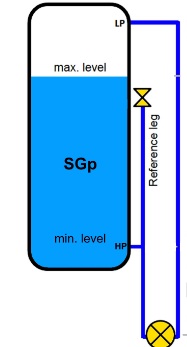
When a wet leg installation is used (see Figure below), the low-pressure side of the level transmitter will always experience a higher pressure than the high-pressure side. This is due to the fact that the height of the wet leg (X) is always equal to or greater than the maximum height of the liquid column (H) inside the tank.

When the liquid level is at H meters, we have:

Phigh = Pgas + S?H

Plow = Pgas + S? X

?P = Phigh – Plow = S?H – S? X

= – S (X – H)

The differential pressure ?P sensed by the transmitter is always a negative number (i.e., low pressure side is at a higher pressure than high pressure side). ?P increases from P = -S? X to P = -S (X-H) as the tank level rises from 0% to 100%

If the transmitter were not calibrated for this constant negative error (-S? X), the transmitter output would read low at all times.

To properly calibrate the transmitter, a positive bias (+S? X) is needed to elevate the transmitter output. This positive biasing technique is called zero elevation.

to know about OPEN & CLOSED LEVEL MEASUREMENT