
- Objective of the HVAC Damper Installation Method Statement
- Scope of HVAC Damper Installation Works
- Governing Standards and Codes for HVAC Dampers
- Definitions
- Roles and Responsibilities in Damper Installation
- Tools, Equipment, and Safety Precautions
- Pre-Installation Requirements for Dampers
- Installation of Volume Control & Motorized VCD Dampers
- Fire Dampers, Smoke Dampers & Relief Dampers Installation
- Testing, Commissioning, and Consultant Approval
- Attachments & Documentation
- Instrumentation & Control Integration with BMS
- FAQ on HVAC Damper Installation
HVAC dampers are very important for making sure that air is distributed safely, efficiently, and reliably in modern building services and industrial facilities. Dampers are put in place to control the flow of air, keep fires from extending, and keep smoke from getting out of hand in case of an emergency. For HVAC dampers to be installed correctly, a method statement must be followed. This is necessary to meet project specifications, safety norms, and international standards like NFPA and UL.
The following article gives a full method description for putting in many kinds of HVAC dampers, such as:
- Volume Control Dampers (VCD)
- Motorized Volume Control Dampers (MVCD)
- Fire Dampers
- Fire Rated Motorized Dampers
- Smoke Motorized Dampers
- Relief Dampers
Instrumentation, MEP, and HVAC EPC design engineers, contractors, and QA/QC teams can use it to make sure that installation is done safely, quickly, and to the right standards.
Objective of the HVAC Damper Installation Method Statement
This method statement sets forth a clear plan for how to install HVAC dampers and what order to do the work in. It makes sure that:
- Requirements for safety, quality, and the environment are met.
- Throughout the life of the project, dampers do their job reliably.
Scope of HVAC Damper Installation Works
This document talks about how to install the following kinds of HVAC dampers:
Volume Control Dampers (VCDs) are used to control the flow of air by hand.
- Motorized VCDs with actuators that let the BMS control them automatically.
- Fire Dampers are used to keep fires from spreading in ductwork.
- Fire-Rated Motorized Dampers combine safety from fire with automation.
- Smoke Dampers stop smoke from spreading during crises.
- Relief Dampers are used to keep the pressure in the system balanced and the duct safe.
The scope is in line with Health, Safety, and Environment (HSE) Plans, Project Quality Plans (PQP), and Inspection Test Plans (ITPs).
Types, Functions, and Importance: What is Damper in HVAC system?
Governing Standards and Codes for HVAC Dampers
The installation will be done according to:
- Approved drawings for the HVAC shop.
- Project requirements and material submissions.
- PQP is for Project Quality Plan and ITP stands for Inspection Test Plan.
- The Health, Safety, and Environmental Plan (PSP/HSE) and the NFPA requirements for fire and smoke dampers.
- UL rules for connecting ducts and making sure dampers work.
Definitions
To be consistent, this method statement uses the following words and abbreviations:
- PQP – Project Quality Plan
- PSP – Project Safety Plan
- ITP – Inspection Test Plan
- WIR – Work Inspection Request
- MIR – Material Inspection Record
- QA/QC – Quality Assurance & Quality Control
Calculate Reliable Backup Power Needs: Fire Alarm Battery Size Calculator – Professional Tool for Accurate Backup Power Sizing
Roles and Responsibilities in Damper Installation
To install something successfully, you need to coordinate across multiple fields:
- The project manager is in charge of making sure that resources, equipment, and PQP/PSP compliance are all in order.
- Construction Manager: In charge of overseeing the work, testing, and commissioning.
- Site Engineer: Makes ensuring that technicians follow the drawings, reports on progress, and guides them.
- QA/QC Engineer checks for conformity, raises WIR/MIR, and gets approval from the consultant.
- The site foreman is in charge of the workers, gives them assignments, and makes sure they follow the rules.
- The Safety Officer makes sure that HSE rules are followed and checks that they are.
- Store Keeper: Makes sure that dampers and accessories are stored safely and only given out as needed.
Tools, Equipment, and Safety Precautions
To install a damper safely and correctly, you need the following:
- Hand Tools: A toolbox, wrenches, screwdrivers, and a torque wrench.
- Power Tools: A drill with bits for concrete.
- Equipment for lifting: chain block, crane, and forklift for big dampers.
- Tools for measuring: a measuring tape, a spirit level, and a marker.
- Digital multimeter and ammeter for checking the actuator are two testing tools.
- Wear a safety helmet, gloves, steel-toed shoes, eye protection, and a high-visibility vest.
Safety PPE for Damper Installation Activities
The most important thing to remember while installing HVAC is safety. When installing dampers, workers typically have to operate at heights, move heavy items, and connect electrical and pneumatic actuators. This implies that several dangers must be managed. Important safety steps are:
Trained Personnel Only:
People who use power tools, lifting devices, and electrical testing gear must be taught and certified to do so. For instance, only licensed riggers should use cranes or chain blocks, and only professional electricians should work with actuator wire.
Mandatory Use of PPE:
PPE is required: Workers must always wear safety helmets, steel-toed boots, gloves, safety glasses, and vests that are easy to see. Face shields and dust masks should also be worn when cutting or grinding ducts.
Barricades and Safety Nets:
When dampers are used in risers, shafts, or above ducting, there is a chance that things will fall. Put up caution tapes, barricades, and safety netting around work locations to keep workers and those surrounding safe.
Adequate Lighting:
Night shifts, mechanical rooms, and ceiling spaces that don’t get enough natural light should all have enough lighting. There should also be emergency lighting.
Inspected Lifting Equipment:
Before using cranes, forklifts, chain blocks, and slings, they must be checked, tested with a load, and marked. Damaged dampers and accidents on the job site are often caused by lifting things the wrong way.
Controlled Site Access:
Only workers with valid Work Permits should be able to get to the work area. This makes sure that the HVAC, electrical, civil, and fire safety teams all work together well.
Complete Guide for Engineers: 30+ International Standards for Control Systems: The Complete Guide for Automation & Instrumentation Engineer
Pre-Installation Requirements for Dampers
Before you may begin installing in the damper, you need to do a few things first:
Drawing and Schedule Approval:
Check the most recent IFC drawings, damper schedules, and coordination layouts for approval of the drawing and schedule. Installation must precisely follow these plans to make sure that everything lines up with other services like cable trays and sprinkler pipes.
Site Readiness:
Make sure that the duct supports, insulation, and access points are all in place. Before putting in the damper, any civil or electrical work that is still going on should be finished.
Safe Handling and Transport:
You should never carry dampers by their blades, actuators, or linkages. Instead, you should use frames or sleeves. Forklifts should have padding on the edges to protect them from harm, and dampers should not be dragged on the floor.
Physical Inspection:
Look for dents, bent frames, missing screws, or broken actuators. Even tiny changes can make air leak or cause the actuator to over-torque.
Instrumentation Readiness:
The team in charge of instrumentation should check the actuator voltage, signal type (0–10V, 4–20mA, or ON/OFF), and wiring paths. Make sure that the BMS panels are set up to work with the actuator if it supports BACnet or Modbus.
Access for Maintenance:
Make sure there are access doors or removable duct sections so that actuators may be checked, fixed, and replaced.
Estimate Airflow Resistance with Precision: HVAC Fan Static Pressure Calculator – Accurate Airflow Resistance Estimator for Fan Sizing
Installation of Volume Control & Motorized VCD Dampers
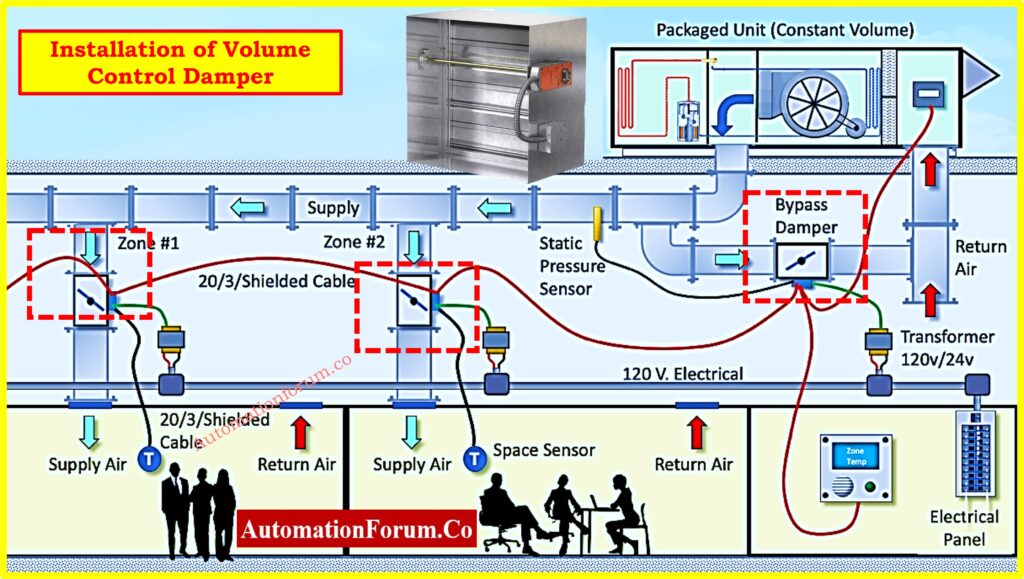
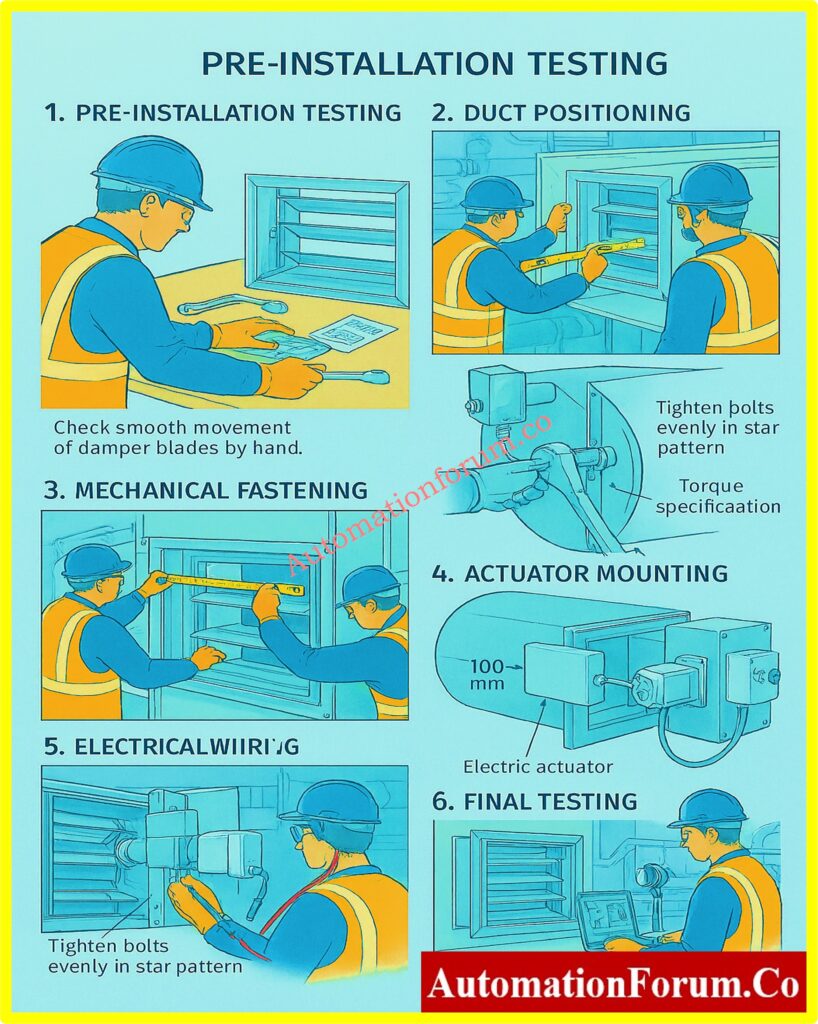
Cycle Testing Before Installation:
Before installation, do a cycle test by turning the blades by hand to make sure they move smoothly and don’t get stuck. This shows that the damper has not been bent.
Positioning in Duct Opening:
Put the damper directly in the middle of the duct opening. Don’t twist, rack, or squeeze the frame to make it fit, as this will throw off the alignment of the blades.
Fastening and Alignment:
Follow the manufacturer’s directions to attach the damper with screws, bolts, or rivets. To keep the frame from bending, keep the spaces between the pieces uniform and use shims if you need to.
Structural Bracing:
For big ducts or systems that move air quickly, use horizontal mullion bracing and vertical supports to keep them from vibrating and being pushed by air pressure.
Actuator Mounting (Motorized VCDs):
- For easier access, actuator shafts should stick out around 100 mm from the duct.
- When feasible, make sure that actuators are not in the path of the air.
- Securely connect the actuator linkage, making sure not to apply too much torque.
Electrical/Control Wiring:
- Follow the control schematics to connect the actuator wiring.
- Check the polarity of the analog signals (0–10VDC or 4–20mA) for modulating actuators.
- Give BMS feedback connections (open/close).
Operational Check:
- Turn the damper on and off by hand and using the actuator. All parts must open and close at the same time. Before giving it to someone, any binding must be fixed.
Refer the below link for the 82 Essential Drawings and Documents for Instrumentation and Control Engineers
Fire Dampers, Smoke Dampers & Relief Dampers Installation

Clearance Around Sleeves:
- NFPA 90A and the manufacturer’s instructions say that there should be at least ¼ to 1½ inches of space between the damper sleeves and the wall or floor openings. This allows for thermal expansion during fire.
Sleeve Insertion:
- insert the damper sleeve into the hole that has been made. On the actuator side, the sleeve extension can’t be more than 16 inches, and on the other side, it can’t be more than 6 inches.
Duct Termination:
Retaining Angles:
- Install 16-gauge steel retaining angles on both sides of the wall or floor. Use bolts to hold it down, with at least two on each side and 6 inches between them.
Fusible Link & Spring Check:
- Check that the fusible links (which normally melt at 165°F / 74°C) and closure springs are working properly. If it’s broken, get a new one.
Actuator Connections (Motorized Dampers):
- Connect the wires to the actuators according to the approved schematics.
- Check the BMS/fire alarm signals to see if they work for opening and closing the damper.
- Make sure that the actuators get the right voltage and frequency.
Smoke Control Integration:
- The Fire Alarm System (FAS) must be able to close and open smoke dampers based on smoke detection. Check the fail-safe position (open or closed) according to the design.
Methods, Design, and Safety Applications: Smoke control for HVAC system
Access for Maintenance:
- Make sure there are doors or removable duct sections that can be opened for inspection and testing on a regular basis.
Consultant Approval:
- After the installation is done, you need to get consultant approval by raising Work Inspection Requests (WIR). No duct insulation should be done unless it is approved.
Determine Accurate Duct Diameters Easily: HVAC Circular Duct Size Calculator – Accurate Airflow and Diameter Sizing Tool
Testing, Commissioning, and Consultant Approval
Testing dampers properly makes sure they work well in both normal and emergency situations:
- Functional Testing: Manually and with actuators, cycle the dampers. Blades should move freely and not make too much noise or torque.
- Testing for Integration: Check the reaction of the actuator from the BMS/DDC panels. Make sure that the open/close signals and feedback connections work properly.
- Fire and Smoke Simulation: Check the release of the fusible link for fire dampers. Use fire alarm signals to open and close smoke dampers to make sure they work.
- Leakage Testing: Check closed dampers for leaks that are too big according to ASHRAE and project criteria.
- Final Documentation: Write down the results in QA/QC checklists, get the consultant’s approval, and make changes to the as-built drawings.
Place Detectors Accurately Every Time: Fire Alarm Detector Coverage Calculator – Professional Excel Tool for Accurate Detector Placement
Attachments & Documentation
- Inspection and Test Plan (ITP) that lists the inspection points and the witness and hold stages.
- Installation Checklist: making sure that all mechanical, electrical, and control work is done.
- Risk Assessment: finding dangers such working with hot materials, lifting, and going into small spaces.
Improve HVAC Air Distribution Efficiency: Rectangular Duct Air Velocity Calculator for HVAC Engineers
Instrumentation & Control Integration with BMS
From a controls point of view, dampers are an important aspect of airflow automation loops:
- Motorized VCDs: Get control signals from BMS that are either analog (0–10VDC or 4–20mA) or digital (ON/OFF).
- Fire/Smoke Dampers: Connected to Fire Alarm Panels so they close automatically when there is a fire.
- Feedback Monitoring: The actuator position feedback (either open/close end switches or modulating feedback) is sent back to the BMS.
- Critical Facilities: In cleanrooms, data centers, or pharmaceutical facilities, dampers may work with pressure differential transmitters to make sure that the environment is controlled exactly.
Basics Explained for Beginners & Engineers: What is an HVAC System ?
So, installing dampers connects mechanical HVAC systems and instrumentation control systems, making it an important safety and automation task.
Installing HVAC dampers involves accuracy, following safety rules, and following NFPA/UL regulations. A well-organized method statement makes sure that VCDs, motorized dampers, fire dampers, and smoke dampers work properly, keep people safe, and improve airflow control.
EPC engineers, contractors, and project teams can make sure that HVAC systems are installed correctly, are approved for inspections quickly, and work well for a long time by following this instructions.
Refer the below link for the Circular HVAC Duct Air Velocity Calculator for Engineers
FAQ on HVAC Damper Installation
Where should HVAC dampers be installed?
HVAC dampers are usually put inside ductwork or at areas where ducts branch off to control the flow of air.
- To balance the flow of air, Volume Control Dampers (VCDs) are put in main ducts or branches.
- Fire and Smoke Dampers are put in place when ducts go through walls or floors that are fire-rated to stop the spread of fire and smoke.
- Most of the time, relief dampers are put close to air handling units (AHUs) or fans to keep pressure variations in check.
- Motorized dampers are commonly put in places where BMS controls the airflow automatically.
How do you install dampers?
Damper installation involves:
- Pre-check: Make sure the consultant has approved the materials and designs.
- Positioning: Put the damper in the duct opening so that it is level and does not twist.
- Fastening: Use screws, bolts, or rivets to hold the damper in place with the right amount of space between them.
- Bracing is adding supports to keep the frame from vibrating and bending.
- If the actuator is motorized, extend the shaft outside the duct for access and attach it according to the wiring schematic.
- Testing: For motorized dampers, check the signal response with the BMS or control system while manually cycling the blades.
How to set HVAC dampers?
- Manual Dampers (VCDs):
Set during system air balancing by moving the blades to get the right CFM (cubic feet per minute) of air in each zone. A handle or quadrant is then used to lock the position. - Motorized Dampers:
BMS/DDC panels control them automatically. Control logic, not manual adjustment, sets the actuator to open or close according on temperature, pressure, or fire alarm signals.
What is a HVAC damper?
An HVAC damper is a mechanical part that is put inside ducts to control or stop the flow of air. Dampers can be:
- Manual (VCDs): you can change them by hand to balance the airflow.
- Motorized: operated by electric or pneumatic actuators and connected to automation systems.
- Fire/Smoke Dampers are safety devices that close on their own when there is a fire to keep flames and smoke from spreading.
- Relief Dampers are dampers that automatically open and close dependent on the pressure in the system.
When to use HVAC damper?
When you need to, use dampers:
- Make sure that air flows evenly throughout rooms or areas.
- Combine zone control with automation (BMS/DCS).
- Stop fire and smoke from spreading through ducting.
- Take away extra pressure from HVAC systems.
- Stop the passage of air for maintenance or to keep things separate.
Dampers are very important for keeping the atmosphere under control and keeping people safe in important places like cleanrooms, data centers, and hospitals.
How many dampers on HVAC?
The number of dampers depends on how the system is set up, zoning rules, and safety codes:
- Most of the time, each branch duct contains at least one VCD to keep things in balance.
- A fire/smoke damper is needed for every wall or floor that is rated for fire.
- There is at least one motorized damper in each zone that the BMS controls.
- Most of the time, relief dampers are put in for each AHU or fan segment.
In a medium-sized office building, for instance, you might have dozens of VCDs, several fire/smoke dampers, and many motorized dampers, depending on how the ducts are set up and how many zones you want to regulate.
