
- Why MTTD Calculation is Important in the Process Industry
- What is MTTD (Mean Time To Detect)?
- MTTD Calculation Formula
- How to use the MTTD Calculator Step by Step
- Real-World Examples of MTTD in Process Instrumentation
- Where is MTTD used in Process Instrumentation?
- Who Should use this MTTD Calculator?
- Benefits of MTTD Calculation in Instrumentation
- Common Errors to Avoid in MTTD Calculations
- MTTD vs MTTA vs MTTR vs MTBF vs MTTF – Understanding the Differences
- Instrumentation Examples Where MTTD is Critical
- Is a Higher or Lower MTTD Better?
- How to Reduce MTTD
- MTTD Calculator – Inputs & Interpretation
- FAQ on MTTD Calculation
This Mean Time To Detect (MTTD) Calculator was made for the instrumentation, reliability, and operations teams in the process industry. It lets you figure out how long it usually takes to find a failure or abnormal state after it happens. This is important for increasing asset availability, shortening total outage windows, and making alarms and monitoring more effective.
MTTD has a direct impact on how quickly maintenance can even start. For transmitters, PLC I/O, control valves, solenoid valves, analyzers, and industrial networks, faster detection means that repairs can start sooner, which means less overall downtime and better OEE, safety integrity, and SLA compliance.
Why MTTD Calculation is Important in the Process Industry
Accurately calculating MTTD helps you:
- Figure out how well alarms and monitoring systems work and find their weak points.
- Reduce down on the amount of time equipment stays broken before action occurs.
- Increase OEE Availability by finding failures sooner.
- Check the responsiveness of vendor/service SLAs by watching contracts.
- Put diagnostics, online condition monitoring, and alarm rationalization at the top of your list.
- Explain why you are spending money on analytics, redundancy, and health monitoring.
A low MTTD makes sure that failures don’t go unnoticed for 24 hours a day, 7 days a week, which keeps production going and keeps people safe.
What is MTTD (Mean Time To Detect)?
Mean Time To Detect (MTTD) is the average amount of time that passes between the start of a failure (or abnormal situation) and the time it is found (alarm raised, event flagged, or issue observed).
A lower MTTD indicates that the plant can spot problems more rapidly. When combined with good MTTA/MTTR performance, this leads to faster triage, faster work requests, and shorter outages overall.
MTTD is all about discovery latency. It doesn’t include the time it takes to acknowledge (MTTA) or fix (MTTR).
MTTD Calculation Formula
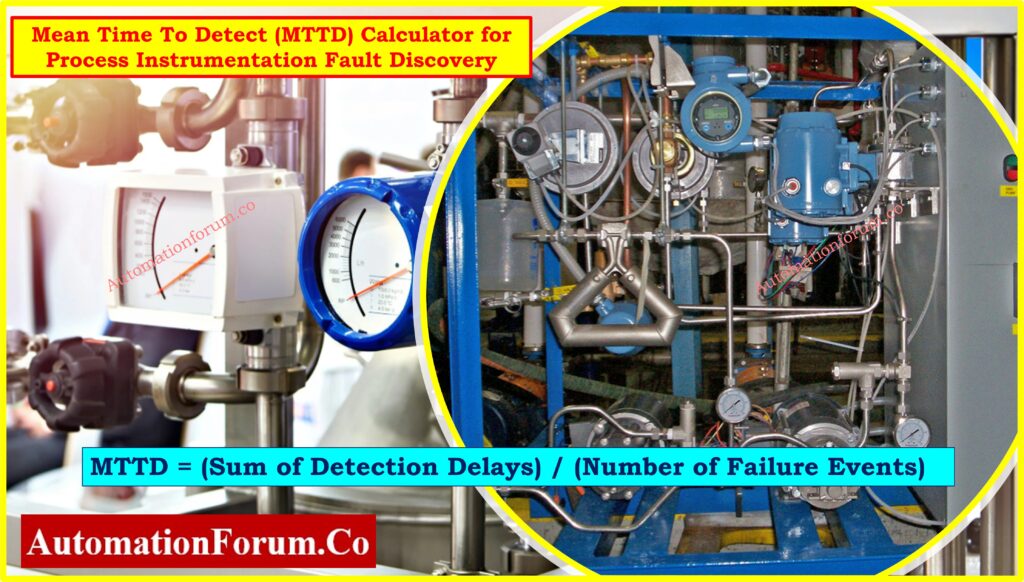
MTTD = (Sum of Detection Delays) / (Number of Failure Events)
Where:
- Detection Delay for each event = Detection Timestamp – Failure Start Timestamp
- Failure Events = Count of unplanned, repairable failure/abnormality occurrences in the period
Units: minutes or hours (keep consistent across events)
Please don’t include planned testing or shutdowns; only look at failures or unexpected situations that happen without warning.
How to use the MTTD Calculator Step by Step
- Capture Failure Start Time: From event logs, diagnostics, sequence-of-events (SOE), historian trends, or timestamps of system faults.
- Capture Detection Time: This is the time of the alarm logs, the time the CMMS work request was made, or the time the SOC/NOC alert went off.
- Compute Detection Delay for Each Event: Detection Time – Failure Start Time.
- Sum All Detection Delays & Count Events.
- Calculate MTTD: Divide total detection delay by the number of events.
- Interpret: Lower MTTD = faster discovery. Track trend monthly/quarterly by asset class.
Real-World Examples of MTTD in Process Instrumentation
Example 1: Analyzer Sample System Plugging
- Five plugging incidents in a month.
- Detection delays (hrs): 2.0, 1.5, 3.0, 1.0, 2.5 – Total = 10.0 hrs
- MTTD = 10.0 / 5 = 2.0 hours
Example 2: PLC Output Card Partial Failure (One Channel)
- Three incidents. Delays (min): 30, 45, 20 – Total = 95 min
- MTTD = 95 / 3 ≈ 31.7 minutes
Interpretation: Not bad, however event-driven diagnostics and loopback integrity tests could help find problems in less than 10 minutes.
Where is MTTD used in Process Instrumentation?
| Application Area | MTTD Role |
| Alarm Management (ISA-18.2) | Measures how quickly alarms reflect true abnormal states. |
| CM & Predictive Monitoring | Validates effectiveness of health/condition tags. |
| OEE (Availability) | Reduces unobserved downtime window prior to action. |
| SLA Performance | Confirms monitoring/alerting responsiveness. |
| Functional Safety (Ops) | Faster discovery of bypasses, trips, or degraded states. |
| RCA & Reliability | High MTTD highlights blind spots, poor visibility, or noisy data. |
Who Should use this MTTD Calculator?
- Instrumentation Maintenance Engineers: Check that critical loops can be detected.
- Engineers that work on reliability should look at the trends in MTTD and MTTR to tell the difference between monitoring problems and repair problems.
- Control and DCS Engineers: Set the right alarm thresholds, delays, and SOE time sync integrity.
- SIS Engineers: Quickly find demand and fault states for safety functions.
- Operations/Shift Supervisors: Make sure that the panel and alarm response routines start on time.
- OEMs and vendors should show how they monitor SLA performance when they offer remote diagnostics.
Benefits of MTTD Calculation in Instrumentation
- Increases the availability of assets: Starts the clock for repairs early.
- Makes alarm and monitoring design stronger: alarm rationalization based on data.
- Helps When detection is faster, staging becomes useful.
- Improves safety by making it easier to spot blocked interlocks, bypassed trips, and bad actors.
Common Errors to Avoid in MTTD Calculations
- That’s MTTA/MTTR territory, where you use repair start time instead of detection time.
- Including planned tests or shutdowns that aren’t real failures.
- Time-sync problems between the PLC/DCS, historian, and CMMS make sure that NTP is correct.
- Counting false alarms as detections when they weren’t linked to a true breakdown.
- Combining metrics: Don’t mix up MTTD (finding out), MTTA (acknowledging), and MTTR (fixing).
MTTD vs MTTA vs MTTR vs MTBF vs MTTF – Understanding the Differences
| Metric | Full Form | Used For | Repairable? | Indicates |
| MTTD | Mean Time To Detect | Detection/monitoring speed | Yes | Time from failure occurrence to detection |
| MTTA | Mean Time To Acknowledge | Operator response to alarm | Yes | Time from detection to human/system acknowledgment |
| MTTR | Mean Time To Repair | Restoration speed | Yes | Time from start of repair to functional restoration |
| MTBF | Mean Time Between Failures | Reliability | Yes | Average operating time between failures |
| MTTF | Mean Time To Failure | Life of non-repairables | No | Time until first/final failure |
Refer the below link for the MTBF Calculator for Instrumentation Maintenance Reliability Planning
Instrumentation Examples Where MTTD is Critical
| Equipment Type | Why MTTD Matters |
| Pressure Transmitter | Early detection of freeze-off, impulse line blockage, or drift prevents hidden bad readings. |
| Control Valve/Positioner | Detects stiction, travel deviation, or air failure before quality loss escalates. |
| PLC I/O Modules | Identifies channel faults, degraded comms, or rack issues rapidly. |
| Radar Level Transmitter | Flags weak echo, false level, or configuration loss early. |
| Temperature Sensors (RTD/TC) | Detects open/shorted sensors before batch quality suffers. |
| Analyzers | Highlights sample system issues, calibration drift, and analyzer health. |
Is a Higher or Lower MTTD Better?
Lower is always better. It means:
- Faster awareness and triage
- Less loss of production before action begins
- Less exposure to states that are dangerous or not in compliance
- Better performance on SLAs and KPIs
A more MTTD could mean that there are blind spots, alarms are not set up correctly, diagnostics are not good enough, or people are not following the right training/workflow.
Must-have for calculation for instrumentation and maintenance Engineer: Mean Time To Repair (MTTR) Calculator for Process Instrumentation Downtime Analysis
How to Reduce MTTD
- Alarm Rationalization (ISA-18.2 / EEMUA 191): Set the right priority, restrictions, and shelving rules.
- Heartbeat and watchdog signals: Find silent communication problems.
- Sequence-of-Events (SOE): Capture events in milliseconds with clocks that are in sync (NTP/PTP).
- Condition Monitoring: vibration, DP across filters, and loop performance indexes.
- Dashboards and Notifications: Direct to the right role, including escalation.
- Operator Training and SOPs: Make sure that everyone responds to alarms and logs in the same way.
- Bad Actor Elimination: Get rid of the things that keep causing false alarms that disguise real ones.
Refer the below link for the Mean Time To Failure (MTTF) Calculator for Instrumentation Reliability Assessment
MTTD Calculator – Inputs & Interpretation
Inputs (for a chosen period/asset class):
- A list of start timings for failures
- Alarm/log/SOE/CMMS generation timestamps that match
Outputs:
- MTTD (average minutes/hours)
- Distribution (min, max, 90th percentile) to find outliers
- Trend (month-on-month) to check for progress
Interpretation Tips:
- Keep an eye on MTTD, MTTA, and MTTR all at once. The sum is a rough estimate of the overall outage exposure when failures affect availability.
- Group by how important the asset is and how the service is delivered (continuous vs. batch).
- Use control charts to find differences when you adjust your alarm approach.
You must track:Top 10 Essential Maintenance Metrics Every Reliability Engineer Must Track
FAQ on MTTD Calculation
Does MTTD include acknowledgment or repair time?
No. MTTD terminates as soon as the problem is found or flagged. MTTA is for acknowledgment, and MTTR is for repair.
What data sources are best for MTTD?
Alarm/Event logs, SOE, historian trends, device diagnostics, and timestamps for creating CMMS requests (make sure the clocks are in sync).
How often should I calculate MTTD?
Monthly for each asset class, and quarterly for plant-level KPIs.
What is a good MTTD target?
For important loops, try to get them done in less than five minutes (usually less than one minute with good diagnostics). For assets that aren’t vital, make sure they are in line with risk and OEE impact.
How does MTTD improve safety?
It makes it possible for faster safety measures and recovery operations by shortening the time that risky conditions stay unknown.
Here you can find over 200+ online instrumentation calculators
