
This Mean Time To Failure (MTTF) Calculator is a powerful tool for instrumentation engineers, reliability professionals, and maintenance planners. It helps you predict the average time a non-repairable component will function before failing, which is essential in improving system design, ensuring safety, and choosing the right spare parts strategy.
MTTF is a fundamental metric in reliability engineering, particularly for non-repairable process instrumentation components like sensors, fuses, or electronic modules where replacement not repair is the only option after failure.
Why MTTF Calculation Important in Process Instrumentation
Accurate MTTF values enable:
- Selecting the most reliable equipment during design and procurement.
- Predicting lifecycle performance for critical components.
- Supporting safety assessments for devices used in SIS (Safety Instrumented Systems).
- Estimating spares demand and replenishment schedules for single-use or sealed components.
- Designing robust replacement cycles that prevent unplanned shutdowns.
In sectors such as oil & gas, chemicals, pharmaceuticals, and utilities where uptime, safety, and precision are non-negotiable MTTF helps engineers plan better, purchase smarter, and operate safer.
What is MTTF (Mean Time To Failure)?
MTTF stands for Mean Time To Failure and represents the average operational time before failure for a non-repairable device. Once such a device fails, it cannot be repaired it must be replaced.
This reliability metric is mostly used for:
- Passive sensors (e.g., thermocouples)
- Electronics without field-serviceable components
- Fuses, relays, and sealed transmitters
- One-time-use safety devices or protection elements
MTTF Calculation Formula
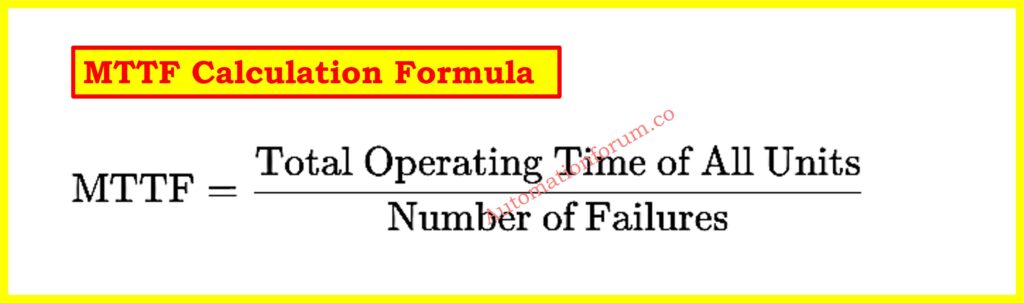
Where:
- Total Operating Time = Sum of all usage hours before failure
- Number of Failures = Number of failed units in that observation period
Note: MTTF is used only for non-repairable items. If the item can be repaired and reused, use MTBF (Mean Time Between Failures) instead.
Try the MTTF Calculator Now
Use this calculator to get actionable reliability insights and optimize your replacement strategies before failure strikes.
How to use the MTTF Calculator?
- Record Operating Hours: Collect the total runtime of identical units in similar service conditions.
- Track Failures: Count the number of times failure occurred (typically in the field or via stress testing).
- Enter Data: Input total hours and failure count into the calculator.
- Interpret the MTTF: A longer MTTF indicates better reliability for the given component.
Real-World MTTF Examples in Instrumentation
Example 1: Thermocouple in a Furnace Control System
- Total operating time: 12,000 hours
- Number of failed units: 4
MTTF = 12,000 / 4 = 3,000 hours
Interpretation: The average thermocouple lasts 3,000 hours in this application. If this is below process tolerance, consider switching to higher-grade thermocouples or increasing protection from thermal cycles.
Example 2: Pressure Sensor in Nitrogen Purging Skid
- Operating hours (5 units): 5 x 8,000 = 40,000 hours
- Failures: 2 sensors failed after 10 and 14 months, respectively
MTTF = 40,000 / 2 = 20,000 hours
Interpretation: The sensor has high reliability, suggesting suitability for continuous operation. Use this data for predictive spare planning.
Where is MTTF used in Process Instrumentation?
| Application Area | MTTF Role |
| Asset Reliability Studies | Predicts time-to-failure trends for non-repairable devices |
| Safety Instrumented Systems | Helps define test intervals for one-shot components |
| Procurement Specs | Select components with longer expected life |
| Spare Inventory Planning | Supports demand forecasting for one-time-replace items |
| Instrument Replacement Cycle Planning | Establish ideal replacement intervals before failure occurs |
Who Should use the MTTF Calculator?
- Reliability Engineers: To assess and compare expected life spans of various field devices.
- Instrument Maintenance Planners: For smarter stocking and timely replacements.
- OEMs & EPCs: To rate product life during design qualification.
- Safety Engineers: To estimate longevity in SIL-rated instrumentation.
- Procurement Teams: To select vendors based on failure data.
Benefits of Calculating MTTF in Instrumentation
- Helps in selecting longer-lasting devices
- Supports reliability-centered maintenance (RCM) planning
- Improves system uptime by avoiding surprise failures
- Enables predictive inventory management
- Supports risk-based maintenance and SIL assessment
Common Mistakes in MTTF Estimation
- Mixing up repairable components with MTTF (use MTBF instead)
- Using limited sample sizes or data from inconsistent environments
- Including standby units that haven’t failed or been in active service
- Ignoring environmental or load-related stress differences
- Assuming MTTF equals warranty period (it usually doesn’t)
Optimize Downtime Using MTTR Calculator: Mean Time To Repair (MTTR) Calculator for Process Instrumentation Downtime Analysis
MTTF vs MTBF vs MTTR – Quick Comparison
| Metric | Full Form | Used For | Repairable? | Indicates |
| MTTF | Mean Time To Failure | Non-repairable items | No | Time until failure occurs |
| MTBF | Mean Time Between Failures | Repairable equipment | Yes | Time between two failures |
| MTTR | Mean Time To Repair | Repair time post-failure | Yes | Time taken to fix equipment |
Refer the below link for Top 10 Essential Maintenance Metrics Every Reliability Engineer Must Track
Examples Where MTTF is Critical in Instrumentation
| Equipment Type | Why MTTF Matters |
| Thermocouple | Often fails due to thermal cycling replacement planning is key |
| Photoelectric Sensors | Non-serviceable; used in material handling |
| Gas Detection Sensors | Electrochemical cells with fixed life |
| Fuses | Designed to fail once timely replacement ensures circuit protection |
| Optical Encoders | Fail due to wear or optics degradation |
MTBF Analysis for Plant Reliability: Mean Time Between Failures (MTBF) Calculator for Process Instrumentation Maintenance(Repairable Instruments)
Is a Higher or Lower MTTF Better?
Higher MTTF is better. It means:
- Less frequent failures
- Lower total cost of ownership
- Increased uptime and productivity
- Fewer unscheduled shutdowns
- Better vendor reliability
A low MTTF can indicate substandard quality, environmental stress, or misuse in application.
Here you can find over 200+ online instrumentation calculators
 for process instrumentation. Optimize non-repairable component lifecycle, reliability, and spare parts planning.)