
Introduction to Fire and Gas Detection Systems
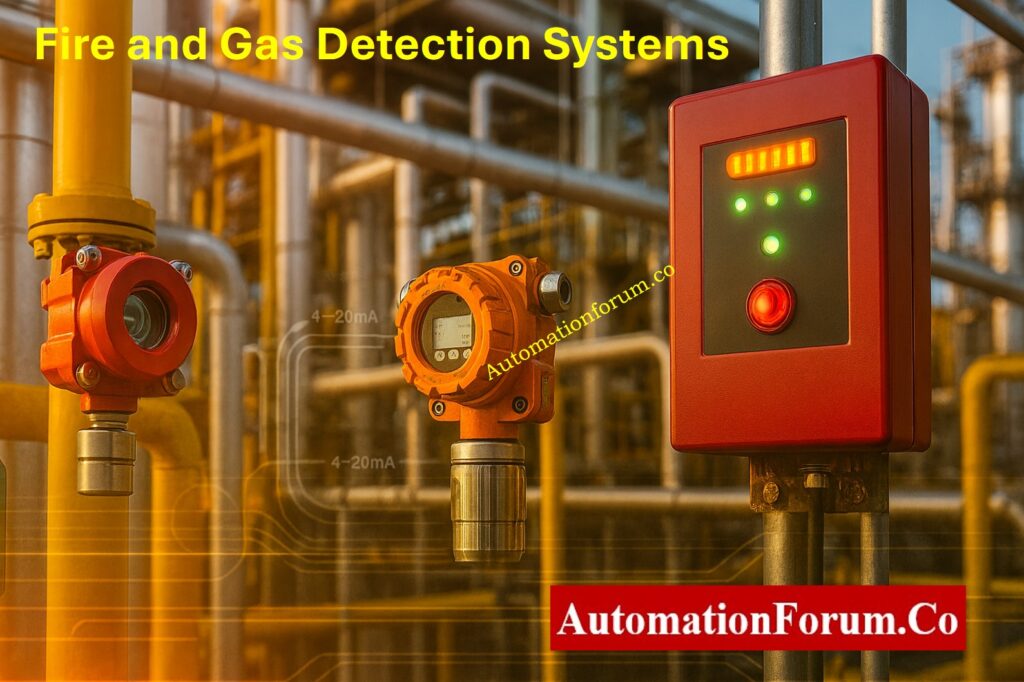
An integral feature of industrial safety automation is a Fire and Gas Detection System (FGS), which is meant to constantly watch for and respond to gas or fire releases. It is an important part of the Safety Instrumented System (SIS) or Emergency Shutdown (ESD) design of a facility.
These systems are the first line of defense against disasters in large industrial places like refineries, petrochemical complexes, offshore platforms, and power plants.
Core Functions of Fire and Gas Systems
- Detect flammable and toxic gases in process and utility areas all the time. This can help you find any leaks or problems before they get worse.
- Detect smoke, flames, or an unusual spike in temperature that shows a fire is starting so that you can respond quickly and manage it.
- Control panels and field equipment can sound and show alarms, directing people to safe exits and corrective actions.
- Automatically turn on things like deluge systems, fire suppression units, emergency isolation valves, or ventilation shutdowns to limit the damage.
🔥 Fire and Gas Detectors Classification 🔥
Classification of Fire and Gas Detectors
Fire and gas detectors are mostly grouped by the kinds of dangers they are meant to find. There are two main groups:
- Gas detectors, which can tell if there are flammable or poisonous gases around.
- Fire detectors pick up on signs of fire, like smoke, flames, or heat.
Each category uses special detecting technologies that are best for certain manufacturing environments and hazards.
Learn the Real Importance of Fire and Gas Detection Systems in Industries: Importance of Fire & Gas Detection System
Gas Detectors
Gas detectors are very important since they constantly check the air for dangerous or combustible gases. They are typically split into two primary types based on how they are used and what kind of gas they are:
- Flammable Gas Detectors
- Toxic Gas Detectors
Master Intrinsic Safety Systems – Ex ia, Ex ib, and Ex ic Explained: Intrinsic Safety Protection Systems: Understanding Ex ia, Ex ib, and Ex ic
Flammable Gas Detectors
Flammable gas detectors are made to check how much combustible gas is in the air. Most of the time, the measurements are given as a percentage of the Lower Flammable Limit (LFL) or the Upper Flammable Limit (UFL).
These detectors are very important for stopping explosions and fires by giving early warnings in places where hydrocarbons are processed, compressors are used, and storage facilities are used.
Common technologies used to find flammable gas:
- Catalytic (Pellistor) Gas Detectors
- Infrared (IR) Gas Detectors
- Open Path (Line-of-Sight) Infrared Gas Detectors
Catalytic (Pellistor) Gas Detector – Working Principle and Features
Working Principle:
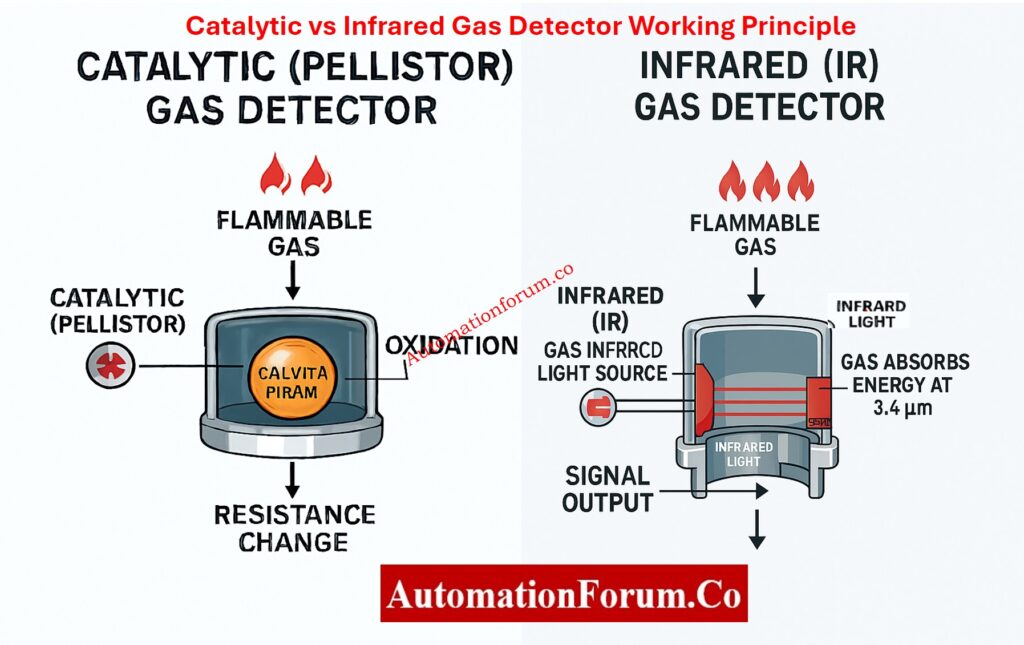
Catalytic gas detectors work on the oxidation principle, which means that combustible gases touch a heated catalytic bead. This contact causes fire, which makes heat. The Wheatstone bridge circuit’s electrical resistance varies when the temperature goes up, which lets the detector read gas concentration correctly.
Key Features and Applications:
- Very good at detecting hydrocarbon gases like methane, propane, and butane that are often present in oil and gas operations.
- Works best in places with a lot of oxygen, where catalytic oxidation can happen quickly.
- Needs to be calibrated every so often to make sure it is accurate, especially in places where silicones or sulfides could poison the sensor.
Typical Alarm Settings:
- Low Alarm: 20% LFL (Early warning of gas presence)
- High Alarm: 60% LFL (Critical gas level demanding immediate action)
Infrared (IR) Gas Detector – Working Principle and Advantages
Working Principle:
Infrared gas detectors measure how much infrared radiation is absorbed at certain wavelengths. A reference wavelength that isn’t impacted by gas is used to compare hydrocarbon gases, which absorb IR light at about 3.4 µm. The ratio of these two readings gives a precise measure of gas concentration, regardless of how old the sensor is or how strong the source is.
Advantages and Applications:
- Works well even in places with low oxygen levels, when catalytic detectors might not work.
- Not affected by typical poisons including lead, silicones, and sulfur compounds.
- Commonly used in refineries, offshore facilities, gas turbine enclosures, and LNG plants where dependability and quick reaction are very important.
Recommended Alarm Settings:
- Low Alarm: 20% LFL
- High Alarm: 60% LFL
Open Path (Line-of-Sight) IR Gas Detector – Coverage and Applications
Working Principle:
Open Path detectors send a beam of infrared light over extended distances (up to 200 meters) from a transmitter to a receiver. Any gas that can catch fire that gets inside the beam path takes in some of this IR energy. To find the total amount of gas in that area, you utilize the amount of absorption.
Benefits and Applications:
- Covers a lot of ground in big open regions, making it great for outdoor installations where point-type detectors might not work.
- Responds very quickly to large gas leaks, which helps lower the risk of an explosion.
- Used a lot on offshore process decks, compressor stations, and tank farms.
Typical Alarm Setpoint:
- 0.5 LFL·m (Equivalent to 50% LFL over one meter)
Learn How Lower Explosive Limit (LEL) Determines Gas Safety Boundaries: Understanding Lower Explosive Limit (LEL)
Toxic Gas Detectors
Toxic gas detectors find hazardous gases that can hurt your health right away or put you at risk of long-term exposure. Parts per million (ppm) is the usual unit of measurement for concentrations. This gives an early warning before they reach harmful levels.
These detectors protect those who work in small places, analysis shelters, labs, and process units that deal with dangerous compounds.
Examples of Toxic Gases Monitored:
- Hazards to health right away: hydrogen sulfide (H₂S), carbon monoxide (CO), chlorine (Cl₂), and hydrogen fluoride (HF)
- Benzene, toluene, vinyl chloride, and other volatile organic compounds (VOCs) are examples of chronic exposure hazards.
Download Complete IEC Standards Chart for Instrumentation and Control Engineers: IEC Standards Chart for Instrumentation and Control
Electrochemical Cell Type Detector – Working Principle
Advantages and Applications:
- It has great precision and gas selectivity, which cuts down on false alarms.
- It needs little power and lasts a long time with readings that don’t change.
- Often used in process facilities to find H₂S, CO, and other harmful gasses.
Alarm Settings for H₂S Detectors:
- Low Alarm: 5 ppm
- High Alarm: 10 ppm
Semiconductor (MOS) Gas Detector – Working and Limitations
Working Principle:
When the Metal Oxide Semiconductor (MOS) detector comes into contact with target gases, its electrical resistance changes. The semiconductor’s conductivity changes as gas molecules stick to its surface. The shift that happens is seen as gas concentration.
Advantages:
- Small, cheap, and good for networks that detect gas in many places.
- It reacts fast to abrupt gas discharges, so it’s great for keeping an eye on utility corridors or ventilation systems.
Limitations:
- It is sensitive to changes in temperature and humidity.
- Not as picky as electrochemical sensors, therefore they need to be adjusted for the environment.
Ace Your Safety Instrumented System (SIS) Interview with Expert Q&A: Safety Instrumented System(SIS) Interview Questions and Answers
Fire Detectors
Fire detectors pick up on smoke, heat, or flames to let you know about fires before they happen. These detectors are very important for both indoor and outdoor use since they protect people and property.
Fire detectors are classified into three main types:
- Smoke Detectors
- Heat Detectors
- Flame Detectors
Smoke Detectors
Smoke detectors may pick up small particles or fumes from burning things in the air. They work especially well for finding fires early in small locations like control rooms, substations, and office settings.
Main Types of Smoke Detectors:
- Ionisation Smoke Detectors
- Photoelectric (Optical) Smoke Detectors
Ionisation Smoke Detector – Principle and Applications
Working Principle:
An ionization smoke detector has a small chamber that holds a radioactive source called Americium-241. This source ionizes the air, which lets a continuous current flow between two electrodes. When smoke particles get inside the chamber, they stick to the ions, which stops the current and sets off the alarm.
Applications and Benefits:
- Great for finding fires that burn quickly and with a lot of energy but don’t make a lot of smoke (like paper or flammable gas fires).
- Used a lot in data centers, control rooms, and places where electrical equipment is kept.
Download the Ultimate Fire Alarm Detector Coverage Calculator Excel Tool: Fire Alarm Detector Coverage Calculator – Professional Excel Tool for Accurate Detector Placement
Photoelectric Smoke Detector – Principle and Use Cases
Working Principle:
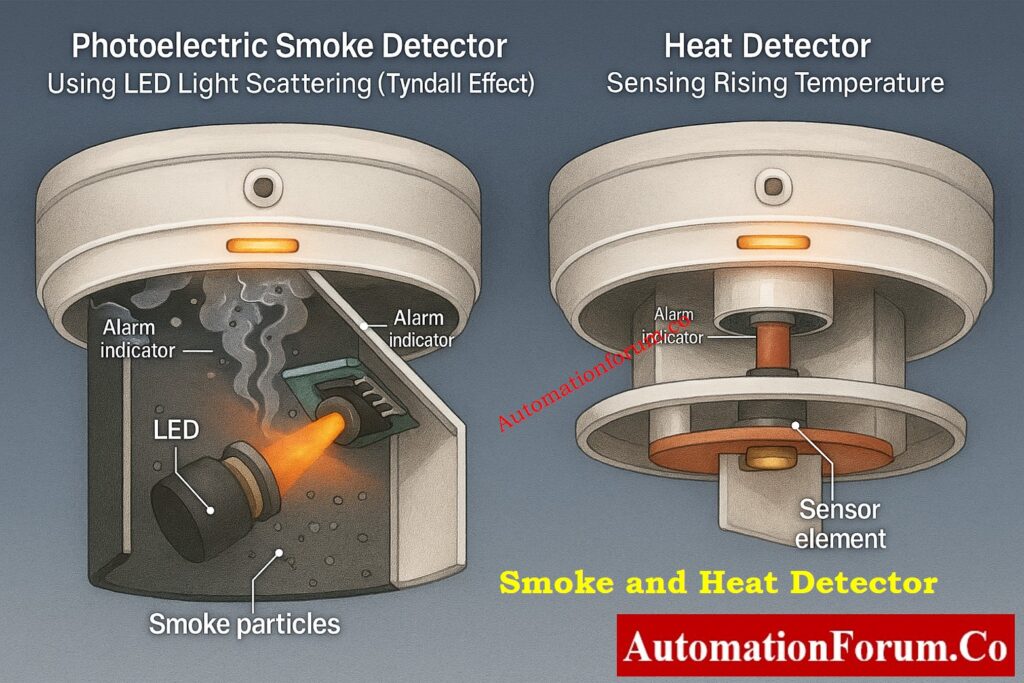
Inside the sensing chamber, this detector has a light-emitting diode (LED) and a photo-diode that are angled. The particles in smoke disperse the light (the Tyndall effect), which lets it reach the photo-diode. The change in the brightness of the light tells the control circuit to set off an alarm.
Applications:
- This is best for finding smoldering flames that make a lot of smoke but not much heat, like fires in wood, plastic, or fabrics.
- A lot of warehouses, control buildings, and substations use it.
Heat Detectors
Heat detectors go off when the temperature rises because of a fire. They function best in places where smoke or dust could set off false alarms, such kitchens or workshops.
Calculate Backup Power Precisely – Fire Alarm Battery Size Calculator: Fire Alarm Battery Size Calculator – Professional Tool for Accurate Backup Power Sizing
Types of Heat Detectors – Fixed Temperature, Rate-of-Rise, and Rate-Compensated Types
- Fixed Temperature Type: Activates when a specific preset temperature (e.g., 70°C or 90°C) is reached.
- Rate-of-Rise Type: This kind goes off when the temperature rises quickly over a short period of time, even if the set threshold hasn’t been met.
- Rate-Compensated Type: This type uses both methods and makes sure that detection is always accurate, no matter how the environment changes.
Flame Detectors
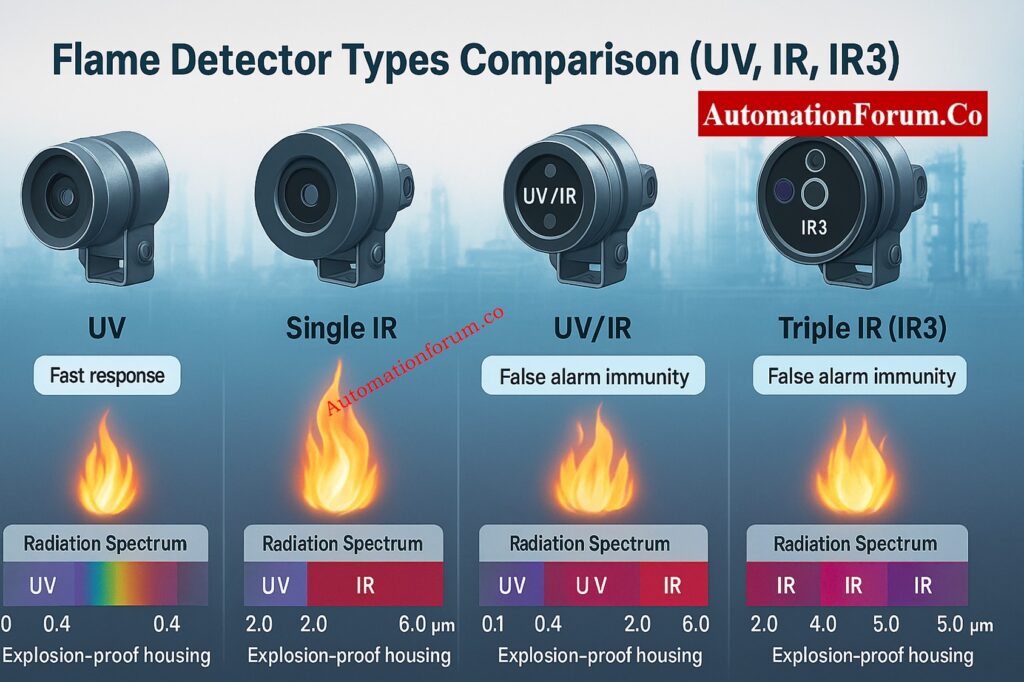
Flame detectors identify fire by sensing radiation energy (UV or IR) emitted by flames rather than smoke or heat. They are designed for high-risk outdoor or process areas such as refineries, fuel storage tanks, turbine enclosures, and hangars.
Main Types of Flame Detectors – UV, IR, UV/IR, and Triple IR Flame Detectors – Key Features
- Ultraviolet (UV) Flame Detectors
- Single Infrared (IR) Flame Detectors
- Combined UV/IR Detectors
- Dual IR and Triple IR (IR2 / IR3) Flame Detectors
Key Features:
- Respond to visible or invisible flames in less than a second.
- Use powerful algorithms to tell the difference between real flames and false alarms created by sunshine, hot surfaces, or welding arcs.
- Able to keep an eye on huge open areas, which makes them perfect for offshore platforms, petroleum terminals, and aircraft hangars.
Follow Professional Method Statement for Instrumentation Cable Termination: Method Statement for Instrumentation Cable Termination
Integration and Communication in Fire and Gas Systems

Smart Detectors and Digital Communication Protocols
Modern fire and gas detectors are getting smarter and more computerized, and they are made to operate well with plant safety networks.
Functions Integrated into Safety Systems (ESD / SIS)
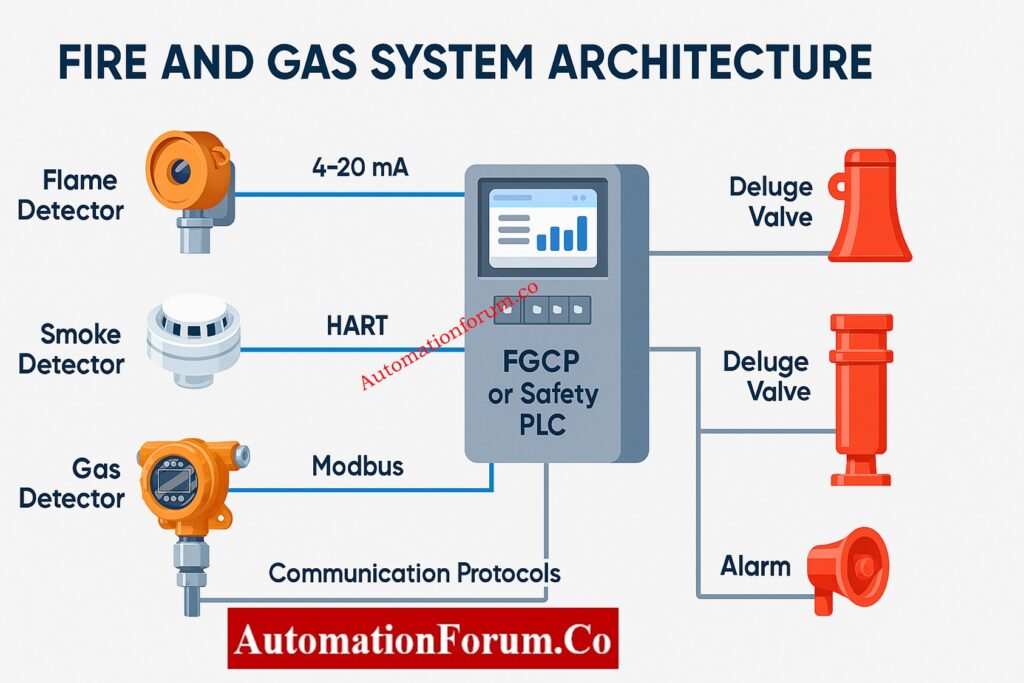
They talk to each other using several industrial protocols, such as 4–20 mA, HART, Modbus RTU/TCP, or FOUNDATION Fieldbus. They are connected to Fire and Gas Control Panels (FGCPs) or Safety PLCs (such Triconex, HIMA, or DeltaV SIS).
Integrated Functions Include:
- alarms that can be seen and heard in both the field and the control rooms.
- Automatic turning on of deluge systems, emergency isolation, and shutting down of ventilation.
- System diagnostics and fault reporting that happen all the time for preventive maintenance.
Prepare Smartly with Top Gas Turbine Instrumentation Interview Q&A: Top Essential Gas Turbine Instrumentation Interview Questions and Answers
Key Parameters for Selecting Fire and Gas Detectors
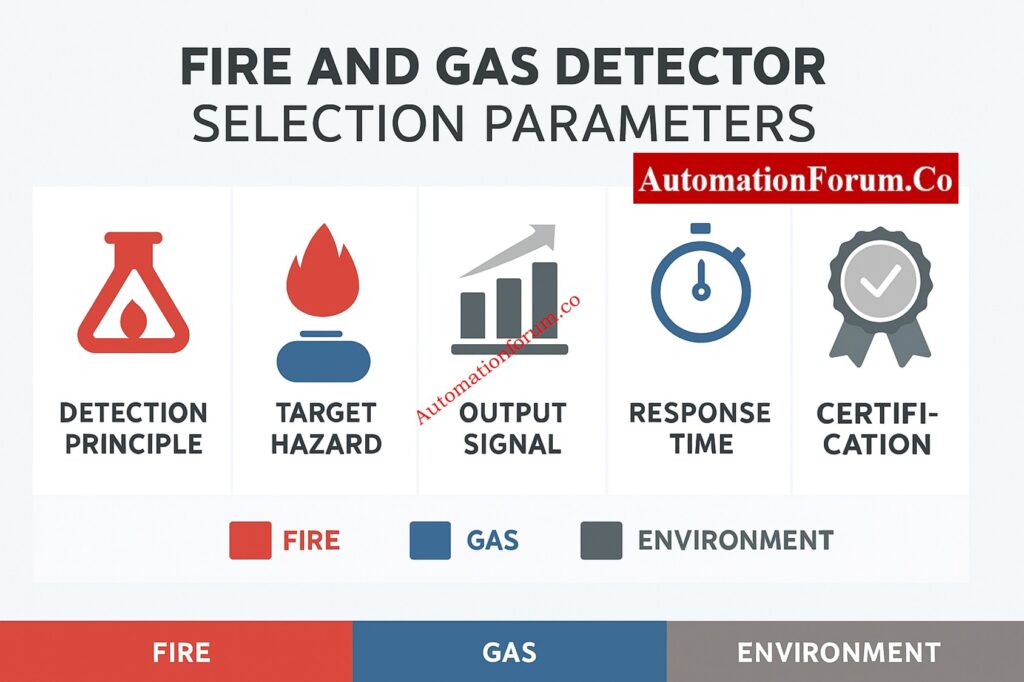
| Selection Parameter | Description |
| Detection Principle | Type of sensing method (Catalytic, IR, UV, Photoelectric, etc.) |
| Target Hazard | Specific gas or fire signature to be detected |
| Environmental Condition | Temperature, humidity, dust, and exposure rating |
| Hazardous Area Classification | Zone 1, Zone 2 (Exd, Exia, Exe protection) |
| Output Signal | 4–20 mA, HART, Relay, Modbus, or Digital |
| Response Time | Typically within 5 seconds or faster |
| Maintenance Frequency | Recommended calibration or test interval |
| Certifications | IECEx, ATEX, FM, UL, SIL compliance |
A good Fire and Gas Detection System is the most important part of any industrial plant’s safety plan. Knowing the many kinds of detectors, how they function, and when to use them makes sure that potential dangers are found quickly, so that steps can be taken quickly to reduce the risk.
Regular testing, calibration, and preventive maintenance are very important for keeping systems reliable and making sure they meet global safety standards in the long term.
Discover Why 3-Wire Fire and Gas Detectors Dominate Industrial Safety: Why 3-Wire Type Fire and Gas Detectors are the Preferred Choice in Industrial Safety?
FAQ on Types of Fire and Gas Detectors
What are the four types of fire detectors?
The four main types of fire detectors are smoke, heat, flame, and multi-sensor detectors.
- Smoke, heat, flame, and multi-sensor detectors are the four basic types of fire detectors.
- Ionization and photoelectric smoke detectors can pick up smoke particles. When the temperature goes up too much, heat detectors go off.
- Flame detectors can pick up UV or IR radiation from flames.
- Multi-sensor detectors can accurately find smoke, heat, and carbon monoxide.
What are the different types of gas detectors?
Most gas detectors are either flammable or poisonous.
- There are catalytic, infrared, and open-path IR types of flammable gas detectors that monitor gases in %LFL.
- There are two main types of toxic gas detectors: electrochemical and semiconductor. They can find gases like H₂S or CO in parts per million (ppm).
What is a type 5 fire alarm?
A Type 5 fire alarm system is a manual fire alarm that can only find fires on its own in a few situations. It has manual call points and might only have detectors in high-risk regions. It is usually put in small factories or plants.
What are the main types of detectors?
Smoke, heat, flame, and gas detectors are the most common types. The Fire and Gas (F&G) system has numerous types of alarms and safety responses that go off when they recognize different fire or gas conditions.
What is a 4 gas detector?
A 4-gas detector is a small instrument that can test four gases at once: O₂, LEL (flammable gas), CO, and H₂S. It makes sure that the air is safe to breathe and finds poisonous or explosive gasses when people are working in tight spaces or doing maintenance.
Explore VESDA Smoke Detection for Early Fire Warning Protection: VESDA Smoke Detection: Advanced Fire Protection with Early Warning Technology
