
- What is Fan Static Pressure in HVAC?
- What does the HVAC Fan Static Pressure Calculator do?
- Core Parameters and Inputs in the Calculator
- Core Static Pressure Formula used
- Step-by-Step Static Pressure Calculation (Imperial Units)
- Result Table from the Excel Calculator
- Understanding HVAC Fan Sizing with Static Pressure
- Recommended Static Pressure Ranges (ASHRAE/SMACNA)
- Common Mistakes in Fan Static Pressure Calculation
- Tips for Accurate HVAC Static Pressure Estimation
- Related Tools for HVAC Engineers
- Download the HVAC Static Pressure Calculator
- Conversion Table (Imperial – Metric)
- FAQs on HVAC Static Pressure (TSP)
One of the most important but often ignored parts of HVAC design is figuring out the fan static pressure correctly. Engineers frequently just think about airflow (CFM or L/s), yet disregarding static pressure can make systems work less well, make more noise, and waste energy. The HVAC Fan Static Pressure Calculator is a special tool that makes it easier to figure out how much pressure is lost over ductwork, filters, coils, and fittings. This makes sure that your fan is the right size and meets ASHRAE and SMACNA criteria.
The article describes the tool’s function, key formulae, calculating logic, and practical applications. It also includes advice on how to avoid making expensive mistakes when designing and installing HVAC systems.
What is Fan Static Pressure in HVAC?
Fan static pressure is the amount of air resistance that an HVAC fan has to deal with in order to move the right amount of air through a duct system. It has:
- Losses of friction from ducting
- Pressure lowers because of elbows, filters, coils, and dampers
- Terminal resistance from things like diffusers and VAV boxes
Static pressure is measured in:
- inches of water gauge (in. w.g.) – for Imperial units
- Pascals (Pa) – for Metric units
If you don’t calculate static pressure correctly, fans could be:
- Undersized – failing to deliver airflow
- Oversized – causing noise, energy waste, and increased cost
What does the HVAC Fan Static Pressure Calculator do?
The Excel tool for the HVAC Fan Static Pressure Calculator is made to:
- Figure out how much pressure is lost in the whole air distribution system
- Help HVAC engineers choose the right size and wattage for the fan
- Use less energy and don’t let the fan speed get too high.
- Check the duct configuration against industry design standards
This tool is very helpful for choosing fans and optimizing ducts whether you are planning a new HVAC system or checking on an old one.
Click here to explore about What is an HVAC System ?
Core Parameters and Inputs in the Calculator
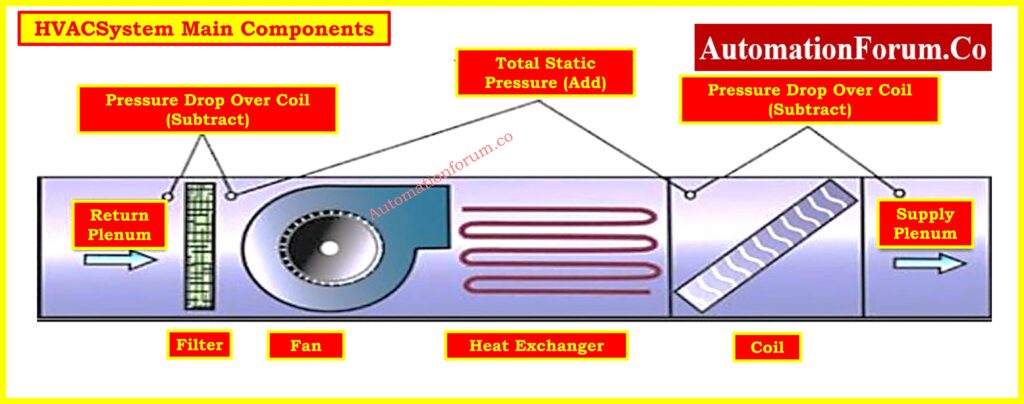
The tool combines standard industry equations with intuitive inputs. Below are the fields used:
| Parameter | Typical Value | Unit | Purpose |
| Airflow | 1200 | CFM | Volume of air that needs to be moved |
| Duct Friction Loss | 0.08 | in. w.g./100 ft | Based on duct size, shape, and material |
| Straight Duct Length | 80 | ft | Main duct length without fittings |
| Number of Elbows | 2 | count | Elbows add resistance; equivalent length used |
| Equivalent Length per Elbow | 10 | ft | From SMACNA standards |
| Filter Pressure Drop | 0.35 | in. w.g. | From filter datasheet (clean state) |
| Coil Pressure Drop | 0.25 | in. w.g. | Resistance due to cooling/heating coil |
All these fields are editable in the Excel tool with formulas embedded, so engineers can test different layouts instantly.
Core Static Pressure Formula used
The calculation for Total Static Pressure (TSP) is:
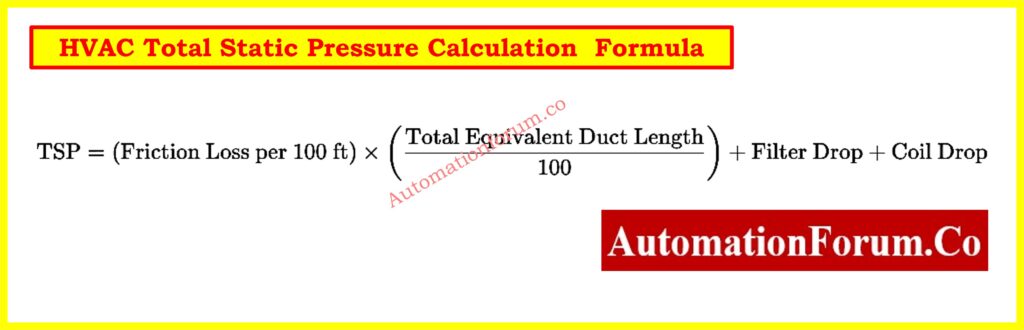
Where:
- Friction Loss depends on the type of duct and the speed of the airflow.
- The total equivalent length is the length of the duct plus the length of the fittings (elbows, transitions, etc.).
- Filter and Coil Drops are the levels of direct resistance that come from product specs.
Step-by-Step Static Pressure Calculation (Imperial Units)
Example Inputs:
- Airflow = 1200 CFM
- Duct Friction = 0.08 in. w.g./100 ft
- Straight Duct = 80 ft
- Elbows = 2
- Elbow Equivalent Length = 10 ft
- Filter Drop = 0.35 in. w.g.
- Coil Drop = 0.25 in. w.g.
Step 1: Calculate Total Equivalent Length
=80+(2×10)=100 ft
Step 2: Calculate Duct Friction Loss
=0.08×(100/100)=0.08 in. w.g.
Step 3: Add Component Losses
TSP=0.08+0.35+0.25=0.68 in. w.g.
This means that the fan you choose must be able to handle 0.68 inches of water gauge static pressure in order to keep the system’s airflow at 1200 CFM.
Click here to explore about What is Damper in HVAC system?
Result Table from the Excel Calculator
| Output | Calculated Value | Unit |
| Total Equivalent Duct Length | 100 | ft |
| Friction Loss Total | 0.08 | in. w.g. |
| Filter Pressure Drop | 0.35 | in. w.g. |
| Coil Pressure Drop | 0.25 | in. w.g. |
| Total Static Pressure (TSP) | 0.68 | in. w.g. |
All formulas are applied within the Excel sheet, ensuring easy validation and recalculations when values change.
Refer the below link for the Pitot tube flow velocity calculator
Understanding HVAC Fan Sizing with Static Pressure
Manufacturers provide fan performance curves showing how much airflow (CFM) a fan can provide at various static pressures. If your total static pressure exceeds the fan’s capacity at a given airflow, performance suffers.
That’s why knowing the exact TSP before selecting a fan is mission-critical.
Recommended Static Pressure Ranges (ASHRAE/SMACNA)
| System Type | Typical Static Pressure |
| Residential Systems | 0.5 – 0.8 in. w.g. |
| Light Commercial | 1.0 – 1.5 in. w.g. |
| VAV Systems | 2.0 – 2.5 in. w.g. |
| High Resistance Systems | 3.0+ in. w.g. |
Always ensure your fan can operate efficiently within the required range and allow margin for filter dirt loading over time.
Common Mistakes in Fan Static Pressure Calculation
| Mistake | Impact |
| Ignoring elbow resistance | Underestimates pressure loss |
| Using nominal filter drop | Dirty filters increase pressure significantly |
| Not applying unit conversions | CFM/Pa mix-ups can ruin calculations |
| Oversizing “just in case” | Increases cost, noise, and space usage |
| Omitting return air resistance | Under-designs total fan duty |
Tips for Accurate HVAC Static Pressure Estimation
- Always figure out how much resistance there is in both the supply and return ducts.
- Use SMACNA tables to find the lengths of fittings that are the same.
- Add parts like dampers, VAV boxes, and silencers.
- When making your ultimate fan choice, think about the pressure of the filthy filter.
- Use fan curve data sheets to check the results.
Related Tools for HVAC Engineers
- HVAC Circular Duct Size Calculator – Accurate Airflow and Diameter Sizing Tool
- Circular HVAC Duct Air Velocity Calculator for Engineers
- Rectangular Duct Air Velocity Calculator for HVAC Engineers
Download the HVAC Static Pressure Calculator
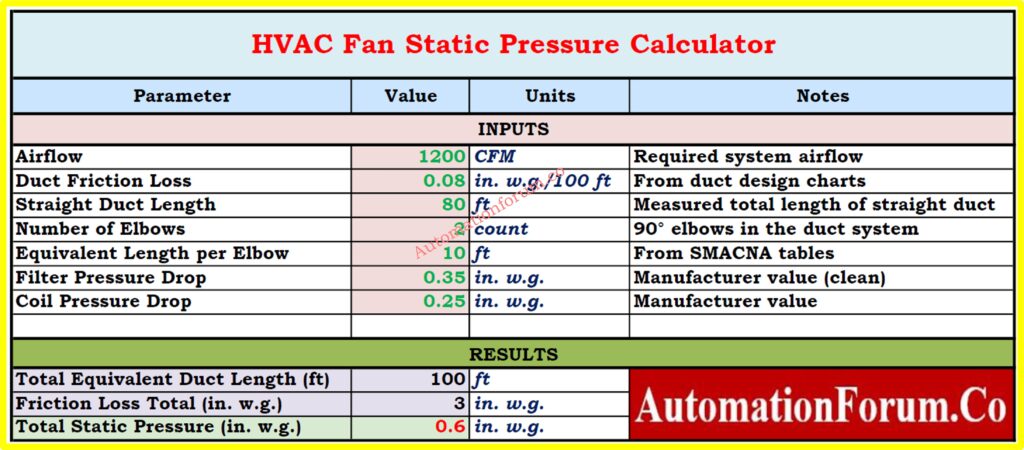
Use this below Excel-based tool to figure out how to arrange your ducts, how much pressure will be lost, and which fan to use:
The HVAC Fan Static Pressure Calculator makes one of the most common mistakes in air system design easier. This tool is useful for HVAC design engineers, field technicians, and MEP consultants.
- Helps you prevent picking the wrong fan, which can be expensive.
- Makes sure the system works well and uses less energy.
- Reduces down on the time it takes to set up and fix things
Conversion Table (Imperial – Metric)
| Convert From | To | Multiply By |
| in. w.g. | Pascals (Pa) | 249.0889 |
| ft | meters | 0.3048 |
| CFM | L/s | 0.4719 |
| Pa | in. w.g. | 0.00402 |
FAQs on HVAC Static Pressure (TSP)
What is Total Static Pressure (TSP) in HVAC?
TSP is the total air resistance a fan must overcome, including ducts, filters, coils, and fittings. It is crucial for selecting the correct HVAC fan.
How do you calculate equivalent duct length for fittings?
Use SMACNA tables. For example, a 90° elbow may equal 10–15 feet of straight duct depending on duct type and radius.
What’s the difference between TSP and ESP?
ESP (External Static Pressure) includes only the external losses (ducts, filters, coils), while TSP includes both internal and external resistances.
Can static pressure change over time?
Yes. As filters clog or ducts deteriorate, pressure increases. Always design with a margin for aging components.
