
A Resistance Temperature Detector (RTD) is a very accurate temperature sensor that works by measuring how the electrical resistance of a metal element, usually platinum, changes as the temperature changes. The PT1000 RTD is one of the best types of RTDs because it is less affected by noise and keeps the signal strong, even across lengthy wire runs and in places with a lot of electrical noise.
The PT1000 has a nominal resistance of 1000 ohms at 0°C. It is commonly used in HVAC systems, laboratory instruments, energy management systems, and process industries. This calculator makes it easier to turn a measured PT1000 resistance into the right temperature by applying a simple linear approximation.
Why use the PT1000 RTD Calculator?
This online tool is meant to help field engineers, calibration technicians, and system integrators who are working on temperature measurement loops that use RTDs. Users can quickly figure out the process temperature by entering the resistance value read from a PT1000 sensor.
Typical Use Cases Include:
- Fixing problems with RTD signals
- Scaling analog inputs in PLCs and DCS
- Checking transmitter data versus the measured resistance
- RTD operating training labs and simulations for learning institutions
Who Should Use PT1000 RTD Calculator?
The PT1000 RTD calculator is ideal for:
- Instrumentation and control engineers set up temperature inputs in DCS and PLC systems.
- Calibration technicians checking the accuracy of field sensors.
- Maintenance workers figuring out why the temperature readings are all over the place.
- System integrators checking to see that RTD scaling works in control panels.
- Trainers and students learn about how RTDs work and how to use linear approximation methods.
Benefits of the PT1000 RTD Calculator
Using this tool simplifies many tasks in the field or lab:
- Estimating temperature quickly from resistance without any fancy software
- Checks sensor accuracy before or after installation
- Helps trainees better understand how RTDs work in a linear way. Saves time when setting up or fixing a system.
- Provides backup verification for the scaling settings of the automation system
PT1000 RTD: Temperature Calculation Formula
This calculator utilizes a linear approximation, which works well for temperatures that aren’t too high or too low. The formula that is usually employed is:
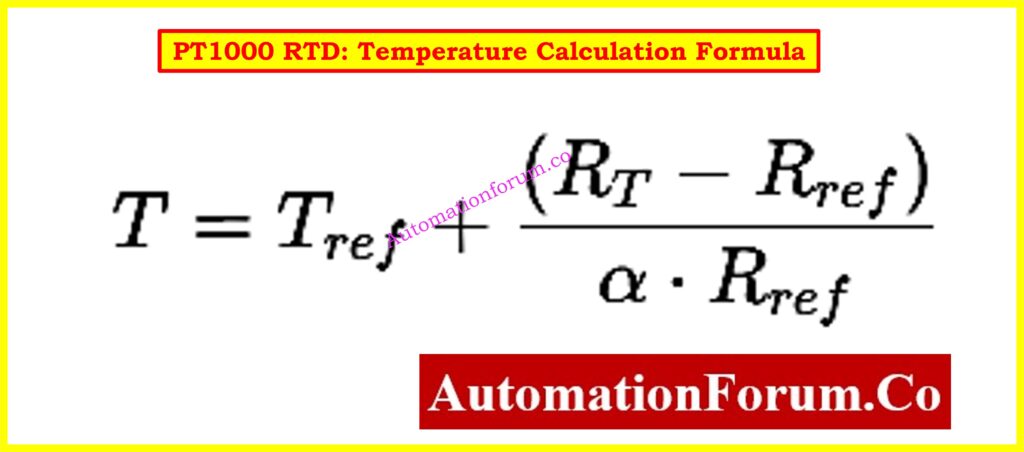
Where:
- T = Calculated process temperature in degrees Celsius
- RT= Measured resistance of the RTD (in ohms)
- Rref = Reference resistance of the RTD at reference temperature (500 ohms at 0°C for PT500)
- α = Temperature coefficient of resistance (commonly 0.00385 for platinum RTDs)
- Tref = Reference temperature, typically 0°C
Example Calculation for PT1000 RTD
Let’s work through a real-world example:
- Rref = 1000 Ω
- Tref = 0°C
- α = 0.00385
- Measured RTD resistance, RT = 1077.0 Ω
T=0+{(1077−1000)/(0.00385×1000)}
T=77/3.85=20°C
So, for a measured resistance of 1077 Ω, the PT1000 RTD corresponds to a temperature of approximately 20°C.
PT1000 RTD Resistance vs. Temperature Table
Based on α = 0.00385 (IEC 60751 Standard)
| Temperature (°C) | Resistance (Ω) |
| -50 | 807.75 |
| -40 | 846.00 |
| -30 | 884.25 |
| -20 | 922.50 |
| -10 | 960.75 |
| 0 | 1000.00 |
| 10 | 1038.25 |
| 20 | 1076.50 |
| 30 | 1114.75 |
| 40 | 1153.00 |
| 50 | 1191.25 |
| 60 | 1229.50 |
| 70 | 1267.75 |
| 80 | 1306.00 |
| 90 | 1344.25 |
| 100 | 1382.50 |
| 150 | 1576.25 |
| 200 | 1770.00 |
| 250 | 1963.75 |
| 300 | 2157.50 |
| 350 | 2351.25 |
| 400 | 2545.00 |
Note: Minor variations may occur in field values due to wire resistance, sensor tolerance, and wiring configuration (2-wire, 3-wire, 4-wire).
Considerations and Limitations
While the linear formula is convenient for quick conversions, keep in mind:
- The RTD curve stops being linear at very high or very low temperatures, which makes it less accurate.
- There is no compensation for lead wire resistance, which is a big concern with 2-wire RTDs.
- The Callendar–Van Dusen equation or lookup tables given by the manufacturer should be utilized for applications that need high accuracy.
- When using Class A or Class B RTDs, always check the tolerances on the datasheet.
What is a PT1000 Temperature Sensor?
At 0°C, the PT1000 is a platinum RTD sensor with a resistance of 1000 ohms. Because it has a greater nominal resistance, it is more stable, can be repeated better, and has stronger signals over longer cable lengths than PT100 or PT500.
PT1000 vs PT100 vs PT500: What’s the Difference?
| RTD Type | Resistance at 0°C | Key Benefit |
| PT100 | 100 Ω | Widely used, industry standard |
| PT500 | 500 Ω | Balance between signal and noise |
| PT1000 | 1000 Ω | Higher resolution, better noise immunity |
What is the Measuring Range of a PT1000 Sensor?
According to IEC 60751 Class B, PT1000 sensors usually work between -50°C and +400°C. This means that they can be used in a wide range of industrial, laboratory, and HVAC settings.
What Does PT1000 Mean?
“Pt” stands for “platinum,” which is the sensing material, and “1000” stands for “resistance of 1000 ohms at 0°C.”
PT1000 is not as prevalent as PT100 in older systems, but it is becoming more popular in newer automation setups since it has better EMI resistance and less self-heating errors.
Explore More Instrumentation Tools
Want to explore more RTD and instrumentation calculators? Refer the below link
Here you can find over 200+ online instrumentation calculators
RTD (Resistance Temperature Detector) Advanced Quiz
Refer the below link to test your knowledge on RTD (Resistance Temperature Detector)
