
- What is the coefficient factor of RTD?
- How is RTD coefficient calculated?
- RTD Formula Example Calculation
- What is temperature coefficient of Pt100?
- Extended RTD Formula (Callendar–Van Dusen Equation)
- Complete RTD Formula for Platinum Sensors
- Constants and Values for Pt100 RTDs
- Example: RTD Formula Calculation Using Callendar–Van Dusen Equation
- Simplified vs. Full RTD Formula – Comparison
What is the coefficient factor of RTD?
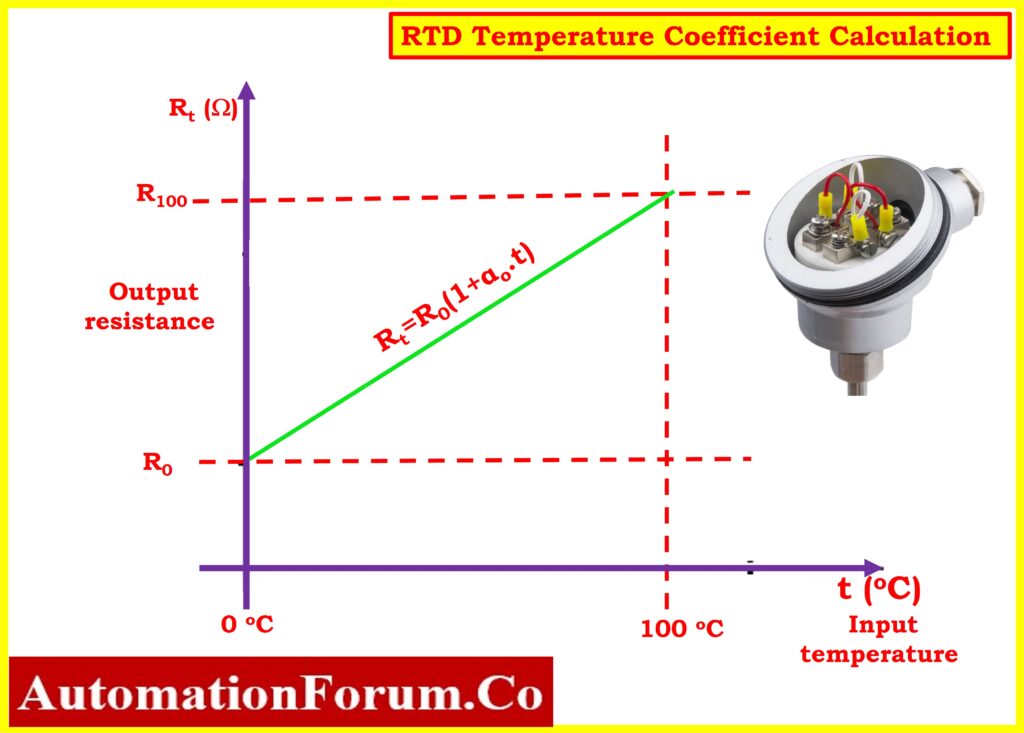
- Resistance Temperature Detectors (RTDs), also known as platinum resistance thermometers (PRTs), are widely used temperature sensors that rely on the principle that the resistance of a metal, in this case, platinum, increases with temperature.
- RTDs functions according to the theory that the resistance of a metal will increase as temperatures increase.
- The Temperature Coefficient of Resistance (TCR), denoted by ?o, is a crucial parameter for RTDs.
- It represents the average resistance change per degree Celsius over a specified temperature range, usually 0°C to 100°C, divided by the resistance of the RTD, Ro, at 0°C.
How is RTD coefficient calculated?
Here’s a step-by-step explanation of how to calculate the TCR for a PT100 RTD, along with an example calculation:
?o = (R100?R0) / (R0 X 100oC) – Equation no. 1
R0 is the resistance of the RTD at zero degrees Celsius (ohm).
R100 is the resistance (ohm) of the RTD at 100 °C.
Note: For the purpose of this conversation, we will only be referring to RTD PT100.
The relationship between resistance (Rt) and temperature (t) for a PT100 RTD is described by the following formula:
Rt= R0(1+?o.t) – Equation no. 2
Where:
Rt is the RTD‘s output resistance in Ohms at temperature t.
R0 is the resistance of the RTD at 0°C (ohms).
?o is the temperature coefficient of resistance (TCR) at 0°C (per °C).
t is the temperature in degrees Celsius.
RTD Formula Example Calculation
Platinum RTD PT100 has a resistance of 100 ohms at 0 degrees Celsius and 139.1 ohms at 100 degrees Celsius.
- Find out how much resistance the RTD has at a temperature of 60 degrees Celsius.
- Perform the TCR (Temperature Coefficient of Resistance) calculation for platinum.
- Determine the temperature at which the resistance is 120 degrees Celsius.
What is temperature coefficient of Pt100?
Perform the Temperature Coefficient Calculation on the RTD PT100.
From Equation no.1:
?o = (R100?R0) / (R0 X 100oC)
?o = (139.1 -100) / (100 X 100)
?o = 0.00391 per degrees Celsius
Determine the RTD’s resistance at 60°C
From Equation no.2:
Rt= R0(1+?o.t)
R60 = Ro(1 + ?t)
R60 = 100(1 + 0.00391×60)
R60 = 123.46?
Determine the temperature at which the resistance is 120
From Equation no.2 :
R120 = Ro(1 + ?t)
120 = 100(1 + 0.00391t)
1 + 0.00391t =120/100
0.00391t = 1.2-1
t = 0.2/0.00392
t = 51.02 degrees Celsius
Refer the link for RTD Calculator: Converting Process Temperature to measured Output Resistance.
Refer the link for RTD Calculator: Converting Measured Resistance to Process Temperature.
Extended RTD Formula (Callendar–Van Dusen Equation)
While the linear RTD formula Rt = R0(1 + αt) is simple and effective for temperatures between 0°C and 100°C, it becomes less accurate at extreme temperatures.
For precise industrial and laboratory-grade RTDs, the Callendar–Van Dusen formula is used to account for the metal’s nonlinear behavior.
Complete RTD Formula for Platinum Sensors
For temperatures above 0°C:
Rt=R0(1+At+Bt2)
For temperatures below 0°C:
Rt=R0[1+At+Bt2+C(t−100)t3]
Where:
- Rt = Resistance of RTD at temperature t (Ω)
- R0 = Resistance at 0°C (Ω), e.g., 100Ω for Pt100
- t = Temperature in °C
- A, B, C = Callendar–Van Dusen constants
Constants and Values for Pt100 RTDs
Typical constants for a Pt100 RTD (per IEC 60751 standard):
- A = 3.9083 × 10⁻³ °C⁻¹
- B = –5.775 × 10⁻⁷ °C⁻²
- C = –4.183 × 10⁻¹² °C⁻⁴
Example: RTD Formula Calculation Using Callendar–Van Dusen Equation
Let’s calculate the resistance of a Pt100 RTD at –50°C.
Rt=100[1+(3.9083×10⁻³)(−50)+(−5.775×10⁻⁷)(−50)2+(−4.183×10⁻¹²)(−50−100)(−50)3]
Rt≈100[1−0.1954−0.00144+0.00157]=80.47Ω
Thus, at –50°C, a Pt100 RTD has approximately 80.47 ohms resistance.
Simplified vs. Full RTD Formula – Comparison
| Parameter | Linear RTD Formula | Callendar–Van Dusen Formula |
| Formula | Rt = R0(1 + αt) | Rt = R0(1 + At + Bt² + C(t−100)t³) |
| Temperature Range | 0°C to 100°C | –200°C to +850°C |
| Accuracy | ±0.5°C typical | ±0.1°C or better |
| Common Use | Process calculations, quick estimates | Calibration, laboratory, high-precision instrumentation |
RTD Formula in Industrial Instrumentation
In industrial automation systems, the RTD formula is implemented in:
RTD linearization software that uses the Callendar-Van Dusen constants internally.
Temperature transmitters to convert resistance to temperature.
PLC or DCS input modules for scaling and compensation.
Calibration tools to verify RTD sensor accuracy.
Click here for more Instrumentation Calculators
 temperature coefficient.)