
- What is HART Protocol
- What is a HART device?
- Major functions of the Smart device:
- How HART Communication Works
- Types of HART Communication Networks
- What is HART Multiplexer?
- How HART Multiplexer Works in Industrial Systems
- What are the applications of HART Multiplexer?
- How to Select a HART Multiplexer
- Advantages of HART Communication
- FAQ on HART Communication
HART stands for Highway Addressable Remote Transducer. It is a bi directional communication protocol used in process instrumentation to exchange digital data between smart field instruments and host systems while still working on the existing 4 to 20 mA loop. HART is widely used because it allows configuration, diagnostics, monitoring, and maintenance without replacing the basic analog loop infrastructure. HART lets a transmitter, valve positioner, or other smart field device send the main process value as an analog signal and send additional information as a digital signal at the same time. This makes it one of the most practical communication methods in process plants where legacy wiring and modern diagnostics must work together.
What is HART Protocol
HART stands for highway addressable remote transducer. HART is a communication protocol for the process instrumentation. It is the global communication standard in process instrumentation. A transducer is a device that is capable to convert the physical variable into a similar electrical signal. HART communication protocol is the most used digital communication protocol in the world. HART is utilized with millions of field devices for effective communication. Most industrial plants around the world are utilizing HART instrumentation for several years. The major purpose of utilizing the HART technology in an industrial plant is to increase productivity. Maintenance costs can be reduced and also downtime by utilizing the HART communication. The highly addressable remote transducer or HART is an open protocol that can easily communicate with the smart field devices.

HART is capable to transmit and receive digital signals through Analog wires. Thus it would facilitate the communication between the field devices and the control system such as DCS, or PLC. HART is capable to do hybrid communication, so we can monitor or control the device remotely. Due to the digital networking feature of the HART, we can access the field device or the controller from anywhere in that network. It utilizes the conventional 4-20mA network so that it can be easily used with the existing system as well as in the current system.
What is a HART device?
A HART device can be described as a field device or smart device. A HART device is a device that communicates by utilizing the HART communication protocol. HART devices are better than the Fieldbus devices. Almost all the smart instruments utilize HART communication.
HART devices are known as smart devices, here the smart refers to signal modulation and rearranging transducer. Smart devices are intelligent transducers that are composed with integrated electronics. This smart device would also have a transduction element and it is also capable to do signal conditioning.
Major functions of the Smart device:
• It is capable to perform the logic functions
• It can do two-way communication
• It would be able to take decisions
How HART Communication Works
Why HART Uses Both Analog and Digital Signals
HART communication would take place between two HART-enabled devices. As we discussed earlier this communication would take place between a field device and the control system. Communication would take place through the instrumentation grade wire. The HART utilizes the Bell 202 frequency shift keying to overlaying the digital signal on the conventional 4-20mA signal. The digital information would be encoded on top of the 4-20mA Analog signal. There would be two simultaneous channels for the communication the 4-20mA Analog signal and the digital signal.
The 4-20mA Analog signal current loop would be utilized to do the primary value communication. Digital signals would be utilized to do any kind of additional data communication. The digital signal would contain several information such as device status, calculated value diagnostics, etc.
Master and Slave Communication in HART
HART is a master-slave communication protocol the communication of the slave device would be initiated by the master device. The slave will be a field device in the process industry like a transmitter, actuator, etc, and the master would be a control system. The control system could be a DCS or PLC. In this, two masters can be connected to each HART loop.
Types of HART Communication Networks
Point to Point Communication
In this type, the 4-20mA signal is utilized to do the communication of one process variable. The additional process variable and other data would be transmitted digitally. This type of communication would be carried out between two devices.
Multidrop Communication
In this type, a single pair of wires would be utilized to do the operation and communication takes place digitally.
Burst mode:
Burst mode allows a HART device to send data repeatedly without waiting for repeated host requests. It is commonly used to transmit a process variable quickly and continuously.
What is HART Multiplexer?
A HART multiplexer is a communication interface that connects multiple HART enabled field devices to a single host system. It collects HART data from many loops and sends it to asset management software, a DCS, or another monitoring system. This helps reduce wiring, simplify access, and centralize diagnostics and configuration. Some multiplexer systems support up to 32 HART compatible field devices on one interface, and larger connected systems can scale much further depending on the architecture.
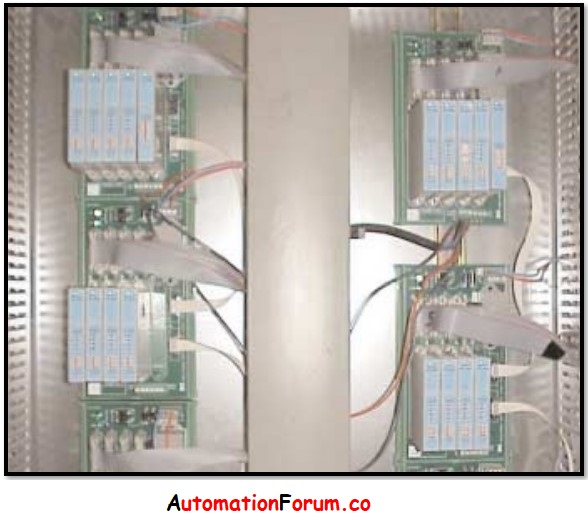
How HART Multiplexer Works in Industrial Systems
The multiplexer gathers HART signals from several field instruments and routes them through a single communication path to the host system. In practical terms, it lets maintenance and instrumentation teams read diagnostics, check configuration, and monitor device status from one location instead of connecting to each device separately.
What are the applications of HART Multiplexer?
HART multiplexers are used for centralized device diagnostics, remote configuration, asset management, maintenance support, loop monitoring, and plant wide access to smart field devices. They are especially useful when many instruments must be checked from one host interface without disturbing the control loop.
How to Select a HART Multiplexer
When selecting a HART multiplexer, check the number of supported HART channels, the host communication interface, the operating temperature, multidrop support, burst mode support, and how well it integrates with your control or asset management system. The best choice is the one that matches the number of loops, the plant environment, and the software platform used in the facility.
What are the different types of HART Communicators available in the market?
• Emerson AMX Trex
• Druck DPI 620
• Yokogawa YHC5150X
• E+H Field expert SMT70
• ProComSol PC HART
Advantages of HART Communication
HART is widely used because it is backward compatible with existing 4 to 20 mA loops, it supports device diagnostics, it improves maintenance efficiency, it provides remote access to field instruments, and it helps reduce downtime. It also gives engineers access to extra data without requiring a full replacement of legacy wiring.
H2 Limitations of HART Protocol
HART is very useful, but it is not the fastest protocol and it is not designed to replace all fully digital networks. In multidrop mode, the analog signal is not available, and reliable signal performance depends on correct loop conditions and proper installation practice.
FAQ on HART Communication
What is the main purpose of HART communication?
The main purpose of HART communication is to add digital communication, diagnostics, and configuration capability to a standard 4 to 20 mA instrument loop.
How does HART work with 4 to 20 mA?
HART sends the process value on the 4 to 20 mA analog loop and sends extra digital information on top of the same wires using FSK.
What is a HART multiplexer used for?
A HART multiplexer is used to connect multiple HART field devices to one host system so the devices can be monitored, configured, and diagnosed from a central location.
Can HART work in multidrop mode?
Yes. HART can work in multidrop mode, but the analog communication is not available in that mode and communication becomes digital only.
Why is HART still used in industry?
HART is still used because it gives digital access to smart instruments while keeping the existing analog loop, which makes it practical for upgrades and plant retrofits.
HART remains one of the most practical communication technologies in process instrumentation because it bridges the gap between traditional analog control and modern digital diagnostics. For plants that want better visibility, easier maintenance, and lower retrofit cost, HART continues to be a strong choice.
