
- What is a condensate pot and where is it used?
- How condensate pot can be utilized to maintain the liquid level in the boiler?
- Why condensate pot is required?
- How to install the condensate pot?
- What are the factors that must be considered while selecting a condensate pot?
- What are the major applications of condensate pots?
- What are the advantages of condensate pots?
- Types of Condensate Pots Used in Steam Applications
- Condensate Pot vs Steam Trap
- Industry Standards and Best Practices for Condensate Pot Installation
- Common Problems in Condensate Pots and How to Fix Them
- Condensate Pot Maintenance Checklist
What is a condensate pot and where is it used?
What Is a Condensate Pot?
A condensate pot is a critical accessory used in steam flow measurement systems to protect pressure instruments and ensure accurate differential pressure readings. It collects and retains condensate, forming a stable liquid seal between hot steam and sensitive measuring instruments such as DP transmitters, flow meters, and pressure gauges. Condensate pots are widely used in boilers, steam drums, heat exchangers, and steam distribution lines across industrial plants.
A condensate pot is mostly utilized in steam pipelines to achieve accurate flow measurement. A condensate pot is capable to provide an interface between the vapor and the liquid. The condensate pot will be installed in the pipeline and it will be installed near the restriction device. Mostly condensate pots are available in a different range of materials. Condensate pots are capable to catch and hold condensate or foreign material. Due to this the manifolds and orifices will be clean from foreign materials.
Condensate pots are also called seal pots because it would create a liquid seal between the instrument and the gases mostly it would be steam. The major function of the condensate pot is to maintain the level of the liquid in the impulse line.

How condensate pot can be utilized to maintain the liquid level in the boiler?
In the boiler system, the high-pressure section of the differential pressure transmitter will be connected to the vapor space on top of the steam drum. Steam would condense in the condensate pot and then the impulse line would be filled by the condensate. The condensate pot is placed in a way that the condensate would be allowed to drain back to the source thus the liquid level can be kept constant.
Why condensate pot is required?
In order to improve the overall performance in a process plant where there is a steam distributed system, steam condensate recovery is required. The performance can be improved by steam condensate recovery. By doing this we can achieve trouble-free operation of steam heated shell and also the tube heat exchanger. In an industrial plant, condensate removal would provide effective operation and there won’t be any hammering or corrosion.
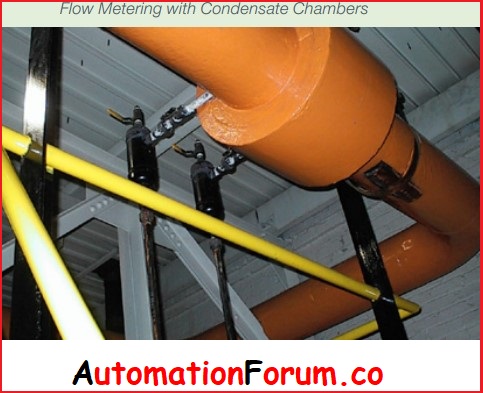
A condensate pot is required in the steam-heated heat exchangers. The condensate pot can prevent flooding in the heat exchanger by the condensate. In a condensate pot, the condensate level can be controlled by utilizing an independent level controller or temperature level cascade controller. If the independent level controller is utilized with the condensate pot, then the manual adjustment would be required. The heat exchangers’ surface area would be manually adjusted to match the actual thermal requirements, so operator intervention is required. If the level control is done by the cascaded process temperature cascade controller, then automatic adjustment of the heat exchangers surface area can be achieved to match the actual thermal requirements.
How to install the condensate pot?
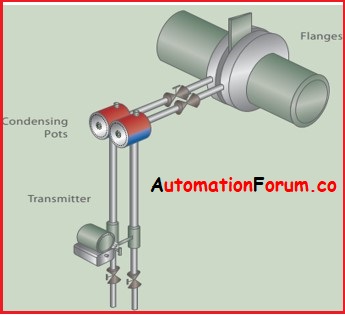
Condensate pots are mostly installed directly in the pipeline and also it can be flanged below the low-lying points of the pipeline. This device can be installed vertically or horizontally according to the pipeline. The Condensate pot will be installed between the flow meter and the transmitter and thus it will act as a barrier to the line fluid thus direct sensing of the flow can be achieved.
- In order to connect to the flanges or to the steam line stainless steel tubing can be utilized
- Condensate pot must be kept near the steam line
- Make sure that the condenser and the condensate chamber are at the same level
- If it is installed in a vertical pipeline then align the lower connection point to the steam pipe with the upper connection point
- The instruments must be kept below the condensate chamber for the flow measurement
- Utilize the air vent on the top of the condensate chamber to vent air during commissioning
- Install tubing and valves to allow the sensing lines to be blowdown every year and this would make sure that there is no plugging because it can affect the measurement
What are the factors that must be considered while selecting a condensate pot?
- Material of construction
- Pressure range
- Volume
- Connection type
- Connection size
- Temperature rating
What are the major applications of condensate pots?
- Power plants
- Chemical industries
- Oil refineries
- Petrochemical industries
- Steel plants
What are the advantages of condensate pots?
- It can provide accurate flow measurement
- It would protect the instrumentation device
- Liquid level can be maintained at a constant level
- It can prevent corrosion in the pipeline
- It will collect the foreign material and condensate in a pipeline and thus it would protect the pipeline and also the components in it
- Condensate pots will create a liquid seal between the hot gases and the instrument, and thus it would protect the instrument
- It will improve the performance of the process plant
- It will reduce the maintenance cost
Types of Condensate Pots Used in Steam Applications
Condensate pots are available in multiple designs depending on process conditions and installation requirements:
- Vertical Condensate Pot – Commonly used in vertical steam lines for stable condensate collection
- Horizontal Condensate Pot – Used where space constraints exist
- Flanged Condensate Pot – Suitable for high-pressure steam applications
- Threaded Condensate Pot – Used in low-pressure utility steam systems
- Welded Condensate Pot – Preferred for critical and high-temperature services
Selecting the correct type improves measurement accuracy and extends instrument life.
Condensate Pot vs Steam Trap
Difference Between Condensate Pot and Steam Trap
Although both handle condensate, their functions are completely different:
| Condensate Pot | Steam Trap |
| Maintains a liquid seal | Removes condensate from steam lines |
| Protects instruments | Improves steam efficiency |
| Used in impulse lines | Used in steam distribution |
| No moving parts | Mechanical or thermodynamic device |
A condensate pot does not replace a steam trap and both are often used together in steam systems.
Industry Standards and Best Practices for Condensate Pot Installation
For reliable operation, condensate pots should comply with industry practices such as:
- Equal elevation for both high and low pressure impulse lines
- Same condensate level maintained in both legs
- Proper insulation to avoid temperature gradients
- Regular venting during commissioning
- Compliance with ASME, ISO, and ISA recommended practices
Following these standards minimizes zero drift and measurement errors.
Common Problems in Condensate Pots and How to Fix Them
Some frequently observed issues include:
- Incorrect elevation causing DP transmitter zero shift
- Blocked impulse lines due to sludge or debris
- Air entrapment affecting pressure transmission
- Unequal condensate level leading to false readings
Regular blowdown, proper venting, and correct installation alignment prevent most issues.
Condensate Pot Maintenance Checklist
To ensure long-term accuracy and reliability:
- Inspect impulse lines annually
- Perform blowdown to remove sludge
- Check vent valves for leakage
- Verify condensate level consistency
- Inspect for corrosion or erosion
Preventive maintenance significantly reduces downtime and calibration errors.
