
What is Gas Chromatography
Gas chromatography is an analytical technique used to separate, identify, and quantify components present in gas mixtures or vaporizable liquid samples. It is widely used in laboratories, refineries, petrochemical plants, natural gas processing units, and environmental monitoring applications.
In gas chromatography, a measured quantity of sample is introduced into a flowing carrier gas stream. The carrier gas transports the sample through a specially designed column placed inside a temperature controlled oven. As the sample travels through the column, individual components separate based on their volatility and interaction with the stationary phase inside the column.
Each separated component exits the column at a different time and enters a detector. The detector converts the concentration of each component into an electrical signal. This signal is processed and displayed as a chromatogram, where each peak represents a specific compound and the peak area corresponds to its concentration.
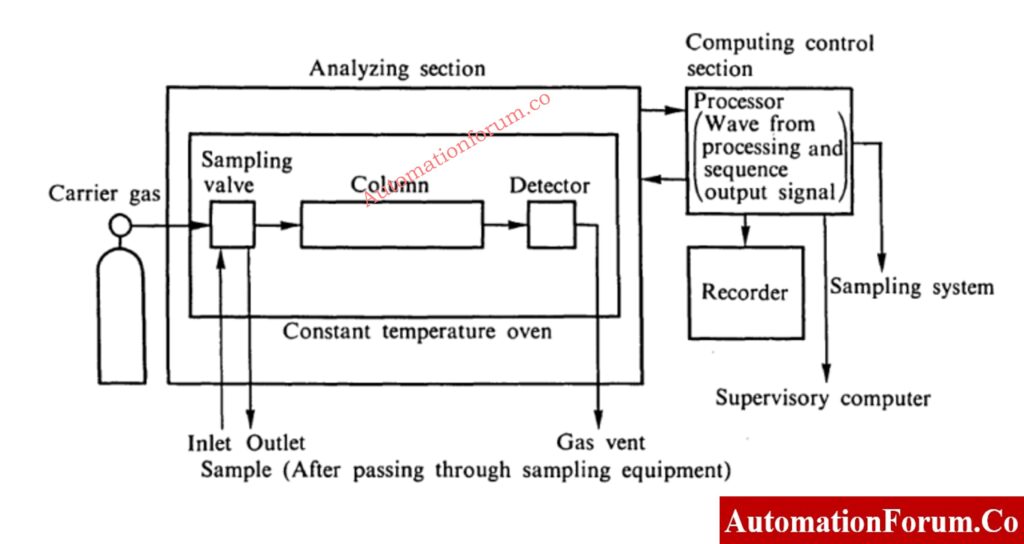
Basic Structure and Working Principle of Process Gas Chromatograph
A typical process gas chromatograph consists of two main sections
1 Analyzing section
2 Computing and control section
Sampling and Analyzing Section
The sampling system plays a critical role in ensuring accurate analysis. Before the sample enters the chromatograph, it must be conditioned properly. The sampling equipment performs the following functions
- Pressure regulation
- Flow stabilization
- Removal of moisture
- Filtration of dust and solid particles
- Temperature control
Once conditioned, a fixed and repeatable volume of sample is introduced into the carrier gas stream through a sampling valve or injector.
The sample then enters the chromatography column located inside a constant temperature oven. The oven maintains stable thermal conditions to ensure reproducible separation. The components of the mixture separate inside the column according to
- Boiling point
- Molecular size
- Polarity
- Interaction with stationary phase
More volatile components generally travel faster and elute earlier, while less volatile components remain longer inside the column and elute later.
After separation, each component flows into the detector where it is converted into a measurable electrical signal.
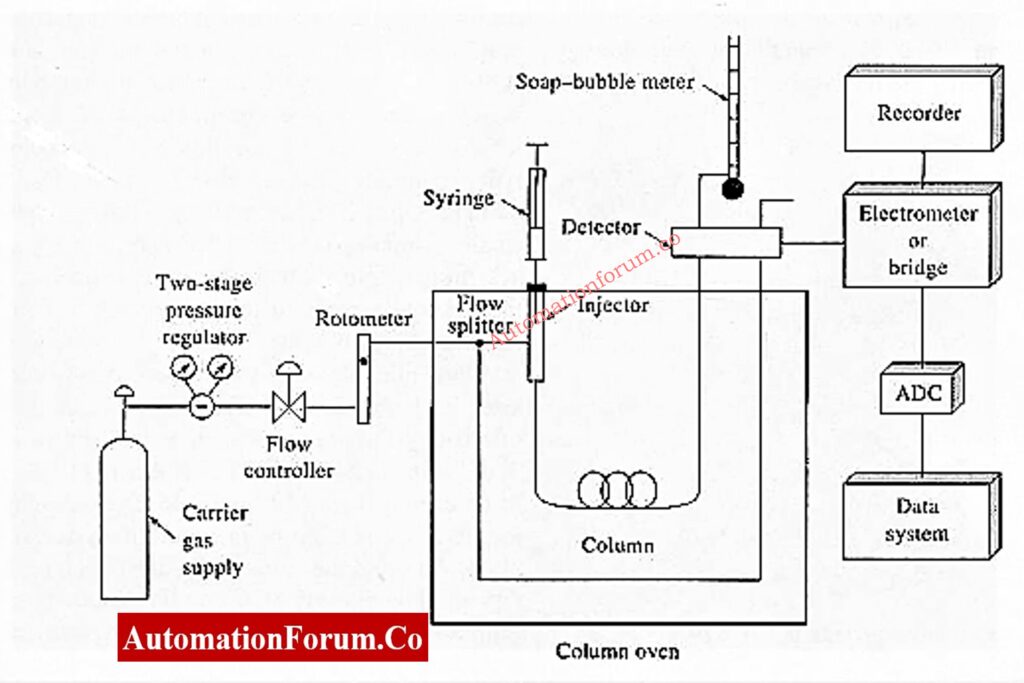
Computing and Control Section
The signal generated by the detector is very small and must be amplified. The computing and control section performs several important operations
- Signal amplification
- Analog to digital conversion
- Peak integration
- Component identification
- Concentration calculation
- Temperature control of oven
- Operation of electromagnetic valves
- Data transmission to recorder or supervisory computer
The processed output is displayed as a chromatogram. Each peak corresponds to a specific component, and the area under the peak represents its quantity.
Major Components of Gas Chromatograph
Column System
The column is the heart of the chromatograph. Proper column selection determines the quality of separation. Important parameters include
- Column length
- Internal diameter
- Type of stationary phase
- Operating temperature
- Carrier gas flow rate
Common column arrangements used in process gas chromatography include
- Pre cut system
- Backflush system
- Foreflush system
- Regrouping system
- Column bypass system
These configurations help in improving separation efficiency and reducing analysis time.
Sample Injector
In laboratory gas chromatography, the sample is usually injected using a microsyringe through a rubber septum into a heated injection port. The injection port temperature is maintained high enough to ensure rapid vaporization of the sample.
In process gas chromatographs, a gas sampling valve is commonly used to introduce a fixed volume of sample. The vaporized sample mixes with the carrier gas and is transported into the column for separation.
Chromatography Column
The column performs the actual separation of the mixture into individual components. The separation efficiency depends on
- Column temperature
- Carrier gas velocity
- Nature of stationary phase
- Sample composition
Lower boiling components generally elute earlier, while higher boiling components elute later. Proper temperature control is essential to achieve sharp peaks and good resolution.
Thermal Conductivity Detector TCD Working Principle
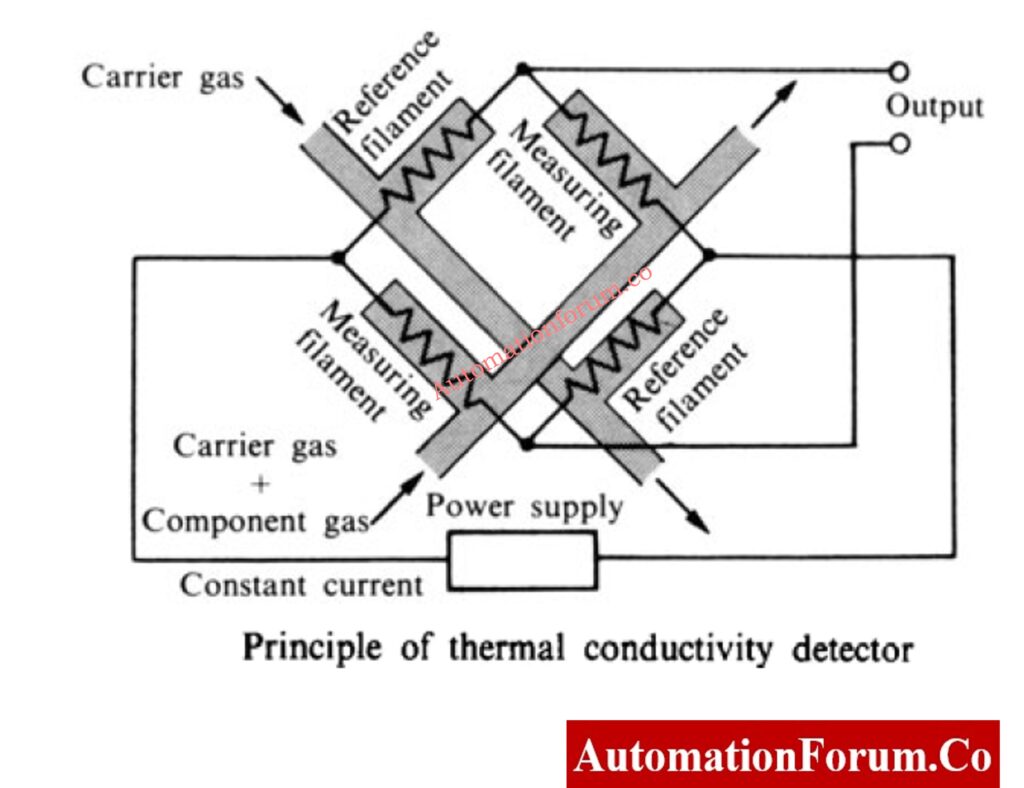
The thermal conductivity detector is one of the most widely used universal detectors in gas chromatography. It operates based on the difference in thermal conductivity between the carrier gas and the sample components.
The detector contains heated metallic filaments arranged in a Wheatstone bridge configuration. Two filaments are exposed to pure carrier gas and act as reference elements. The other filaments are exposed to the column effluent and act as measuring elements.
When only carrier gas is present, the bridge remains balanced. When a sample component passes through the measuring cell, the thermal conductivity of the gas mixture changes. This affects the rate at which heat is removed from the heated filament.
A change in heat loss results in a change in filament temperature. Since electrical resistance of the filament depends on temperature, the resistance changes accordingly. This causes an imbalance in the Wheatstone bridge circuit, producing a voltage output proportional to the concentration of the component.
Common carrier gases used in TCD applications include
- Hydrogen
- Helium
- Nitrogen
- Argon
Hydrogen and helium provide higher sensitivity due to their high thermal conductivity compared to most analyte gases.
The TCD is capable of measuring components over a wide concentration range, from low parts per million levels up to high percentage concentrations.
Flame Ionization Detector FID
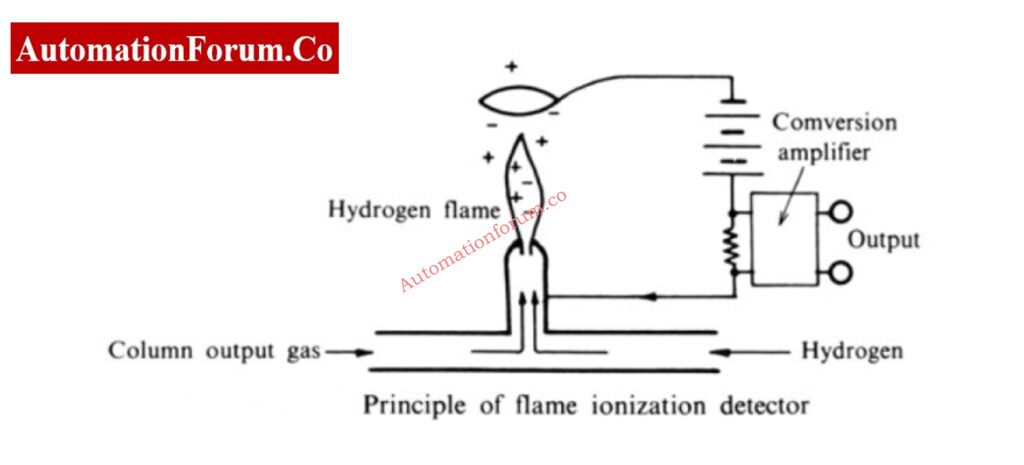
The flame ionization detector is highly sensitive for hydrocarbons and organic compounds. In this detector, the column effluent is burned in a hydrogen air flame.
During combustion, organic compounds produce ions and electrons. A collector electrode placed above the flame captures these ions. The movement of ions generates a small electrical current proportional to the amount of carbon present in the sample.
The signal is amplified and recorded as a peak in the chromatogram. The FID is very sensitive for hydrocarbons but does not respond to permanent gases such as nitrogen, oxygen, carbon dioxide, or water vapor.
Gas chromatography is a powerful and reliable analytical technique for separating and quantifying gaseous and volatile liquid components. It consists of a sampling system, injector, column oven, detector, and computing control section.
The thermal conductivity detector provides universal detection based on heat transfer differences, while the flame ionization detector offers high sensitivity for hydrocarbons.
Together, these components allow accurate qualitative and quantitative analysis in laboratory and industrial process environments such as oil and gas, petrochemical, power generation, and environmental monitoring systems.
